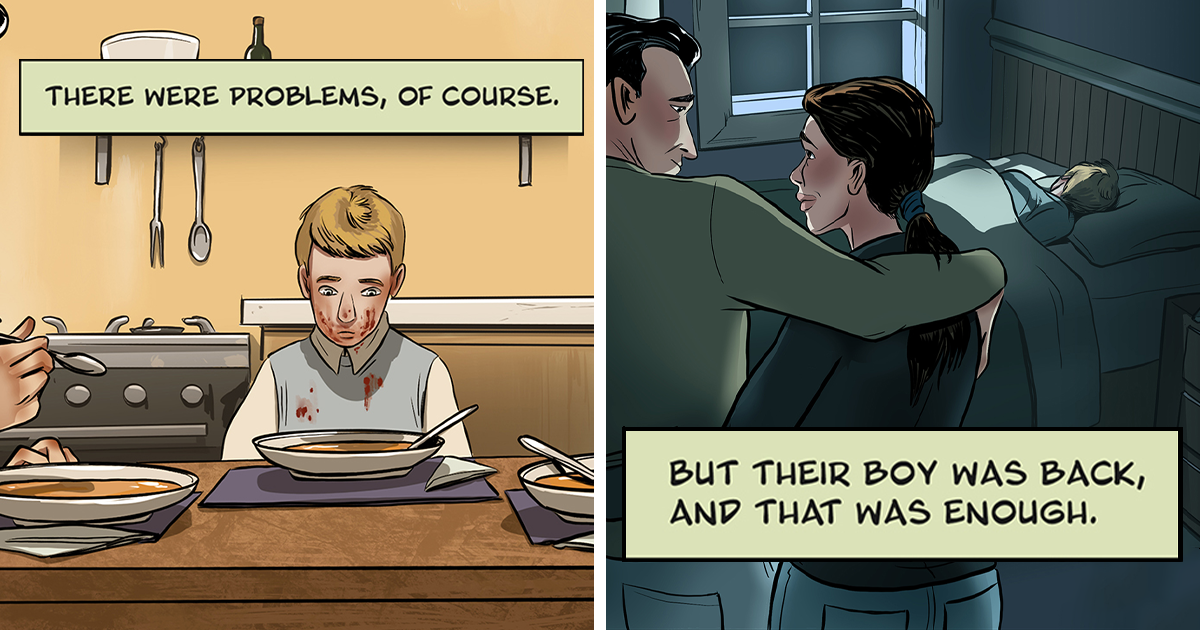
We Create Creepy Comics With Twisted Endings That You Probably Shouldn’t Read Before Going To Sleep (3 New Stories)

Note: The three comic concepts below are original fictional stories created for this feature. They favor suspense, odd details, and late-night unease over graphic imagery. Spooky enough to make your hallway look suspicious, not designed to ruin it forever.
There is a special kind of fear that only a comic can deliver. A movie keeps moving whether you are ready or not. A novel lets your imagination do much of the lighting. A creepy comic gives you one quiet panel, asks you to stare at it, and lets your brain place one additional shadow in the corner. Very rude. Very effective.
For this collection, we created three original creepy comic stories built around slow-burn dread: an ordinary object that knows too much, a familiar home that becomes an unreliable witness, and a childhood ritual that is keeping score. The tension comes from a small, awful realization: the rules were never what the characters thought they were.
That approach suits sequential art. A comic controls what readers see, what it hides between panels, and the precise moment a page turn changes the meaning of a scene. The Library of Congress documents comics and graphic narratives as an enduring visual storytelling form, while contemporary publishers and comics outlets continue to spotlight horror anthologies and graphic novels as an inventive part of the medium.
Why Creepy Comics Make Ordinary Things Feel Untrustworthy
A horror comic does not need a giant cast, a thunderstorm budget, or a mansion with seventeen hallways. A bright kitchen, an empty platform, or an unopened voicemail icon can be enough. Each panel narrows attention, then leaves a little silence around it. That silence is where the story starts whispering.
The Gutter Does Half the Haunting
Between two comic panels is the gutter: the blank space where readers infer motion and missing moments. In a comedy, that gap can hide a punch line. In a creepy comic, it can hide the sound from the attic or the fact that a character has moved closer without being shown walking. The reader becomes a collaborator, which is flattering until they realize they have been helping the nightmare redecorate.
Twists Should Change What Came Before
A good ending is not a prank buzzer hidden beneath a chair. It recasts earlier details: the cup on the windowsill, the elevator stopping at an unused floor, the family photo with one face turned away. The best twists make readers scroll back, squint at page two, and mutter, “Oh, come on,” with genuine respect.
Psychology research suggests that horror enjoyment is more complicated than simply chasing adrenaline. Curiosity, control, and the safety of fictional danger may all contribute. That is why short horror comics can be deeply unsettling without becoming cruel: they let readers test a dark possibility and then return to the real world, where the coat on the chair is probably still just a coat.
Story One: “The Lost-and-Found Car”
Premise: Nora boards the last train after a long shift. An attendant directs her to a vintage railcar marked LOST & FOUND, explaining that passengers may reclaim anything they misplaced before the final stop.
The shelves are packed with umbrellas, gloves, toys, cracked phones, and lunch containers with names written in fading marker. Nora has not lost anythingunless exhaustion counts. Then she sees a blue backpack that looks exactly like the one she owned in high school: sun-faded patch, old band pin, crooked strap. Inside is a commuter pass dated tomorrow.
The attendant smiles gently. “Everything arrives before its owner understands it is missing.” As the train moves, little tags appear on every item: left in a hurry, forgotten after an argument, never claimed. Nora’s backpack reads, returned every night.
She steps off at her regular station, walks home, and falls asleep with the bag beside the couch. The final panel returns to the railcar: a new item rests on the shelfNora’s apartment key, tagged borrowed until morning.
Why the twist works: It turns a commute into a ritual with invisible paperwork. No monster needs to leap from a seat; the unnerving part is that the train has already decided which pieces of Nora’s life are about to disappear. Cosmic dread with good inventory management is still cosmic dread.
Story Two: “The Porch Light Replies”
Premise: Miles housesits for his aunt, whose only unusual instruction is to switch on the porch light before sunset and keep it on until morning. Her quiet suburban street looks reassuringly normal, right down to the lawns that appear professionally afraid of dandelions.
When Miles turns on the light, the house across the street lights up. Then the next one. Soon, every porch light on the block glows in perfect sequence. The following night, he flips his light on for one second and off again. Across the street, a porch light blinks twice. Three houses down, another blinks twice. The whole block is answering.
He treats it as a code. One blink means yes. Two means no. Three means we saw that. Then he notices the dark house next door: no porch light, no car, no visible curtains, and a mailbox overgrown with flyers. “Is it inside that house?” he asks.
Every light on the street goes dark. The neighbor’s porch light comes on by itself.
His aunt answers the phone immediately. When Miles asks what lives next door, she says, “Nothing lives there. That is why we keep the lights on.” The last panel shows dawn. Every porch light is off except his aunt’s. In its warm circle of light is a second shadow, facing the front door from the inside.
Why the twist works: A porch light normally suggests safety. Here, it is a neighborhood warning system. An entire block has agreed on the rules, and nobody told the temporary housesitter. Welcome to the homeowners association; the dues are emotional.
Story Three: “The Sticker Book”
Premise: While cleaning her grandfather’s apartment, twelve-year-old June finds a battered sticker book behind old board games. Its pages show ordinary rooms with empty squares labeled, Place a star where you felt watched.
Her grandfather says he used it as a child, then changes the subject at record speed. June places a silver star beside a playground drawing, remembering the feeling that someone stood behind the slide. The next morning, a new page has appeared: her school cafeteria. A silver star is already in its corner.
June tests it with small momentsa grocery aisle, the library, a bathroom mirror. Each time, another page appears, more detailed than the last: a hand under a desk, a face in a dark tablet screen, a person-shaped blank space in a family photo.
Her grandfather finally explains that the book does not record where people are watched. It records who notices. “It wants you to recognize it,” he says. “That is how it gets a place in the picture.”
June tears out the newest page. The book opens to her grandfather’s childhood bedroom. Every square is covered in stars but one. Under it: Someone forgot to look back. In the final panel, June holds the book before a mirror. Her reflection is normalexcept it is looking at the book while June is looking at the mirror.
Why the twist works: The threat grows through attention, not violence. The more June tries to solve the mystery, the more she gives it what it needs. Never trust a sticker book that is more organized than your calendar.
How We Build Creepy Comics Without Cheap Shocks
Start With a Normal Rule
Catch the last train. Leave the light on. Save old belongings. Normality creates the floor, so a small crack becomes more interesting than a meteor in the living room.
Repeat One Image, Then Alter It
Repetition gives horror rhythm. A train door appears three times; on the fourth, the handle is on the wrong side. A porch light turns on nightly; one evening it shines before anyone reaches the switch. Readers feel the pattern before they understand it.
Use the Final Panel as a New Lens
Twists work when they reframe rather than interrupt. The reader should leave with a second version of the story assembling in their mindand perhaps a reasonable desire to glance once at the nearest reflective surface.
The After-Hours Experience: Why These Stories Linger After the Screen Goes Dark
Reading a creepy comic at night is a tiny bargain between you and your imagination. You promise to look at a few unsettling drawings. Your imagination promises not to promote the bathroom doorway into a major character. One of you is lying, and it is rarely the bathroom doorway.
The lingering feeling begins with stillness. Comics do not sweep past an image as quickly as a film can. You decide how long to sit with the empty train seat, the too-bright porch light, or the reflection that seems half a beat behind. That control is part of the appeal, but it also makes the image personal. You are not merely watching a scary moment happen. You are inspecting it, zooming in, and wondering whether the artist hid another clue in the wallpaper.
Late-night horror also feels different from afternoon horror. In daylight, the world provides rebuttals: conversations, errands, sunlight, and someone asking where the charging cable went. At night, the house becomes quieter, so minor sounds acquire questionable résumés. A refrigerator clicks. Pipes knock. A neighbor’s car door closes. Suddenly, your brain is auditioning each noise for the role of “definitely related to the comic.”
Research reviews indicate that pre-sleep visual media may sometimes be incorporated into dreams, although effects vary widely. Heightened mental arousal near bedtime is also associated with sleep disruption for some people. That does not mean a spooky webcomic will automatically commandeer your dreams. It does mean timing matters when you already feel tired or wound up.
The useful response is not “never read horror at night.” That would be like banning movie popcorn because crumbs exist. Notice your own threshold instead. Maybe you enjoy eerie stories at 8 p.m. but regret them at 1:14 a.m. Maybe atmosphere works for you, while uncanny toys do not. A lighter comic, a funny video, a glass of water, or a familiar bedtime routine can be an excellent palate cleanser after a twisted ending.
There is also a communal side to creepy comics. They are often better the next day, when readers trade theories, circle background clues, and debate whether a final panel reveals a literal threat or a metaphor with excellent lighting. Horror becomes less lonely when somebody else says, “Wait, did you notice the reflection on page four?” Now it is not just you being unsettled. It is collaborative unsettling, which is practically a book club.
That shared rereading explains why twist endings stick. They create a second story built from hints and missed details. A great creepy comic trusts the audience to fill in some of the darkness. It does not explain every rule or label the strange thing in the hallway. It lets the unanswered question breathe.
Read these stories with the lights on, the lights off, or the lights set to “I am brave but not reckless.” The goal is a delicious shiver, not a miserable night. When a final panel works, it should make you smile, close the tab, and glance onceonly onceat the nearest reflective surface. For quality control.
Final Panel: The Best Twists Leave the Door Slightly Open
Creepy comics thrive on restraint. A strange object, a repeated image, an unexplained rule, and one final detail can create more tension than a dozen loud surprises. These three original stories start with recognizable places, then gently remove the safety rail one panel at a time.
That is the pleasure of a twisted horror comic: it turns the familiar into a question mark. The train platform, porch light, and old sticker book are still ordinary objects. Probably. But now they have more atmosphere and a much stronger union contract with your imagination.