
Research synthesis consulted guidance and specifications from KOHLER, Lowe’s, The Home Depot, Signature Hardware, This Old House, Better Homes & Gardens, Angi, Bob Vila, Kingston Brass, Jacuzzi, MTI Baths, Barclay Products, Delta Faucet, and American Standard.
A slipper tub can make an ordinary bathroom look as though it has suddenly inherited a trust fund. With its high, curved back and deep bathing well, this freestanding bathtub is designed for reclining, soaking, and briefly pretending that unread emails do not exist.
Good looks, however, are only part of the story. Slipper tubs can be heavy, thirsty, difficult to clean around, and surprisingly complicated to pair with a faucet. Their tall sides may also be uncomfortable or unsafe for some users. Before ordering the most photogenic tub on the internet, it is worth understanding how the shape, material, dimensions, plumbing, and installation requirements affect everyday use.
What Is a Slipper Tub?
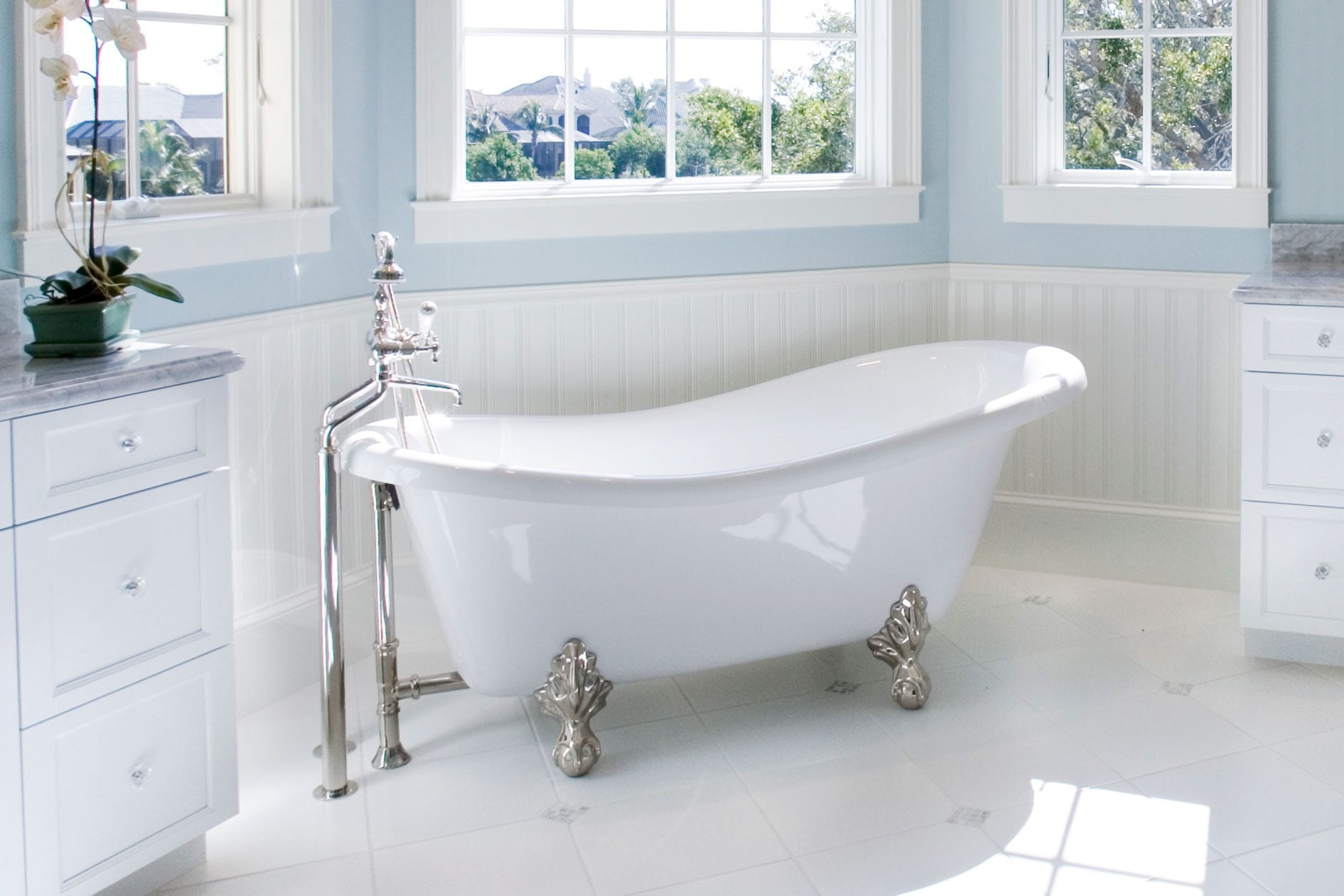
A slipper tub is a bathtub with one or both ends raised above the rest of the rim. The elevated end creates a sloped backrest that supports the shoulders, neck, and head while the bather reclines. Viewed from the side, the silhouette resembles a high-heeled slipper, which explains the name and saves us from calling it “the bathtub with the dramatic back.”
Most slipper tubs are freestanding, meaning their exterior is finished on all visible sides and they do not need to be enclosed by three walls. They may sit on decorative feet, rest on a pedestal base, or have a smooth flat bottom. Traditional versions often feature claw feet and rolled rims, while contemporary models tend to have clean lines, thin edges, and sculptural shapes.
Single-slipper tubs
A single-slipper tub has one raised end and one lower end. The higher side serves as the primary backrest, while the faucet and drain are commonly positioned near the lower end. This arrangement is ideal for one person who prefers to recline in a consistent direction.
Double-slipper tubs
A double-slipper tub rises at both ends and typically places the drain near the center. Either end can be used as a backrest, making the design comfortable for people who like to change positions. Larger double-slipper tubs may accommodate two bathers, although the exterior length can be deceptive. Always inspect the interior floor length and bathing-well dimensions before planning a two-person soak.
Why Homeowners Choose Slipper Tubs
They are genuinely comfortable for reclining
The raised back is more than decoration. A well-designed slipper tub supports the upper body at an angle that can feel more natural than sitting against the nearly vertical end of a standard alcove bathtub. Deep water can cover more of the torso, while the sloped interior reduces the feeling of balancing upright in a porcelain box.
Comfort still depends on body size and tub geometry. A petite person may slide downward in an oversized model, while a tall person may find a compact tub too short through the legs. The perfect curve in a showroom photograph is not automatically the perfect curve for your spine.
They create a strong focal point
Because a slipper tub is finished on all sides, it can stand beneath a window, sit diagonally in a corner, or occupy the center of a spacious bathroom. That placement flexibility makes the tub an architectural feature rather than merely another plumbing fixture.
A clawfoot slipper tub works naturally in Victorian, farmhouse, cottage, and traditional interiors. A flat-bottom acrylic or stone-resin model can suit contemporary, transitional, Scandinavian, or minimalist bathrooms. The shape is old, but it has learned several new outfits.
They offer a deeper soaking experience
Many slipper tubs provide greater water depth than basic combination tub-and-shower units. The useful measurement is not the tub’s total height; it is the soaking depth from the interior floor to the overflow. Two tubs with identical exterior dimensions can offer noticeably different bathing experiences because of their wall thickness, base construction, and overflow placement.
Measure More Than the Empty Bathroom Floor
Choosing a slipper bathtub by length alone is one of the easiest ways to buy an expensive object that looks wonderful and feels terrible. Before shopping, record the available room dimensions, door widths, hallway turns, drain position, ceiling height, window locations, and faucet clearances.
Check the exterior dimensions
Slipper tubs are available in compact models around the low-50-inch range, common mid-sized versions around 55 to 67 inches, and larger tubs measuring 70 inches or more. Width and rim height vary considerably. A tub that technically fits may still make the bathroom feel crowded if it leaves no comfortable walking space.
Check the interior dimensions
The outside length includes the sloped walls and rim, so it does not represent usable legroom. Review the interior floor length, upper bathing-well length, interior width, backrest angle, and soaking depth. A 60-inch tub with thick walls may offer less usable space than a slimmer 57-inch model.
Measure the delivery route
Confirm that the packaged tub can pass through exterior doors, stairways, landings, and bathroom entrances. Cast-iron and solid-surface tubs may require several installers and specialized moving equipment. Discovering that a tub will not turn at the top of the stairs is an exciting plot twist, but not the kind most remodeling budgets enjoy.
Plan cleaning clearance
A freestanding tub placed several inches from the wall can create a narrow canyon that collects dust, hair, and dropped bottle caps. Leave enough room for a hand, mop, or cleaning wand. If the tub must sit close to a wall, determine how the faucet, drain, and surrounding surfaces will be serviced later.
Choosing the Best Slipper Tub Material
Acrylic
Acrylic is one of the most common choices for modern slipper tubs. It is relatively lightweight, warm to the touch, available in many shapes, and generally easier to move than cast iron or stone-based materials. Its lower weight can simplify installation in an upstairs bathroom, although the completed tub, water, and bather still create a significant structural load.
Acrylic can scratch if cleaned with abrasive powders, harsh pads, or gritty tools. Minor surface marks may sometimes be polished, depending on the manufacturer’s instructions. Quality varies, so compare reinforcement, wall thickness, warranty coverage, and whether the base feels rigid under weight.
Cast iron
Cast-iron slipper tubs deliver the traditional appearance many people associate with antique bathing. The enamel surface is hard, durable, and resistant to routine wear when properly maintained. Once heated, the substantial material can help provide a stable soaking experience.
The major drawback is weight. A cast-iron model may weigh several hundred pounds before anyone adds water. Upstairs installations should be reviewed by a qualified contractor or structural professional, especially in older homes. Moving the tub can also be labor-intensive, and chipped enamel generally requires specialized repair.
Stone resin and solid surface
Stone-resin and solid-surface tubs combine mineral material with resin to create a substantial, sculpted appearance. They are popular in modern bathrooms because they can have smooth curves, matte finishes, and a visual weight that feels more luxurious than lightweight plastic.
These tubs are often heavy and may cost more than standard acrylic models. Matte surfaces can also show soap residue differently from glossy finishes. Ask for the manufacturer’s approved cleaning products before introducing your new tub to a mystery spray from the back of the cabinet.
Copper
Copper slipper tubs provide rich color and a handcrafted character. The surface naturally develops a changing patina, which is either charming or alarming depending on whether you expected it. Copper requires care appropriate to its finish. Acidic cleaners, abrasive products, and certain bath additives may alter the surface.
Fiberglass and composite materials
Budget-oriented tubs may use fiberglass or proprietary composite construction. These options can be light and affordable, but durability, rigidity, finish quality, and heat retention differ among products. Read the specifications rather than assuming that all white tubs are built alike.
Structural Support Matters
The floor must support the empty tub, its water, the bather, and any fixtures attached nearby. Water weighs roughly 8.3 pounds per gallon, so a 60-gallon fill adds about 500 pounds before the person enters. The actual bath may use less than the listed capacity because the water is normally kept below the overflow and the bather displaces some of it, but the potential load remains substantial.
Do not guess that a floor is strong enough because it has successfully supported a bed or vanity. A contractor may need to inspect joist size, spacing, span, condition, and the tub’s contact points. Additional blocking or reinforcement may be required, particularly for cast-iron, copper, stone-resin, or oversized two-person tubs.
The subfloor must also be flat and level. A tub that rocks slightly when empty can strain the drain connection after repeated use. Installation instructions may require adjustable feet, a bedding compound, a supported base, adhesive, or manufacturer-specific mounting hardware.
Plumbing and Faucet Planning
Confirm the drain location
Single-slipper tubs often use an end drain, while double-slipper models commonly use a center drain. “Reversible” does not always mean the drain can magically appear anywhere; it may simply mean the tub can be rotated. Compare the specification drawing with the existing plumbing before ordering.
Quick-connect or drop-in drain systems can simplify some freestanding installations, but the parts must be compatible with the tub, drainpipe, floor thickness, and local plumbing requirements. The tub’s weight should be carried by its base or feet, not by the drainpipe.
Choose the faucet before finishing the floor
Many slipper tubs do not include faucet holes or a wide deck. The usual choices are a floor-mounted tub filler, a wall-mounted faucet, or a tub-mounted fixture on a model specifically designed for drilling.
A floor-mounted filler creates a polished freestanding look, but its rough-in valve must be positioned accurately and securely anchored below the finished floor. This often requires structural blocking between joists. The installer must account for the finished floor thickness before tile or stone is completed.
A wall-mounted faucet avoids a floor penetration, but the spout must extend far enough to clear the rim and direct water safely into the tub. Confirm both horizontal reach and vertical clearance. A handheld shower attachment is useful for rinsing the tub, washing hair, bathing children, and cleaning the parts your arms suddenly cannot reach.
Consider filling speed
A deep slipper tub may hold considerably more water than a standard bathtub. A low-flow filler can make filling time feel long enough to start another hobby. Compare the faucet’s flow rate with the tub’s expected bathing volume, available water pressure, pipe size, and the capacity of the water-heating system.
Evaluate hot-water capacity
The tub’s maximum capacity is not the same as the amount of hot water required. Bath water is a mixture of hot and cold, and the bather displaces part of the volume. Still, a large soaking tub can expose the limits of a small tank-style water heater. A plumber can estimate whether the existing system will provide the desired temperature without leaving the next person with a character-building cold shower.
Are Slipper Tubs Easy to Get Into?
The high rim that makes a slipper tub deep and dramatic can also make entry difficult. Users must step over the side and lower themselves to the tub floor without the support normally provided by surrounding walls. Getting out requires enough leg strength, balance, and upper-body control to rise from a low, wet position.
This design may not be suitable for someone with limited mobility, joint pain, balance concerns, or a high risk of falling. Freestanding grab bars should never be improvised, and wall-mounted bars may be too far away if the tub sits in the center of the room. A contractor familiar with accessible bathroom design can help evaluate safer alternatives.
For general safety, consider a slip-resistant interior surface, a secure bath mat outside the tub, accessible controls, and a nearby place for towels. Avoid placing loose stools where they can slide when used as support. Decorative furniture is not a grab bar, no matter how emotionally supportive it appears.
Can a Slipper Tub Be Used as a Shower?
It is possible to add a shower fixture to some clawfoot or freestanding tubs, but a slipper tub usually works best as a dedicated soaking bath. Its high, curved sides complicate curtain placement, and water can splash onto the surrounding floor. A ceiling-mounted curtain ring may suit a traditional clawfoot installation, but it changes the open appearance that attracts many buyers in the first place.
A hand shower is a more practical addition for rinsing, hair washing, and cleaning. In bathrooms designed as wet rooms, a slipper tub may sit inside a fully waterproofed shower zone. That approach requires deliberate waterproofing, drainage, ventilation, and slip-resistant flooring rather than simply declaring the entire room “probably waterproof enough.”
Cleaning and Maintenance
Routine care depends on the material and finish, but mild soap, warm water, and a soft cloth are generally safer than abrasive cleaners. Rinse away bath oils, salts, pigments, and soap residue soon after use. Products marketed as “natural” can still contain acids, dyes, or gritty ingredients that affect a tub’s surface.
Drying the rim and exterior helps prevent water spots, especially on dark finishes, polished metal, and nearby fixtures. Clean underneath clawfoot tubs regularly, since open space beneath the basin can collect dust surprisingly quickly.
Inspect the drain, overflow, faucet base, supply connections, and floor around the tub for signs of moisture. A small leak beneath a freestanding tub can remain hidden until the flooring begins to stain or swell. Keep manufacturer care instructions with the household records so nobody attacks a delicate matte surface with steel wool during an enthusiastic spring-cleaning episode.
How Much Does a Slipper Tub Project Cost?
The tub itself is only one part of the budget. Acrylic models are often the most accessible, while cast iron, copper, stone resin, custom finishes, air systems, and premium hardware can increase the purchase price substantially.
Installation expenses may include demolition, drain relocation, new water lines, a floor-mounted faucet rough-in, subfloor repair, joist reinforcement, finished-floor work, waterproofing, freight delivery, and disposal of the old tub. An air-bath model may also require electrical work, a protected outlet, ventilation for the blower, and future service access.
Before buying, request an installed estimate rather than comparing tub prices alone. A discounted tub that requires major plumbing relocation may cost more overall than a higher-priced model that aligns with the existing drain and faucet layout.
A Practical Slipper Tub Buying Checklist
- Measure the room, doorway, hallways, stair turns, and delivery path.
- Compare exterior size with interior floor length and soaking depth.
- Check whether the backrest angle suits the intended bather.
- Confirm the drain position, overflow location, and rough-in dimensions.
- Select the faucet and valve before the floor and walls are finished.
- Calculate the combined weight of the tub, water, and users.
- Have the floor structure reviewed when installing a heavy model.
- Confirm that the water heater can support the desired bathing volume.
- Plan enough clearance for cleaning and future plumbing service.
- Review entry height, slip resistance, and mobility needs.
- Read the warranty and approved cleaning instructions.
- Include freight, labor, reinforcement, plumbing, and hardware in the budget.
Real-World Experiences With Slipper Tubs
The following observations reflect common homeowner and remodeler experiences rather than a promise that every tub will behave exactly the same way.
The backrest often becomes the favorite feature
People who regularly take long baths tend to appreciate the raised end more than buyers who choose the tub mainly for its appearance. A comfortable backrest changes the bathing posture from “sitting in a container” to actually reclining. Reading, listening to a podcast, or simply resting feels more natural when the shoulders are supported.
The experience is less successful when the tub is oversized for the user. Without a textured floor or enough foot contact, a smaller bather may slide toward the drain. Some homeowners solve this with a bath pillow or a removable nonslip cushion, but testing the shape before purchase remains the better solution.
The first fill can reveal plumbing weaknesses
A homeowner may carefully compare colors and feet, then discover that the tub takes 15 minutes to fill or uses most of the available hot water. This is especially noticeable in homes with long pipe runs, modest water pressure, narrow supply lines, or small tank-style heaters.
One practical approach is to estimate the normal fill level rather than relying only on maximum capacity. A tub listed at 60 gallons may use less during a typical bath because the water stays below the overflow and the person occupies part of the space. Even so, checking faucet flow and hot-water recovery before installation prevents disappointment.
Cleaning access matters every week
A tub installed two inches from a wall may look neatly tucked away, but that narrow space can be nearly impossible to clean. Dust and hair gather behind it, while spilled water leaves marks where no ordinary mop can reach. Homeowners often wish they had either placed the tub closer according to an approved installation detail or left enough space to walk and clean around it.
Clawfoot models are easier to see beneath but not always easier to wipe under. A low-profile cleaning tool helps. Flat-bottom tubs eliminate the open area underneath, although the seam around the base still needs inspection and care.
Floor-mounted faucets require early decisions
During a remodel, the faucet may appear to be a finishing touch. In reality, a floor-mounted filler is an early rough-in decision. The valve location, support framing, floor thickness, tub rim, and spout reach must work together. Moving the faucet after tile installation can mean cutting into a brand-new floor, which is a particularly expensive way to practice emotional resilience.
Homeowners also appreciate shutoff access. A beautiful filler becomes less charming when a future repair requires shutting off water to the entire house or opening finished flooring.
Daily family use may differ from spa-day expectations
For adults who enjoy scheduled soaking, a slipper tub can become the most loved fixture in the bathroom. For families bathing small children, the high walls may require uncomfortable bending. A handheld shower improves rinsing, but reaching over a tall rim repeatedly can strain the back.
Pet owners have similar experiences. The deep basin contains splashes well, but lifting a wet dog over the rim is not a luxury activity. Households that need a highly practical washing station may prefer a lower alcove tub, utility sink, or separate shower in addition to the slipper bath.
The visual impact is usually real
Even homeowners who use the tub less frequently often enjoy what it contributes to the room. A slipper tub softens a bathroom filled with rectangular tile, cabinets, and mirrors. Its curves create an obvious focal point, particularly when paired with a well-positioned light fixture, window, wall treatment, or floor-mounted faucet.
The strongest installations balance beauty with breathing room. A tub does not need to sit in the exact center of the bathroom, but it should look intentionally placed. When the dimensions, plumbing, and circulation space are planned together, the result feels luxurious without turning the morning routine into an obstacle course.
Final Thoughts
A slipper tub is an excellent choice for someone who values deep soaking, upper-body support, and statement-making bathroom design. Single-slipper models provide a dedicated reclining end, while double-slipper tubs offer symmetry and more flexible seating. Acrylic keeps weight and cost relatively manageable; cast iron delivers traditional durability; stone resin creates a sculptural modern look; and copper offers an evolving, handcrafted finish.
The best purchase is not necessarily the largest or most expensive tub. It is the model that fits the room, fits the bather, aligns with the plumbing, suits the floor structure, works with the water heater, and leaves enough space for safe entry and routine cleaning. Handle those practical details first, and the dramatic bubble-bath moments can follow without a dramatic call to the plumber.