
Note: This article is an informational, science-based thought experiment about nuclear-war consequences. It avoids operational details and focuses on public understanding, risk, survival factors, and why prevention matters.
Imagine the world’s nuclear weapons all being launched at once. It sounds like the plot of a disaster movie where the president stares at a giant screen, everyone says “enhance,” and a hacker in a hoodie saves the day with 12 seconds left. Unfortunately, real nuclear risk is not nearly that tidy, cinematic, or polite. It is messy, technical, political, environmental, and terrifyingly human.
The short answer is this: if every nuclear weapon that could be used were detonated in a global exchange, the immediate destruction would be catastrophic, major cities and military sites could be devastated, emergency systems would collapse across many regions, and the planet could face years of climate disruption, food shortages, economic breakdown, and long-term radiation concerns. Humanity would not necessarily vanish in a puff of dramatic smoke, but modern civilization would be hit with a crisis so severe that “bad day” would be the understatement of the century.
Let’s unpack the question carefully, because “all the nukes” is not as simple as flipping one giant villain switch labeled Do Not Press Unless You Hate Brunch.
First, How Many Nuclear Weapons Are There?
At the beginning of 2026, the Federation of American Scientists estimated that nine countries possessed roughly 12,187 nuclear warheads worldwide. The United States and Russia together held about 86 percent of the global inventory. However, not every warhead is sitting on a missile ready to fly. Some are deployed, some are stored, and some are retired but awaiting dismantlement.
That distinction matters. A “launch everything at once” scenario is more of a worst-case thought experiment than a realistic single event. Many weapons would require preparation, delivery systems, authorization chains, and functioning command-and-control networks. Still, even a fraction of the world’s current nuclear arsenal would be enough to cause consequences far beyond the battlefield.
What Happens in the First Minutes?
The first minutes of a large nuclear exchange would be defined by detection, confusion, decision-making under extreme pressure, and mass public uncertainty. Satellites, radar systems, military communications, and national command centers would try to interpret what was happening. In the most dangerous scenario, leaders might believe they must act quickly before their own forces are destroyed.
This is one reason nuclear weapons are uniquely risky. Their destructive power is not the only problem. The speed of decision-making is also a danger. A crisis involving nuclear-armed countries can compress choices into minutes, leaving very little room for calm thinking, fact-checking, or the diplomatic equivalent of “wait, maybe let’s not end civilization before lunch.”
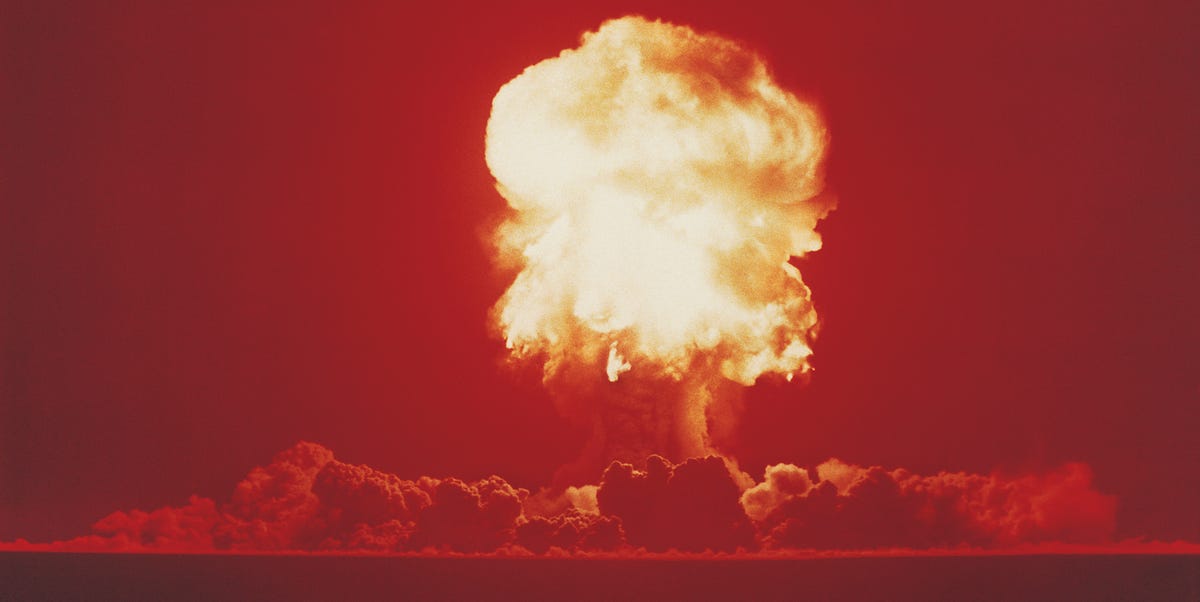
If many weapons were detonated over cities, bases, ports, communication hubs, and industrial areas, the first wave of destruction would come from several effects happening almost at once: intense light, heat, blast pressure, prompt radiation, and then fallout in areas affected by surface or near-surface explosions.
The Immediate Effects: Heat, Blast, Radiation, and Fire
Thermal Radiation
A nuclear explosion releases an enormous burst of light and heat. This thermal pulse can ignite flammable materials, start fires, damage exposed surfaces, and cause injuries at significant distances depending on the weapon yield, weather, terrain, and height of detonation. In cities, fire is especially dangerous because modern urban areas contain dense fuel: buildings, vehicles, gas lines, plastics, furniture, electrical systems, and industrial materials.
Blast Wave
The blast wave is the crushing wall of overpressure and wind that spreads outward from the explosion. It can flatten structures near the detonation point, shatter windows much farther away, damage roads and bridges, and turn ordinary infrastructure into a maze of blocked routes and broken systems. The farther from the center, the more variable the damage becomes, but in a large exchange the affected zones would overlap across many cities and strategic locations.
Prompt Radiation
Prompt radiation is released almost immediately during the explosion. Its effects depend heavily on distance, shielding, weapon design, and detonation conditions. For many large strategic weapons, blast and thermal effects would dominate near the center, while radiation would remain a major concern in specific zones and for people without adequate protection.
Radioactive Fallout
Fallout is one of the scariest words in the nuclear dictionary, and not just because it also sounds like a video game you probably should not use as a survival manual. Fallout forms when radioactive material mixes with soil, dust, and debris and then falls back to Earth. Surface bursts generally produce more local fallout than high-altitude airbursts because they pull more ground material into the radioactive cloud.
Wind and weather would determine where fallout travels. Some areas far from a detonation could become dangerous, while some areas closer by might be less affected depending on wind direction. Fallout is most dangerous early, because many radioactive particles decay quickly. That is why official emergency advice emphasizes getting inside, staying inside, and staying tuned to reliable information.
The First Hours: Emergency Systems Would Be Overwhelmed
In a major nuclear exchange, hospitals, fire departments, ambulance services, police departments, power grids, water systems, and communication networks would be hit at the same time. Even regions not directly struck could lose power, fuel, internet access, supply chains, and medical support.
Modern life is wonderfully convenient, but it is also connected like a giant plate of spaghetti. Electricity supports water treatment. Water supports hospitals. Hospitals need medicine deliveries. Deliveries need fuel. Fuel depends on ports, refineries, pipelines, drivers, payment networks, and roads. When multiple systems fail together, recovery becomes much harder than fixing one broken part.
People often imagine nuclear survival as a simple question: “Am I close to the blast or not?” That is important, but it is not the whole story. The bigger question is whether a society can keep food, water, shelter, sanitation, medical care, and trustworthy communication functioning after massive disruption. In a global nuclear exchange, that challenge would be enormous.
The First Weeks: Food, Water, Medicine, and Trust
After the immediate explosions, survival would depend on basics: clean water, safe food, shelter, medical care, and accurate information. Panic would be a real danger, but misinformation could be just as damaging. When people do not know what is true, they can make choices that increase risk, such as going outside too soon in a fallout area or clogging roads needed by emergency responders.
Food supply chains would be severely disrupted. Some farmland could be contaminated in certain regions. Transportation networks could be damaged. Refrigeration could fail. Ports could close. International trade could freeze. Even countries not directly hit might face shortages because the global food system is highly interdependent.
Medicine would be another crisis. Many essential drugs require global manufacturing and shipping. Hospitals use electricity, clean water, sterile supplies, oxygen, blood products, antibiotics, anesthesia, and trained staff. In a nuclear-war scenario, demand would spike at the exact moment supply collapses. That is the kind of math nobody wants on a spreadsheet.
The Nuclear Winter Problem
The phrase “nuclear winter” describes a possible global climate effect after large-scale nuclear war. The basic idea is that firestorms in cities and industrial areas could send massive amounts of black carbon soot into the upper atmosphere. Once there, soot could block sunlight, cool the surface, reduce rainfall, shorten growing seasons, and damage agriculture.
This is not the same as saying Earth would instantly become an ice planet with penguins running the stock market. The severity would depend on how many weapons were used, where they detonated, how many large fires developed, how much soot reached the stratosphere, and how long it stayed there. But climate modeling has shown that even regional nuclear conflicts could produce serious global agricultural consequences.
Rutgers-led research has estimated that a full-scale nuclear war between the United States and Russia could reduce global caloric production dramatically and lead to famine affecting billions. That does not mean every scientific detail is perfectly settled; climate and agriculture models always involve assumptions. But the core warning is consistent: nuclear war would not stay politely inside national borders. The atmosphere does not carry a passport.
Would the Entire Human Species Go Extinct?
Probably not from the blasts alone. Human beings live across many regions, including rural areas, islands, remote communities, and countries that might not be directly targeted. Some people would survive the immediate detonations, especially those far from blast zones and fallout paths.
But “not extinct” is not exactly a comforting headline. A full-scale nuclear exchange could still kill enormous numbers of people, damage the climate, collapse governments, break food systems, trigger disease outbreaks, and create long-term economic and ecological damage. Civilization is not just humans breathing air. It is schools, farms, hospitals, laws, trust, power grids, clean water, shipping, data centers, factories, and people showing up to do their jobs. Nuclear war attacks all of that at once.
So the better question is not “Would anyone survive?” The better question is “What kind of world would survivors inherit?” The answer is: a far harsher, poorer, colder, less connected, and more fragile world.
Would There Be Safe Places?
Safety would be relative. Distance from targets would matter. Being outside the path of fallout would matter. Having access to a sturdy building, basement, stored water, sealed food, medical supplies, and reliable information would matter. Local weather would matter. Government preparedness would matter. Community cooperation would matter more than most people realize.
Official radiation-emergency guidance is surprisingly simple in its first steps: get inside, stay inside, and stay tuned. A basement or interior room of a sturdy building offers more protection than being outdoors. Closing windows and doors, avoiding fallout dust, using sealed food and bottled water, and listening for official instructions can reduce exposure. This does not make nuclear war “survivable” in a casual sense, but it does mean individual actions can reduce risk in certain circumstances.
One of the most dangerous myths is that there is nothing anyone can do. That belief can become harmful because it leads people to freeze. The truth is more practical: there may be many situations where the right action, taken quickly, improves the odds. The goal is not heroics. The goal is boring, calm, useful behavior. In emergencies, boring can be beautiful.
What Would Happen to the Internet, Banking, and Daily Life?
The internet would not simply “turn off everywhere,” but major parts of it could fail. Data centers require electricity, cooling, fiber connections, staff, and stable networks. Banking depends on communications, identity systems, payment processors, and trust. If power grids and telecommunications were damaged across multiple regions, digital life would become unreliable or unavailable.
Cash might become useful in some places, but supply shortages would matter more than payment method. You can have a wallet full of money and still not buy bread if there is no bread. Fuel would become a critical resource. So would batteries, radios, clean containers, water filters, first-aid supplies, and local knowledge.
International markets would crash. Insurance systems would be overwhelmed. Governments might impose emergency controls. Travel would be restricted. Refugee movements could be massive. Food-producing countries might stop exports to protect domestic supplies. Even nations far from detonations would face a brutally simple question: how do we feed people if the global system breaks?
Why “Limited” Nuclear War Is Still a Huge Deal
Many people hear the phrase “limited nuclear war” and assume it means “small.” That is like calling a house fire “limited” because only the kitchen is currently on fire while the rest of the house politely waits its turn.
Even a smaller nuclear conflict could create regional devastation, radiation hazards, economic panic, and climate effects. It could also escalate. Once the nuclear threshold is crossed, leaders may fear more attacks, misread signals, or strike additional targets. Princeton’s Plan A simulation, which examined a plausible escalating conflict between the United States and Russia, estimated more than 90 million people dead or injured within the first few hours. That scenario was not even “every nuke on Earth.”
This is why arms control, hotlines, verification systems, nonproliferation agreements, diplomacy, and crisis communication are not boring policy furniture. They are the seatbelts, guardrails, smoke alarms, and emergency brakes of the nuclear age.
Experiences and Reflections Related to This Topic
Most people do not experience nuclear risk directly. They experience it through school lessons, documentaries, old public-safety films, news headlines, museum exhibits, scientific simulations, family stories, and the occasional late-night internet rabbit hole that starts with “just one article” and ends with staring at the ceiling at 2:13 a.m. wondering whether civilization has a backup generator.
One common experience is disbelief. Nuclear numbers are so large that the brain rejects them. A person can understand one explosion, one city, one emergency alert. But thousands of warheads? Global food disruption? Smoke changing crop yields years later? Those ideas are too big to feel real at first. The mind tries to shrink them into movie scenes because movies have endings, heroes, and credits. Real life has logistics.
Another experience is the strange contrast between ordinary life and extraordinary risk. Someone may read about nuclear winter while sitting in a comfortable room, drinking coffee, and hearing a washing machine beep in the background. That contrast can feel almost absurd. The world is capable of making both birthday cakes and ballistic missiles. Humanity is very talented and occasionally needs adult supervision.
Emergency-preparedness discussions can also feel awkward. Nobody wants to be the person at dinner saying, “Great pasta, by the way, where is your interior shelter area?” Yet basic preparedness is not panic. It is a form of kindness. Having water, flashlights, batteries, a radio, first-aid supplies, copies of important documents, and a family communication plan can help in many disasters, not only nuclear emergencies. Preparedness is not about becoming a bunker goblin. It is about reducing chaos when normal systems wobble.
Students often encounter this topic through history: Hiroshima, Nagasaki, the Cold War, the Cuban Missile Crisis, arms-control treaties, and modern tensions. The most valuable lesson is not simply that nuclear weapons are powerful. Everyone already knows that. The deeper lesson is that human decisions, miscommunication, pride, fear, technology, and timing can interact in dangerous ways. Nuclear risk is not only a science topic. It is a human behavior topic.
There is also a hopeful experience hidden inside the fear. The world has lived with nuclear weapons since 1945, and nuclear weapons have not been used in war since then. That does not mean the system is safe forever, but it proves that restraint, diplomacy, public pressure, scientific warning, and international agreements can matter. People built the danger, which means people can reduce it. That may not be as dramatic as a movie hero cutting the red wire, but it is much more useful.
Conclusion: The Real Answer Is Prevention
If all the nukes were launched at once, the result would be a civilization-level disaster: immediate destruction in targeted areas, overwhelmed emergency systems, dangerous fallout zones, global economic collapse, possible climate cooling, agricultural failure, famine risk, and long-term health and environmental consequences. The exact outcome would depend on where weapons detonated, how many worked, weather conditions, fire behavior, government responses, and international cooperation after the fact.
But the main conclusion does not require a supercomputer. Nuclear war is not a bigger version of conventional war. It is a different category of disaster. It attacks cities, infrastructure, climate, food systems, medical care, trust, and time itself. The best survival strategy is not learning to live after every weapon is used. The best survival strategy is making sure that never happens.
That is why nuclear-risk reduction matters: arms control, secure communication, fewer weapons on high alert, stronger nonproliferation, public education, and leaders who understand that “winning” a large nuclear war is like winning an argument on a sinking ship. Technically possible to claim, but deeply missing the point.