
Note: This article synthesizes current astronomy information from reputable science sources including NASA, NASA Jet Propulsion Laboratory, The Planetary Society, Caltech, Scientific American, and planetary science research summaries.
If Jupiter had a “do not touch” sign hanging on one of its moons, Io would be the one glowing red-hot behind the velvet rope. This wild world is not just another gray ball of rock politely circling a planet. Io is a volcanic troublemaker, a sulfur-painted daredevil, and arguably the most dramatic moon in the solar system. While Earth’s Moon gives us peaceful tides and romantic night skies, Jupiter’s moon Io gives us lava fountains, poisonous frost, electrical currents, and volcanoes that refuse to take weekends off.
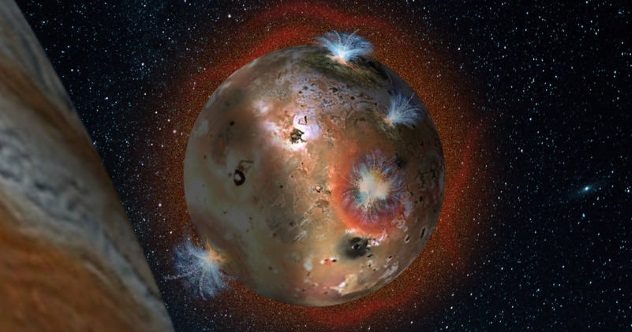
Among Jupiter’s famous Galilean moons, Io stands out like a pepperoni pizza dropped into a chemistry lab. It is slightly larger than Earth’s Moon, but that is where the similarity ends. Instead of quiet craters and dusty plains, Io has hundreds of active volcanoes, colorful sulfur deposits, enormous lava lakes, and a surface that keeps renewing itself like a planet-sized screensaver set to “chaos.” Scientists study Io because it offers a front-row seat to tidal heating, extreme volcanism, and the way a moon can interact with a giant planet’s magnetic field.
Below are 10 out-of-this-world facts about Jupiter’s moon Io, written for anyone who likes space science with a little personality. Buckle up. This moon does not do boring.
1. Io Is the Most Volcanically Active World in the Solar System
Io’s biggest claim to fame is simple: it is the most volcanically active body in the solar system. Earth has famous volcanoes like Kilauea, Etna, and Mount St. Helens, but Io makes them look like scented candles. Scientists estimate that Io has roughly 400 active volcanoes, and some of them blast lava and volcanic plumes high above the surface.
This constant activity means Io’s surface is always changing. Lava flows spread across the ground, volcanic deposits repaint the landscape, and older features get buried under fresh material. That is one reason Io does not look heavily cratered like many other moons. Impact scars do not last long when the moon keeps resurfacing itself with molten rock.
In other words, Io is not sitting quietly in space collecting dust. It is constantly remodeling, and its preferred renovation tool is lava.
2. Jupiter Squeezes Io Like a Cosmic Stress Ball
Io’s volcanoes are not powered the same way Earth’s volcanoes are. On Earth, plate tectonics and internal heat drive much of the volcanic activity. Io’s engine is different: tidal heating.
Io orbits very close to Jupiter, and Jupiter is enormous. As Io travels around the gas giant, Jupiter’s gravity pulls on it with incredible force. Meanwhile, two neighboring moons, Europa and Ganymede, tug on Io as well. These gravitational interactions keep Io’s orbit slightly elliptical, meaning the distance between Io and Jupiter changes as it moves.
That changing distance causes Io to flex. The moon is stretched and squeezed again and again, creating friction inside its rocky interior. That friction produces heat, and that heat melts rock into magma. Imagine bending a paper clip back and forth until it warms up. Now imagine the paper clip is a moon and the hand doing the bending is the largest planet in the solar system. That is Io’s daily routine.
3. Io’s Surface Can Rise and Fall by About 330 Feet
Earth’s ocean tides are impressive, but Io’s solid surface tides are downright ridiculous. Because Jupiter’s gravitational pull is so intense, Io’s rocky surface can bulge up and down by as much as about 330 feet. That is taller than a 30-story building.
On Earth, tides move water. On Io, the ground itself flexes. This constant movement helps explain why the moon is so volcanically restless. The interior is being worked over continuously, like dough in the hands of a very aggressive cosmic baker.
This is one of the reasons scientists love studying Io. It shows how gravity can act as a heat source. A moon does not need to be close to the Sun to be geologically active. It can be far out in the colder reaches of the solar system and still be heated from within by gravitational tugging.
4. Io Looks Colorful Because It Is Coated in Sulfur Compounds
Io is often described as looking like a moldy pizza, and honestly, the comparison is hard to unsee. Its surface features yellows, whites, reds, oranges, greens, and dark patches. These colors are not decorative choices from an ambitious space designer. They come largely from sulfur and sulfur compounds, along with volcanic materials and sulfur dioxide frost.
The surface chemistry of Io is one of its strangest features. Sulfur can appear in different colors depending on temperature and form. Volcanic eruptions spread sulfur-rich material across the moon, while sulfur dioxide can freeze on the surface as frost. The result is a moon that looks less like a traditional rocky satellite and more like a science experiment with trust issues.
These colors are useful to researchers. By studying Io’s surface patterns, scientists can identify recent eruptions, plume deposits, lava flows, and areas where frost has accumulated. Io’s wild palette is not just pretty; it is a geological map written in volcanic paint.
5. Io Has a Thin Atmosphere Made Mostly of Sulfur Dioxide
Io does have an atmosphere, but do not imagine anything breathable, cozy, or remotely vacation-friendly. Its atmosphere is extremely thin and made mostly of sulfur dioxide. That gas comes from volcanic eruptions and from sulfur dioxide frost that sublimates, meaning it turns directly from solid to gas when warmed by sunlight.
The atmosphere is so delicate that it changes depending on sunlight, temperature, volcanic activity, and Io’s position around Jupiter. When parts of Io move into shadow, the atmosphere can partially collapse as sulfur dioxide freezes back onto the surface. When sunlight returns, the frost can turn back into gas.
So Io’s atmosphere behaves less like Earth’s stable blanket of air and more like a moody stage curtain that opens and closes depending on lighting. It is another reminder that Io is a place of extremes: volcanoes below, radiation above, and sulfur chemistry everywhere in between.
6. Io Helps Feed Jupiter’s Giant Plasma Torus
Io does not just affect itself. It also plays a major role in Jupiter’s vast magnetic environment. Material from Io’s atmosphere escapes into space and becomes ionized, forming a doughnut-shaped ring of charged particles around Jupiter known as the Io plasma torus.
This torus is made largely of sulfur and oxygen ions. Jupiter’s powerful magnetic field sweeps up material from Io and accelerates it, creating a complex and intense environment around the planet. Scientists estimate that Io supplies material to Jupiter’s magnetosphere at a rate of roughly a ton per second.
That means Io is not just a volcanic moon; it is also a supplier for one of the most powerful magnetic systems in the solar system. Somewhere, a warehouse manager is impressed.
7. Io Acts Like an Electric Generator
Here is where Io gets even weirder. As it orbits through Jupiter’s magnetic field, Io behaves like an electric generator. The moon can develop hundreds of thousands of volts across itself and drive enormous electrical currents along Jupiter’s magnetic field lines.
This interaction connects Io to Jupiter in a very real way. Charged particles move along magnetic pathways between the moon and the planet, helping create auroral emissions in Jupiter’s upper atmosphere. Io is not merely orbiting Jupiter like a quiet sidekick; it is plugged into the giant planet’s magnetic system like a glowing extension cord of doom.
This relationship helps scientists understand how moons, planets, magnetic fields, and charged particles interact. It also proves that space can be electrically dramatic without needing a thunderstorm or a villain pressing a large red button.
8. Loki Patera Is One of the Solar System’s Most Famous Lava Lakes
One of Io’s most famous volcanic features is Loki Patera, a huge volcanic depression filled with lava. It is roughly 124 miles, or about 200 kilometers, across. That is not a backyard lava puddle. That is a molten feature big enough to make geography teachers pause and say, “Well, that is excessive.”
NASA’s Juno spacecraft has recently provided new observations of Io’s lava lakes, including Loki Patera. Juno’s instruments have helped scientists see hot rings around some lava lakes, suggesting that many are covered by cooler crust in the center while molten lava remains exposed around the edges.
This kind of detail matters because Io’s volcanoes do not all behave the same way. Some produce plumes. Some create lava flows. Some seem to operate as enormous lava lakes where magma rises, cools, sinks, and circulates. Loki Patera is one of the best examples of how Io’s geology is not just active, but complicated.
9. Juno Has Given Scientists Fresh Clues About Io’s Interior
NASA’s Juno mission has transformed modern understanding of Io. During close flybys in December 2023 and February 2024, Juno came within about 930 miles of Io’s surface. That is extremely close in spacecraft terms, especially around Jupiter, where radiation makes every visit feel like sending electronics through a cosmic microwave.
Juno’s gravity measurements and infrared observations have helped scientists investigate whether Io’s volcanoes are fed by a global magma ocean or by more localized magma chambers. Recent findings suggest that many of Io’s volcanoes may be powered by their own individual reservoirs of hot magma rather than one single moon-wide ocean of molten rock.
This is important because it changes how scientists model Io’s interior. Io may not simply be a giant shell floating over one universal magma sea. Instead, it may have a more complex internal system where heat, melt, and rock interact in different regions. The more scientists learn, the more Io looks like a volcanic machine with many engines running at once.
10. Io Recently Produced One of the Most Powerful Volcanic Events Ever Observed
Io was already famous for extreme volcanism, but recent Juno observations pushed its reputation even further. During a December 27, 2024 flyby, Juno’s infrared instrument detected an enormous hot spot in Io’s southern hemisphere. The feature was so intense that it saturated the detector, which is science-speak for “the instrument basically squinted and said, ‘Too bright.’”
The volcanic region was estimated to cover tens of thousands of square miles, and researchers described it as the most intense volcanic eruption ever recorded on Io. Observations suggested that multiple closely spaced hot spots may have erupted at the same time, possibly connected to a large subsurface magma system.
Events like this are not just spectacular. They help scientists understand volcanic processes across the solar system. Io gives researchers a natural laboratory for studying how heat escapes from rocky worlds, how magma moves underground, and how surfaces can be reshaped on short timescales.
Why Io Matters More Than Its Size Suggests
Io may be only slightly larger than Earth’s Moon, but its scientific importance is huge. It helps researchers study tidal heating, a process that may also matter for icy moons like Europa and Enceladus. While Io turns tidal energy into volcanism, other moons may turn similar gravitational flexing into subsurface oceans. That makes Io part of a much bigger story about habitability, geology, and energy in the outer solar system.
Io also shows how dynamic moons can be. For a long time, people imagined moons as cold, dead, cratered objects. Io shattered that assumption when Voyager 1 revealed active volcanoes in 1979. Since then, spacecraft and telescopes have shown that moons can be geologically alive in surprising ways.
Studying Io is like studying a version of planetary evolution with the fast-forward button pressed. Its surface changes quickly, its interior releases heat violently, and its relationship with Jupiter affects an entire magnetic environment. For planetary scientists, Io is not just interesting. It is essential.
Experience: What Learning About Io Feels Like
The first experience many people have with Io is not through a telescope, but through a photo. You see this strange yellow-orange moon covered in blotches, rings, and dark scars, and your brain tries to compare it to something familiar. A pizza? A bruised fruit? A badly behaved marble? Then you learn that those colorful marks are not decorative patterns, but volcanic deposits, sulfur compounds, lava flows, and frost. Suddenly the image stops being funny for a second and becomes astonishing.
One of the best ways to appreciate Io is to imagine standing far away from it, safely, very safely, in a fictional observation craft. Jupiter would dominate the sky like a banded giant, enormous enough to make every human landmark feel microscopic. Below, Io’s surface would look alive with heat. Plumes could rise from volcanic vents. Lava lakes would glow in infrared. Frosty sulfur dioxide plains would stretch across the ground, interrupted by dark lava fields and bright deposits from old eruptions. It would be beautiful in the same way a lightning storm is beautiful: amazing to watch, terrible to touch.
That is the emotional power of Io. It changes the way you think about moons. Earth’s Moon feels calm and ancient, a familiar companion that has watched over human history. Io feels like a warning label from the universe. It reminds us that a moon can be restless, dangerous, colorful, electrically connected to its planet, and scientifically priceless all at the same time.
For students, space fans, and casual readers, Io is also a perfect gateway into deeper astronomy. It connects many big ideas in one place: gravity, orbital resonance, heat, volcanism, magnetism, atmospheric escape, and spacecraft exploration. You do not need to memorize equations to understand the core lesson. Jupiter pulls, other moons tug, Io flexes, rock melts, volcanoes erupt. That chain of cause and effect is elegant, even if the result looks like a moon having the worst stomachache in the solar system.
There is also something humbling about Io’s constant change. On Earth, we often think of landscapes as permanent. Mountains seem eternal. Craters on the Moon can last for billions of years. But Io is different. Its surface is rewritten again and again. A volcanic deposit visible today may be altered by the next major eruption. A hot spot can brighten, fade, or explode into scientific headlines. Io teaches us that worlds are not always static museum pieces. Some are active stories still being written.
The most exciting part is that Io is not finished surprising us. Juno has already delivered fresh clues, and future observations from spacecraft and Earth-based telescopes will keep revealing new details. Each eruption, plume, lava lake, and magnetic interaction adds another page to the story. Io may be hostile to life as we know it, but for curiosity, it is a five-star destination.
Conclusion
Jupiter’s moon Io is one of the most extraordinary places in the solar system. It is volcanically furious, chemically colorful, electrically connected to Jupiter, and constantly reshaped by tidal heating. From its sulfur dioxide atmosphere to its massive lava lakes and record-breaking eruptions, Io proves that moons can be far more exciting than quiet rocks in orbit.
What makes Io especially fascinating is that its weirdness is not random. Every plume, lava flow, and glowing hot spot tells a story about gravity, heat, and motion. Jupiter squeezes Io. Europa and Ganymede help keep its orbit unsettled. The interior heats up. The surface erupts. Material escapes into space and feeds Jupiter’s magnetic environment. It is a cosmic chain reaction, and Io is the fiery link holding the drama together.
So the next time someone says moons are boring, point them toward Io. This is a world with hundreds of volcanoes, lava lakes bigger than cities, an atmosphere that freezes and returns, and a habit of rewriting planetary science textbooks. Io is not just out of this world. It is out of this world, on fire, and somehow still asking for more attention.
SEO Tags