
Music festivals are supposed to be magical: big stages, loud guitars, neon wristbands, overpriced lemonade, and that one friend who swears they “know a shortcut” through a crowd of 80,000 people. But sometimes the dream turns into a logistical casserole of mud, heat, broken promises, crowd-control failures, canceled headliners, and bathrooms that belong in a horror franchise.
This list of the 20 worst music festivals you’d never want to attend looks at real events that became infamous for fraud, poor planning, severe weather, overcrowding, safety failures, or plain old chaos wearing a VIP lanyard. Some were tragic. Some were absurd. A few were so badly organized that even a group chat birthday dinner would have shown better project management.
The goal here is not to mock attendees or minimize serious events. Instead, it is to analyze what went wrong, why these festivals became cautionary tales, and what modern festivalgoers can learn before spending half a paycheck to sleep in a field next to a speaker tower.
1. Fyre Festival 2017: Luxury Marketing, Disaster Delivery
Fyre Festival promised a glamorous island experience in the Bahamas with models, villas, gourmet food, and elite musical performances. What many guests found instead was unfinished infrastructure, emergency-style lodging, confusion, limited supplies, canceled performances, and the internet’s most famous sad sandwich.
The festival became a master class in influencer hype without operational reality. Slick orange social media tiles created excitement, but behind the curtain, planning was falling apart. Founder Billy McFarland later pleaded guilty to fraud-related charges and was sentenced to prison. Fyre remains one of the worst music festivals in modern pop culture because it turned “exclusive luxury” into a global punchline with luggage tags.
2. Woodstock ’99: Peace, Love, and Extremely Poor Planning
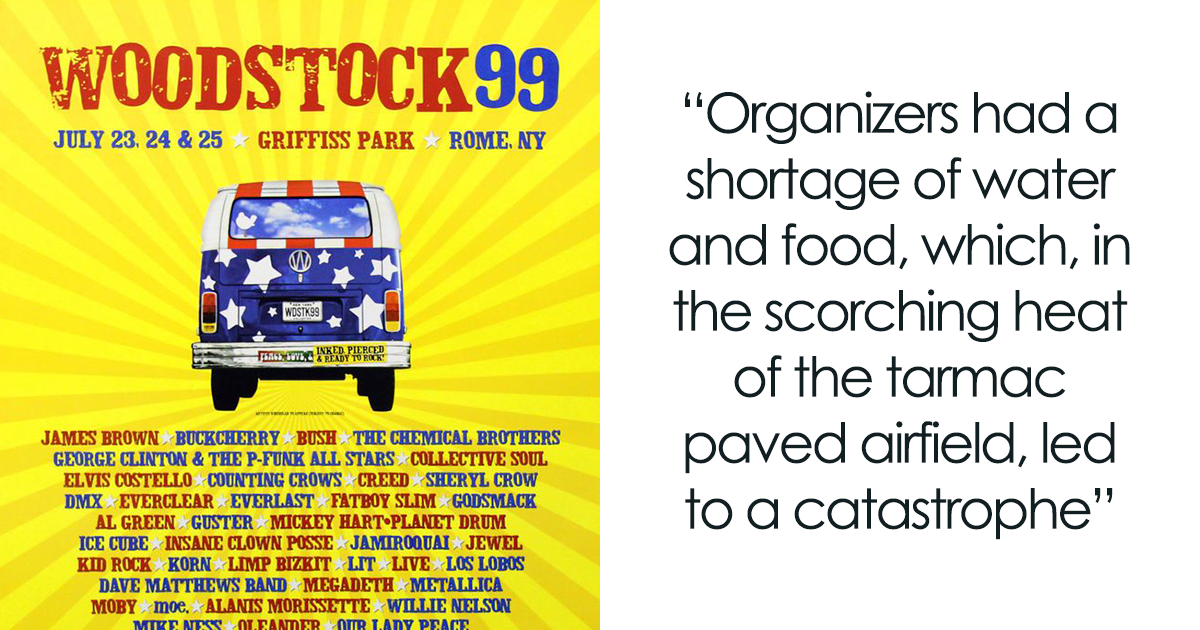
Woodstock ’99 was designed to celebrate the legendary 1969 festival, but it became remembered for heat, high prices, sanitation problems, fires, aggressive crowds, and a general sense that someone had confused “festival management” with “leave everyone on hot pavement and hope for vibes.”
The event took place on a former air base in Rome, New York, where shade was scarce and temperatures climbed. Bottled water was expensive, trash piled up, and frustrations grew. By the final night, fires and unrest dominated the headlines. Woodstock ’99 is now one of the most studied examples of how nostalgia, commercial pressure, and poor crowd care can turn a music festival into a cautionary documentary.
3. Altamont Free Concert 1969: The End of the Peace-and-Love Illusion
Altamont was meant to be a West Coast answer to Woodstock, with the Rolling Stones headlining a free concert in California. Instead, the event became infamous for poor planning, last-minute venue changes, inadequate security arrangements, and violence near the stage.
The festival has long been described as a symbolic end to the 1960s counterculture dream. Unlike Woodstock’s muddy optimism, Altamont showed how quickly a massive gathering can become dangerous when crowd control, security, and logistics are treated like minor details. Spoiler: they are not minor details. They are the entire soup.
4. Astroworld Festival 2021: A Crowd-Safety Tragedy
The 2021 Astroworld Festival in Houston became one of the most devastating modern festival tragedies after a crowd surge during Travis Scott’s set resulted in multiple deaths and many injuries. Investigations and lawsuits focused heavily on crowd management, event layout, communication, and emergency response.
Astroworld remains a major case study in festival safety because it raised urgent questions about how promoters, artists, venue operators, and security teams should identify and respond to dangerous crowd density. The lesson is painfully clear: when a crowd stops being able to move safely, the show must stop being the priority.
5. Route 91 Harvest Festival 2017: A Country Festival Turned Nightmare
Route 91 Harvest was a country music festival held in Las Vegas. In 2017, it became the site of the deadliest mass shooting in modern U.S. history. The event forever changed how outdoor concerts think about emergency planning, venue perimeters, evacuation routes, and security coordination.
This is one of the darkest entries on the list, not because the festival itself was poorly loved or poorly attended, but because attendees came for music and community and were met with a terrifying public-safety crisis. It remains a reminder that large events require planning not only for common problems, but also for rare, high-impact emergencies.
6. Love Parade 2010: Crowd Flow Gone Terribly Wrong
Love Parade in Duisburg, Germany, was a massive electronic music event that ended in tragedy after crowd movement broke down near a tunnel and ramp area. Investigations later focused on planning failures, crowd capacity, and bottleneck design.
The Love Parade disaster is often cited by crowd-safety experts because it showed how dangerous a poorly designed entry and exit system can be. Music festivals are not just stages and DJs. They are traffic systems with humans inside them. When the map is wrong, the playlist does not matter.
7. Roskilde Festival 2000: A Crowd Collapse During Pearl Jam
Denmark’s Roskilde Festival is one of Europe’s most respected music events, but its 2000 edition became associated with tragedy during Pearl Jam’s performance, when a crowd collapse near the front led to multiple deaths.
The incident influenced conversations about barriers, pit design, crowd surfing, wet ground, security visibility, and how performers and organizers communicate during emergencies. Roskilde continued in later years, but the 2000 tragedy remains one of rock history’s most sobering reminders that even beloved festivals can face serious risk.
8. Pukkelpop 2011: Severe Weather Meets Festival Infrastructure
Pukkelpop in Belgium was struck by a violent storm in 2011 that caused stage and tent damage, leading to deaths, injuries, and cancellation of the festival. The storm arrived with terrifying speed, showing how outdoor festivals can be vulnerable to extreme weather.
This event is now part of the broader discussion about weather monitoring, evacuation plans, temporary structures, and real-time communication. If a festival app can send you eight push notifications about merch drops, it should definitely be able to guide you during dangerous weather.
9. Indiana State Fair 2011: Stage Safety Under Scrutiny
Before a scheduled Sugarland concert at the Indiana State Fair, strong winds from an approaching storm caused a stage structure to collapse. The incident led to deaths, injuries, lawsuits, and deep scrutiny of outdoor stage design and emergency decision-making.
Although it was a fair concert rather than a traditional multi-day music festival, it belongs in this conversation because it exposed the same issue many festivals face: weather is not background decoration. It is a serious production variable, and ignoring it can have irreversible consequences.
10. TomorrowWorld 2015: Mud, Rain, and Stranded Attendees
TomorrowWorld in Georgia was supposed to be an electronic music wonderland. In 2015, heavy rain transformed roads and fields into a muddy mess, shuttle transportation faltered, and many non-camping attendees were left stranded or forced into long, miserable walks.
The festival’s brand promised fantasy. The weather delivered swamp. Attendees complained of poor communication and transportation chaos. TomorrowWorld did not return after that edition, proving that even beautiful stage design cannot rescue a festival if guests cannot safely get home.
11. Electric Zoo 2023: Lines, Cancellations, and Overcapacity Complaints
Electric Zoo in New York had a rough 2023 edition. The first day was canceled only hours before opening, reportedly because the main stage was not ready. Later, the festival faced major entry delays, capacity issues, and angry ticket holders who had already spent money on travel, hotels, and glitter levels that could be seen from space.
For fans, the frustration was not just the cancellation. It was the feeling of uncertainty: long lines, late communication, denied entry, and confusion. Electric Zoo 2023 became a textbook example of how fast trust disappears when logistics wobble in public.
12. Electric Zoo 2013: A Festival Halted by Medical Emergencies
A decade before its 2023 controversy, Electric Zoo’s 2013 edition also made headlines when its final day was canceled after serious drug-related medical emergencies, including deaths. City officials and organizers agreed to shut down the remaining programming.
This entry highlights another major festival issue: attendee health. Large events need medical teams, hydration access, education, chill-out areas, and fast response systems. The music may be electronic, but the crowd is human, and humans are not designed to run on bass drops and poor decisions.
13. Blue Ridge Rock Festival 2023: Weather, Cancellations, and Refund Anger
Blue Ridge Rock Festival in Virginia was heavily disrupted in 2023 after severe weather led to evacuations and the cancellation of most of the event. Attendees later complained about communication, conditions, transportation, and refund confusion.
The festival organizers cited safety concerns related to weather, while reports and attendee accounts raised broader questions about staffing and operations. Whatever the full recipe, the result was sour: thousands of rock fans left frustrated, muddy, and extremely unlikely to describe the experience as “well-oiled.”
14. The Hudson Project 2014: A Muddy Exit Strategy
The Hudson Project, held in New York, was hit by severe weather during its inaugural edition. Heavy rain led to cancellations and left many attendees dealing with mud, stuck vehicles, and a rough departure from the festival grounds.
Mud at a festival can be fun for about twelve seconds. After that, it becomes a transportation crisis wearing brown shoes. The Hudson Project showed that a festival needs not only a weather plan, but also a realistic plan for roads, parking, towing, communication, and mass exit under bad conditions.
15. Erie Canal Soda Pop Festival 1972: Bull Island Chaos
The Erie Canal Soda Pop Festival, often called the Bull Island Rock Festival, was held over Labor Day weekend in 1972 after legal and location problems forced changes. It became infamous for overcrowding, poor sanitation, traffic nightmares, food shortages, and general disorder.
Many legendary festival disasters sound like modern problems caused by social media hype. Bull Island proves otherwise. Long before influencer wristbands and drone shots, promoters were perfectly capable of underestimating infrastructure. History may not repeat, but it definitely keeps forgetting to order enough toilets.
16. Powder Ridge Rock Festival 1970: No Music, Still a Festival Somehow
Powder Ridge Rock Festival in Connecticut was canceled before it happened, but thousands of people showed up anyway. With the official event shut down and performers absent, attendees found themselves at a non-festival festival with limited organization.
It is hard to imagine a worse review than: “The bands did not play, but the crowd arrived.” Powder Ridge became a strange counterculture legend, proving that cancellation notices are only useful if people actually receive and believe them.
17. Woodstock ’94: Mudstock Before the Meltdown
Woodstock ’94 was far more successful than Woodstock ’99 in cultural memory, but it was still a muddy, overcrowded, messy event that earned the nickname “Mudstock.” Heavy rain turned the grounds into a giant mud pit, and the crowd size reportedly exceeded expectations.
Some attendees remember it fondly, and several performances became iconic. Still, from a comfort and logistics perspective, Woodstock ’94 was not exactly a spa weekend with guitar solos. It showed that even a festival remembered with affection can be physically exhausting when weather and crowd size get rowdy.
18. Governors Ball 2019: A Weather Evacuation Mess
Governors Ball in New York faced major backlash in 2019 after Sunday programming was delayed, then the festival grounds were evacuated because of severe weather. Many fans were frustrated after waiting for hours only to be told to leave shortly after gates opened.
To be fair, canceling during dangerous weather is often the right call. The criticism centered on timing, communication, and the emotional whiplash of “come in, get excited, now please exit.” Festivals cannot control thunderstorms, but they can control how clearly they talk to soaked customers holding $18 snacks.
19. VestiVille 2019: Fyre Festival, Belgian Remix
VestiVille in Belgium promised major artists, luxury experiences, and a polished urban music festival. It was canceled at the last minute after safety and infrastructure concerns, with some artists pulling out and fans drawing immediate comparisons to Fyre Festival.
Anytime your festival is compared to Fyre, that is not a marketing win. It means the public has moved from “Will the headliner be good?” to “Does this event physically exist in a safe and functional form?” That is a very bad pivot.
20. BPM Festival 2017: A Closing Party Marred by Violence
The BPM Festival in Playa del Carmen, Mexico, was a major electronic music event. In 2017, a shooting outside a club hosting a festival-related closing party left multiple people dead and injured. Authorities said it was not terrorism, but the incident shook the international dance music community.
This entry is included not because the broader festival lacked artistic value, but because the experience became associated with a severe safety crisis. For travelers, it reinforced a practical truth: destination festivals require attention not just to lineups and beaches, but also to local security conditions, venue safety, and emergency planning.
Why Do Music Festivals Go Wrong?
Bad Logistics Hide Behind Good Branding
A beautiful lineup poster can hide an ugly spreadsheet. Many failed festivals look amazing online because marketing is easier than infrastructure. You can announce headliners in one afternoon. Building safe entrances, medical systems, water access, transportation routes, weather procedures, staff training, and emergency communication takes months of serious work.
Crowds Are Not Just Big Audiences
A crowd is a moving system. When too many people are pushed into narrow spaces, when exits are unclear, or when barriers create pressure points, the situation can become dangerous quickly. The worst music festival disasters often involve not one mistake, but a chain of small failures that meet at exactly the wrong moment.
Weather Is a Headliner Whether You Booked It or Not
Rain, heat, lightning, wind, and mud have ruined many festivals. The problem is not bad weather itself. The problem is pretending weather is a surprise guest instead of a guaranteed planning factor. A serious festival should know when to pause, evacuate, shelter, communicate, and refund.
Communication Can Save the Experience
Fans can handle delays better than confusion. What makes people furious is silence, contradiction, and vague announcements. When attendees are tired, wet, hot, hungry, or worried, clear updates matter. A festival that communicates well can survive a storm. A festival that ghosts its own customers becomes a meme with wristbands.
Festival Survival Lessons From These Disasters
Before buying tickets, check more than the lineup. Look at the promoter’s history, venue layout, refund policy, transportation options, weather risks, and reviews from previous years. A festival with great artists but terrible logistics is like a sports car with no brakes: exciting for about three minutes, then deeply concerning.
At the event, identify exits early, choose meeting points with friends, stay hydrated, pace yourself, and listen to official safety instructions. If a crowd feels too dense, move sideways and away when possible rather than pushing forward. If weather alerts appear, take them seriously. Your favorite artist will tour again. Your safety is not a limited-edition merch drop.
Extra Festival Experience: What It Feels Like When a “Dream Weekend” Goes Sideways
Anyone who has attended a big festival knows the first few hours feel like entering a temporary city built by people who love music and hate normal sleep schedules. There are flags waving, bass rumbling, food trucks sizzling, strangers complimenting outfits, and that special festival optimism that says, “Sure, the map is confusing, but we’ll figure it out.” Then the cracks appear.
Maybe the water station is a 30-minute walk away. Maybe the app crashes right when the schedule changes. Maybe the shuttle line looks less like transportation and more like a historical reenactment of human patience leaving the body. Maybe the sky turns dark, and suddenly everyone is checking weather radar with the seriousness of NASA employees.
The worst festival experiences often begin with small inconveniences. A late gate opening. A missing sign. A bathroom area that needed twice as many units. A security line that snakes into direct sun. On their own, these problems are annoying but survivable. Together, they create stress. And stress spreads through a crowd faster than a rumor about a surprise guest.
One of the biggest lessons from disastrous festivals is that fans are usually more reasonable than organizers fear. People understand rain. They understand delays. They even understand cancellations when safety is truly at risk. What they do not forgive is being treated like walking ticket revenue after the money has cleared. A tired fan can remain loyal. A confused, ignored, overheated fan becomes a one-person public relations department, and not the kind you want.
There is also a strange comedy to festival discomfort, at least when it stays safe. Everyone becomes a field engineer. Ponchos turn into architecture. A granola bar becomes currency. Someone with a portable charger becomes royalty. A dry pair of socks feels like winning a Grammy. These small survival rituals are part of festival culture, but they should never be used as an excuse for poor planning.
A good festival creates adventure without neglect. It lets people feel spontaneous while quietly protecting them with smart systems: visible staff, clear signage, reliable water, trained medics, safe stages, realistic capacity, weather plans, and transportation that does not require attendees to solve a puzzle at midnight in ankle-deep mud.
So, would every festival on this list be awful from the first note? Not necessarily. Some had incredible performances. Some attendees still remember moments of joy. But a festival is not judged only by what happens onstage. It is judged by whether people can arrive, enjoy the music, handle basic human needs, and leave safely. That is the real headline act.
Conclusion: The Worst Music Festivals Teach the Best Lessons
The worst music festivals are not just stories about mud, fraud, bad weather, or chaotic crowds. They are reminders that live music depends on trust. Fans trust organizers to plan honestly. Artists trust promoters to build safe stages. Cities trust events to protect public spaces. When that trust breaks, even the best lineup can become background noise to a disaster.
From Fyre Festival’s fantasy marketing to Woodstock ’99’s overheated breakdown, from Altamont’s security failures to Astroworld’s crowd-safety tragedy, these events show that music festivals require more than vibes. They require humility, planning, communication, and respect for the people who bought the ticket.
In other words: book the bands, yes. But also book enough water, exits, medics, toilets, shade, shuttles, weather experts, and adults in the room. Rock and roll may love chaos, but festivalgoers still deserve a safe ride home.