30 Wild NSFW Outfits People Dared To Wear To Work, As Shared By Folks Online

Work fashion has changed a lot. The modern office is no longer a sea of gray suits, stiff collars, and shoes that sound like they are reporting quarterly earnings. Today, employees show up in sneakers, hoodies, denim, smart casual outfits, creative accessories, and sometimes clothing choices so bold they make the break room microwave look emotionally stable.
That is where the internet comes in. Across workplace forums, advice columns, social media threads, and “you won’t believe what happened at my job” stories, people have shared unforgettable examples of outfits that were technically worn to work but spiritually belonged somewhere else: a beach party, a nightclub, a costume contest, a music festival, or a mysterious alternate universe where HR has simply stopped answering emails.
Before we get dramatic, let’s be clear: this article uses “NSFW outfits” in the workplace senseclothing that may be too revealing, distracting, unsafe, offensive, messy, or simply wildly unsuitable for a professional environment. This is not about shaming personal style. Fashion is fun. Self-expression matters. But when clothing interferes with safety, customer trust, team comfort, or basic professionalism, the outfit becomes less “iconic” and more “please check the employee handbook.”
Below are 30 wild work outfit stories and categories inspired by real online discussions, workplace dress-code debates, HR guidance, and the everyday chaos of people trying to interpret “business casual” without a translator.
Why Workplace Outfits Become a Big Deal
Dress codes are not just about looking neat. They often exist for practical reasons: safety, hygiene, brand image, customer expectations, and fairness. A construction site may require protective footwear. A restaurant may ban loose jewelry or open-toe shoes. A law office may expect business professional attire because clients associate polished presentation with trust. A creative studio may allow more expressive clothing, but even there, “creative” usually does not mean “I got dressed during a power outage.”
The tricky part is that workplace fashion has become more flexible. Hybrid work, startup culture, casual Fridays, and changing social norms have made many employees rethink what “professional” means. That flexibility can be great. It can also create confusion when one person hears “relaxed dress code” and arrives in clean jeans and a sweater, while another hears the same phrase and shows up looking ready to headline a foam party.
30 Wild NSFW Outfits People Dared To Wear To Work
1. The Pajama Set That Refused to Clock Out
Pajamas are comfortable, honest, and emotionally supportive. Unfortunately, they are rarely office-ready unless your job involves sleep studies or testing mattresses. Online stories often mention coworkers arriving in full pajama sets and insisting they were “basically lounge wear.” The problem is not comfort; it is context.
2. The Sheer Shirt Situation
Light, breathable fabrics can be stylish, but sheer clothing can become a workplace problem when it reveals more than intended. In most offices, layering is the difference between fashion-forward and “HR just cleared its throat from across the room.”
3. The Club Dress at the 9 A.M. Meeting
Some outfits are perfect for dancing, rooftop photos, and dramatic entrances. A Monday morning budget meeting is not usually one of those places. The issue is not whether the outfit is fashionable; it is whether it matches the room, the role, and the workday.
4. The Graphic Tee With an Offensive Message
A shirt with a funny slogan can make coworkers smile. A shirt with profanity, insults, explicit jokes, or hateful imagery can make everyone wish email had a “hide human interaction” button. Most dress codes restrict offensive language for a reason.
5. The Beach Outfit in a Corporate Office
Flip-flops, board shorts, bikini tops, and beach cover-ups may be great near water. In an office, they can look like someone took a wrong turn between vacation and payroll.
6. The “Just Came From the Gym” Look
Athleisure can be clean and polished when styled carefully. But sweaty workout clothes, compression gear, or gym shorts can cross the line quickly, especially in customer-facing roles. The treadmill may respect the look. The client may not.
7. The Costume That Was Not for Halloween
People online love stories about employees arriving in capes, wigs, fantasy outfits, or full character costumes on ordinary workdays. In creative settings, a playful accessory might be accepted. A full costume at the accounts-payable desk, however, may raise questions no spreadsheet can answer.
8. The Ripped Clothing Disaster
Distressed denim can be trendy, but there is a difference between “fashionably distressed” and “survived a raccoon incident.” Many workplaces allow jeans but still expect them to be clean, intact, and neat.
9. The Visible Undergarment Problem
This is one of the most common dress-code flashpoints. Whether accidental or intentional, visible undergarments can make coworkers uncomfortable and put managers in an awkward position. A good rule: if the outfit needs constant adjusting, it may not be workday-ready.
10. The Micro-Shorts Mystery
Shorts can be acceptable in some workplaces, especially casual offices, outdoor jobs, or warm climates. But ultra-short styles can cause problems in professional settings. When the chair becomes a strategic challenge, the outfit may be doing too much.
11. The Slippers-as-Shoes Experiment
Slippers belong at home, near tea, blankets, and emotional recovery. At work, they often look sloppy and may create safety risks. Even in casual offices, footwear usually needs to be clean, secure, and appropriate for the environment.
12. The Heavy Perfume Cloud
Not technically an outfit, but it travels with one. Some online workplace complaints are less about clothing and more about scent. Strong fragrance can trigger headaches or discomfort for coworkers. Professional presentation includes not turning your cubicle into a department-store perfume counter.
13. The Political or Shock-Value Outfit
Clothing that seems designed to provoke arguments can derail a workplace fast. Even when employees have personal beliefs, employers may restrict apparel that disrupts operations, offends customers, or creates conflict.
14. The See-Through Leggings Issue
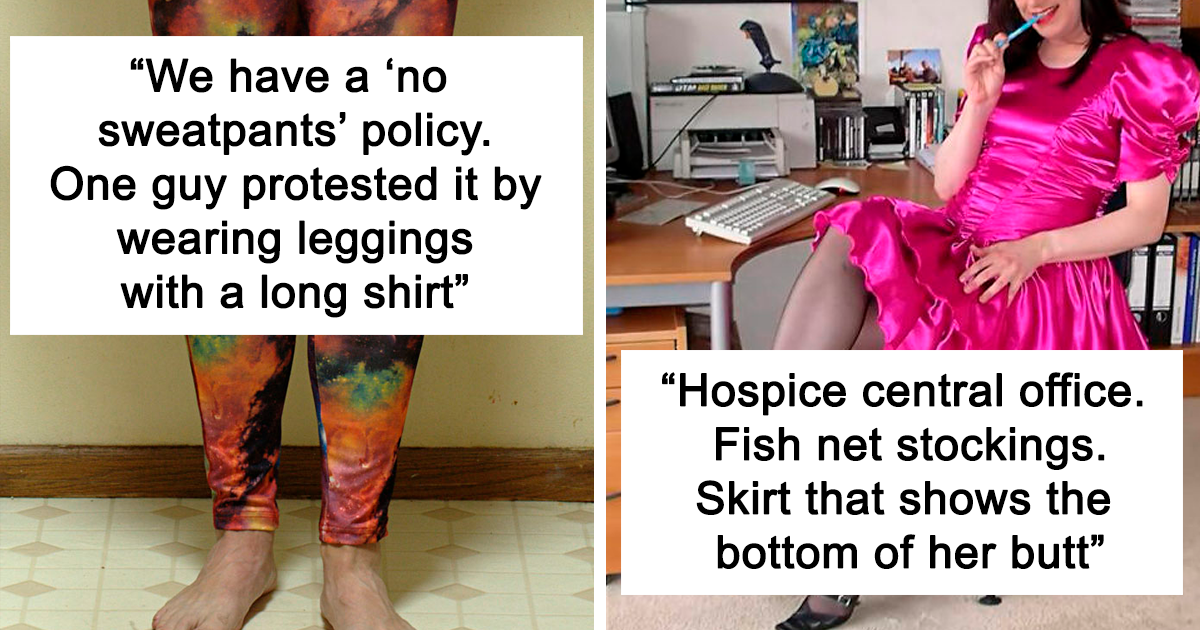
Leggings can be acceptable in some casual workplaces when paired thoughtfully. The problem starts when thin fabric becomes unexpectedly transparent under office lighting. Fluorescent bulbs have betrayed many people.
15. The Open-Toe Shoes in a Hazard Zone
In an office, sandals may be fine depending on policy. In warehouses, kitchens, clinics, factories, and labs, footwear can be a safety issue. If falling objects, sharp tools, spills, or equipment are involved, cute shoes lose the argument.
16. The “Laundry Day” Outfit
Wrinkled shirts, stained pants, mismatched socks, and clothes that look rescued from the floor can send the message that the wearer gave up before the coffee kicked in. Clean and neat still matters, even in casual workplaces.
17. The Festival Outfit at the Front Desk
Fringe, glitter, mesh, neon, dramatic accessories, and tiny tops may be fun at a concert. At a reception desk, they can confuse visitors who expected help finding the conference room, not VIP wristbands.
18. The Hat That Would Not Leave
Some companies allow hats. Others ban them, especially in customer-facing or formal environments. Baseball caps, beanies, and novelty hats can look too casual unless the workplace culture clearly supports them.
19. The Outfit With Too Many Logos
Brand-heavy clothing can look loud, especially in professional settings. Worse, logos from competitors or controversial brands may clash with company image. Your shirt should not start a marketing crisis before lunch.
20. The Extreme Heels at a Practical Job
High-fashion shoes can be stunning, but some jobs require standing, walking, lifting, or moving safely. If the footwear makes basic tasks risky, it belongs in a different setting.
21. The Tank Top in a Formal Office
Sleeveless clothing can be polished, but casual tank tops often read too informal in traditional workplaces. The safest version is structured, clean, and layered when needed.
22. The “I Forgot the Dress Code” First-Day Outfit
First days are already stressful. Showing up wildly underdressed makes them unforgettable for the wrong reason. Online advice repeatedly suggests asking about dress code before starting a new job, because guessing can turn into a full-body typo.
23. The Novelty Onesie
Animal onesies, holiday onesies, and cartoon onesies are delightful at home. At work, they tend to suggest either a theme day nobody else knew about or a personal rebellion against buttons.
24. The Too-Tight Professional Outfit
Even traditional office clothes can become inappropriate if they restrict movement, draw constant attention, or do not fit the work environment. Fit matters as much as category.
25. The Extremely Low-Cut Top
Necklines are personal, but workplaces often expect clothing that does not distract from the job. The goal is not to police bodies; it is to keep the focus on work, customers, and professional interaction.
26. The Transparent White Pants Surprise
White clothing can look sharp, but thin fabric plus bright office lighting can create accidental drama. A quick mirror check in natural and indoor light can prevent many “I had no idea” moments.
27. The Overly Casual Remote-Work Hangover
After working from home, some employees struggle to return to office standards. A hoodie may be fine. A blanket wrapped like formalwear is usually not.
28. The Loud Accessory Avalanche
Huge chains, noisy bracelets, flashing accessories, or costume jewelry that clacks across the keyboard can become distracting. Accessories should support the outfit, not announce themselves to accounting.
29. The Outfit That Breaks Uniform Rules
Restaurants, retail stores, airlines, clinics, and hospitality jobs often use uniforms for branding and safety. Ignoring those rules can cause confusion for customers and create unfairness among employees who follow the standard.
30. The “But It’s Designer” Defense
Expensive does not always mean appropriate. A designer outfit can still be too revealing, too casual, too flashy, or too impractical for work. The office does not grade receipts; it evaluates context.
What These Outfit Stories Teach Us About Dress Codes
The funniest workplace outfit stories usually happen when expectations are unclear. “Business casual” can mean different things to different people. For one team, it means chinos, loafers, blouses, polos, cardigans, and clean denim. For another, it means no jeans, no sneakers, no T-shirts, and no visible tattoos. Without specific examples, employees are left to interpret a vague phraseand interpretation is where the chaos puts on sunglasses.
Good dress codes explain the “why.” Closed-toe shoes may be required because of safety hazards. Minimal jewelry may be necessary in food service. Clean uniforms may help customers identify staff. Restrictions on offensive graphics may protect a respectful workplace. When rules connect to legitimate business reasons, they are easier to understand and enforce.
Fairness also matters. A dress code should not punish one gender more than another, target certain body types, or ignore religious and cultural needs. Employers should apply standards consistently, use respectful language, and avoid making personal comments about an employee’s body. The focus should stay on the policy, the role, and the business reason.
How to Avoid Becoming the Outfit Story Everyone Tells Later
If you are unsure what to wear to work, start with the safest version of the dress code and adjust after observing the environment. On a first day, slightly overdressed is usually better than wildly underdressed. Bring a layer. Choose clean shoes. Avoid clothing with offensive text or images. Do the sit-down test, the bright-light test, and the “would I be comfortable meeting a client in this?” test.
For business casual, reliable options include tailored pants, dark jeans if allowed, blouses, button-down shirts, polos, cardigans, simple dresses, loafers, flats, clean sneakers if permitted, and neat sweaters. For more formal workplaces, add blazers, structured dresses, dress shoes, and conservative colors. For creative workplaces, add personality through color, texture, and accessoriesbut keep the outfit functional.
Managers should handle outfit problems with tact. A public comment can humiliate someone and turn a fixable issue into a morale problem. A private, policy-based conversation works better: explain the rule, connect it to the workplace need, and give clear examples for next time. “This violates our closed-toe shoe policy because you work near equipment” is much better than “Your shoes are weird.”
500 Extra Words: Real-Life Lessons From Wild Workplace Outfit Experiences
The biggest lesson from wild workplace outfit stories is that clothing communicates before people speak. That may sound unfair, but it is true. A person can be talented, kind, brilliant, and reliable, yet an outfit that clashes loudly with the workplace can distract from all of that. The outfit becomes the headline, and the work becomes the small print.
Many people learn this the awkward way. A new hire may copy what they wore in college and realize office lighting, office chairs, and office culture are a completely different ecosystem. Someone returning from remote work may forget that “camera-on from the shoulders up” is not the same as walking through the lobby. A worker in a relaxed office may push the boundary little by little until one day the boundary pushes back with a calendar invite from HR.
There is also a confidence trap. Some employees believe that if they feel confident in an outfit, that should be enough. Confidence matters, but workwear also has to cooperate with the job. A confident outfit that makes it hard to bend, walk, sit, lift, greet customers, or focus is not serving the person wearing it. It is creating a side quest.
Another common experience is the “everyone else wears it” defense. This can be valid if a dress code is outdated or unevenly enforced. However, it can also be risky. If coworkers are technically breaking the policy, copying them does not guarantee protection. The better move is to ask for clarification: “Can you give me examples of what business casual means here?” That question is simple, mature, and much less painful than being remembered as the person who wore pool slides to a client presentation.
On the employer side, wild outfit stories often reveal weak policies. If a company only says “dress appropriately,” it should not be shocked when employees define “appropriate” through personal taste, weather, TikTok trends, or whatever was clean that morning. Clear policies with examples help everyone. Even better, policies should be updated as the workplace changes. A dress code written in 1998 may not fit a hybrid design agency in 2026.
The best workplace outfits usually live in the middle: comfortable but polished, expressive but not disruptive, practical but not boring. A person can show personality through color, shoes, jewelry, jackets, patterns, and silhouettes without turning every hallway into a runway emergency. The goal is not to erase individuality. The goal is to make sure style supports credibility instead of wrestling it in the parking lot.
So yes, the internet will always love a jaw-dropping office outfit story. But for real life, the winning formula is simple: know the dress code, understand your role, respect the setting, and keep one emergency blazer nearby. That blazer has saved more reputations than anyone will ever admit.
Conclusion
Wild NSFW work outfits make hilarious online stories because they expose the strange gap between personal style and professional expectations. One person’s “bold fashion moment” can be another person’s “please review section four of the employee handbook.” The best workplaces avoid confusion by writing clear, fair, practical dress codes. The best employees avoid drama by dressing for the job, the audience, and the day ahead.
Fashion should not be boring, but it should be functional. Whether the workplace is formal, casual, creative, or uniform-based, the right outfit helps people focus on your skills instead of wondering if you accidentally walked in from a beach, club, gym, or costume party. In the end, great workwear says, “I know where I am, I know what I’m doing, and yes, I checked the mirror before leaving.”