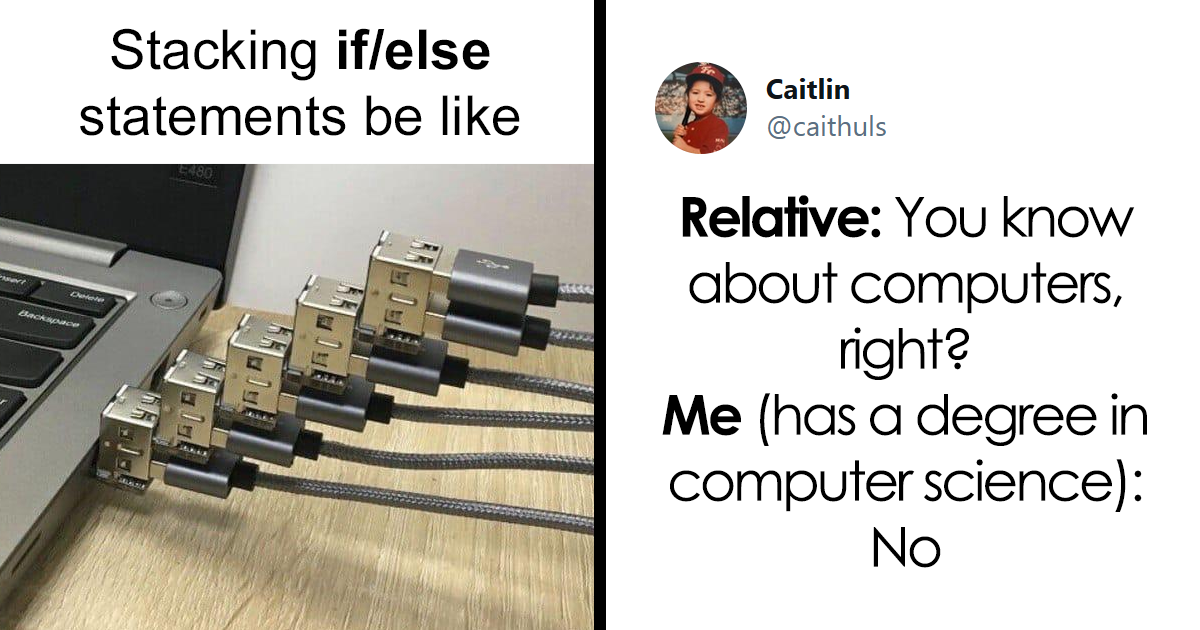
35 Jokes That Programmers Will Definitely Relate To, As Shared In This Online Group

Programmers have a special kind of humor. It is not always loud, obvious, or suitable for explaining to a relative who believes “the Wi-Fi” is a single cloud floating above the neighborhood. Developer jokes tend to live somewhere between logic, caffeine, sleep deprivation, and the mysterious confidence of a person who changes one character in production code at 4:58 p.m.
Across programming communities, coders regularly trade stories about bugs, deadlines, broken builds, impossible feature requests, and the eternal battle between “it should be easy” and “it has been three days.” These jokes are funny because they are painfully familiar. They turn the weird little frustrations of software development into something everyone on the team can laugh about before opening another ticket.
Note: The jokes below are freshly written for this article and inspired by common programmer experiences, rather than copied from any individual post or online group.
Why Programmer Humor Never Runs Out of Material
Programming is one of the few jobs where a missing punctuation mark can create a full-blown crisis, a tiny typo can ruin an afternoon, and a feature described as “just a small change” can quietly become a five-week expedition through old code. Developers work with abstract systems, but the consequences are very real: failed deployments, confused users, red error messages, and messages from coworkers that begin with “Hey, quick question…”
That is why coding jokes work so well. They turn complicated technical concepts into little survival stories. A database query becomes a haunted house. A merge conflict becomes a family argument. A production deployment becomes the moment in a movie when someone says, “What could possibly go wrong?” right before everything catches fire.
35 Programmer Jokes That Hit a Little Too Close to Home
-
1. The “Small Change” Request
Manager: “Can we make one tiny update before launch?”
Developer: “Sure. Should I cancel my weekend now or wait until after the meeting?” -
2. Debugging Confidence
I fixed a bug by staring at the code for 45 minutes.
I still do not know what I changed, but I am now emotionally attached to that line. -
3. The Classic Production Mystery
My code worked perfectly in development.
Production simply has a more dramatic personality. -
4. Documentation Expectations
“Did you read the documentation?”
“Yes. That is why I am even more confused now.” -
5. The Bug Report
User report: “The app is broken.”
Helpful details included: none.
Emotional damage included: extensive. -
6. The Git Merge Conflict
Git said there was a conflict.
Honestly, Git was right. My branch and I were no longer speaking. -
7. The “Works on My Machine” Defense
“It works on my computer.”
“Great. Can your computer join the team and handle customer support?” -
8. The Missing Semicolon
I spent two hours fixing an error caused by one missing semicolon.
Somewhere, a punctuation teacher just felt a disturbance in the force. -
9. The Late-Night Deployment
Deploying on Friday night is like opening an umbrella indoors.
You may not believe in bad luck, but you are certainly inviting a conversation with it. -
10. The Naming Problem
There are only two hard problems in programming: naming things, cache invalidation, and remembering why this old joke has an incorrect number.
-
11. The Empty Commit Message
Commit message: “fix.”
Future developer: “Fix what?”
Past developer: “You will understand when the time is right.” -
12. The Feature Request Avalanche
Client: “Can the button do one more thing?”
Developer: “Absolutely. At this point, it can probably file taxes too.” -
13. The Stack Overflow Ritual
Programmer: “I solved the issue.”
Also programmer: “By finding a 2013 answer written by someone named xXCodeWizardXx.” -
14. The Test That Passes Alone
My unit test passes when I run it by itself.
Put it with the other tests, and suddenly it becomes shy and refuses to participate. -
15. The Database Query
I asked the database for one record.
It returned 600,000 rows and a strong opinion about my indexing strategy. -
16. The Design Mockup Reality Check
Designer: “It should look exactly like the mockup.”
Developer: “Excellent. Does the mockup also come with a working backend, responsive behavior, and a miracle?” -
17. The Infinite Loading Spinner
The loading spinner is not broken.
It is simply taking a moment to reflect on the meaning of existence. -
18. The Legacy Code Introduction
I opened the legacy project and saw a comment that said, “Do not touch this.”
Naturally, I spent the next six hours touching it very carefully. -
19. The Code Review Compliment
Reviewer: “Interesting approach.”
Developer translation: “I have questions, concerns, and possibly a small emergency.” -
20. The Meeting About the Meeting
We scheduled a meeting to discuss whether we needed another meeting.
Agile has entered its final form. -
21. The Password Reset Experience
I built a secure login system.
Then I forgot my own password and became the first user to test it emotionally. -
22. The Comment That Aged Badly
Code comment from 2019: “Temporary workaround.”
Code comment from 2026: “Historic landmark.” -
23. The CSS Mystery
CSS is not difficult.
CSS just enjoys asking, “What exactly do you mean by centered?” -
24. The Browser Compatibility Surprise
The website works beautifully in my browser.
In another browser, it looks like it was designed during a power outage. -
25. The Code Cleanup Plan
I started refactoring to make the code cleaner.
Four hours later, the code is cleaner, but I am not. -
26. The Keyboard Shortcut Problem
I know 47 keyboard shortcuts in my editor.
I still cannot remember where I put my coffee. -
27. The API Error
The API returned a 500 error.
That is developer language for, “Something happened, and nobody wants to talk about it.” -
28. The Sprint Planning Prediction
“This task should take about two hours.”
Narrator: “It did not take two hours.” -
29. The Commented-Out Code Museum
I found 80 lines of commented-out code in the repository.
Nobody knows why it is there, but removing it feels disrespectful to history. -
30. The Junior Developer Question
Junior developer: “Why does this function have six parameters?”
Senior developer: “Because it started with one.” -
31. The Coffee Dependency
I do not drink coffee because I am tired.
I drink coffee because my code has opinions before 9 a.m. -
32. The Unreadable Variable
Variable name:
x2FinalNewUpdatedReallyFinal.
It tells you everything you need to know and nothing you want to know. -
33. The “Quick Fix” That Escaped
I added one quick fix last month.
It now has dependencies, documentation, and a calendar invite. -
34. The Build Failure
The build failed because of an unknown error.
Even the computer has decided it needs personal space. -
35. The Programmer’s Vacation
Programmer on vacation: “I will not check work messages.”
Also programmer, 14 minutes later: “Just making sure the deployment survived.”
What These Programming Jokes Reveal About Developer Life
The best programmer jokes are not really about syntax, programming languages, or complicated computer science theory. They are about uncertainty. A programmer can write clean code, follow best practices, review every pull request, test an application carefully, and still wake up to an error report caused by something nobody predicted.
That uncertainty creates a shared language among developers. A joke about a merge conflict is funny because nearly every programmer has experienced the moment when two perfectly reasonable code changes collide and create a file that looks like a robot argument. A joke about debugging is funny because developers know the strange mix of logic and luck involved in finding the one incorrect character hiding inside thousands of lines of code.
Programmer humor also helps teams stay human. Software development can involve deadlines, technical debt, unclear requirements, changing priorities, and pressure to ship products quickly. Laughing at the chaos does not solve every problem, but it can make the difficult moments feel less isolating. It reminds developers that the bug was not created to personally ruin their day. Probably.
Why Developers Love Jokes About Bugs, Git, and Deadlines
Bugs Feel Personal
A bug is rarely just a bug. It may be an hour of confusion, a missed lunch, a suspiciously quiet deployment channel, and a long trail of console logs. When a developer says, “I fixed it,” they may mean they have restored order to a tiny digital universe that was behaving like a haunted vending machine.
Git Can Be Both Helpful and Humbling
Version control tools make collaboration possible, but they also create memorable drama. Branches multiply. Merge conflicts appear. Someone accidentally commits a file they definitely should not have committed. Git protects developers from many mistakes, then politely records every mistake for future archaeology.
Deadlines Make Everything Funnier
A deadline changes the emotional temperature of a coding task. A feature that seemed interesting on Monday can feel like a quest from an ancient prophecy by Thursday afternoon. The closer launch day gets, the more likely developers are to communicate in screenshots, reaction GIFs, and unusually specific messages about server logs.
500 More Words of Programmer Experiences Everyone Recognizes
There is a particular type of programming experience that is difficult to explain to people outside the field. You can spend an entire morning making almost no visible progress, yet still solve a major problem. You might begin with an error message that seems unrelated to your work, follow three misleading clues, discover a configuration file nobody remembers creating, and finally fix the issue by changing one setting. To anyone watching from the outside, it can look like nothing happened. To the programmer, it feels like escaping a maze designed by a mischievous computer.
Another universal experience is reading code you wrote months ago. At first, you assume the previous developer made some unusual choices. Then you recognize your own variable names, your own formatting habits, and your own comments. Suddenly, you are not reviewing someone else’s questionable decisions. You are reviewing your past self, who apparently believed tempFinal2 was a meaningful name and that “I will clean this up later” was a legally binding plan.
Programmers also understand the emotional roller coaster of a bug that disappears when someone else looks at it. You can reproduce the problem ten times in a row. You can gather screenshots, logs, timestamps, and a carefully written explanation. Then the moment a teammate joins the call, the application behaves perfectly. The bug has not been fixed. It has simply decided to protect its reputation by pretending it never existed.
Then there is the joy of finally understanding an unfamiliar system. At the beginning, a large codebase can feel like walking into a library where every book is written in a different language and half the shelves are on fire. After a few weeks, patterns begin to emerge. You learn where the important files live, which service controls what, which folder must not be touched without a backup, and which teammate knows the answer before you finish asking the question.
Programmers also bond over the difference between a task description and the actual task. A ticket might say, “Add a new field to the form.” In practice, that can mean changing the database schema, updating validation rules, adjusting the API, redesigning a mobile layout, rewriting tests, refreshing documentation, and explaining to someone why adding one field affects six systems. The joke is not that developers dislike simple requests. The joke is that “simple” is often a word people use before discovering the hidden basement.
And still, despite the bugs, the alerts, the merge conflicts, and the suspiciously timed production failures, programming remains deeply satisfying. Few things compare to building something that did not exist before, solving a difficult problem, or watching a feature finally work after hours of effort. The jokes are part of that culture. They are small reminders that developers are not just writing code. They are navigating puzzles, collaborating under pressure, and occasionally arguing with a computer until it agrees to behave.
Final Thoughts
Programmer jokes work because they are built from real moments: the failed builds, the confusing error messages, the “quick” changes that become major projects, and the mysterious code nobody wants to delete. Whether you are a professional developer, a student learning your first language, or someone who has ever tried to center a button with CSS, these jokes probably feel familiar for a reason.
At the end of the day, humor is one of the best debugging tools a developer can have. It will not fix a broken deployment or resolve a merge conflict, but it can make the journey through those problems much more bearable. And sometimes, after a long day of coding, that is exactly enough.