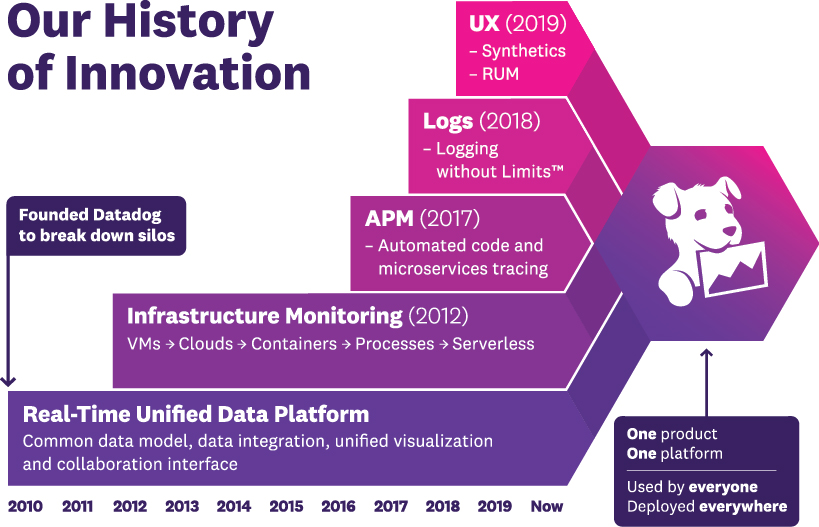

Datadog is one of those SaaS companies that makes founders quietly stare into the distance and whisper, “So that’s what great execution looks like.” The company started with infrastructure monitoring, then expanded into logs, APM, user experience monitoring, network performance, security, and a growing cloud observability platform. By the time Datadog passed roughly $700 million in annual recurring revenue, it was not just another cloud software success story. It was a masterclass in product-led growth, enterprise expansion, and turning technical complexity into a very large, very sticky business.
The most fascinating part is not simply that Datadog grew fast. Plenty of SaaS companies grow fast for a season, especially when the market is hot and every investor is carrying a pitch deck and a reusable water bottle. What makes Datadog special is how it grew: with a developer-friendly entry point, a powerful usage-based model, a widening product suite, and a customer base that kept expanding over time.
Below are five interesting learnings from Datadog at $700,000,000+ ARR, rewritten with practical analysis for SaaS founders, marketers, operators, and anyone trying to understand how a cloud monitoring company became a category-defining platform.
Learning 1: Big Customers Drove the Majority of Revenue
One of the clearest lessons from Datadog is that a company can start with a low-friction, developer-friendly product and still become a serious enterprise revenue machine. Datadog has long offered accessible ways for teams to try the platform, but its revenue engine became heavily powered by larger customers.
At the $700 million+ ARR stage, customers spending $100,000 or more annually represented only a small percentage of the total customer base, yet they generated the majority of revenue. That is a very important SaaS pattern. Datadog did not have to choose between “bottom-up” adoption and enterprise expansion. It used one to feed the other.
Why this matters for SaaS growth
Many software companies misunderstand product-led growth. They assume it means staying small, cheap, and self-serve forever. Datadog proves the opposite. A great product-led motion can create trust inside engineering teams, then expand into larger commercial relationships once the product becomes mission-critical.
For a monitoring platform, this makes perfect sense. A small team may begin by tracking a few services. Then the company moves more workloads to the cloud. Then the engineering organization grows. Then incidents become more expensive. Suddenly, the tool that started as a practical dashboard becomes a central part of how the business keeps systems alive. At that point, Datadog is no longer “nice to have.” It is closer to the smoke detector, the security camera, and the emergency room all rolled into one.
The key takeaway is simple: make adoption easy, but build a product valuable enough that large customers can grow into large contracts. The entry point should feel simple. The ceiling should feel almost unlimited.
Learning 2: Multi-Product Adoption Was the Real Growth Multiplier
Datadog’s growth was not only about adding more customers. It was also about getting existing customers to use more products. At the $700 million+ ARR stage, a large share of customers already used two or more Datadog products, and a meaningful group used four or more. This matters because multi-product adoption changes the economics of a SaaS company.
When a customer uses only one product, the relationship is useful but vulnerable. Another vendor can undercut pricing. A new tool can appear. A budget owner can ask, “Do we really need this?” But when the customer uses infrastructure monitoring, logs, APM, network monitoring, and security workflows together, the platform becomes deeply embedded in daily operations.
The platform advantage
Datadog’s expansion shows the power of a platform strategy done correctly. The company did not simply bolt random features onto the product and call it innovation. It expanded into adjacent problems that the same technical teams already cared about. Infrastructure monitoring led naturally to application performance monitoring. APM connected naturally with logs. Logs connected with security signals. User experience monitoring connected with performance and incident response.
That is how a product suite becomes more than a menu. It becomes a connected operating system for technical teams. The more products customers use, the more context they get in one place. The more context they get, the harder it becomes to go back to a pile of disconnected tools.
For founders, the lesson is not “launch ten products immediately.” Please do not do that unless your roadmap enjoys chaos for breakfast. The real lesson is to expand from a strong core into adjacent use cases where your data, workflow, and buyer trust already give you an advantage.
Learning 3: Net Revenue Retention Was a Growth Superpower
Datadog’s net revenue retention has been one of the most impressive parts of its business model. High net revenue retention means existing customers spend more over time after accounting for downgrades and churn. In plain English: customers do not just stay; they grow.
This is the dream in SaaS. New customer acquisition is expensive. Sales teams cost money. Marketing campaigns cost money. Conferences cost enough to make a finance team blink twice. But when existing customers expand naturally, growth becomes more efficient.
Usage-based pricing and natural expansion
Datadog benefits from a powerful expansion mechanism: as customers run more cloud workloads, generate more logs, monitor more services, and adopt more products, their usage can grow. The customer’s success and the vendor’s revenue become connected.
That can be a wonderful model when customers see clear value. It can also become dangerous if pricing feels surprising or confusing. Datadog’s success suggests the company managed to create enough value that expanded usage was often accepted as a fair trade. In other words, customers were not simply paying more because a contract forced them to. They were paying more because their environments became more complex and Datadog helped them manage that complexity.
The bigger lesson is that retention is not a customer success department metric. It is a company-wide outcome. Product quality, onboarding, pricing, support, integrations, documentation, and sales expectations all shape retention. If any of those break, net revenue retention starts coughing like an old lawn mower.
Learning 4: Datadog Balanced Self-Service, Inside Sales, and Enterprise Sales
Another interesting learning from Datadog is its go-to-market balance. The company did not rely on only one sales motion. It combined a self-service tier, high-velocity sales, and enterprise selling. That mix helped Datadog serve small teams, fast-growing startups, mid-market companies, and large enterprises without forcing everyone through the same buying process.
This is harder than it sounds. A self-service product must be easy enough for users to adopt without a long sales cycle. An enterprise product must be secure, reliable, flexible, and supported enough for large organizations. A high-velocity inside sales motion must move quickly without feeling pushy. An enterprise sales motion must handle complex procurement without turning every deal into a twelve-act opera.
Why the hybrid model worked
Datadog’s product category gave it a strong advantage. Developers and operations teams could feel the value quickly. If a dashboard helped them understand an outage, the product did not need a 90-slide presentation with stock photos of people pointing at glass walls. The value was visible.
At the same time, monitoring and observability become more strategic as organizations grow. Large companies need governance, security, support, billing flexibility, and broader account management. Datadog’s go-to-market model allowed it to meet customers where they were, then expand as those customers matured.
For SaaS companies, this is a practical reminder: do not let your sales motion fight your product motion. If users want to try before talking to sales, let them. If large accounts need guidance, give it to them. Growth often comes from designing a buying journey that matches customer behavior instead of forcing customers through your favorite funnel diagram.
Learning 5: The Market Was Big, But Execution Made It Real
Datadog benefited from major market trends: cloud migration, microservices, containerization, DevOps, distributed systems, security needs, and now AI-driven infrastructure complexity. But a big market alone does not create a great company. A big market is just a large room. Execution is what keeps you from wandering around in it holding a brochure.
Datadog executed by building for technical users, expanding its product surface, investing in integrations, and becoming more useful as customer environments became more complex. The company positioned itself at the intersection of several urgent questions: Is our infrastructure healthy? Why is the application slow? Where did the error start? Are users affected? Is there a security issue? What changed?
The power of becoming the system of record for operations
When a product becomes the place teams go during stressful moments, it gains unusual importance. Nobody wants to debug a production incident while switching between twelve dashboards, three log tools, a chat thread, and one spreadsheet named “final_final_real_incidents_v7.” Datadog’s promise was to bring more of that context together.
That positioning helped Datadog become more than a tool. It became a workflow hub for engineering, operations, and security teams. The more urgent the problem, the more valuable unified visibility becomes.
For SaaS builders, the lesson is that great markets reward clarity. Datadog did not simply sell “data.” It sold faster troubleshooting, better uptime, smoother cloud operations, and more confidence for teams responsible for complex systems. That is much easier to understand than a vague promise to “unlock digital transformation,” which usually sounds like someone spilled consulting jargon into a blender.
What SaaS Companies Can Learn from Datadog’s $700M+ ARR Playbook
Datadog’s journey offers a practical playbook for SaaS companies at many stages. First, start with a painful problem that users feel often. Monitoring is not theoretical. When systems fail, teams need answers immediately. Second, make the product easy to adopt, especially for the users who experience the pain directly. Third, build expansion into the product through additional use cases, usage growth, and deeper workflow value.
Fourth, do not treat enterprise revenue as the opposite of product-led growth. Datadog shows that bottom-up adoption can create credibility for top-down expansion. Fifth, keep improving the platform. The cloud does not stand still, and neither can a company serving cloud teams.
Datadog also shows that category leadership is often built through compounding advantages. More customers create more feedback. More feedback improves products. More products create more expansion. More expansion improves retention. Better retention supports more investment. More investment strengthens the platform. Around and around it goes, like a SaaS flywheel wearing a very expensive smartwatch.
Common Mistakes Companies Make When Trying to Copy Datadog
The biggest mistake is copying the visible tactics without understanding the underlying system. A company may see Datadog’s multi-product success and decide to launch a pile of products before the first one is truly loved. That usually creates confusion, not growth. A platform strategy only works when the core product has trust, usage, and a clear reason for adjacent expansion.
Another mistake is assuming usage-based pricing automatically creates expansion. It does not. Usage-based pricing works when customers clearly understand value and can predict costs well enough to trust the relationship. If usage grows but customer value does not feel equally obvious, expansion becomes resentment with an invoice attached.
A third mistake is ignoring the operational discipline behind enterprise growth. Large customers need security, reliability, compliance, procurement support, documentation, and responsive account management. You cannot simply add an “Enterprise” button to the pricing page and wait for Fortune 500 companies to arrive with gift baskets.
Extra Experience: Practical Lessons from Applying Datadog-Style Thinking
One of the most useful experiences related to Datadog’s growth story is seeing how often software teams underestimate the value of visibility. In many organizations, monitoring begins as an afterthought. A team ships an application, adds a few alerts, creates a dashboard, and assumes everything is fine. Then traffic spikes. A database slows down. A background job fails silently. Customers complain before the internal team notices. Suddenly, observability is not a “technical nice-to-have.” It is the difference between calm problem-solving and a company-wide fire drill with everyone typing in capital letters.
The Datadog lesson applies far beyond infrastructure monitoring. In content marketing, for example, teams need visibility into rankings, clicks, conversions, engagement, and revenue impact. In sales, leaders need visibility into pipeline quality, deal velocity, and expansion potential. In customer success, teams need visibility into product usage, risk signals, and renewal health. The pattern is the same: when complexity grows, guessing becomes expensive.
A practical experience for SaaS operators is to map where customers first feel pain and where that pain expands over time. Datadog’s initial wedge was infrastructure monitoring, but the customer’s real problem was broader: understanding modern cloud systems. That broader problem created room for logs, APM, security monitoring, user experience monitoring, and more. In your own business, the first product may only solve one part of the customer’s workflow. The expansion opportunity sits in the next painful question the customer asks after solving the first one.
Another experience is the importance of trust before expansion. Customers rarely want to buy four products from a vendor they barely trust. They may try one product, test support, evaluate reliability, and see whether the company keeps its promises. If that first experience is strong, expansion becomes natural. If the first experience is weak, every upsell attempt feels like a waiter offering dessert after dropping soup in your lap.
Datadog-style growth also teaches teams to respect the difference between adoption and dependency. Adoption means someone uses your product. Dependency means their workflow becomes meaningfully better because your product is there. The strongest SaaS companies move from adoption to dependency by becoming part of daily operations, decision-making, reporting, and incident response. Once a product is tied to business-critical workflows, retention improves because replacing it creates real operational risk.
Finally, Datadog’s story is a reminder that durable SaaS growth is rarely built on one trick. It is not only pricing, only product, only sales, only brand, or only timing. It is the combination. The product must solve a real problem. The market must be expanding. The go-to-market motion must fit customer behavior. The pricing must scale with value. The platform must keep evolving. And the company must execute quarter after quarter, even when the market changes, budgets tighten, or competitors start waving free trials like carnival tickets.
Conclusion
Datadog at $700,000,000+ ARR is a powerful case study in modern SaaS growth. The company proved that a developer-friendly product can scale into enterprise revenue, that multi-product adoption can dramatically strengthen retention, and that cloud complexity can become a massive business opportunity when solved with clarity and speed.
The five biggest learnings are clear: large customers can drive most of the revenue, multi-product adoption is a growth multiplier, net revenue retention can become a superpower, hybrid go-to-market models can serve multiple customer segments, and execution is what turns a big market into a category leader.
For founders, marketers, and SaaS operators, Datadog’s story is both inspiring and slightly intimidating. It shows what happens when a company finds a painful technical problem, earns trust with users, expands intelligently, and keeps building as the market evolves. In other words, Datadog did not just watch the cloud grow. It built one of the dashboards everyone else used to watch it happen.