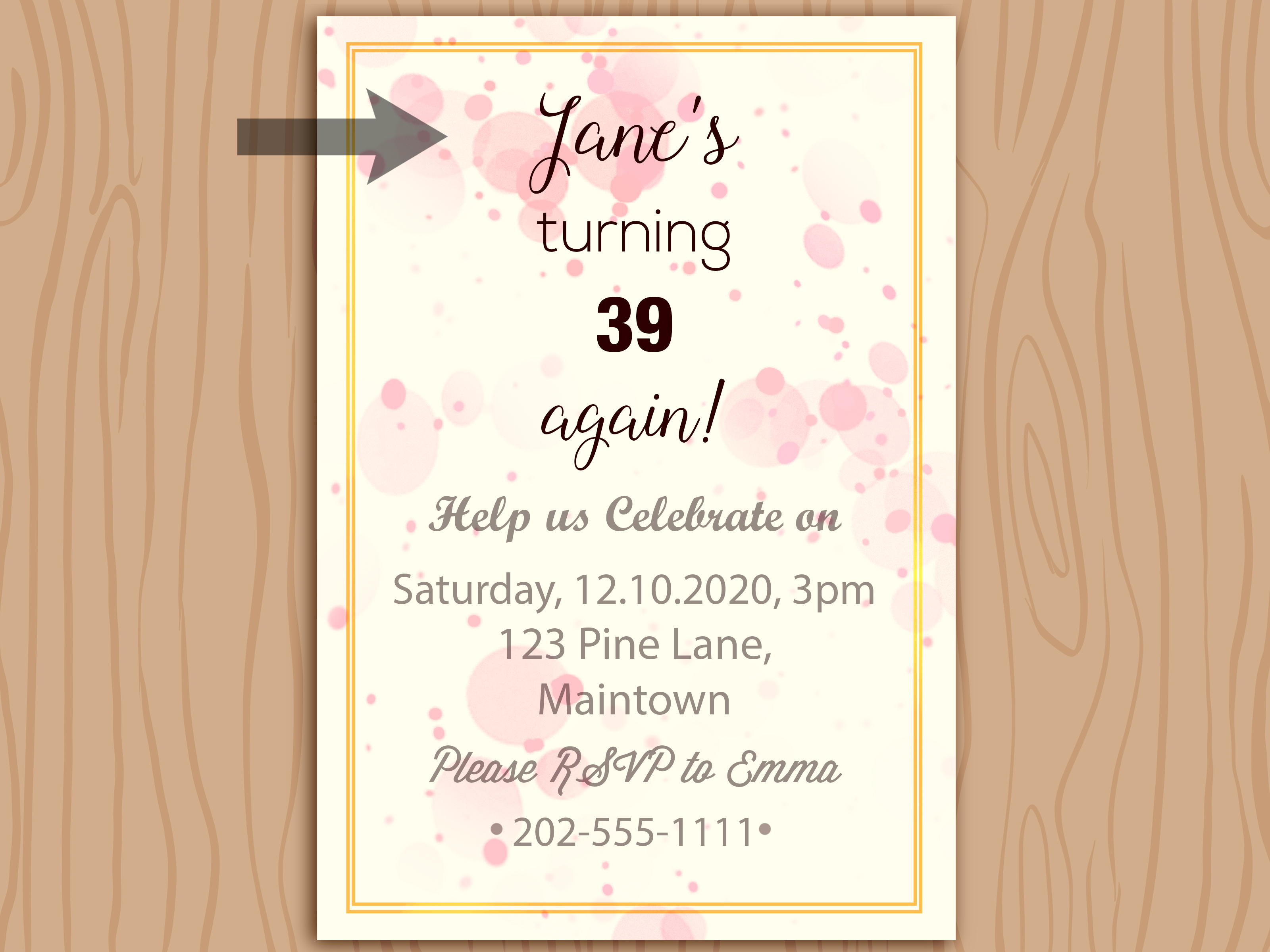

A birthday invitation has one deceptively simple job: tell people where the cake is. Yet somehow, many invitations leave guests wondering whether the party starts at 3:00 p.m. or whether that is merely the suggested time for beginning a scavenger hunt across town.
A well-written birthday invitation should feel cheerful, sound like the host, and answer every practical question before guests need to ask it. Whether you are planning a toddler’s dinosaur party, a teenager’s movie night, a surprise celebration, or a sophisticated milestone dinner, the right wording sets expectations from the beginning.
This guide explains how to write a birthday invitation in 14 clear steps, with wording examples, etiquette tips, and practical lessons that can save you from last-minute texts asking, “Wait, are parents staying?”
What Information Belongs on a Birthday Invitation?
Every effective birthday party invitation should communicate six essentials: who is celebrating, what kind of event is planned, when it will happen, where it will take place, how guests should respond, and whether they need to know anything special.
The design can be elegant, silly, colorful, minimalist, or covered in cartoon sharks. The basic information, however, must remain easy to find. Guests should not have to decode decorative calligraphy like archaeologists studying an ancient cake-related manuscript.
How to Write a Birthday Invitation in 14 Steps
1. Decide What Kind of Birthday Party You Are Hosting
Before writing a single line, define the event. Is it a casual backyard barbecue, a children’s activity party, a formal dinner, a pool party, a surprise gathering, or a virtual celebration?
The format determines the tone and the details guests need. A bowling party invitation should mention shoe arrangements and drop-off instructions. A cocktail party may require dress guidance. A pool party should remind guests to bring swimsuits, towels, and possibly their bravest inflatable flamingo.
Write down the basic plan before choosing invitation wording. This prevents you from creating a beautiful invitation only to realize that you forgot to explain the party involves hiking three miles uphill.
2. Identify the Guest of Honor Clearly
Place the birthday person’s name near the top of the invitation. For a child’s party, include the child’s first name and age when appropriate:
“Mia is turning 7!”
For an adult birthday invitation, you can use a full name, first name, nickname, or playful description:
“Join us as Daniel celebrates the big 4-0.”
If someone else is hosting, make that clear as well. Guests should know whether the invitation comes from the birthday person, a parent, a spouse, or a friend organizing a surprise.
3. Open With an Engaging Invitation Line
The opening line creates the mood. It can be straightforward, warm, funny, or connected to the party theme.
Simple wording works well for nearly any celebration:
“Please join us for Ava’s birthday celebration.”
A more playful party could begin with:
“Cake, confetti, and questionable dance moves are coming your way!”
For a themed children’s party, try wording such as:
“Calling all superheroes! Leo is turning 6 and needs your help saving the birthday cake.”
Creativity is welcome, but clarity should win every argument. A clever rhyme is not helpful if nobody can tell what the event actually is.
4. Match the Wording to the Party’s Tone
The language should reflect the celebration. Use relaxed wording for an informal gathering and polished language for a formal milestone event.
A casual invitation might say:
“Come hang out, eat tacos, and celebrate Jordan’s 30th birthday.”
A formal invitation might read:
“You are cordially invited to an evening celebrating the 70th birthday of Margaret Ellis.”
Do not force formal language onto an event involving water balloons. Likewise, an elegant restaurant dinner probably does not need an opening line that says, “Let’s get wild, party animals,” unless Margaret specifically requested chaos.
5. State the Date Without Ambiguity
Include the day of the week, full date, and year when necessary:
Saturday, October 17, 2026
Writing both the weekday and date helps guests catch scheduling mistakes. Avoid numerical date formats such as “10/11,” which can be misread and may send someone to your door a month early carrying a wrapped board game.
For digital invitations, verify that the platform’s automatically generated calendar date matches the date printed in the design.
6. Provide a Clear Start and End Time
Give the exact starting time and include an ending time when it helps guests plan. End times are especially useful for children’s parties, drop-off events, venue rentals, and structured activities.
For example:
2:00–4:30 p.m.
If the party begins with a scheduled activity, explain when guests should arrive:
“Please arrive by 1:45 p.m.; the movie begins at 2:00 p.m.”
Use “noon” or “midnight” instead of 12:00 when possible. Those words eliminate the classic 12:00 a.m. versus 12:00 p.m. debate, a conflict responsible for more confusion than most birthday cakes deserve.
7. Write the Complete Location
List the venue name and full street address. Do not assume every guest knows where “our usual park” is.
A complete location might look like this:
Riverbend Community Center
245 Oak Street
Austin, TX 78704
If the venue is difficult to find, add a short direction such as “Enter through the west lobby” or “The party room is behind the main bowling desk.” For a home celebration, parking instructions can prevent your neighbors from becoming unwilling participants.
Digital invitations may include a map link, but the written address should still appear clearly in the invitation.
8. Explain the Theme or Main Activity
A theme gives guests a preview of the experience and helps them prepare. Mention costume requests, planned activities, or special equipment.
Examples include:
“Wear your favorite pajamas for a movie-night celebration.”
“Bring a swimsuit and towel for an afternoon by the pool.”
“Western attire is encouraged but not required.”
Avoid making optional participation sound mandatory. If costumes are welcome but not expected, say so. Guests should not feel they need to purchase a pirate outfit merely to qualify for cupcakes.
9. Clarify Who Is Invited
This step is particularly important for children’s birthday invitations. State whether parents should stay, whether the event is drop-off, and whether siblings are included.
You can write:
“Parents are welcome to stay and enjoy refreshments.”
“This is a drop-off party; pickup is at 4:30 p.m.”
“Due to limited space, we can accommodate invited children only.”
Addressing the invitation to the specific invited person also reduces confusion. If the entire family is welcome, use wording such as “The Nguyen Family.” If only one child is invited, use that child’s name.
For classroom invitations, follow the school’s distribution policy. When only some classmates are invited, private delivery usually avoids unnecessary embarrassment and playground-level diplomatic incidents.
10. Include Food and Refreshment Information
Guests often need to know whether a meal will be served. A party at 6:00 p.m. creates very different expectations from one at 2:00 p.m.
Useful phrases include:
“Dinner and birthday cake will be served.”
“Join us for appetizers, drinks, and dessert.”
“Pizza and cake will be provided for the children.”
If you are collecting dietary information, include a brief request with the RSVP instructions. Do not promise that every environment is completely allergen-free unless you can genuinely guarantee it.
11. Add Gift Guidance When Necessary
Gift information is optional. When the guest of honor prefers no presents, use warm, pressure-free wording:
“Your presence is the only present we need.”
“No gifts, pleasejust come celebrate with us.”
If the party supports a charity, explain the request simply:
“In place of gifts, guests may bring an unopened children’s book for the neighborhood literacy drive.”
Avoid wording that sounds like an admission fee. A birthday invitation should invite people to celebrate, not make them feel they have accidentally opened an invoice.
12. Write Precise RSVP Instructions
Tell guests exactly how, when, and to whom they should respond. Include an RSVP deadline, contact name, and preferred response method.
For example:
“Please RSVP to Rachel by September 28 at 555-0148.”
For an online invitation, guests may respond through the event page, but including a backup phone number or email address can help anyone who has technical trouble.
Choose a deadline that gives you enough time to confirm catering, party favors, activity reservations, and seating. If responses are missing after the deadline, a polite follow-up is appropriate. Reliable RSVP instructions are among the most frequently emphasized elements in modern invitation guidance.
13. Add Special Instructions
Include only the extra information guests genuinely need. Depending on the event, this might cover:
- Dress code or costume suggestions
- Parking or building-entry instructions
- Items guests should bring
- Age or height requirements for activities
- Waivers required by the venue
- Weather backup plans
- Accessibility information
- Whether the party is a surprise
For a surprise birthday invitation, make the secrecy request impossible to miss:
“Shh! This is a surprise. Please arrive by 6:30 p.m. and do not contact the guest of honor about the party.”
Place critical instructions in visible text rather than hiding them beneath a decorative graphic or several paragraphs about the meaning of birthdays.
14. Proofread Before Sending
Read the invitation slowly and verify every detail against your reservation, calendar, and contact information. Check the spelling of the guest of honor’s name, venue address, date, start time, RSVP deadline, and phone number.
Ask another person to review it. The host often sees what the invitation is supposed to say rather than what it actually says.
For printed invitations, order or print one sample first. For digital invitations, send a test to yourself and open it on both a phone and a computer. Confirm that the text is readable, links work, maps point to the right location, and no essential sentence disappears behind a giant illustrated balloon.
Complete Birthday Invitation Wording Examples
Children’s Birthday Party Invitation
Calling All Space Explorers!
Noah is turning 8, and we are launching an out-of-this-world celebration.
Saturday, November 14, 2026
1:00–3:30 p.m.
Galaxy Fun Center
3100 North Main Street, Phoenix, AZ
Pizza, cake, and arcade games will be provided.
This is a drop-off party. Please RSVP to Kim by November 5 at 555-0182.
Casual Adult Birthday Invitation
Good Food, Cold Drinks, Another Candle
Join us for an evening celebrating Marcus’s 35th birthday.
Friday, September 18, 2026
7:00 p.m.
The Garden Room
88 Willow Avenue, Denver, CO
Dinner and drinks will be served. Casual attire.
Please RSVP by September 10.
Formal Milestone Birthday Invitation
You Are Cordially Invited
Please join the Carter family for an evening honoring
Eleanor Carter on her 80th birthday.
Saturday, December 5, 2026
Reception at 6:00 p.m.
Dinner at 7:00 p.m.
The Grandview Hotel
1200 Lakeshore Drive, Chicago, IL
Cocktail attire requested.
Kindly reply by November 15.
Surprise Birthday Invitation
Keep It SecretSofia Is Turning 50!
Help us surprise Sofia with dinner, music, and the impressive acting skills required to pretend nothing is happening.
Saturday, August 29, 2026
Guests must arrive by 5:45 p.m.
Sofia arrives at 6:15 p.m.
Harbor House Restaurant
42 Marina Boulevard, San Diego, CA
Please RSVP to Elena by August 15.
Do not mention the celebration to Sofia.
Common Birthday Invitation Mistakes
One of the most common mistakes is prioritizing clever wording over essential information. “Let’s party under the stars” sounds charming, but guests still need a date, address, and start time.
Another mistake is assuming that expectations are obvious. Parents may not know whether siblings can attend. Adult guests may not know whether dinner is included. Nobody automatically knows that your backyard becomes muddy after light rain or that the restaurant requires validated parking.
Other problems include setting no RSVP deadline, using an incorrect map location, choosing unreadable fonts, sending the invitation too late, and forgetting to identify a surprise party. Successful invitations balance personality with practical detail, a principle consistently reflected across stationery, etiquette, design, and digital invitation resources.
Practical Experiences: What Hosts Learn After Sending Invitations
The most useful birthday invitation lessons usually appear five minutes after the invitations have been sent. That is when the first guest replies with a question you thought the invitation had answered perfectly.
Consider a common children’s party scenario. A parent writes, “Come celebrate Lily’s birthday at the trampoline park from 2:00 to 4:00.” The invitation looks cheerful and includes the address. Within an hour, the messages begin: Are parents staying? Are siblings allowed? Do children need special socks? Is the waiver completed online? Will food be served?
The host did not write a bad invitation. The host simply wrote from the perspective of someone who already knew the plan. Guests read from the perspective of people who know nothing except that trampolines are involved.
A better version adds three short lines: “This is a drop-off party for invited children. Grip socks and pizza are provided. Please complete the venue waiver before arrival.” Those sentences may not be poetic, but they prevent twelve separate text conversations.
Adult celebrations create similar surprises. Imagine planning a 40th birthday dinner at a restaurant and writing only the venue and starting time. Some guests may assume the host is paying for dinner. Others may expect to purchase their own meals. A tactful invitation should remove that uncertainty. Depending on the arrangement, it can say, “Dinner will be hosted,” “Join us for drinks and appetizers,” or “Guests may order individually from the restaurant menu.” Clear wording is kinder than letting everyone perform mental arithmetic when the check arrives.
RSVP deadlines also teach memorable lessons. Without a deadline, guests often intend to reply “later,” a magical period that sometimes lasts until the morning of the party. A specific date turns an open-ended request into a manageable task. Adding the reason can help: “Please RSVP by May 6 so we can confirm the activity reservation.”
Surprise parties offer perhaps the greatest invitation-writing challenge. The word “SURPRISE” should appear prominently, not in tiny text near the bottom. Guests should receive an arrival time earlier than the guest of honor’s arrival. They also need a warning not to post publicly, tag the birthday person, or casually ask, “What are you wearing Saturday night?”
Another practical lesson is to test digital invitations. A design that looks spacious on a laptop may turn into microscopic text on a phone. Long paragraphs may be cut off, decorative fonts may become difficult to read, and map links may select the wrong branch of a restaurant. Sending a test invitation to yourself catches these problems before your guests arrive at a similarly named venue across town.
Finally, experienced hosts learn that perfection is unnecessary. Guests do not expect award-winning literature. They want to know what is happening, when to arrive, where to go, what to bring, and how to respond. Add warmth, humor, and personality after those questions are answered. The best birthday invitation is not the one with the fanciest rhyme. It is the one that makes attending feel easy.
Conclusion
Learning how to write a birthday invitation is mostly an exercise in thoughtful communication. Begin with the essential event details, match the wording to the celebration, and anticipate the questions your guests are likely to ask. Then add a little personality so the invitation feels like the beginning of the party rather than a calendar notification wearing a paper hat.
Whether you choose a printed card, email, text invitation, or online event page, keep the message readable and complete. A clear invitation helps guests respond promptly, arrive prepared, and focus on what really matters: celebrating the guest of honor and determining who gets the corner piece of cake.