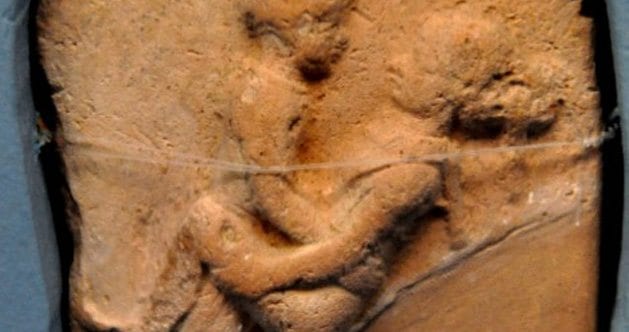

Ancient Babylon is often introduced with a greatest-hits playlist: the Ishtar Gate, the Tower of Babel, the Hanging Gardens, and one extremely ambitious king named Nebuchadnezzar II. Yet the real city was more interesting than its legends. Babylon was not merely a backdrop for kings, gods, and dramatic biblical speeches. It was a crowded urban center where craftspeople repaired jewelry, merchants authenticated transactions, students wrestled with mathematics, families gathered in courtyard houses, and priests organized festivals with the precision of modern event planners.
Archaeology has transformed Babylon from a symbol into a place inhabited by recognizable human beings. Monumental foundations reveal royal power and urban planning, while clay tablets, seals, maps, bricks, and household remains expose the quieter rhythms of work, religion, education, trade, and family life. Some objects discussed below were excavated within Babylon itself; others come from the broader Babylonian world and help historians interpret how people in the capital likely lived. Together, they provide a more balanced picture than ancient legends alone.
Why Babylonian Archaeological Remains Matter
Babylon stood beside the Euphrates River in what is now Iraq. It rose to political prominence under Hammurabi in the eighteenth century BCE and reached another spectacular peak as the capital of the Neo-Babylonian Empire between 626 and 539 BCE. At that later height, its palaces, temples, defensive works, gates, and ceremonial streets advertised the power of the monarchy while supporting an enormous religious and administrative system.
However, archaeologists have excavated only part of the ancient city. UNESCO reports that approximately 85 percent of the protected archaeological property remains unexcavated. In other words, Babylon is still keeping most of its receipts in the drawer. What has been uncovered is enough to demonstrate sophisticated urban design, monumental architecture, scientific learning, and a society organized through written records.
10 Remains and Artifacts That Bring Ancient Babylon to Life
1. The Ishtar Gate and Its Glazed-Brick Creatures
The Ishtar Gate was more than an attractive city entrance. Constructed under Nebuchadnezzar II during the sixth century BCE, it formed part of a carefully planned ceremonial landscape. Its molded and glazed bricks displayed bulls and dragonlike mušḫuššu creatures associated with powerful deities, including Adad and Babylon’s patron god, Marduk.
The gate reveals the technical skill of Babylonian builders. Southern Mesopotamia lacked abundant building stone, so architects transformed clay into durable baked bricks and covered them with intensely colored glazes. The result combined engineering, theology, and royal messaging. Anyone entering through this gateway understood that Babylon was protected by more than guards. The gods themselves appeared to be on security dutyand they did not look interested in checking visitor badges politely.
2. The Processional Way and Its Striding Lions
Running through the Ishtar Gate, the Processional Way was one of Babylon’s most important streets. Sections were decorated with repeated images of lions, the animal associated with Ishtar, goddess of love and war. The lions were not random decoration. They created a visual rhythm that guided people along the ceremonial route while symbolically protecting it.
During the spring New Year festival, statues of gods traveled along this route as part of rituals connecting the king, the divine world, and the city’s population. The roadway therefore reveals how religion occupied public space. Babylonian worship was not confined to a quiet temple room. It moved through the streets with crowds, music, officials, divine statues, and enough ceremony to make a modern parade organizer reach nervously for a clipboard.
3. The Inner and Outer City Walls
The surviving lines of Babylon’s fortifications reveal a city deeply concerned with defense, movement, and royal prestige. Walls and gates controlled access, protected important districts, and established a clear boundary between the ordered city and the landscape beyond it. Their construction required enormous quantities of mud brick, baked brick, labor, food supplies, and administrative coordination.
These defenses also tell us something about social organization. Workers had to manufacture bricks, transport materials, maintain canals, build embankments, and repair weather damage. Supervisors had to distribute rations and record deliveries. Monumental walls were therefore not simply military objects. They were the visible outcome of taxation, labor management, skilled craftsmanship, and royal authority. Even a defensive wall has an office story hidden inside italthough Babylon’s office memos were written in wet clay.
4. The Foundations of Nebuchadnezzar’s Palace Complex
Babylon’s palatial remains expose the physical distance between royal life and ordinary urban existence. Nebuchadnezzar II rebuilt large portions of the city and created vast palace complexes containing courtyards, halls, storage areas, administrative rooms, service spaces, and ceremonial zones. These were not oversized private homes. They were governmental machines made of brick.
The arrangement of rooms helped control who could approach the king and how visitors experienced royal power. A person might pass through gates and courtyards before reaching more restricted spaces, with architecture steadily increasing the sense of authority. Meanwhile, storerooms and service rooms remind us that palace splendor depended on cooks, guards, scribes, cleaners, craftspeople, messengers, and warehouse managers. Someone had to polish the magnificence, count the grain, and locate the missing ceremonial cup.
5. Esagila, the Great Temple of Marduk
Esagila was the principal sanctuary of Marduk and one of Babylon’s most important religious institutions. Archaeological traces and written records show that the temple stood at the center of a ritual system that shaped the city’s identity. During the New Year festival, Marduk’s statue played a central role in ceremonies that renewed the relationship among the god, the king, and the community.
Temples were also economic institutions. They held property, employed workers, received offerings, managed workshops, stored commodities, and maintained detailed accounts. Comparable Neo-Babylonian temple archives record textile workers, metalworkers, jewelry, livestock, grain, and repair assignments. These records reveal that devotion involved much more than prayer. It also required inventory control. Apparently, even a goddess’s gold jewelry could end up in a repair box with a dated administrative note.
6. The Remains of Etemenanki, Babylon’s Great Ziggurat
Near Esagila stood Etemenanki, the monumental ziggurat whose name is commonly translated as the “House of the Foundation of Heaven and Earth.” Its archaeological remains are less visually dramatic than the towering reconstructions seen in books, but the surviving footprint reveals a structure designed on an extraordinary scale. UNESCO identifies it as a probable source behind later traditions about the Tower of Babel.
A ziggurat was not an apartment building, fortress, or convenient ancient observation deck. It was a sacred monument linking the city’s landscape with Babylonian ideas about cosmic order. Building and repeatedly restoring it required engineers, brickmakers, transport workers, scribes, priests, and laborers from across the kingdom. Its foundations therefore reveal both religious ambition and the government’s ability to mobilize people and resources for projects that could outlast several reignsand probably several budget meetings.
7. Private Houses in the Merkes Residential Quarter
Palaces explain how kings wanted Babylon to be seen, but houses reveal how residents actually used the city. Excavations in the Merkes district uncovered private homes and portions of a neighborhood surrounding the Temple of Ishtar of Akkad. The remains help researchers reconstruct street patterns, property boundaries, domestic architecture, and the relationship between houses and nearby religious buildings.
Babylonian homes commonly organized rooms around an open courtyard. Such a space admitted light, provided ventilation, and supported cooking, household work, conversation, and family activities. Exterior walls offered privacy from the street, while rooms could be adapted as family circumstances changed. These buildings show that ancient urban life was not entirely foreign. People needed shade, storage, practical circulation, quiet corners, and somewhere to avoid the relative who had been telling the same story since the last New Year festival.
8. Cuneiform Administrative, Legal, and School Tablets
Clay tablets are among the most revealing archaeological remains of Babylonian civilization because they preserve voices that monumental architecture often ignores. Administrative texts record rations, labor, deliveries, loans, property, and temple assets. Legal documents illuminate marriages, inheritances, disputes, sales, leases, and business partnerships. These were the spreadsheets, contracts, school notebooks, and occasionally passive-aggressive correspondence of their day.
School tablets show how scribes learned signs, vocabulary, literature, and mathematics. One Old Babylonian tablet in the Penn Museum contains a dialogue between a supervisor and a student scribe, including criticism and instruction that sound surprisingly familiar to anyone who has ever submitted homework. Collections at Penn, Yale, and other institutions contain thousands of such documents, allowing scholars to reconstruct not only elite politics but also employment, education, craftsmanship, and family obligations.
9. Cylinder Seals and Clay Seal Impressions
Cylinder seals were small carved stones rolled across wet clay to create an identifying image. They could mark ownership, authenticate a transaction, secure a container, or seal a door. In practical terms, a seal functioned like a signature, company stamp, security device, and personal profile picture rolled into one tiny object.
Their imagery also reveals religious beliefs and social identity. Surviving Babylonian seals portray worshipers approaching gods, protective figures, divine symbols, and carefully arranged ceremonial scenes. Some were carved from valuable stones and may have been worn as protective amulets. Clay loan labels and seal impressions record witnesses and participants in transactions, demonstrating that Babylonian commerce depended on recognizable identities and documented accountability. Trust was important, but a properly impressed piece of clay was better.
10. Maps, Mathematical Tables, Astronomical Records, and Protective Texts
Some of the most revealing Babylonian remains fit comfortably in one hand. Clay maps depict canals, fields, roads, villages, and property divisions, showing how water management shaped agriculture and trade. Mathematical tablets preserve multiplication exercises, reciprocal tables, geometric problems, and a base-60 numerical tradition whose influence survives in the 60 minutes of an hour.
Astronomical records document careful observation of planets, eclipses, and recurring celestial patterns. Other tablets and amulets preserve medical recipes, rituals, and incantations intended to protect people during illness, pregnancy, and childbirth. These materials demonstrate that Babylonian knowledge did not always separate science, religion, and magic into modern categories. A scholar might calculate precisely, observe patiently, consult tradition, and still recommend a protective charmessentially covering every possible department.
Experiencing the Archaeological World of Ancient Babylon
Encountering Babylonian remains, whether at the site in Iraq, in a museum gallery, or through a detailed digital collection, can be a strangely intimate experience. Monumental reconstructions often make the first impression. Blue glazed bricks, marching lions, massive walls, and images of the ziggurat encourage visitors to think in terms of kings and empires. The scale is impressive, but scale can also create distance. Babylon begins to feel like a civilization populated entirely by rulers, priests, and mythological dragons.
The experience changes when attention shifts to smaller objects. A clay tablet may be no larger than a modern phone, yet it can preserve a loan, a delivery, a worker’s ration, a school exercise, or the inventory of jewelry sent for repair. Suddenly, ancient Babylon is no longer a theatrical ruin. It is a functioning city full of deadlines, responsibilities, mistakes, and routine paperwork. The handwriting may be cuneiform, but the administrative mood is eternal.
A useful way to experience a Babylonian gallery is to compare three kinds of evidence. First, examine an object connected with public power, such as a glazed brick or royal inscription. Notice how color, repeated symbols, and formal language create authority. Second, study an administrative object, such as a tablet or sealed label. Look for fingerprints, uneven lines, erased signs, and crowded writing. Those imperfections reveal a human hand working under practical conditions. Third, find a domestic or protective objecta figurine, amulet, household vessel, or school text. These pieces often reveal emotions that royal monuments suppress: worry about illness, concern for a child, hope for divine protection, or frustration with a student.
At Babylon itself, visitors must also learn to distinguish ancient remains from modern reconstruction. Some twentieth-century rebuilding was placed directly over archaeological foundations, and UNESCO has noted that certain reconstructed heights and designs were based partly on conjecture. That does not make the site meaningless, but it changes the questions a thoughtful visitor should ask. Which bricks are ancient? Which walls were reconstructed? What evidence guided the restoration? Archaeology becomes more interesting when a ruin is treated as an argument rather than a stage set.
Another rewarding experience is to imagine movement rather than viewing each remain as an isolated object. Follow the Processional Way mentally toward the Ishtar Gate. Picture craftspeople maintaining the glazed surfaces, guards controlling access, vendors working nearby, priests preparing divine statues, and residents gathering for the New Year festival. Then leave the ceremonial district and enter a residential neighborhood. The soundscape changes from official processions to grinding grain, children learning, traders negotiating, animals complaining, and families sharing meals around a courtyard.
Digital museum collections make this kind of exploration possible even without international travel. High-resolution photographs allow viewers to enlarge seal carvings, inspect individual cuneiform wedges, and compare objects from different periods. Keeping simple notes can make the experience more memorable: identify the object’s material, original function, user, and hidden human story. A brick may represent labor. A seal may represent identity. A map may represent control of water. A protective plaque may represent fear mixed with hope.
The most powerful lesson is that Babylon was neither the sinful fantasy of later literature nor a flawless wonderland of blue gates and hanging gardens. It was a complicated city. Its residents worked, worshiped, borrowed, studied, celebrated, argued, planned, became sick, raised families, and worried about the future. Archaeological remains create that connection precisely because they are incomplete. A broken tablet or worn brick invites us to reconstruct the life around itand to recognize that ancient people were not decorative figures in history. They were busy.
Conclusion: Babylon Beyond the Legends
The archaeological remains of ancient Babylon reveal a society that combined monumental ambition with meticulous recordkeeping. The Ishtar Gate and palace foundations demonstrate royal power, while temples and ceremonial roads show how religion shaped public life. Houses expose family space and neighborhood organization. Tablets, maps, mathematical exercises, seals, and amulets bring us closer to workers, students, merchants, parents, and craftspeople.
Babylon’s greatest archaeological achievement may therefore be its ability to shrink the distance between the ancient and modern worlds. Behind the dragons and ziggurats were people trying to earn a living, protect their households, educate their children, keep accurate accounts, and persuade the universe to cooperate. Some things have changed dramatically in 2,500 years. Paperwork, apparently, is immortal.
SEO Information