
The story of the Army sidearm is not just a parade of pistols, revolvers, calibers, and alphabet-soup model numbers. It is the story of how soldiers moved from smoky single-shot flintlocks to modular, optics-ready service pistols built for a digital battlefield. In other words, the Army sidearm went from “please work once” to “please integrate with everything short of a coffee maker.”
For more than two centuries, the U.S. Army pistol has reflected the Army’s bigger problems: mobility, logistics, reliability, close-range defense, ammunition supply, training, and the stubborn reality that a sidearm is rarely the main weapon but often becomes the most personal one. It rides on the hip, sits in a tanker’s cramped compartment, accompanies military police, and serves officers, aviators, medics, and special roles where a rifle is impractical.
This long evolution of the Army sidearm runs through flintlock pistols, percussion locks, cap-and-ball revolvers, metallic cartridges, double-action revolvers, the legendary M1911, the NATO-standard Beretta M9, and today’s SIG Sauer M17 and M18 Modular Handgun System. Each generation solved one problem and created a new argument at the armory counter. That, apparently, is tradition.
From Flintlock Sparks to the First American Military Pistols
The earliest American military sidearms were simple, rugged, and slow. The Model 1775 flintlock pistol, associated with the Revolutionary War era, was a muzzle-loading smoothbore pistol inspired by British designs. It was not a precision instrument. It was more like a short wooden thunderstick with ambition. Loading required powder, ball, priming, patience, and a willingness to accept that weather had a vote.
Still, the flintlock pistol mattered because it gave mounted troops, officers, and certain soldiers a compact defensive weapon. In a time when cavalry and messengers could not conveniently carry long guns in every situation, a pistol had value even if its effective range and rate of fire were modest by modern standards.
The Model 1805 Harpers Ferry Pistol
The Model 1805 Harpers Ferry flintlock pistol marked an important step in American arms production. Manufactured at the U.S. Armory at Harpers Ferry, it became one of the first pistols produced by a national armory. Its existence signaled that the young United States wanted domestic military manufacturing, not endless dependence on foreign patterns, imported parts, or battlefield improvisation.
Like other early pistols, the Model 1805 was still a single-shot muzzle-loader. But it represented standardization: a government-made arm, produced to a pattern, intended for military service. That ideastandardized design, repeatable manufacturing, and predictable supplywould shape every Army sidearm decision that followed.
Percussion Pistols: Less Spark, More Reliability
By the 1840s, percussion ignition began replacing flintlock systems. The U.S. Model 1842 percussion pistol was a .54-caliber smoothbore muzzle-loading pistol and one of the last major single-shot military pistols before revolvers changed everything. Percussion caps made ignition more dependable than flint and priming powder. Soldiers no longer had to rely quite so much on sparks, powder pans, and good weather manners.
But the basic limitation remained: one shot, then a slow reload. In a close fight, that was a very loud opening statement followed by an awkward pause. The Army needed more than a single shot. The answer came with revolving cylinders.
The Revolver Revolution: More Shots, Fewer Awkward Pauses
The revolver transformed the Army sidearm because it gave soldiers multiple shots before reloading. During the mid-19th century, Colt revolvers became central to American military handgun development. The Colt Model 1860 Army revolver, a .44-caliber cap-and-ball revolver, became one of the most important handguns of the Civil War period. More than 200,000 were produced, and large numbers were purchased for Union service.
The Model 1860 was still a percussion revolver, not a modern cartridge handgun. Loading loose powder, ball, and percussion caps was not exactly a speedy afternoon hobby. But six shots in one revolver was a tremendous advantage compared with single-shot pistols. Cavalrymen, officers, and soldiers who needed compact firepower had a practical sidearm with repeat capability.
Why Revolvers Ruled
Revolvers fit the 19th-century Army because they were mechanically understandable, durable, and powerful enough for mounted and frontier service. They also matched the industrial strengths of the era. Before reliable self-loading pistols were ready for military life, revolvers offered the best balance of capacity and dependability.
For soldiers on the frontier, in cavalry roles, or in close-range emergencies, the revolver became more than equipment. It became a symbol of personal security. And yes, it also became a symbol of the American West, because history loves branding almost as much as marketing departments do.
The Colt Single Action Army: The Peacemaker in Uniform
In 1873, the Colt Single Action Army revolver entered U.S. Army service. Chambered most famously in .45 Colt, the Model 1873 became one of the most recognizable sidearms in American history. Its nickname, “Peacemaker,” is a little dramatic for a firearm, but the 19th century was not known for subtle product naming.
The Single Action Army used metallic cartridges, which made loading and ammunition handling simpler than cap-and-ball revolvers. This was a major step forward. Cartridges combined bullet, powder, primer, and case in one unit, helping make ammunition more reliable and practical in field conditions.
Its single-action operation meant the hammer had to be manually cocked before each shot. That sounds slow by modern standards, but in its day the design was strong, serviceable, and trusted. The Colt SAA served during the Indian Wars era and became linked with cavalry, frontier posts, and the rough practicalities of a growing nation.
The Double-Action Era and the .38 Debate
By the 1890s, the Army moved toward double-action revolvers with swing-out cylinders, including the Colt Model 1892 series. A double-action trigger allowed the shooter to fire by pulling the trigger through a longer stroke without manually cocking the hammer each time. The swing-out cylinder made loading and unloading faster than the older gate-loading system.
The idea was modern. The controversy came from caliber and field performance. The .38 Long Colt cartridge used in the Army’s double-action revolvers drew criticism after combat experience in the Philippines. Reports from that period influenced the Army’s renewed interest in larger-caliber sidearms. The lesson was blunt: technical modernization does not matter much if soldiers lose confidence in the cartridge.
The Colt New Service Model 1909 in .45 Colt served as a bridge between old revolver power and the coming automatic-pistol age. It was a large double-action revolver, stronger and more modern than earlier designs, but it was also a stopgap. The Army was already looking toward a self-loading pistol that could combine power, speed, and reliability.
The M1911: The Legend Arrives
In 1911, the Army adopted the Colt M1911 pistol, designed by John Moses Browning. Chambered in .45 ACP, the M1911 became one of the most famous service pistols in world history. It was a semi-automatic handgun with a single-action trigger, a detachable magazine, and a design that proved exceptionally durable across decades of military service.
The M1911’s timing was perfect. It arrived before World War I and became deeply associated with American soldiers in both world wars, Korea, Vietnam, and the Cold War. Its reputation was built on ruggedness, stopping power, and familiarity. Soldiers trusted it. Armorers understood it. Generations argued about it, which is usually how you know a military weapon has become iconic.
The M1917 Revolvers: A Wartime Backup Plan
When the United States entered World War I, the demand for sidearms exceeded M1911 production. The Army turned to Colt and Smith & Wesson to produce M1917 revolvers chambered for .45 ACP. These revolvers used half-moon clips to hold rimless pistol cartridges so they could function properly in a revolver cylinder.
The M1917 is a perfect example of military practicality. The Army wanted more .45-caliber sidearms quickly, and revolver production helped fill the gap. It was not glamorous, but logistics rarely are. Logistics is the person at the party making sure there are enough chairs while everyone else discusses destiny.
The M1911A1 and Decades of Service
In 1926, the M1911 was updated into the M1911A1, with changes such as a shorter trigger, improved sights, relief cuts behind the trigger, and an arched mainspring housing. These refinements made the pistol more comfortable and manageable for many users while preserving the basic Browning design.
For much of the 20th century, the M1911A1 was the Army sidearm. It served in mud, sand, jungle, snow, and every supply room where someone insisted the last inventory was “definitely accurate.” Its long service life came from a combination of mechanical strength, large wartime production, and institutional familiarity.
Yet by the late Cold War, the Army faced new priorities. NATO standardization favored 9mm ammunition. Many existing M1911A1 pistols were worn from decades of use. The military wanted greater magazine capacity, double-action capability, and a common sidearm across services. The .45 legend was not defeated by lack of respect. It was overtaken by logistics, standardization, and modernization.
The Beretta M9: NATO Standardization Comes to the Holster
In 1985, the U.S. military selected the Beretta 92-series pistol as the M9. The M9 fired the 9x19mm NATO cartridge and used a 15-round magazine, giving soldiers more onboard ammunition than the seven-round M1911A1. It was a double-action/single-action pistol with an open-slide design and a reputation for accuracy.
The M9 replaced the M1911A1 as the standard Army sidearm, although the transition did not happen overnight and specialized units continued to use other handguns. The Beretta’s adoption was controversial. Some soldiers loved the M1911 and viewed the 9mm pistol with the kind of suspicion usually reserved for mystery meat in a field ration.
But the M9 offered clear institutional advantages: NATO ammunition compatibility, higher capacity, modern safety features, and a standardized service pistol for a new era. It served through Panama, the Gulf War, Somalia, the Balkans, Iraq, Afghanistan, and countless training ranges where magazines mysteriously disappeared at the exact moment they were needed.
Strengths and Criticisms of the M9
The Beretta M9 earned respect for accuracy, smooth shooting, and reliability when properly maintained. At the same time, it faced criticism for grip size, locking-block wear, magazine issues in harsh environments, and its lack of an accessory rail on the original model. As battlefield accessories evolved, especially weapon lights and aiming devices, the M9 began to show its age.
The deeper issue was not that the M9 was a bad pistol. It was that the Army’s requirements had changed. A service pistol in the 1980s did not need the same modularity, accessory compatibility, and ergonomic flexibility expected in the 21st century.
The Modular Handgun System: Enter the M17 and M18
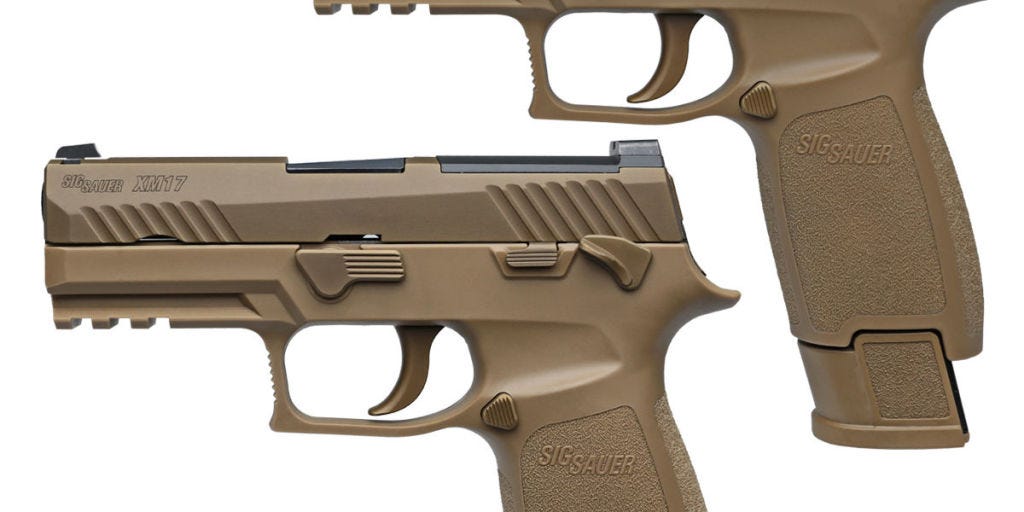
In 2017, the Army selected SIG Sauer’s P320-based entry for the Modular Handgun System program. The full-size version became the M17, while the compact version became the M18. The new system was designed to replace the Beretta M9 and M11 pistols while offering improved ergonomics, modular grip options, accessory rails, night sights, and compatibility with modern support equipment.
The M17 and M18 reflect a major shift in how the Army thinks about sidearms. Instead of treating a pistol as one fixed object, the Modular Handgun System treats it as part of a larger package: pistol, ammunition, magazines, holsters, accessories, training, and sustainment. That systems approach is very modern and very Army. Nothing says “progress” quite like making the pistol bring paperwork friends.
The 101st Airborne Division was among the first Army units to receive the new M17 and M18 pistols in 2017. The fielding marked the Army’s first major standard sidearm change in more than three decades. It also showed how far the Army sidearm had come: from one-shot flintlocks to striker-fired modular pistols built for different hand sizes, mission profiles, and accessories.
What 240 Years of Army Sidearms Really Tell Us
The evolution of the Army sidearm is not a straight line from “bad” to “good.” It is a chain of trade-offs. The flintlock was slow but available. The percussion pistol was more reliable but still limited. The revolver offered multiple shots but eventually gave way to magazine-fed semi-automatics. The M1911 delivered power and durability but had limited capacity by later standards. The M9 offered capacity and NATO standardization but eventually lacked modern modularity. The M17 and M18 bring adaptability, but they also show that no weapon is ever the final word.
Every Army sidearm answers the question of its own time. In the 18th century, the question was, “Can we make a domestic military pistol?” In the Civil War, it was, “Can a soldier fire more than once before reloading?” In 1911, it was, “Can a semi-automatic pistol be powerful and reliable enough for military service?” In 1985, it was, “Can we standardize with NATO and modernize across the services?” In 2017, it became, “Can one handgun system adapt to many soldiers and many missions?”
Experiences and Practical Reflections: Living With the Army Sidearm Legacy
Anyone who studies the Army sidearm long enough notices that these weapons are more than mechanical objects. They become memory holders. Veterans remember the weight of an M1911 on a pistol belt, the wide grip of an M9, the first time they qualified on a range, or the satisfying click of a well-maintained sidearm passing inspection. Even for people who only encounter these pistols in museums, the experience is surprisingly personal. A rifle may dominate a battlefield display, but a pistol feels human-scaled. It looks like something one person carried through one specific moment.
Handling the history of Army sidearms, even academically, also teaches humility. The Model 1805 Harpers Ferry pistol looks primitive beside an M17, but it represented cutting-edge national manufacturing in its day. The Colt Model 1860 Army revolver looks slow to load now, yet it gave Civil War soldiers a dramatic increase in repeat fire. The Single Action Army may seem old-fashioned, but metallic cartridges made it a huge leap in practicality. The M1911 may inspire nostalgia bordering on poetry, but its adoption came from serious lessons about performance and soldier confidence. The M9 may be mocked by some traditionalists, but it served for decades across major operations and helped align U.S. forces with NATO ammunition standards.
One useful experience when examining this topic is to compare sidearms by the problems they solved rather than by fan loyalty. Firearms culture often turns into team sports: .45 versus 9mm, steel versus polymer, hammer-fired versus striker-fired, old school versus new school. The Army, however, has to think in less romantic terms. Can the weapon be issued at scale? Can it be maintained by armorers with limited time? Can new soldiers learn it safely? Does it work with current ammunition supply? Can it accept lights, holsters, suppressor-support equipment, and future accessories? Is it durable enough for thousands of users who may not treat it like a collector’s heirloom? These questions are not glamorous, but they are the real engine of sidearm evolution.
Another reflection is that the sidearm often lives in the shadow of the rifle, yet it refuses to become irrelevant. Critics sometimes say pistols are rarely decisive in war, and historically that is often true. But “rarely” is not “never.” A sidearm matters to military police, pilots, vehicle crews, officers, special operations personnel, and anyone whose primary duties make a long gun awkward. It also matters psychologically. A compact defensive weapon can provide confidence in situations where a soldier is separated from heavier arms, working in confined spaces, or performing duties where a rifle is not practical.
The 240-year evolution of the Army sidearm also mirrors the American relationship with technology. The Army repeatedly adopts what seems sensible, then learns from field use, then modernizes again. The process is imperfect, expensive, argued over, and occasionally hilarious in hindsight. Yet it works. The result is a living timeline of American military priorities: independence, industrialization, mobility, firepower, standardization, ergonomics, modularity, and system integration.
In the end, the best way to appreciate the Army sidearm is not to ask which pistol was “the greatest.” A better question is: which pistol best served the soldier of its era? By that measure, each major sidearm earns its place. The flintlock helped start the story. The revolver gave soldiers repeat shots. The M1911 became an icon of American resolve. The M9 carried the Army into the NATO-standard modern age. The M17 and M18 now point toward a future where adaptability is as important as raw specifications. That is a long journey for something small enough to fit in a holster.
Conclusion
The 240-year evolution of the Army sidearm is a compact history of American military change. From flintlock sparks to modular polymer frames, the Army pistol has followed the needs of soldiers, the limits of technology, and the demands of logistics. Each model tells a story about what the Army valued at the time: reliability, power, capacity, standardization, or adaptability.
The Army sidearm may never be the largest weapon in the fight, but it remains one of the most revealing. It shows how small tools can carry big lessons. And after more than two centuries of upgrades, debates, trials, and range qualifications, one thing is certain: the next Army sidearm argument is already loading.
Note: This article is written for historical and educational publishing purposes, focusing on design evolution, military procurement, and the role of Army sidearms across American history.