The Icy Crust of Saturn’s Moon Titan Could Be Hiding Secrets to Our World and Life Beyond It

Saturn’s largest moon looks as though someone took Earth, swapped its water for liquid natural gas, turned the thermostat down to “absolutely not,” and wrapped the whole thing in orange smog. Yet beneath Titan’s alien appearance lies a world that is strangely familiarand scientifically irresistible.
Titan has clouds, rainfall, rivers, dunes, coastlines, lakes, and seas. Its thick atmosphere is rich in nitrogen, just like Earth’s, while methane drives a planet-wide weather cycle that resembles our hydrological cycle. The major difference is that Titan’s average surface temperature is about -290 degrees Fahrenheit. At that temperature, water is not something that splashes. It behaves like bedrock.
That frozen water-ice crust may be far more complicated than a simple planetary shell. Recent research suggests that parts of it could contain methane trapped inside crystalline cages, creating an insulating layer several miles thick. Even deeper, Titan may hold slushy ice, isolated pockets of warm liquid water, or perhaps a more extensive water-rich layer whose exact structure remains under debate.
In other words, Titan’s crust may be a freezer, blanket, chemical laboratory, geological archive, and astrobiological treasure chest all at once. Subtle signs in its impact craters and tidal movements could help scientists understand Titan’s atmosphere, the chemistry that preceded life on Earth, and the range of environments in which life might emerge elsewhere.
Research basis: NASA Titan facts, Cassini findings, and Cornell analysis of Titan’s seas.
Titan Is an Alien World With an Earthlike Personality
Methane Plays the Role of Water
On Earth, sunlight evaporates water from oceans, moisture condenses into clouds, rain falls, rivers flow, and the cycle begins again. Titan runs a comparable system using methane and ethane. These substances are gases under normal Earth conditions, but Titan is cold enough to keep them liquid on its surface.
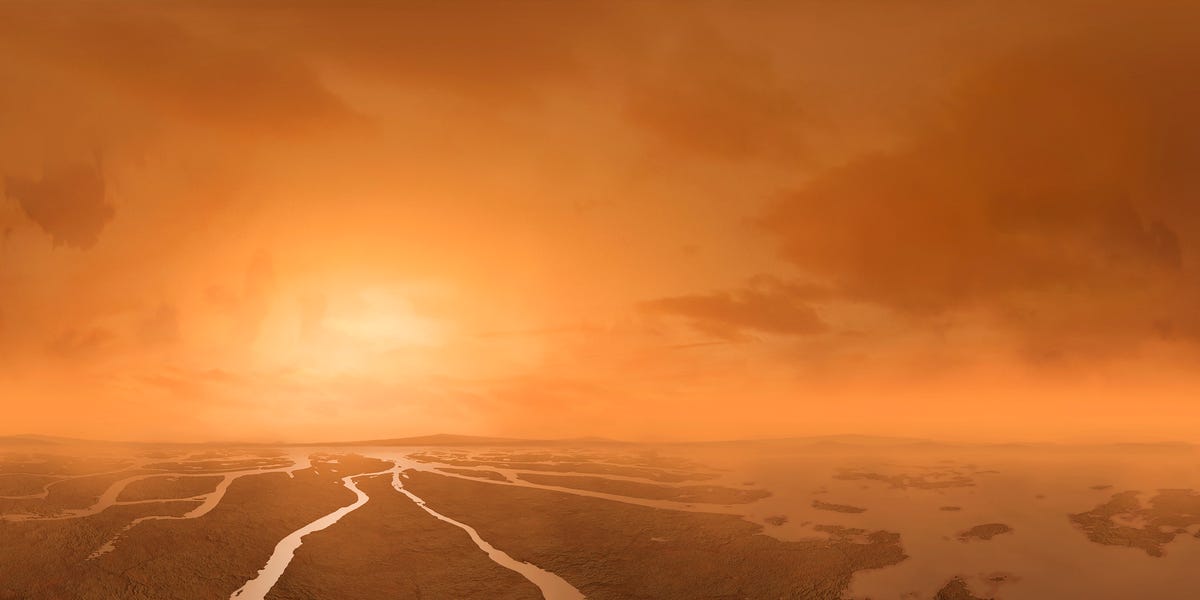
Methane clouds gather in Titan’s atmosphere. Rainstorms reshape the landscape, carve channels through icy ground, and replenish lakes and seas concentrated mainly near the moon’s poles. Radar analysis of Kraken Mare, Ligeia Mare, and Punga Mare indicates that their composition and surface roughness vary by location. Researchers have even detected evidence of currents, tidal activity, and ripples near river mouths.
Titan is therefore not a frozen museum exhibit. It is an active world with weather, erosion, sediment transport, and seasonal change. Its lakes may look calm from orbit, but they participate in a dynamic climate system. Titan is basically running Earthlike software on very different chemical hardware.
Water Ice Becomes Titan’s Rock
At Titan’s surface temperature, water ice is extremely hard. It forms mountains, plains, boulders, crater walls, and the foundation beneath hydrocarbon rivers. Methane rainfall can erode this icy terrain much as water wears down sandstone on Earth.
Meanwhile, sunlight and energetic particles break apart nitrogen and methane high in Titan’s atmosphere. The fragments recombine into hydrocarbons, nitriles, and increasingly complex organic compounds. Many of these substances settle onto the surface as dark particles, creating enormous equatorial dunes whose grains may resemble coarse coffee grounds.
That combination is what makes Titan so appealing to astrobiologists: abundant organic chemistry sits on top of a world built largely from water ice. Whenever heat from an impact, geological activity, or the interior temporarily melts that ice, liquid water may mix with carbon-rich material. Those contact zones could host chemistry relevant to the origin of life.
The Strange Clue Hidden in Titan’s Shallow Craters
Titan Has Fewer Visible Craters Than Expected
Impact craters are useful planetary time capsules. An old, inactive surface generally accumulates many of them, while erosion or geological resurfacing gradually erases them. Titan has surprisingly few clearly identified impact craters, and many are much shallower than scientists would expect for a moon with a solid icy exterior.
Some crater loss can be explained by methane rainfall, sediment deposits, dunes, and other surface processes. However, recent computer modeling points to another possibility: Titan’s upper crust may deform and relax after an impact, slowly filling in the crater from below.
A Methane-Clathrate Blanket Could Be Several Miles Thick
Researchers led by scientists at the University of Hawaiʻi examined whether a layer of methane clathrate could explain Titan’s unusually shallow craters. A clathrate is a crystal in which water molecules form cage-like structures that trap smaller moleculesin this case, methane.
The models that best matched observed crater depths included a methane-clathrate layer roughly three to six miles thick. This material would be mechanically and thermally different from ordinary water ice. It could insulate warmer ice beneath it, allowing the deeper shell to flow and deform more readily over geological time.
Imagine dropping a heavy ball onto a thick mattress rather than a concrete floor. The initial dent may be dramatic, but the mattress slowly rebounds. Titan’s crust would not bounce back in a weekend, of course. Planetary geology has the scheduling habits of a very relaxed tortoise. Nevertheless, over millions of years, warm ice could flow enough to soften crater topography.
The proposed clathrate layer may also serve as a methane reservoir. Methane is steadily destroyed by ultraviolet radiation in Titan’s upper atmosphere, so some process must replenish it over time. Methane released from clathrates by impacts, fractures, warming, or geological activity could contribute to that supply, although impacts alone may not replace everything the atmosphere loses.
Research basis: University of Hawaiʻi crater modeling, JPL clathrate chemistry, and impact simulations.
Does Titan Hide a Global Ocean or a Slushy Interior?
For years, one of the most exciting interpretations of Cassini data was that Titan possessed a global ocean beneath its outer ice shell. Measurements showed that Titan changes shape as it moves through Saturn’s gravitational field. A flexible crust floating over liquid water appeared to provide a reasonable explanation.
More recent analysis has complicated that picture. Researchers revisited not only how much Titan deforms, but also when the deformation occurs. Titan’s response to Saturn’s tidal pull appears to lag behind the maximum force by roughly 15 hours. That delay suggests that much of the interior may behave more like a thick, viscous mixture than a freely moving ocean.
According to the newer model, Titan could contain layers of high-pressure ice, slushy channels, and isolated pockets of meltwater closer to its rocky core. Some pockets might become surprisingly warm by outer-solar-system standards, potentially reaching temperatures near 68 degrees Fahrenheit under the right pressure and chemical conditions.
This does not make Titan less interesting. A giant open ocean would offer an enormous potential habitat, but it might also be chemically diluted and poorly connected to nutrients at the surface or minerals in the core. Smaller water pockets and slushy pathways could concentrate salts, organic molecules, nutrients, and energy sources. Life often prefers a useful kitchen to an enormous swimming pool.
The global-ocean question is not permanently settled. Interior models depend on limited spacecraft measurements, laboratory data, and assumptions about how exotic forms of ice behave under tremendous pressure. Titan may still surprise us with a structure that combines features from several competing models.
Research basis: 2025 Cassini reanalysis from NASA, the University of Washington, and Nature.
Why Titan Matters to the Search for Life
Titan Preserves Chemistry Resembling Early Earth
Modern Earth is covered with life, oxygen, oceans, forests, cities, plastic lawn chairs, and countless other features that have altered the planet’s original chemistry. Titan offers a chance to investigate complex organic reactions in an environment untouched by biology as we know it.
Its nitrogen-methane atmosphere produces hydrogen cyanide, acetylene, ethane, benzene, and many other carbon-bearing compounds. Some are important ingredients or chemical stepping-stones in laboratory experiments studying prebiotic chemistry. Titan may therefore preserve examples of processes that occurred before life emerged on Earth, even if Titan itself never became inhabited.
The analogy is not perfect. Early Earth was warmer, had widespread liquid water, and received much more sunlight. Still, Titan allows scientists to study how atmospheric energy can turn simple molecules into increasingly complicated organic material. It is less a frozen copy of ancient Earth than a parallel experiment performed with different temperatures, solvents, and timescales.
Impact Craters Could Create Temporary Habitable Oases
Large impacts deliver enough energy to melt water ice. When an asteroid or comet strikes Titan, the resulting melt pool may remain liquid for hundreds or thousands of years, depending on its size and composition. Organic material from Titan’s surface could wash or fall into that water, producing a temporary laboratory for water-based prebiotic chemistry.
Selk Crater is especially interesting because scientists suspect that liquid water and organic compounds may have mixed there in the past. Even if the water later refroze, chemical products could remain preserved in the ice like evidence sealed inside a cosmic freezer bag.
Could Life Use Liquid Methane Instead of Water?
The most radical possibility is that Titan’s surface lakes could support a form of life unrelated to terrestrial biology. Earth organisms rely on liquid water, cell membranes, and chemistry that works at comparatively warm temperatures. Titan’s hypothetical organisms would need to function in liquid methane or ethane at about -290 degrees Fahrenheit.
No evidence of such life has been found. Nevertheless, researchers investigate whether molecules could assemble into membrane-like compartments under Titan conditions. A 2025 NASA-supported study proposed that amphiphilic molecules might coat methane raindrops and lake surfaces. When spray droplets fall back into a lake, interacting molecular layers might form vesiclestiny compartments that resemble an important structural feature of primitive cells.
Vesicles are not organisms. They do not eat, reproduce, complain about Mondays, or demonstrate any other recognized sign of life. Their possible formation would simply show that Titan’s environment can produce greater molecular organization than scientists once assumed.
Even water-based life inside Titan may be extremely scarce. Bioenergetic modeling published in 2025 suggested that limited transport of useful organic food from the surface to a deep habitable layer could support only a tiny total biomass. Titan could theoretically contain microbes while remaining one of the least crowded neighborhoods in the solar system.
Research basis: NASA protocell research and University of Arizona bioenergetic modeling.
What Titan’s Frozen Crust Could Teach Us About Earth
Titan is not only relevant to alien life. Its methane-clathrate crust may provide a natural laboratory for studying processes with direct parallels on Earth.
Earth contains methane hydrates beneath seafloors and in permafrost regions. These ice-like deposits lock methane inside water-based crystal cages. Changes in temperature and pressure can destabilize them and release methane, a powerful greenhouse gas. Titan’s environment is far colder and follows very different climate rules, but examining how methane is stored, transported, and released there can improve scientists’ general understanding of clathrate behavior.
Titan also demonstrates that a climate cycle does not have to be based on water. Methane evaporates, condenses, rains, erodes the landscape, flows through rivers, and collects in seas. Studying this cycle tests atmospheric and climate models under conditions impossible to reproduce on Earth at planetary scale.
The moon’s shallow craters also offer lessons in glaciology. Warm ice beneath an insulating crust may relax in a way comparable to flowing terrestrial glaciers. By comparing crater deformation on Titan with ice movement on Earth, researchers can refine models describing how frozen materials behave over long periods.
Most importantly, Titan challenges Earth-centered assumptions. It reminds us that familiar processesweather, erosion, sedimentation, climate cycles, and molecular self-organizationcan operate with unfamiliar materials. Nature is less interested in following our definitions than we are in writing them.
Dragonfly Will Explore Titan One Flight at a Time
NASA’s Dragonfly mission is designed to take advantage of Titan’s thick atmosphere and low gravity. The nuclear-powered rotorcraft will fly between multiple scientific sites rather than remaining beside a single landing platform.
NASA currently targets a launch no earlier than July 2028, followed by arrival at Titan in late 2034. During a planned mission lasting about 3.3 Earth years, Dragonfly is expected to travel through equatorial dune fields and eventually investigate areas associated with Selk Crater.
The spacecraft will analyze surface samples, measure atmospheric conditions, study geology, monitor seismic activity, and examine organic compounds. Its mass spectrometer will help determine what molecules are present and how far Titan’s prebiotic chemistry has progressed.
Dragonfly is not primarily designed to announce, “Congratulations, we found aliens.” Its core mission is to evaluate habitability and investigate the chemistry that occurs before biology. It may identify environments where water and organics interacted, detect compounds of astrobiological interest, and reveal whether Titan’s surface preserves chemical indicators associated with water-based or hydrocarbon-based processes.
Directly drilling through miles of ice is far beyond Dragonfly’s mission. Even so, surface materials can carry information about the interior. Impacts, fractures, erosion, and possible geological activity may expose or transport substances that originated below. Titan’s crust may be hiding the evidence, but it may also occasionally leave clues lying around for a flying robot to collect.
Research basis: NASA’s current Dragonfly mission schedule and science objectives.
Why the Icy Crust May Be the Key to Titan’s Biggest Mysteries
Titan’s crust separates two dramatically different chemical environments. Above it lies a freezing world dominated by nitrogen, methane, ethane, and atmospheric organic compounds. Below it may lie high-pressure ice, slush, mineral-rich water pockets, or another water-bearing structure.
That boundary controls whether surface organics can reach liquid water, whether nutrients from the rocky core can move upward, and whether methane stored in clathrates can escape into the atmosphere. It also determines how quickly craters disappear, how heat flows through the moon, and how Titan’s interior responds to Saturn’s gravity.
In astrobiology, boundaries are often more productive than uniform environments. Seafloor vents, shorelines, mineral surfaces, ice-water interfaces, and wet-dry cycles can concentrate ingredients and provide usable energy. Titan’s ice shell may contain numerous boundaries where materials meet, react, freeze, melt, and separate again.
The icy crust is therefore not merely an obstacle covering the interesting part. It may be the interesting part.
Experiencing Titan From Earth: A Journey Through Data and Imagination
No human has stood on Titan, so any honest “experience” of the moon begins with spacecraft data, laboratory experiments, and a carefully restrained imagination. Fortunately, Titan provides enough real-world detail to make the mental journey unforgettable.
Picture descending beneath an orange ceiling of haze. The sunlight is weak and heavily filtered, creating a dim landscape that feels less like noon and more like the final minutes before a storm. Titan’s dense atmosphere would press against a spacesuit with roughly one and a half times Earth’s sea-level pressure, yet the moon’s low gravity would make every movement feel unusually light.
During the Huygens probe’s descent in January 2005, cameras revealed branching channels, rounded ice cobbles, and terrain shaped by flowing liquid. The images were astonishing because the landscape looked recognizable. It had drainage networks and what appeared to be shorelines. Then the temperature reading reminded everyone that this was not a damp afternoon beside an Earthly river. It was cold enough for water to serve as stone.
A traveler walking across Titan might hear little besides the movement of the atmosphere and the machinery of a protective suit. The ground could contain hardened water ice coated with organic sediment. Dark dunes might rise in long parallel lines, built from particles manufactured in the atmosphere and delivered by a slow, continuous chemical snowfall.
Farther north, the landscape would become wetterin the Titan sense of the word. Methane rivers could lead toward broad hydrocarbon seas. Rain might fall in large drops because of the moon’s low gravity and thick air. A storm rolling over Kraken Mare would be both familiar and completely wrong: clouds, wind, waves, and rain, all operating without liquid water.
The most intriguing experience, however, would be the one no camera can yet provide: imagining the journey downward. Beneath the surface, pressure would rise as ordinary ice gave way to methane-bearing clathrates and warmer, softer layers. The crust might deform slowly around old impact structures. Deeper still, solid ice could become a complicated mixture of crystals, salty slush, and meltwater pathways.
Instead of finding a clean underground ocean with a convenient shoreline, an explorer might encounter something resembling a planet-sized frozen sponge. Warm water pockets could form near the rocky interior, connected by narrow slushy channels. Minerals from the core might enter the water, while carbon-rich molecules from above would struggle to travel downward.
That difficulty is scientifically important. A habitable environment needs more than liquid. It needs ingredients, energy, and a way to bring them together. Titan may possess all three, but perhaps in different places. Its crust acts like a strict event organizer who has invited every necessary guest and seated them at separate tables.
Experiencing Titan through research also teaches patience. Cassini’s mission ended in 2017, yet scientists continue extracting new discoveries from its observations. A tiny delay in Titan’s tidal deformation changed how researchers interpreted the moon’s entire interior. Slightly shallow craters inspired models of a methane-rich insulating crust. Radar echoes revealed the composition and movement of distant seas.
This is what makes Titan exploration feel so rewarding: the moon rarely hands over a direct answer. It offers a ripple, a crater, a chemical spectrum, or a delayed gravitational response. Scientists then assemble those clues into a modelfully aware that the next clue may rearrange the picture again.
When Dragonfly finally begins flying through Titan’s haze, humanity’s experience of this moon will become more immediate. Each landing site will provide a new patch of ground, a new sample, and another chance to determine how organic chemistry evolves on a world that resembles Earth only after every familiar ingredient has been creatively rearranged.
Conclusion: Titan Is Hiding More Than Ice
Titan’s icy crust may hold the key to several mysteries at once. A methane-clathrate layer could explain why impact craters become shallow, help insulate warmer ice, and preserve part of the methane supply feeding the atmosphere. Deeper slushy regions or water pockets could create environments where minerals, heat, water, and organic compounds interact.
None of this proves that Titan supports life. It does show that habitability cannot be reduced to a checklist containing only “liquid water: yes or no.” The arrangement of water, energy, nutrients, organic molecules, and geological pathways matters just as much.
By studying Titan, scientists can investigate methane climate cycles, the behavior of icy crusts, the chemistry of early Earth, and the possibility of biology based on unfamiliar solvents. The moon’s greatest contribution may be teaching us how many assumptions we carry when searching for life.
Titan is cold, distant, hazy, and stubbornly secretive. Naturally, that makes it one of the most inviting destinations in the solar system.