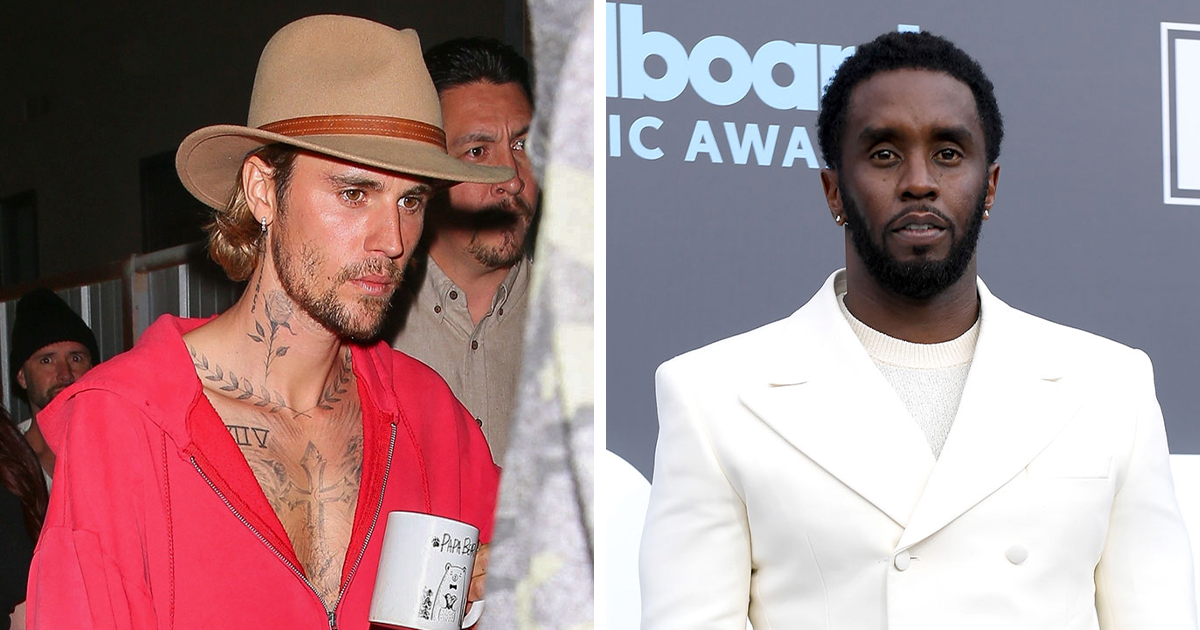
“Looks Rough”: New Photos Of Justin Bieber In First Outing Amid Diddy Scandal Raises Eyebrows

Justin Bieber has spent more than half his life in the spotlight, which is a polite way of saying the internet has treated him like a public group project since he was a teenager. One new photo, one oversized hoodie, one tired walk across a sidewalk, and suddenly millions of strangers become part-time stylists, full-time detectives, and completely unlicensed wellness experts. That is exactly what happened when new photos of Justin Bieber surfaced during renewed public attention on Sean “Diddy” Combs’ legal scandal.
The phrase “looks rough” began bouncing around social media after pictures showed Bieber in a casual public outing. Some fans expressed worry. Others connected his appearance to the Diddy scandal, resurfaced old videos, and online rumors about Bieber’s past proximity to Combs. But before the internet grabs a magnifying glass and a fog machine, it is worth slowing down. A photo can show a moment. It cannot explain a person’s health, marriage, trauma, schedule, mood, or breakfast choices. And yes, sometimes a celebrity simply looks like someone who left the house before caffeine had fully clocked in.
This story sits at the messy intersection of celebrity culture, fan concern, legal news, and social media speculation. It involves real public reporting, serious allegations surrounding Combs, and a pop star whose life has repeatedly been interpreted by people who do not know him. The result is a headline that grabs attention, but the deeper story is about how quickly the public turns images into assumptions.
Why Justin Bieber’s New Photos Sparked So Much Concern
The latest round of concern began when Bieber was seen out in public after Combs’ indictment had already placed the music mogul under intense media scrutiny. Reports described fans reacting strongly to Bieber’s appearance, with some saying he looked thin, tired, or emotionally weighed down. The reaction spread quickly because Bieber’s public image has always carried two competing ideas: global superstar and vulnerable former child star.
For longtime fans, seeing Bieber appear subdued naturally stirs emotion. Many remember him as the teen with the swoop haircut, the purple hoodie, and enough YouTube-era charm to power a small suburb. But today’s Justin Bieber is not that kid. He is an adult, a husband, a father, an artist who has faced health challenges, and a person who has repeatedly asked for breathing room. The public, unfortunately, does not always hand out breathing room generously. It usually sells it back as a subscription.
The photos became especially loaded because of the wider Diddy scandal. Old clips of Bieber and Combs resurfaced online, prompting speculation about their past interactions. Bieber’s representative later made clear that Bieber was not among Combs’ victims and emphasized that attention should remain on people who were genuinely harmed and seeking justice. That statement matters because it draws a line between legitimate concern and rumor-driven storytelling.
The Diddy Scandal Context: What Is Actually Known
Sean “Diddy” Combs was indicted in 2024 on federal charges that included sex trafficking, racketeering-related allegations, and transportation-related offenses. Prosecutors alleged a years-long pattern of coercive conduct. Combs denied the allegations and pleaded not guilty. In 2025, the criminal case moved through trial, where Combs was acquitted of the most serious sex trafficking and racketeering charges but convicted on prostitution-related transportation offenses. Later, he was sentenced to more than four years in prison.
That legal context is serious, and it should not be flattened into celebrity gossip confetti. The most responsible way to cover the topic is to separate confirmed facts from speculation. The case involved real court proceedings, named charges, verdicts, and sentencing. Bieber’s name entered the online conversation mainly because of old public footage and his past association with Combs, not because of any verified claim that he was a victim.
This distinction is important for SEO, journalism, and basic human decency. Search engines reward clarity, but readers deserve fairness. Using Bieber’s name to chase scandal traffic without acknowledging his team’s statement would be misleading. Turning someone’s facial expression or outfit into “proof” of a hidden story would be even worse. The internet may love a mystery board with red string, but responsible writing should not behave like a basement detective who has had three energy drinks.
Why People Read So Much Into Celebrity Photos
Celebrity photos are strange little cultural objects. They look simple, but they invite big narratives. A star walking to a car becomes “a crisis.” A hoodie becomes “a message.” Sunglasses become “hiding pain.” A quiet expression becomes “confirmation.” In Bieber’s case, the speculation machine works overtime because audiences have watched him grow up in public. People feel like they know him, even though they mostly know edited fragments: interviews, paparazzi shots, stage performances, Instagram captions, and headlines.
That creates something psychologists often call a parasocial relationship, which is a one-sided emotional bond with a public figure. Fans can care deeply, and that care can be genuine. But the problem begins when care turns into certainty. “I hope he’s okay” is compassionate. “This photo proves what happened to him” is a leap over a canyon in roller skates.
Bieber has also had publicly known health struggles. In 2022, he revealed that Ramsay Hunt syndrome had caused facial paralysis and led him to postpone tour dates. Later, he paused more performances to prioritize his health. Those facts help explain why fans may be sensitive when new photos appear. But they do not give anyone permission to diagnose him from a sidewalk picture. Health is not a scavenger hunt.
Justin Bieber’s Life Now: Fame, Fatherhood, And Privacy
Another part of the story is that Bieber’s life has changed dramatically. He and Hailey Bieber welcomed their son, Jack Blues Bieber, in August 2024. Becoming a parent is wonderful, but it is also famously exhausting. New parents often move through the world powered by love, adrenaline, and the haunted glow of someone who has slept in ninety-minute installments. Even without fame, that season can be intense.
For Bieber, fatherhood arrived after years of public scrutiny, health challenges, career pressure, and marriage rumors. Every public outing can become a referendum on his happiness. If he smiles, people analyze whether it is forced. If he does not smile, people worry. If he dresses casually, people call it concerning. If he dresses sharply, people call it staged. At a certain point, the man cannot even wear pants without the internet convening a panel.
That is why the new photos struck such a nerve. They were not just pictures; they became a screen onto which people projected concern, suspicion, sympathy, and sometimes judgment. The healthier response is to acknowledge that fans may care while also recognizing that Bieber owes the public neither a performance of cheerfulness nor a detailed explanation of his private life.
How The Headline Became Bigger Than The Photos
The headline “Looks Rough” works because it is short, emotional, and instantly clickable. It makes readers curious: What happened? How rough? Is there a scandal connection? Should fans be worried? From an SEO perspective, it contains strong search hooks: Justin Bieber photos, Diddy scandal, first outing, fan concern, and celebrity news. From an editorial perspective, however, the challenge is to use that curiosity responsibly.
The best celebrity coverage does not pretend photos are meaningless, because public reaction is part of the story. But it also does not inflate reaction into fact. In this case, the strongest angle is not “Justin Bieber looks bad.” That is lazy, subjective, and frankly a little rude. The stronger angle is: “Why did these photos trigger such a big response, and what do we actually know?”
That framing allows the article to capture search interest while avoiding harmful speculation. Readers still get the context they came for: the Diddy scandal, Bieber’s public appearance, fan reactions, and the history behind the concern. But they also get a more thoughtful analysis of how celebrity narratives form.
The Problem With Turning Concern Into Content
There is a fine line between empathy and consumption. Fans can genuinely worry about Justin Bieber. Many have followed him since childhood and watched him struggle under fame’s microscope. But when every expression becomes a headline, concern can become another form of pressure. It asks the celebrity to constantly reassure strangers: I am healthy. My marriage is fine. My past is not yours to decode. My face today is not a press release.
The Diddy scandal has already created an environment where people are revisiting old entertainment-industry relationships with new suspicion. Some of that reexamination is necessary, especially when power, age gaps, and alleged misconduct are involved. But reexamination should not become a rumor festival. The people directly involved in legal proceedings and alleged harm deserve to be centered with accuracy and respect. People adjacent to the story should not be turned into symbolic evidence without facts.
Bieber’s representative’s statement was important because it redirected attention away from speculative narratives and toward those who had actually come forward in the Combs case. That is a meaningful editorial boundary. It says: do not erase real victims by inventing a storyline around a more famous name.
What Readers Should Take Away From The Justin Bieber Photo Reaction
The biggest lesson is simple: photos are not full stories. They can raise questions, but they cannot answer them. A celebrity can look tired because of stress, travel, parenting, illness, work, grief, jet lag, bad lighting, or because the photographer caught one unfortunate frame between blinks. Most of us would not survive a paparazzi photo taken while leaving a grocery store. The average person’s “quick errand face” is not exactly album-cover material.
Justin Bieber’s new photos became news because they appeared during a larger cultural moment. The Diddy case had people reconsidering old videos, industry dynamics, and celebrity relationships. Bieber’s history as a young star made the conversation even more emotional. His prior health struggles added another layer. His new role as a father made fans more protective. Put all of that together, and one public outing became a full internet weather system.
But responsible readers can hold two ideas at once. First, concern for Bieber can be sincere. Second, speculation can still be unfair. The right response is not to mock his appearance or spin theories. It is to stick with verified information, respect privacy, and remember that a person is more than the most awkward photo taken of them that week.
Why This Story Matters Beyond Justin Bieber
This story is not only about Bieber. It is about how the internet treats famous people, especially those who became famous young. Child stars often grow up under conditions that would be difficult for anyone: constant attention, public mistakes, adult business pressures, and millions of strangers commenting on their bodies, relationships, and mental state. When they become adults, the public sometimes forgets they are allowed to evolve privately.
Bieber’s career has included enormous success, from early viral fame to Grammy-winning recognition and global tours. It has also included very public growing pains. That combination makes him a magnet for concern. People want him to be okay, but they also want content. Those desires can collide. The challenge for fans and publishers is to care without consuming every vulnerable-looking moment as entertainment.
The Diddy scandal adds another uncomfortable layer because it reminds audiences that the entertainment industry has often placed young performers near powerful adults. That reality deserves scrutiny. But scrutiny should be evidence-based. Otherwise, it risks turning serious issues into clickbait and turning real people into characters in a story they did not volunteer to narrate.
Experience Section: What This Moment Feels Like For Fans And Readers
For many fans, seeing Justin Bieber look tired or withdrawn can feel surprisingly personal. That reaction makes sense. Bieber was not introduced to the world as a distant, polished superstar. He arrived through the internet, singing into a camera, looking like a kid someone might have known from school. His rise felt intimate because it happened on screens people used every day. Fans watched him grow, stumble, apologize, marry, pause, return, and become a father. That long timeline creates emotional investment.
Imagine being a fan who grew up with his music. “Baby” might remind you of middle school dances, “Sorry” of late-night car rides, and “Peaches” of a summer that smelled like sunscreen and questionable iced coffee. When new photos appear and people say he “looks rough,” it can feel less like celebrity gossip and more like seeing an old friend look exhausted across a crowded room. You do not know the full story, but you instinctively hope they are okay.
At the same time, fans have to navigate the awkward reality of modern celebrity culture. Concern is often packaged beside ads, thumbnails, reaction posts, and comment sections where empathy and cruelty sit shoulder to shoulder like they accidentally booked the same flight. One person writes, “Praying for him.” Another writes something harsh about his appearance. A third claims to know exactly what is happening based on three photos and a TikTok thread. The result can feel chaotic, even for readers who arrived with good intentions.
The more useful experience is to pause before sharing. Ask: Is this confirmed? Is this kind? Does this help anyone? Would I say this about a person I actually knew? Those questions do not remove curiosity, but they make it more humane. They also help separate real public-interest reporting from emotional guesswork.
There is also a lesson for anyone who has ever had an unflattering photo taken. Most people have looked “rough” at some point: after finals, after a long shift, after a family emergency, after a red-eye flight, or after deciding that laundry-day sweatpants were socially acceptable because the grocery store lighting “probably wouldn’t be that bad.” Now imagine that moment being photographed, published, enlarged, captioned, and debated by strangers. Suddenly, the Bieber story becomes less about celebrity distance and more about basic empathy.
Fans can still care. Readers can still be curious. Writers can still cover the story. But the healthiest version of that experience keeps the human being at the center. Justin Bieber is not a clue in someone else’s scandal board. He is an artist, a public figure, a husband, a father, and a person whose private life remains private unless he chooses otherwise. The photos may have raised eyebrows, but the better response is to raise standards.
Conclusion
Justin Bieber’s new public outing drew attention because it arrived at a tense moment: the Diddy scandal had reignited scrutiny of old celebrity connections, fans were already alert to Bieber’s well-being, and social media was ready to turn a few images into a full narrative. But the responsible takeaway is not that the photos prove anything. They do not.
What they prove is that the internet still struggles to separate concern from speculation. Bieber’s representative has addressed rumors tying him personally to Combs’ alleged victim list, and the legal facts around Combs have developed through formal court proceedings. Everything beyond that should be handled carefully. A tired-looking photo is not evidence. A viral theory is not reporting. A headline can raise a question, but it should not pretend to answer what it cannot know.
In the end, the “Looks Rough” conversation says as much about us as it does about Justin Bieber. It shows how quickly people project meaning onto celebrity images, especially when scandal is nearby. It also offers a chance to do better: read carefully, avoid body commentary, center verified facts, and remember that even world-famous people deserve room to have an ordinary, imperfect, not-camera-ready day.