
Buying a Canada Goose jacket should feel exciting, not like solving a crime scene with a magnifying glass and a suspiciously dramatic soundtrack. But because Canada Goose parkas are expensive, highly recognizable, and popular in the resale market, counterfeit versions are everywherefrom sketchy websites to “brand-new with tags” listings that somehow cost less than a nice dinner.
The tricky part? Some fake Canada Goose jackets are laughably bad. Others are convincing enough to fool a rushed buyer scrolling at midnight. A counterfeit may copy the red, white, and blue Arctic Disc, add a fur-like hood trim, and even include tags that look official at first glance. That is why spotting a fake Canada Goose jacket requires looking at several details together: the badge, stitching, hologram, materials, labels, hardware, seller behavior, and price.
This guide breaks down the most practical ways to compare Canada Goose real vs fake products before you spend serious money. Think of it as a friendly authentication checklistwith fewer frozen fingers and more common sense.
Why Fake Canada Goose Jackets Are So Common
Canada Goose sits in the sweet spot counterfeiters love: premium price, strong brand recognition, and a simple visual identity that casual buyers recognize instantly. A parka with a circular sleeve patch can look “close enough” in blurry photos, especially when the seller leans hard on phrases like “100% authentic,” “gift from a friend,” or “lost receipt.” Convenient, isn’t it?
Counterfeits also thrive because many shoppers hunt for deals. There is nothing wrong with saving money, but luxury outerwear is not usually sold at magical 80% discounts by anonymous sellers with three product photos and a username like WinterDrip_492. Real Canada Goose products hold value because of their construction, insulation, branding, and warranty support. When a deal looks wildly below market, your first thought should not be “lucky me.” It should be “why?”
Start With the Seller, Not the Sleeve Patch
Before inspecting thread density and zipper engraving, inspect the seller. The safest route is to buy directly from Canada Goose or from an authorized retailer. Canada Goose states that buying from an authorized retailer helps ensure the product is authentic and eligible under the brand’s warranty policy. That matters because a convincing-looking jacket is still a risk if you cannot verify where it came from.
Red Flags in a Seller Listing
Be cautious if the seller refuses to provide clear photos of the badge, hologram, labels, zipper, wash tags, and receipt. Be even more cautious if the listing uses only stock photos. Stock photos prove that the internet has pictures; they do not prove the jacket in the box is real.
Watch for vague backstories such as “received as a gift,” “bought overseas,” “don’t know the model,” or “no receipt but trust me.” Sometimes those stories are honest. Sometimes they are fog machines covering a counterfeit disco. Ask direct questions: Where was it purchased? When? Is proof of purchase available? Can the seller provide close-up photos in natural light?
Check the Arctic Disc Badge Carefully
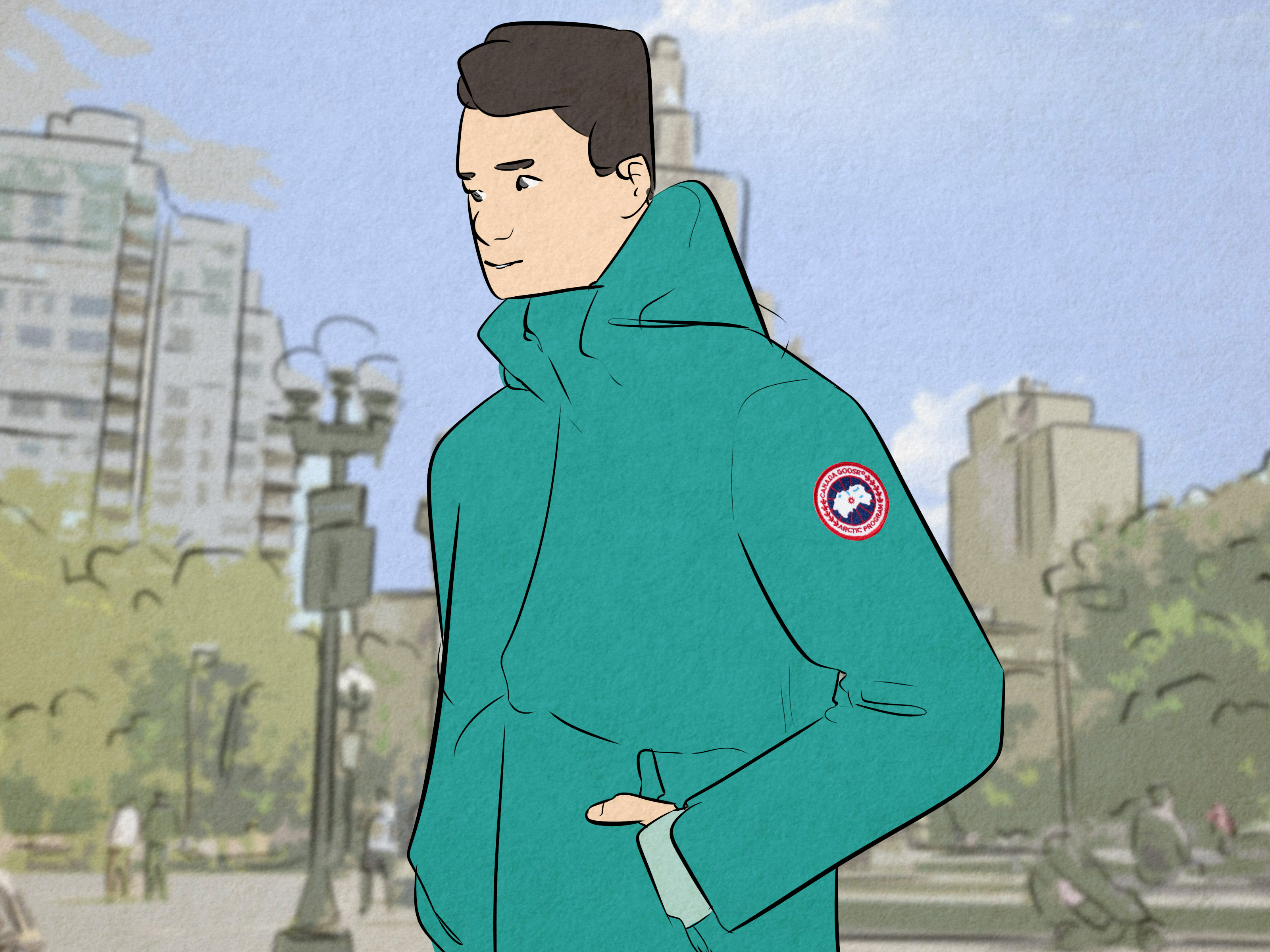
The Arctic Disc is one of the most important details when comparing a real vs fake Canada Goose jacket. On authentic pieces, the badge should look clean, balanced, and sharply embroidered. The lettering should be readable, the spacing should feel even, and the maple leaves should look crisp rather than blob-like.
Counterfeit badges often fail in small but revealing ways. Letters may be too thick, uneven, crowded, or oddly shaped. The words “Canada” or “Arctic” may be misspelled. The red maple leaves may look like tiny red sea creatures instead of leaves. The island shapes in the center may appear sloppy, swollen, or poorly placed. If the badge looks like it was embroidered during an earthquake, walk away.
Real Badge Signs
A real Canada Goose badge usually has neat stitching, clean edges, consistent colors, and readable text. The outer ring, letters, leaves, and center map should work together visually. It does not need to look like a museum artifact under a microscope, but it should look premium.
Fake Badge Signs
A fake badge often shows thick lettering, messy white threads, incorrect spacing, fuzzy borders, and distorted maple leaves. On some replicas, the red leaves look too large or too simple. On others, the text curves awkwardly around the patch. If one side of the badge appears heavier than the other, that is another warning sign.
Inspect the Hologram Label
Canada Goose introduced a unique hologram label in Fall 2017 as a proof-of-authenticity feature. On newer products, this sewn-in hologram should show a polar bear image and visual elements that shift when viewed from different angles. This is one of the most useful authentication clues, especially for jackets produced after that period.
However, do not panic if an older used jacket does not have the newer hologram. Production year matters. A vintage or older Canada Goose piece may have different labeling than a recent model. The right question is not simply “Does it have a hologram?” The better question is “Does the label match the model and production era?”
Fake Hologram Warning Signs
Fake jackets may have a flat, dull, poorly placed, loosely attached, or generic-looking hologram. Some counterfeiters add shiny labels because buyers expect shine. But a random reflective sticker is not the same as an official Canada Goose authentication feature. If the hologram looks cheap, crooked, or inconsistent with known Canada Goose labeling, treat it as a major red flag.
Look at the Fur Ruff or Hood Trim
For older Canada Goose parkas that originally included natural fur, the fur ruff is another major clue. Authentic Canada Goose fur ruffs were designed for function, helping protect the face from extreme cold. They typically look full, soft, and dense. Counterfeit fur often looks thin, tangled, greasy, flat, or unevenlike it lost an argument with a vacuum cleaner.
There is one important update: Canada Goose announced it would stop purchasing fur by the end of 2021 and stop manufacturing with fur no later than the end of 2022. That means newer models may not include natural fur at all. So, do not judge a newer jacket as fake simply because it lacks fur. Instead, compare the jacket to the exact model, year, and product version.
How to Evaluate Hood Details
Look beyond the trim itself. Check the hood seams, attachment points, snaps, zipper track, and stitching. A real jacket should feel sturdy and deliberate. A fake may have loose threads, crooked seams, weak snaps, or trim that sits strangely on the hood. If the hood looks like it was added as an afterthought, that is not a good sign.
Study the Interior Labels and Wash Tags
The inside tags are where many counterfeits start sweating. Authentic Canada Goose labels should be cleanly printed, properly stitched, and consistent with the product. The font should look sharp, not blurry or overly thick. The tag stack should feel secure, not flimsy or carelessly attached.
Look for spelling mistakes, odd grammar, incorrect spacing, or cheap label material. Counterfeiters sometimes copy the general layout but miss small details. A fake tag may say the right brand name while using the wrong font weight, awkward spacing, or low-quality printing. It is the clothing equivalent of wearing a tuxedo with plastic flip-flops.
Do Not Remove Tags
Canada Goose notes that inside garment tags contain valuable information needed for warranty claims, and removing them can affect warranty support. That is another reason to be cautious with used jackets missing interior tags. Missing tags do not automatically prove a jacket is fake, but they remove important verification clues.
Examine the Zippers, Buttons, and Hardware
Luxury outerwear should not feel flimsy. On an authentic Canada Goose jacket, zippers should move smoothly, pulls should feel substantial, and buttons or snaps should be cleanly finished. Hardware is expensive to replicate well, so counterfeiters often cut corners here.
Check for rough zipper movement, lightweight pulls, shallow engraving, inconsistent button text, or peeling finishes. If the zipper catches constantly or the snaps feel like they came from a bargain craft kit, be skeptical. Real winter performance gear should be built for repeated use, not just for five photos on a marketplace listing.
Feel the Fabric and Insulation
A real Canada Goose parka should feel structured, warm, and well-built. The shell fabric should have a durable feel, and the insulation should be evenly distributed. Counterfeits may feel limp, overly puffy in odd places, flat in others, or strangely light for the style.
Down quality and construction affect warmth. Fake jackets may use inferior fill, uneven stuffing, or materials that do not perform in harsh weather. That is more than a style problem. If you buy a counterfeit expecting serious winter protection, you may end up with a very expensive costume and very cold shoulders.
Try the Compression Test
Gently compress a padded section and release it. Quality down insulation usually rebounds, while cheap fill may stay flat or clump. This test is not foolproof, but it helps you identify jackets that feel suspiciously lifeless. Also run your hand across panels to feel for empty spots or lumpy fill distribution.
Compare the Model Details
Canada Goose has many styles: Expedition, Langford, Chateau, Wyndham, Chilliwack, Shelburne, Trillium, and more. Each model has its own pocket placement, hood design, length, fit, quilting pattern, cuffs, and label details. A counterfeit may combine features from several models into one Frankenstein parka.
Before buying, search for the exact model name and compare official product photos or trusted retailer images. Does the pocket shape match? Are the sleeve details correct? Is the length right? Does the interior layout make sense? If the seller claims the jacket is a Langford but it has pocket placement closer to a different model, slow down.
Be Careful With “Rare” Explanations
Sellers may explain inconsistencies by calling the jacket “limited edition,” “sample,” “Japan release,” or “older season.” Those things can exist, but they should not be magic words that cancel every red flag. Rare items usually require more proof, not less.
Understand the Role of RDS and Newer Labels
Canada Goose achieved Responsible Down Standard certification in 2021. RDS is a voluntary standard that tracks certified down materials through the supply chain and focuses on animal welfare practices. Because the brand has updated materials, certifications, and sustainability practices over time, labels may vary by production year.
That is why authentication is not about memorizing one tag and applying it forever. A jacket from 2015, 2019, and 2024 may not have identical interior details. Good authentication compares the product against the correct era, not against a random photo from the internet.
Price: The Loudest Clue in the Room
Price alone cannot authenticate a Canada Goose jacket, but it can tell you when to slow down. A used jacket may be discounted. A seasonal sale may happen through legitimate retailers. But an almost-new Canada Goose parka listed at a tiny fraction of normal resale value should make your eyebrows climb.
Counterfeit sellers depend on urgency. They want you to think, “If I don’t buy it now, someone else will.” Real bargains can wait long enough for you to ask questions. Scams usually cannot.
Ask for the Right Photos Before Buying
If you are buying online, ask for clear, close-up photos of the following areas:
- The front and back of the jacket in natural light
- The Arctic Disc badge
- The hologram label, if applicable
- The neck label and size label
- The full stack of interior wash tags
- The zipper pull, buttons, snaps, and cuffs
- The hood trim and seam details
- The proof of purchase, with personal information hidden
If the seller refuses or sends blurry photos, do not negotiate with fog. Move on. Serious sellers understand that expensive outerwear requires proof.
What to Do If You Already Bought a Suspicious Jacket
First, stop using the item until you document everything. Take photos of the listing, payment receipt, shipping label, packaging, tags, badge, hologram, and seller messages. If you paid by credit card and the product was misrepresented or never delivered as promised, consumer-protection guidance recommends using your card dispute process when appropriate.
If you bought through a marketplace, open a claim quickly and follow that platform’s rules. Do not remove tags, alter the jacket, or send it somewhere without documenting its condition. If the seller pressures you to close a dispute before receiving a refund, consider that a five-alarm scam siren.
Quick Canada Goose Real vs Fake Checklist
- Seller: Authorized retailer or verifiable resale seller?
- Receipt: Real proof of purchase available?
- Badge: Clean lettering, crisp leaves, no misspellings?
- Hologram: Present and correct for newer products?
- Tags: Sharp print, proper stitching, no strange grammar?
- Hardware: Strong zippers, clean snaps, quality finish?
- Fabric: Durable shell and even insulation?
- Model: Details match the claimed style and year?
- Price: Reasonable for the condition and market?
- Behavior: Seller answers questions clearly?
Real-World Experiences: Lessons From Buying Canada Goose Online
Here is the practical side of the story: most fake Canada Goose purchases do not begin with someone saying, “Today I shall ignore every red flag.” They begin with excitement. A buyer sees the exact parka they want, in the right size, at a price that feels almost too good. The photos look decent. The seller seems friendly. The listing says “authentic” in capital letters, as if caps lock has legal authority. Then the jacket arrives, and small doubts start tapping on the window.
One common experience is the “something feels off” moment. The buyer opens the package and notices the jacket feels lighter than expected. The badge looks okay from a distance, but the maple leaves look thick up close. The zipper pull feels hollow. The fur trim looks limp. None of these details alone may feel like absolute proof, but together they create a pattern. Authentication is often about patterns, not one dramatic clue.
Another common experience happens during resale shopping. A seller may provide many photos but avoid the important ones. They show the front, the back, the sleeve from far away, maybe a stylish mirror shotbut not the hologram, wash tags, or zipper details. When asked, they reply, “It is packed already,” or “I’m busy,” or “I have many buyers waiting.” That pressure is not proof of fraud, but it is a reason to pause. A real seller of a high-value jacket should understand why buyers need verification.
Some buyers also get confused by older vs newer Canada Goose details. For example, not every older jacket will match newer labels. Newer products may reflect changes in materials, fur policy, or certification labeling. That is why comparing a used parka to the correct model year is essential. A missing feature may be normal for one era and suspicious for another. The smartest buyers do not ask, “Does this match a random jacket online?” They ask, “Does this match this exact model from this approximate production period?”
In-person shopping has its own lessons. When you hold a real Canada Goose jacket next to a fake one, the difference often becomes clearer. Authentic pieces usually feel more structured. The stitching looks calmer. The hardware feels less toy-like. The badge has sharper definition. The whole jacket feels intentional. Fakes often try to win from across the room; real quality tends to win in your hands.
The best personal rule is simple: never let excitement outrun verification. If the price is suspicious, the seller is impatient, the photos are incomplete, and the badge looks messy, do not try to “make it work.” There will always be another jacket. There may not always be another chance to recover your money.
Also, remember that buying fake is not harmless. Counterfeit goods can support shady supply chains, leave buyers without warranty protection, and fail when real weather arrives. A fake parka may look warm in a selfie, but winter does not care about selfies. If you need serious cold-weather protection, authenticity is not just about status. It is about performance, safety, and value.
The most reliable buying experience usually comes from official stores, authorized retailers, or trusted resale channels with strong buyer protection. If you choose peer-to-peer resale, slow down and build your own evidence file before paying. Save the listing, ask for detailed photos, compare model details, and use secure payment methods. A genuine seller will not be offended by careful questions. A scammer might beand that reaction tells you plenty.
Conclusion
Spotting a real vs fake Canada Goose jacket is not about one magical clue. It is about combining evidence. Start with the seller, then inspect the badge, hologram, tags, hardware, fabric, fur or hood trim, model details, and price. The Arctic Disc should be sharp. The hologram should make sense for the production year. The tags should be clean. The jacket should feel like premium winter gear, not a costume with ambition.
When in doubt, do not rush. Ask for more photos, compare the exact model, verify the seller, and use payment methods that protect you. A real Canada Goose jacket is built for cold weather and long wear. A fake is built for one thing: taking your money before you notice the maple leaves look like tiny red pancakes.