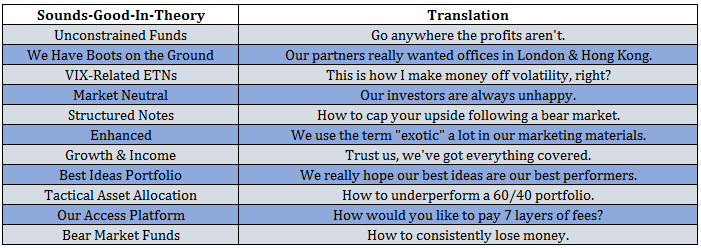

The Sounds-Good-In-Theory-Portfolio is the investment portfolio equivalent of buying a treadmill on January 1: noble, ambitious, slightly expensive, and dangerously likely to become a clothing rack. It is built from ideas that sound brilliant in a pitch deck, comforting in a conference room, and almost heroic in a retirement-planning conversation. Then real life arrives wearing muddy boots.
This kind of portfolio is not usually made of obviously silly investments. That is what makes it tricky. It is often assembled from strategies with polished names: tactical asset allocation, market neutral funds, enhanced income products, unconstrained funds, volatility-linked products, “best ideas” portfolios, structured notes, alternative strategies, and access-only opportunities. Each one can sound reasonable. Some may even have a legitimate role for certain investors. But when they are mixed together without discipline, costs, risks, taxes, time horizon, and human behavior in mind, the result can be a portfolio that looks sophisticated but behaves like a raccoon in a jewelry store.
The lesson is not “never use advanced investment tools.” The lesson is simpler and more useful: an investment strategy should work not only in theory, but also in your actual life, with your actual nerves, your actual tax situation, your actual timeline, and your actual ability to stay the course when markets start throwing furniture.
What Is a Sounds-Good-In-Theory Portfolio?
A Sounds-Good-In-Theory Portfolio is a collection of investments chosen mainly because the story sounds attractive. It may promise flexibility, downside protection, higher income, smoother returns, global insight, elite access, or clever timing. On paper, each feature sounds like something any rational investor would want. Who does not want growth and income? Who would reject protection from losses? Who would not enjoy access to exclusive managers? That is like asking whether you want your coffee hot, your Wi-Fi fast, and your neighbor’s leaf blower permanently retired.
The problem is that investment features are not free. Flexibility can mean lack of discipline. Downside protection can mean capped upside and high fees. Tactical trading can mean being wrong twice: once when getting out and again when trying to get back in. Exclusive access can mean you are arriving after the best performance has already been harvested by earlier investors. “Enhanced” can simply mean “more complicated, more expensive, and harder to explain at Thanksgiving.”
A strong portfolio is not built from exciting labels. It is built from clear goals, sensible asset allocation, broad diversification, reasonable costs, tax awareness, and a rebalancing process that does not depend on someone having a crystal ball. Spoiler: Wall Street owns many marble lobbies, but no working crystal balls.
Why These Portfolios Are So Tempting
Investors are human, and humans love stories. A plain portfolio of diversified stock and bond funds may be effective, but it does not exactly enter the room with a fog machine. A complex strategy, however, can sound intelligent. It offers the emotional comfort of action. It whispers, “You are not like those ordinary investors. You have a strategy.”
They Promise Control in an Uncertain World
Markets are unpredictable. Stock prices move for reasons that are not always clear. Interest rates rise and fall. Inflation cools, heats up, and occasionally behaves like a toddler in a grocery aisle. In that environment, strategies that promise control are appealing. A tactical fund says it can move between assets. A structured note says it can limit some downside. A volatility product says it can profit when fear rises. A bear market fund says it can help when stocks fall.
The emotional pitch is powerful: “Do not just sit there. Do something.” But investing often rewards the opposite. It rewards having a plan before the storm, not trying to build an umbrella in the middle of a hurricane.
They Feel More Sophisticated Than Simplicity
Simple investing can feel suspiciously basic. Broad index funds, diversified asset allocation, regular contributions, and periodic rebalancing may sound too plain to be powerful. Yet many reputable investor education resources emphasize the same foundational concepts: asset allocation across stocks, bonds, and cash; diversification within and across asset classes; risk tolerance; time horizon; and rebalancing when a portfolio drifts.
Complexity is not automatically bad. But complexity should earn its seat at the table. If an investment cannot be explained clearly, if its fees are high, if its risks appear only in tiny print, or if it requires perfect timing to work, the investor should pause. A portfolio does not become smarter just because it requires three webinars and a glossary.
The Usual Suspects in a Sounds-Good-In-Theory Portfolio
Not every product below is automatically bad. The issue is that these strategies are often bought for the story and misunderstood in practice. Here are the common ingredients.
1. Unconstrained or “Go-Anywhere” Funds
Go-anywhere funds sound wonderful because the manager is not boxed in. They can buy what they want, avoid what they dislike, and move wherever opportunities appear. In theory, that freedom is valuable. In practice, an extremely wide mandate means the manager has more decisions to make and more chances to be wrong.
If a fund can own almost anything, the investor must understand how decisions are made, what risks are allowed, how performance should be judged, and when the manager may underperform. Without that clarity, “unconstrained” may become a polite word for “we will figure it out later.” That is not a strategy; that is a group project with money.
2. Tactical Asset Allocation
Tactical asset allocation attempts to shift between asset classes based on changing market conditions. The appeal is obvious: own more stocks before stocks rise, own more bonds or cash before stocks fall, and look calm while everyone else refreshes their brokerage app with the energy of a caffeinated squirrel.
The challenge is execution. Tactical strategies must make several decisions correctly: when to reduce risk, where to move, when to return, and how much to allocate. Even if a model is disciplined, investors may abandon it after a rough stretch. Tactical investing can work in some forms, but it is much harder than the sales brochure makes it sound.
3. Market Neutral Funds
Market neutral funds aim to reduce exposure to broad market moves by balancing long and short positions. The dream is an uncorrelated return stream that helps when traditional assets struggle. That is attractive because true diversification is valuable.
However, if long and short exposures offset each other, the manager must generate skill-based excess return after costs. That is not easy. Shorting adds complexity, borrowing costs, and risk. A market neutral fund may reduce market exposure, but it does not remove the need for manager skill. “Neutral” does not mean “safe,” just as “mild salsa” does not mean “safe around a white shirt.”
4. Structured Notes
Structured notes often combine a bond-like component with derivative exposure to an index, stock, commodity, or other asset. They may promise partial downside protection, income, or participation in gains up to a limit. They can be useful in certain situations, especially for investors who fully understand the terms.
But many structured notes are expensive, illiquid, difficult to compare, and loaded with conditions. The protection may be limited. The upside may be capped. Credit risk may depend on the issuing bank. Tax treatment may be less friendly than expected. Investors should read the fine print slowly, preferably with coffee and someone nearby to prevent rage-scrolling.
5. VIX-Linked and Volatility Products
Volatility-linked products can sound exciting during scary markets. When headlines are dramatic and the VIX is jumping, investors naturally wonder if they can profit from fear. The problem is that many volatility exchange-traded products are designed for short-term trading, not long-term holding. Their performance can be affected by futures curves, daily resets, compounding effects, and product structure.
In plain English: the product may not behave the way an investor assumes. Owning a volatility product because “markets feel risky” can be like buying a fire extinguisher that sprays confetti unless you understand the operating manual.
6. “Enhanced” Funds
The word “enhanced” has a magical quality. Enhanced index. Enhanced income. Enhanced yield. Enhanced strategy. It sounds like regular investing went to the gym, got a better haircut, and started drinking electrolyte water.
Sometimes enhancement is real. Other times it means leverage, derivatives, higher turnover, higher fees, or additional risks layered onto a simple idea. Investors should ask: enhanced how, at what cost, under what conditions, and compared with what benchmark? If the answer is mostly adjectives, keep digging.
7. Growth and Income Funds
Growth and income sounds like a perfect meal: capital appreciation for dessert and dividends for the main course. The issue is that these funds can sometimes become expensive, closet-index-like blends of large companies that do not offer a clear advantage over cheaper diversified funds.
There is nothing wrong with wanting both growth and income. But investors should understand whether the fund truly provides a distinct strategy or simply repackages broad equity exposure with a nicer label.
8. “Best Ideas” Portfolios
A best ideas portfolio sounds logical. Why would anyone want a manager’s second-best ideas? Unfortunately, investing does not work like ranking pizza toppings. Managers do not know ahead of time which holdings will perform best. Concentrating in a smaller list can improve returns if the picks are right, but it can also increase risk if the picks are wrong.
Concentration is not automatically reckless. Many great investors use it. But concentration requires conviction, patience, and a tolerance for ugly stretches. A best ideas fund may be less diversified than investors realize, and “best” can only be judged after the fact.
9. Bear Market Funds
Bear market funds are designed to profit when stocks decline. They become emotionally appealing after markets have already fallen, which is usually the least helpful time to discover them. Since stock markets have historically risen over long periods, permanently holding a short-biased fund can be a costly drag.
These funds may have tactical uses for experienced investors, but they are dangerous as emotional purchases. If an investor buys a bear fund because they are scared, they also need a plan for when to sell it. “When I feel better” is not a plan. It is a mood ring with a ticker symbol.
What a Practical Portfolio Does Differently
A practical portfolio may look less glamorous, but it usually has better manners. It begins with the investor rather than the product. Before choosing investments, it asks several basic questions: What is the money for? When will it be needed? How much risk is acceptable? What losses could cause panic selling? What taxes matter? What fees are reasonable? What role does each holding play?
It Starts With Asset Allocation
Asset allocation is the division of a portfolio among categories such as stocks, bonds, and cash. Stocks generally offer higher long-term growth potential but higher volatility. Bonds may provide income and stability, though they carry interest-rate and credit risk. Cash can reduce short-term risk but may lose purchasing power to inflation over time.
The right mix depends on time horizon and risk tolerance. A 30-year-old investing for retirement can usually accept more volatility than someone who needs a home down payment next year. A retiree drawing income from a portfolio may need a different structure than a worker contributing every month. The best portfolio is not the one that impresses strangers online. It is the one that fits the goal.
It Uses Diversification Intentionally
Diversification means spreading investments so one holding, sector, country, or asset class does not dominate the outcome. A diversified portfolio can include U.S. stocks, international stocks, bonds, cash, real estate exposure, or other assets depending on the investor’s needs. Within stocks, diversification may include different sectors, company sizes, and styles such as value and growth. Within bonds, it may include different maturities, issuers, and credit qualities.
Diversification does not guarantee profits or prevent losses. It simply reduces the odds that one bad decision sinks the ship. Think of it as financial seat belts. Seat belts do not make driving risk-free, but refusing to wear one because it is not perfect is not exactly genius behavior.
It Rebalances
Over time, markets move and portfolio weights drift. If stocks rise strongly, a 60% stock allocation may become 70%. That may increase risk beyond the investor’s comfort level. Rebalancing brings the portfolio back toward target weights by trimming assets that have grown too large and adding to those that have become too small.
Rebalancing is not magic. It will not always boost returns. But it can help control risk, maintain diversification, and enforce a disciplined “buy low, sell high-ish” behavior. Investors should also consider taxes before rebalancing taxable accounts because selling appreciated assets may create capital gains.
How to Avoid Building a Sounds-Good-In-Theory Portfolio
Ask What Job Each Investment Has
Every holding should have a job. Growth engine. Income source. Stability anchor. Inflation hedge. Liquidity reserve. Diversifier. If an investment’s only job is “sounds smart,” it may be unemployed.
Check the Cost
Fees matter because they come out of returns whether the strategy works or not. Complex funds, structured products, and active strategies often cost more than plain index funds. Higher fees are not always wrong, but they raise the hurdle the strategy must clear.
Understand the Worst-Case Behavior
Do not ask only, “How can this make money?” Ask, “How can this disappoint me?” A product may underperform in rising markets, falling markets, flat markets, high-rate environments, low-rate environments, or periods when liquidity disappears. The risk section is not decoration. It is where the goblins live.
Beware of Performance Chasing
Many investors discover strategies after a great run. Unfortunately, past returns often attract money at the wrong time. A fund that looks brilliant after a specific market environment may struggle when conditions change. Before buying, ask whether the return came from repeatable skill, a favorable cycle, leverage, concentration, or plain luck wearing a tuxedo.
Keep a Written Investment Policy
A written plan can prevent emotional decisions. It should include target allocation, acceptable ranges, rebalancing rules, contribution strategy, withdrawal policy, and reasons to sell. This does not need to be a 40-page document with legal footnotes. Even one page can help. The goal is to make decisions when calm so you do not improvise when markets are yelling.
A Better Example: The Boring-But-Useful Portfolio
Imagine an investor with a long-term retirement goal. Instead of buying a little of every exciting product, they build a simple portfolio: diversified U.S. equity funds, international equity funds, high-quality bond funds, and a cash reserve. They choose an allocation based on risk tolerance and time horizon. They contribute regularly. They rebalance once or twice a year or when allocations drift meaningfully. They keep fees low. They ignore hot predictions unless those predictions bring snacks.
This portfolio will not always win. In some years, a concentrated tech portfolio may crush it. In other years, a tactical manager may look brilliant. In a panic, bear market funds may briefly look like superheroes. But the boring portfolio has advantages: it is understandable, diversified, low-maintenance, tax-manageable, and easier to stick with. In investing, “easy to stick with” is not a minor feature. It may be the feature.
Experience Notes: Lessons From the Sounds-Good-In-Theory Portfolio
The most memorable investing mistakes often do not begin with greed. They begin with confidence. Someone hears a smart explanation, sees a polished chart, and thinks, “That makes sense.” The danger is that “makes sense” is not the same as “will work for me.” A strategy can be intellectually appealing and emotionally impossible to hold.
One common experience is buying a flexible fund because it promises to go wherever opportunity appears. At first, the investor feels protected. The manager can avoid trouble, right? Then the market rises and the fund lags. The investor becomes annoyed. Later the market falls and the fund does not protect as much as expected. Now the investor is not just annoyed; they are reading quarterly commentary like it is a breakup text. The real issue was not only performance. It was unclear expectations.
Another experience involves chasing “income” products. Investors love income because it feels tangible. A distribution arriving in the account feels more real than price appreciation. But high income may come from credit risk, leverage, option strategies, return of capital, or exposure to assets that can fall sharply. The monthly payment looks calm while the underlying value quietly practices parkour. A healthy portfolio should distinguish between sustainable income and income that is simply risk wearing a cardigan.
Structured products can create a similar lesson. The investor may think, “I get protection and upside.” Later they discover that the protection applies only under certain conditions, the upside is capped, the note is hard to sell, or the return depends on a formula that seems to have been written during a thunderstorm. The product may have done exactly what the contract said. The problem is that the investor bought the summary, not the contract.
Then there is the emotional experience of holding diversifiers. A truly diversified portfolio always owns something that is disappointing. That is normal. In a strong stock market, bonds may feel dull. When U.S. stocks dominate, international stocks may feel useless. When growth stocks soar, value stocks may look dusty. Investors often want diversification right up until it diversifies. Then they wonder why they own the laggard. But the laggard is often there for a reason. A portfolio where every holding is hot at the same time may not be diversified; it may simply be one giant bet wearing different hats.
The practical lesson is to build a portfolio you can explain on a bad day. Not a sunny day. Not a day when markets are green and every financial headline sounds like a motivational poster. A bad day. If you can still explain why each holding exists when it is underperforming, you probably own a portfolio rather than a pile of reactions.
Many investors eventually learn that boring is not the enemy. Confusion is the enemy. High fees are the enemy. Panic is the enemy. A strategy that works only if you behave perfectly during stress may be too fragile. The best portfolio is not the one with the most impressive vocabulary. It is the one that gives your money a clear job, gives your behavior some guardrails, and gives your future self fewer reasons to shout, “Who approved this?”
Conclusion
The Sounds-Good-In-Theory-Portfolio is a useful warning label for modern investors. Wall Street will always produce investments that sound clever, exclusive, protected, enhanced, tactical, or revolutionary. Some will be useful. Many will be unnecessary. A few will be financial glitter: shiny, impossible to clean up, and somehow still in your account years later.
A better approach is not anti-intellectual. It is disciplined. Start with goals. Match asset allocation to time horizon and risk tolerance. Diversify across and within asset classes. Watch costs. Understand taxes. Rebalance when the portfolio drifts. Most importantly, avoid buying something just because the sales story makes you feel sophisticated.
Note: This article is for educational and informational purposes only and should not be treated as personal financial, legal, or tax advice. Investors should consult qualified professionals before making decisions based on their own circumstances.