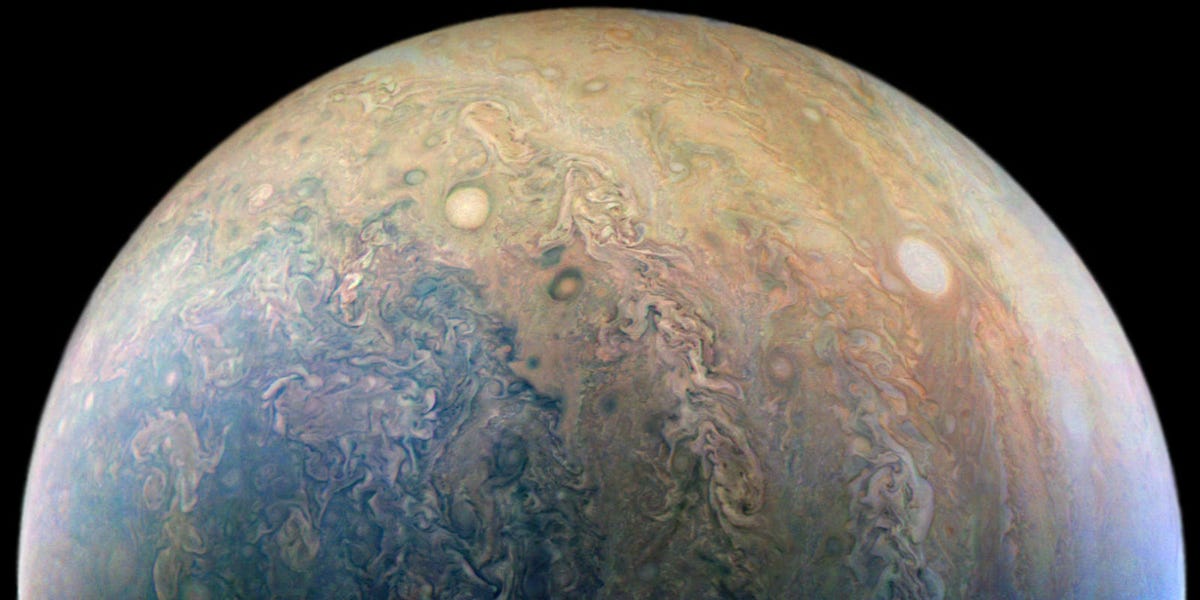

Jupiter has always been the solar system’s show-off: the biggest planet, the fastest spinner, the proud owner of the Great Red Spot, and the kind of world that looks calm from a backyard telescope only because it is 400-plus million miles away. Up close, it is not calm. It is not simple. And thanks to NASA’s Juno mission, it is definitely not the tidy striped gas giant many scientists expected.
When the first Juno science results arrived, they did something great science often does: they politely walked into the room, knocked over several old assumptions, and asked for a bigger whiteboard. Juno revealed a “whole new Jupiter,” filled with Earth-sized polar cyclones, strange deep weather, an uneven magnetic field, mysterious auroras, and hints that the planet’s interior may be much messier than earlier models suggested.
In other words, Jupiter did not merely answer questions. It responded like a dramatic professor: “Interesting theory. Now explain this.”
Why the Juno Mission Matters
NASA launched Juno on August 5, 2011, sending the solar-powered spacecraft on a five-year journey to Jupiter. After a gravity assist from Earth in 2013, Juno arrived at the giant planet in July 2016 and entered a highly elliptical polar orbit. That orbit was the mission’s secret weapon. Instead of circling Jupiter around its equator like a cautious tourist bus, Juno dives over the poles and skims close to the cloud tops before swinging far away again.
This path lets the spacecraft avoid some of Jupiter’s worst radiation belts while still collecting intimate data from a planet that is anything but welcoming. Jupiter’s radiation environment is so intense that spacecraft electronics need special protection. Juno carries its most sensitive components in a titanium vault, which sounds less like a science mission and more like a bank heist against cosmic particles.
The purpose of Juno is bigger than taking stunning pictures, although JunoCam has given the public enough jaw-dropping images to keep desktop wallpapers busy for decades. The mission was designed to investigate Jupiter’s origin, structure, atmosphere, magnetic field, gravity field, water abundance, and polar magnetosphere. Because Jupiter likely formed early in solar system history, understanding it helps scientists understand how the planets, including Earth, came to be.
The First Close Pass Changed the Conversation
Juno’s first major data-collection pass occurred on August 27, 2016. During that flyby, the spacecraft passed within about 3,000 miles of Jupiter’s cloud tops. That may sound far until you remember Jupiter is roughly 11 times wider than Earth. On a planetary scale, Juno was practically brushing the planet’s hair.
The first peer-reviewed results, released in 2017, combined findings from multiple instruments. Scientists used microwave measurements to peer below the clouds, magnetometers to map Jupiter’s magnetic field, gravity measurements to probe the planet’s interior, and particle detectors to study its auroras. The outcome was not one simple discovery but a bundle of surprises, each one tugging on a different thread of Jupiter’s story.
Before Juno, scientists knew Jupiter was complex. What they did not know was just how deeply that complexity ran. The early data showed that the planet’s visible bands are only the beginning, the polar regions are wildly different from the equator, and the interior may not match the neat layered diagrams often found in textbooks.
Surprise #1: Jupiter’s Poles Are Stormy, Strange, and Not Striped
For centuries, observers have associated Jupiter with its famous belts and zones: those creamy, rust-colored stripes that make the planet look like a marbled dessert with weather problems. But before Juno, no spacecraft had flown directly over Jupiter’s poles in a way that could reveal them clearly.
Juno changed that. Its images showed polar regions crowded with enormous cyclones, some comparable in size to Earth. Instead of the familiar horizontal banding seen near the equator, the poles appeared chaotic, bluish, and packed with swirling storms. It was as if Jupiter had been wearing a striped suit for public appearances while hiding a thunderstorm rave under its hat.
This discovery mattered because it challenged assumptions about how heat, rotation, and atmospheric circulation work on gas giants. On Earth, cyclones form and fade based on ocean temperatures, pressure systems, and seasonal energy. On Jupiter, there is no solid surface, the rotation is blisteringly fast, and the atmosphere extends downward into depths that are difficult to define. The stable arrangement of huge polar cyclones suggests powerful atmospheric structures that scientists are still working to explain.
Surprise #2: Jupiter’s Weather Goes Deep
Jupiter’s clouds are beautiful, but they are also sneaky. They hide the machinery below. Before Juno, scientists debated how deep the visible belts, storms, and jet streams might extend. Were the colorful cloud bands shallow weather patterns, or were they connected to deep flows within the planet?
Juno’s microwave radiometer offered a new way to look beneath the top cloud layer. It detected uneven distributions of ammonia, including a deep ammonia-rich region near the equator and ammonia-depleted zones elsewhere. This was unexpected. Many models assumed Jupiter’s atmosphere would be more evenly mixed beneath the visible clouds.
The ammonia pattern suggested that Jupiter’s weather does not operate like a thin painted surface. Instead, storms and circulation systems plunge deep into the atmosphere. The planet’s famous stripes are not just cosmetic. They may be the visible expression of deep, powerful processes moving heat and material through a world made mostly of hydrogen and helium.
What the Ammonia Clues Mean
Ammonia is useful because it affects microwave signals and helps trace atmospheric circulation. Juno found that ammonia was not smoothly distributed from top to bottom. In some places, it seemed to rise from deeper layers; in others, it was depleted. That patchiness points to active vertical motion, possibly including upwelling plumes and sinking regions.
In plain English: Jupiter’s atmosphere is not a calm soup. It is a boiling, spinning, layered, planet-sized science experiment with no off switch.
Surprise #3: The Magnetic Field Is Powerfuland Lumpy
Jupiter’s magnetic field was already known to be enormous. It creates the largest magnetosphere of any planet in the solar system, a vast region shaped by charged particles, the solar wind, and material from the volcanic moon Io. But Juno’s first measurements showed that the field was stronger and more irregular than expected close to the planet.
That irregularity is important. A smooth magnetic field might suggest a dynamo operating deep within the planet in a relatively uniform way. A lumpy magnetic field hints that the dynamothe process generating the fieldmay be occurring closer to the surface or in a more complicated region than scientists once thought.
This forced researchers to rethink Jupiter’s internal structure. Deep inside the planet, hydrogen is squeezed under such immense pressure that it behaves like a metallic fluid, capable of conducting electricity. Motion in that electrically conducting layer is thought to generate the magnetic field. Juno’s data suggested that the details of this process are stranger than expected.
Surprise #4: Jupiter’s Core May Not Be a Neat Ball
One of Juno’s biggest goals was to help answer a classic planetary science question: does Jupiter have a solid core? Older models often pictured the planet as having a compact heavy-element core surrounded by layers of metallic hydrogen and molecular hydrogen. Juno’s gravity measurements complicated that picture.
The first results hinted that Jupiter might not have a sharply defined core at all. Instead, its heavy elements may be spread out across a larger region, creating what scientists often describe as a “dilute” or “fuzzy” core. That phrase may sound adorable, like Jupiter is wearing slippers, but it has serious implications.
A fuzzy core could mean that Jupiter formed differently than expected, or that dramatic events early in solar system history mixed its interior. One possibility is that a large impact in Jupiter’s youth stirred heavy materials outward. Another is that the planet’s formation process naturally produced a more gradual transition between core and envelope. Either way, Juno showed that Jupiter’s interior is not simply a stack of clean layers.
Surprise #5: Jupiter’s Auroras Do Not Behave Like Earth’s
Jupiter’s auroras are spectacular. They glow in ultraviolet and infrared light near the poles, powered by charged particles moving through the planet’s magnetic environment. On Earth, auroras are closely tied to solar wind particles guided by our magnetic field. Jupiter’s auroras are driven by a more complicated system involving the planet’s rapid rotation, intense magnetic field, and plasma supplied by Io.
Juno’s first observations revealed unexpected particle behavior over Jupiter’s poles. Instead of simply copying Earth’s auroral physics on a larger scale, Jupiter played by its own rules. The spacecraft detected electron patterns and energy flows that did not match simple Earth-based analogies.
That is one reason Juno is so valuable. Scientists cannot understand other planets by scaling Earth up like a balloon animal. Jupiter is its own world, with its own physics, and Juno gave researchers the close-up data needed to stop guessing from afar.
How Juno Sees Beneath the Clouds
Juno is not a single camera with wings. It is a carefully equipped science platform. Its instruments include a microwave radiometer for probing atmospheric layers, a magnetometer for mapping magnetic fields, gravity science equipment that uses tiny shifts in spacecraft motion, plasma and energetic particle detectors, ultraviolet and infrared instruments, and JunoCam for visible-light images.
The spacecraft spins as it travels, allowing its instruments to scan Jupiter in strips. During close approaches, Juno gathers data rapidly as it races from north to south over the planet. These encounters are brief but extremely productive. Each pass adds another slice to the three-dimensional puzzle.
Because Juno’s orbit is polar, it can study regions that earlier missions could not see well. Pioneer, Voyager, Galileo, and Cassini all contributed enormously to Jupiter science, but Juno was built to answer different questions. It does not merely look at Jupiter; it weighs, scans, maps, and listens to the giant planet.
Why the First Results Were Such a Big Deal
The excitement around Juno’s first results was not just about pretty pictures, although those certainly helped. The deeper importance was that several independent lines of evidence pointed in the same direction: Jupiter is more dynamic, less uniform, and more internally complex than expected.
That has ripple effects beyond Jupiter. Gas giants are common around other stars. Many of the first exoplanets discovered were massive Jupiter-like worlds, although some orbit much closer to their stars than Jupiter does to the Sun. By understanding Jupiter better, scientists improve their models of giant planets everywhere.
Jupiter also shaped the early solar system. Its gravity influenced the architecture of planetary orbits, affected the asteroid belt, and may have played a role in delivering or redirecting material during planetary formation. Learning what Jupiter is made of and how it formed helps reconstruct the solar system’s childhood. And as every family knows, childhood explains a lot.
The Human Side of a Robotic Mission
One charming part of Juno is how public the mission became. JunoCam images were made available for citizen scientists and image processors, who turned raw data into dramatic portraits of Jupiter’s storms. Many of the most famous Juno images seen online were enhanced by members of the public working with NASA data.
That public involvement matters. Space missions can feel remote, locked behind equations and acronyms. Juno made Jupiter feel alive and immediate. Suddenly, people were not just reading about a gas giant; they were seeing curling clouds, pearl-like storms, blue polar haze, and turbulent bands from a perspective no human eye had ever had before.
Science still depends on careful measurement, peer review, and cautious interpretation. But wonder is fuel too. Juno reminded people that exploration is not only about collecting data. It is also about discovering that a familiar world can become unfamiliar again.
What Juno Taught Scientists About Being Wrong
The best scientific missions do not simply confirm what researchers already believe. They find the cracks. Juno’s first results showed that some models of Jupiter were too smooth, too shallow, or too Earth-centered. That is not a failure. That is the point.
Before Juno, scientists had good reasons for their theories. They used telescopes, earlier flybys, the Galileo orbiter, atmospheric probes, and physics-based models. But Jupiter is difficult to study from a distance. Its cloud tops hide the deeper atmosphere, and its radiation environment makes close measurements challenging. Juno delivered the missing close-up evidence.
When the data arrived, researchers had to revise. The polar storms were more organized and dramatic than expected. The magnetic field was more uneven. The ammonia distribution was stranger. The interior seemed less tidy. Jupiter was not refusing to make sense; it was refusing to fit an oversimplified sense.
Experience: Following Juno’s First Results as a Space Fan
There is a special kind of excitement that comes from watching a space mission move from “artist’s concept” to “actual data.” Before Juno reached Jupiter, the mission existed for most people as diagrams, launch footage, and patient explanations from scientists. Then came arrival, orbit insertion, and the first close passes. Suddenly Jupiter was no longer just the bright object in the night sky. It was a place with weather systems large enough to swallow Earth and physics weird enough to make textbooks sweat.
For many readers, the first experience of Juno’s results probably came through images. You opened a NASA release, a science article, or a social media post and saw Jupiter from above the poles. That view felt wrong in the best possible way. Where were the familiar stripes? Why did the clouds look like cream stirred into coffee by a very energetic giant? Why did the poles look like a storm committee holding an emergency meeting?
That moment captures why planetary exploration matters. A backyard telescope can show Jupiter’s bands and four Galilean moons, which is already magical. But Juno added depth. It revealed that the visible planet is only the opening chapter. The real story continues beneath the clouds, inside the magnetic field, and in the hidden flows that shape the atmosphere.
The Juno mission also offers a useful lesson in patience. Space exploration is not instant gratification. Juno launched in 2011, reached Jupiter in 2016, and began returning results after years of planning, engineering, navigation, and risk management. In an age when people complain if a web page takes four seconds to load, Juno is a reminder that some of humanity’s best answers require five-year journeys and a spacecraft wrapped in radiation armor.
Following the mission can also change how you look at the night sky. Jupiter becomes more than a bright point. It becomes a spinning world with deep ammonia flows, polar cyclones, intense auroras, and a magnetic field so large it dominates a huge region of space. The next time you see Jupiter shining overhead, it may look peaceful. Thanks to Juno, you know better. That dot is a giant, turbulent, fast-spinning laboratoryand it has been keeping secrets for 4.5 billion years.
Perhaps the most enjoyable experience is realizing that surprise is not an obstacle in science; it is the reward. Juno did not make Jupiter less understandable. It made Jupiter more real. Real planets are messy. Real atmospheres are layered. Real magnetic fields wobble, twist, and misbehave. The first results from Juno made Jupiter feel less like a poster and more like a place. A dangerous place, yes. A place where no one is opening a beach resort, absolutely. But a place worth studying because it helps explain where we came from.
Conclusion: Juno Revealed a Wilder Jupiter
The first results from the Juno mission transformed scientists’ view of Jupiter. The spacecraft found enormous polar cyclones, deep atmospheric motion, uneven ammonia distribution, a powerful lumpy magnetic field, strange auroral behavior, and evidence that Jupiter’s interior may be more diffuse than expected. These discoveries did not close the book on Jupiter. They opened several new chapters and added a few dramatic footnotes.
Juno’s achievement is not just that it reached the largest planet in the solar system. It reached Jupiter in a way that allowed scientists to ask better questions. It flew over the poles, skimmed near the clouds, endured radiation, and returned data that made the familiar planet unfamiliar again.
That is the beauty of exploration. Sometimes the world you thought you knew turns around, reveals Earth-sized storms on its poles, and says, “You have been looking at my stripes for centuries. Now let me show you the rest.”