
Note: This article is based on real, publicly reported information from reputable technology, gaming, Microsoft, and industry sources, rewritten as original publication-ready content.
Microsoft has discontinued Kinect again, which sounds a bit like announcing that a ghost has retired. For many gamers, Kinect already “died” years ago when the Xbox motion sensor faded from living rooms, stopped being bundled with consoles, and eventually became that mysterious black bar hiding in a closet next to old HDMI cables and one lonely Wii Remote. But the story did not end there. Kinect came back wearing a business suit, carrying an Azure badge, and calling itself the Azure Kinect Developer Kit.
Now that version has also reached the end of production. Microsoft ended manufacturing of the Azure Kinect Developer Kit, making clear that the company is no longer interested in selling Kinect-branded hardware directly. The technology, however, is not vanishing into the digital afterlife. Parts of Kinect’s depth-sensing DNA continue through partner devices, industrial sensors, mixed reality tools, robotics projects, healthcare applications, and computer vision systems.
So yes, Microsoft discontinued Kinect again. But no, Kinect did not simply fail and disappear. Its story is stranger, smarter, and more influential than that. Kinect was a blockbuster gaming accessory, a misunderstood Xbox One requirement, a hacker playground, an enterprise AI sensor, and finally a technology platform that outgrew its own brand name. Not bad for a camera that once asked people to rearrange their coffee tables so they could jump in front of the television.
What Happened: Microsoft Ends Azure Kinect Production
The latest chapter centers on the Azure Kinect Developer Kit, a compact depth camera and microphone device introduced for developers, researchers, and businesses. Unlike the original Kinect for Xbox 360, Azure Kinect was not designed primarily for dancing games, fitness titles, or shouting “Xbox, pause” while holding a bowl of nachos. It was built for artificial intelligence, spatial computing, computer vision, speech recognition, robotics, healthcare, retail, manufacturing, and media production.
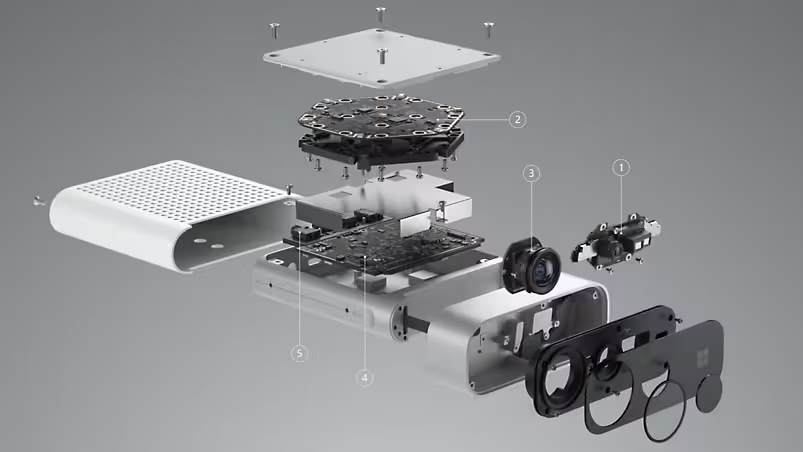
Microsoft positioned Azure Kinect as a developer kit with advanced AI sensors that could connect with Azure AI services. The hardware included a depth camera, an RGB camera, a microphone array, and orientation sensors. In plain English, it could see space, detect people, understand movement, capture sound, and provide data that software could use to interpret the physical world.
The key update is that Microsoft stopped producing the Azure Kinect Developer Kit. Existing users were told they could continue using their devices, and the software development kit remained available for download. But if a company wanted a long-term depth-camera solution, Microsoft pointed customers toward partner products rather than a new Microsoft-made Kinect device.
That shift matters because it shows Microsoft is not abandoning the underlying technology. Instead, the company is stepping away from first-party Kinect hardware. Think of it as Microsoft saying, “We invented the recipe, but someone else can run the restaurant.”
A Quick History of Kinect: From Living Room Star to Enterprise Sensor
The Xbox 360 Era: Kinect Becomes a Phenomenon
Kinect launched for Xbox 360 in 2010 with a promise that sounded futuristic at the time: you are the controller. No gamepad. No wand. No plastic guitar. Just your body, your voice, and enough living-room space to avoid kicking a lamp.
The device used cameras, infrared sensing, microphones, and software to track body movement and voice commands. It turned players into on-screen avatars, made dance games feel surprisingly natural, and gave families a reason to wave at the television without anyone calling it strange. Kinect Adventures, Dance Central, Kinect Sports, and fitness games became early showcases for motion-controlled entertainment.
Commercially, Kinect started like a rocket. It became one of the fastest-selling consumer electronics accessories of its time, selling millions of units shortly after launch. For a moment, it looked like Microsoft had found the next major interface for gaming. The controller was not dead, but it had definitely been asked to share the couch.
The Hacker and Maker Community Loved Kinect
While mainstream gamers were bowling in their socks, developers and hardware hackers saw something even more exciting: an affordable depth-sensing camera. Before Kinect, similar technology was often expensive and difficult to access. Kinect gave artists, roboticists, researchers, educators, and experimental programmers a relatively cheap way to capture motion and map space.
That sparked a wave of creative projects. People used Kinect for 3D scanning, interactive installations, robot navigation, gesture control, medical experiments, digital puppetry, augmented reality prototypes, and accessibility tools. In some ways, Kinect became more important outside the Xbox ecosystem than inside it. The device was a consumer product, but its soul belonged to the lab, the studio, and the workshop.
The Xbox One Problem: Mandatory Hardware Meets Market Reality
Kinect’s biggest stumble came with Xbox One. Microsoft initially bundled Kinect with every Xbox One console, helping push the launch price higher than Sony’s PlayStation 4. That decision created a major perception problem. Some players liked voice commands and motion features, but many simply wanted a powerful game console at a competitive price.
There were also privacy concerns. A camera and microphone sitting in the living room made some users uncomfortable, even when Microsoft explained how the system worked. Add in the broader Xbox One launch controversies around online requirements and used games, and Kinect became tangled in a messy public-relations knot.
In 2014, Microsoft began selling an Xbox One option without Kinect. That move lowered the console price and gave customers more choice. It also signaled that Kinect was no longer central to the Xbox strategy. Once the device was optional, game developers had less incentive to build major Kinect-only experiences. A peripheral works best when many users own it; once the audience shrinks, the software pipeline usually shrinks with it.
Why Microsoft Discontinued Kinect the First Time
The first major discontinuation came when Microsoft stopped manufacturing Kinect hardware for Xbox. The reasons were practical rather than dramatic. Kinect was clever, but it did not become essential for most console players. Traditional controllers remained faster, more precise, and more comfortable for the majority of games. Motion control was fun for dancing, fitness, party games, and novelty experiences, but it did not replace the standard gamepad.
The hardware also created design challenges. Developers had to account for room size, lighting conditions, body tracking limitations, and different user abilities. Many players did not have enough open space. Others simply did not want to stand up after a long day. Gaming culture had room for motion controls, but not every night is a “move the coffee table and perform cardio” night.
Another issue was value. When Kinect was bundled with Xbox One, players who did not want it still paid for it. When it was sold separately, fewer players bought it. That put Microsoft in a difficult position: Kinect needed broad adoption to attract developers, but broad adoption was hard without bundling, and bundling made the console less competitive. That is a classic hardware trap, and Kinect walked right into it wearing tap shoes.
Azure Kinect: The Comeback Nobody Saw Coming
After Kinect faded from Xbox, Microsoft revived the brand in a more serious form. Azure Kinect Developer Kit arrived as a compact AI sensor platform for businesses and developers. Instead of asking players to jump, it asked engineers to build systems that could understand people, places, motion, and space.
Azure Kinect was tied to Microsoft’s broader interests in cloud computing, artificial intelligence, edge devices, mixed reality, and enterprise software. Its depth-sensing technology was related to work used in HoloLens 2, Microsoft’s mixed reality headset. The new Kinect was smaller than earlier versions and aimed at practical applications rather than living-room entertainment.
Possible uses included patient fall detection in healthcare, worker safety monitoring in industrial settings, exercise tracking, retail analytics, robotics perception, volumetric video capture, and interactive digital signage. In other words, Kinect grew up. It traded “Dance Central” for “spatial data pipeline,” which is less catchy at parties but more useful in enterprise planning meetings.
Why Microsoft Discontinued Kinect Again
The end of Azure Kinect production does not appear to be a simple case of failure. It looks more like a strategic handoff. Microsoft built valuable sensing technology, proved its usefulness, and then moved toward a partner ecosystem rather than continuing to sell its own developer kit.
That makes business sense. Hardware is difficult. Manufacturing devices requires supply chains, inventory management, warranties, support channels, and long-term component planning. Microsoft is a massive hardware company in some areas, but its biggest strengths today are cloud services, AI platforms, developer tools, enterprise software, operating systems, and partnerships.
By encouraging companies such as Orbbec, Analog Devices, and industrial sensor makers to build on related depth-sensing technology, Microsoft can keep the ecosystem alive without carrying the full burden of a niche hardware product. Customers that need depth cameras can look to specialized vendors. Microsoft can focus on Azure, AI services, mixed reality software, and the broader platform layer.
This is the real meaning behind “Microsoft discontinues Kinect, again.” The branded device is ending, but the sensing ideas behind it are being absorbed into other products and industries.
What This Means for Developers and Businesses
For developers already using Azure Kinect, the news is inconvenient but not immediately catastrophic. Existing devices can still function, and the SDK has remained available. However, long-term planning becomes more complicated. If a robotics lab, hospital system, media studio, or industrial automation team built a workflow around Azure Kinect hardware, it now needs a migration strategy.
The most obvious path is partner hardware. Some replacement options use similar depth-sensing modules or provide software bridges to help developers move applications. But migration is rarely a perfect copy-and-paste job. Teams may need to test field of view, depth accuracy, synchronization, operating-system support, SDK compatibility, mounting options, lighting performance, and long-term supply availability.
For businesses, the lesson is simple: developer kits are not the same as permanent infrastructure. A developer kit is excellent for prototyping, research, and proof-of-concept work. But once a system becomes mission-critical, organizations need a hardware roadmap, support guarantees, backup suppliers, and a plan for replacement parts. Kinect’s second discontinuation is a reminder that even exciting technology needs boring procurement discipline. Boring, unfortunately, is often what keeps projects alive.
What This Means for Gamers
For gamers, the latest discontinuation is more symbolic than practical. Kinect had already been absent from modern Xbox strategy for years. Xbox Series X and Series S do not support Kinect as a native accessory, and the modern Xbox platform is focused on traditional games, Game Pass, cloud gaming, cross-platform services, and controller-based experiences.
Still, Kinect left a cultural mark. It was one of Microsoft’s boldest attempts to change how people interact with games and entertainment. It made voice commands feel futuristic before smart speakers became common. It helped popularize full-body tracking in the home. It brought families into games that might otherwise have intimidated them. And yes, it also produced plenty of awkward living-room moments, which are an underrated part of gaming history.
The funny thing is that many Kinect ideas eventually became normal elsewhere. Face recognition, depth cameras, gesture tracking, spatial mapping, voice assistants, and body-aware software all became part of modern technology. Kinect may not have won the console war, but it helped teach the tech industry how machines could perceive human space.
Kinect’s Legacy: Bigger Than Xbox
Kinect is often remembered as a failed gaming accessory, but that label is too small. The device was a commercial hit at launch, a creative tool for developers, and a stepping stone for computer vision. Its technology influenced mixed reality, depth sensing, facial recognition, gesture interfaces, and AI-powered spatial awareness.
HoloLens, Windows Hello-style authentication, volumetric capture systems, robotics experiments, and modern depth-camera products all exist in a world Kinect helped shape. It lowered the cost of experimentation and made depth data feel accessible. That matters. Many technologies do not succeed exactly as first imagined, but they still push the industry forward.
Kinect’s journey also shows how product timing can make or break an idea. In 2010, motion gaming was exciting. In 2013, a mandatory living-room camera felt risky and expensive. In 2019, AI and spatial computing made depth sensing valuable again. By 2023, specialized partner hardware made more sense than a Microsoft-branded kit. The same core technology moved through different markets, wearing a different outfit each time.
Why Kinect Still Matters in the Age of AI
Artificial intelligence is hungry for context. A chatbot can process text, but a robot, smart display, healthcare monitor, or mixed reality headset needs to understand the physical world. That means recognizing people, estimating distance, tracking movement, mapping rooms, detecting objects, and interpreting activity safely and accurately.
Kinect was built around that challenge long before “AI everywhere” became the default tech slogan. Its depth camera helped computers understand not just what a scene looked like, but how that scene was arranged in space. That is incredibly useful for robotics, accessibility, training simulations, fitness coaching, industrial safety, and immersive media.
Today, computer vision can use standard cameras, machine learning models, phone sensors, lidar, radar, and specialized depth cameras. Kinect is no longer the only affordable doorway into spatial computing. But it was one of the first devices that made people say, “Wait, my computer can understand where I am in the room?” That realization helped change expectations.
The Business Lesson: Innovation Is Not Always a Straight Line
The Kinect story is a great case study in how innovation actually works. It is not a clean staircase where every product becomes bigger, better, and more profitable. Sometimes a technology launches in one market, struggles in another, finds a second life elsewhere, then gets absorbed into a broader ecosystem.
Microsoft’s decision to discontinue Kinect again does not erase the product’s achievements. It highlights a common pattern in tech: the brand dies, the idea survives. The original PalmPilot disappeared, but smartphones absorbed the personal digital assistant. The iPod faded, but digital music became the air we breathe. Kinect hardware is gone, but depth sensing and spatial intelligence are everywhere.
For Microsoft, Kinect’s legacy fits neatly into its current direction. The company is focused on AI, cloud services, enterprise platforms, and partner ecosystems. Selling a niche depth camera under the Kinect name may not be essential anymore. Enabling other companies to build sensors while Microsoft provides software, AI tools, and cloud infrastructure is much closer to the company’s modern playbook.
Experiences Related to Microsoft Discontinues Kinect, Again
The experience of following Kinect over the years feels like watching a talented actor get repeatedly cast in the wrong movie before finally finding a better role off-Broadway. For many Xbox 360 owners, Kinect began as pure magic. You stood in front of the TV, waved your hand, and the system recognized you. You played a dance game and suddenly discovered that your “natural rhythm” had been exaggerated on your résumé. Families laughed, kids jumped, parents joined in, and living rooms briefly became tiny fitness studios with snack breaks.
Then came the Xbox One era, and the mood changed. What once felt optional and playful started to feel mandatory and expensive. Some players enjoyed saying voice commands, signing in automatically, or using Skype with the camera. Others looked at the sensor and thought, “I paid extra for this, and I mostly use it to tell my console to stop listening.” The experience became divided. Kinect fans saw convenience and possibility. Skeptics saw cost, clutter, privacy questions, and not enough must-play games.
Developers had a different relationship with Kinect. For them, the device was less about entertainment and more about access. A student building a robot, an artist creating an interactive wall, or a researcher tracking human movement could suddenly experiment with depth sensing without needing a giant budget. That was powerful. Kinect made advanced sensing feel reachable. It invited tinkering. It made people stay up too late testing skeleton tracking in messy rooms while telling themselves, “Just one more calibration.” Famous last words.
Azure Kinect created another kind of experience: cautious excitement. Businesses and researchers saw a compact device that could support serious applications. Healthcare teams could imagine fall detection. Fitness platforms could analyze posture. Manufacturers could explore safety monitoring. Media creators could capture volumetric video. But enterprise users also think in timelines, warranties, supply chains, and support windows. When Microsoft ended production, those users did not just feel nostalgia. They had practical questions: Can we buy replacements? Will the SDK remain usable? Which partner device is closest? How much engineering time will migration require?
That is why this second discontinuation feels different from the first. The Xbox Kinect ending was about consumer demand. Azure Kinect ending is about ecosystem maturity and hardware strategy. For gamers, it is a memory. For developers, it is a migration task. For Microsoft, it is a shift from selling a device to enabling a market.
The most lasting experience Kinect gave people was a glimpse of a more natural computer interface. It was imperfect, sometimes goofy, and occasionally frustrating, but it made technology feel physical. It asked computers to meet humans in human space, not just through keyboards, mice, and controllers. That idea is still alive in AI cameras, smart sensors, mixed reality, robotics, and accessibility tools. Kinect may be discontinued again, but its best trick was never the hardware. Its best trick was making people believe machines could understand movement, space, and presence. That trick is still very much on stage.
Conclusion: Kinect Is Gone, but Its Ideas Are Everywhere
Microsoft discontinuing Kinect again closes another hardware chapter, but it does not close the story. The original Kinect changed gaming for a moment, inspired developers for years, and helped bring depth sensing into mainstream conversation. Azure Kinect then carried the concept into AI, robotics, healthcare, media, and industrial computing.
The Kinect brand may now belong mostly to tech history, but its influence is alive in devices and systems that sense space, recognize people, track motion, and blend digital intelligence with the physical world. Microsoft may no longer want to manufacture Kinect hardware, but the world Kinect imagined is becoming more normal every year.
In the end, Kinect did not fail because the idea was bad. It struggled because the right idea arrived in the wrong packages at different times. As a mandatory console accessory, it was too much. As a developer sensor, it was useful but niche. As a foundation for modern spatial computing, it was ahead of the curve.
So when we say Microsoft discontinued Kinect again, we should add one important detail: the device is gone, but the vision is not. The camera bar may be retired, but the technology it helped popularize is still watching the future take shape.