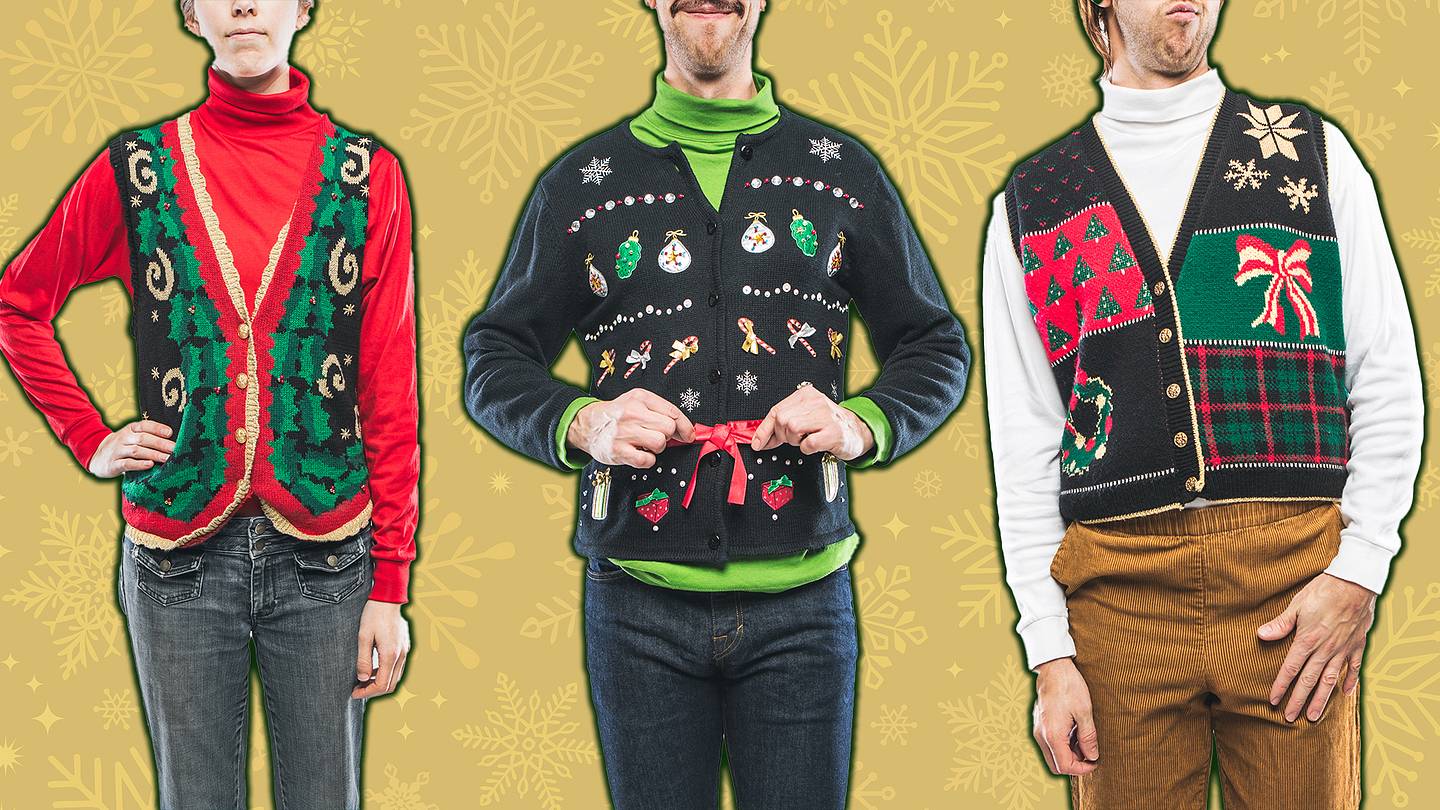

Some holiday traditions arrive with solemn music and candlelight. The ugly Christmas sweater barged through the door wearing battery-powered antlers, three pounds of tinsel, and a pom-pom snowman placed where no snowman should ever be placed. Once treated as the unfortunate result of a well-meaning relative and an overconfident craft-store visit, these loud knits are now a December uniform.
Ugly Christmas sweaters have become party invitations, office icebreakers, social media props, charity fundraisers, retail products, and miniature wearable comedy stages. Their triumph is especially strange because the entire idea depends on celebrating bad taste. Yet that contradiction is precisely the point. In a season packed with polished family photos, carefully wrapped gifts, and ambitious tablescapes, tacky holiday knitwear gives everyone permission to loosen the ribbon.
Before the “Ugly”: Christmas Sweaters Were Earnest
The earliest festive sweaters were not designed to make anyone laugh. Mid-20th-century holiday knits featured familiar winter images such as snowflakes, reindeer, trees, bells, and Santas. Their designs were generally quieter than today’s blinking, jingling, three-dimensional creations. Smithsonian’s look at vintage examples traces garish holiday knitwear across decades from the 1940s through the 1980s, while fashion histories place its commercial rise in the postwar period.
A sweater with a stitched reindeer was once simply seasonal clothing, much like a plaid scarf or red cardigan. The garment did not become “ugly” until fashion moved on and people began looking backward. Yesterday’s wholesome knit became tomorrow’s visual punch line.
The 1980s Turned the Volume to Eleven
If the 1950s supplied the basic recipe, the 1980s added an industrial-size jar of sprinkles. Holiday sweaters grew brighter, busier, and more dimensional. Sequins, metallic thread, appliqués, pom-poms, oversized motifs, and bold color clashes fit neatly into a decade already famous for excess. Television personalities and fictional characters helped normalize expressive knitwear, while the broader culture embraced clothes that were not shy about entering a room before their owners did.
The result was a recognizable aesthetic: red and green fighting for territory, a snowman with suspiciously large buttons, and at least one gold star capable of interfering with nearby radio signals.
The 1990s Put the Sweater in Fashion Exile
By the 1990s, festive knits looked increasingly dated. Minimalism and casual cool did not leave much space for a cardigan covered in stuffed elves. Christmas sweaters became associated with older relatives, awkward family gatherings, and gifts accepted with a smile that said, “How thoughtful,” while the eyes quietly searched for a receipt.
Pop culture captured that embarrassment perfectly. In the 2001 movie Bridget Jones’s Diary, Mark Darcy’s large reindeer sweater works as an instant character gag: respectable man, deeply questionable knit. The sweater was funny because it was uncool. That distinction would soon collapse.
The Party That Changed Holiday Fashion
Accounts vary slightly on the exact year, but the modern ugly sweater party is widely traced to Vancouver around 2001 or 2002. Organizers invited guests to hunt down their worst seasonal knitwear and wear it proudly. What began as a deliberately cheesy gathering offered a perfect social formula: low stakes, easy participation, instant conversation, and photographs that became funnier with every additional reindeer.
The concept spread because it solved a recurring holiday problem. Traditional parties can create pressure to look elegant, purchase a new outfit, and perform seasonal sophistication. An ugly Christmas sweater party reverses the rules. The person who looks the least polished may win a trophy. Bad matching becomes good planning. A dangling ornament is not a wardrobe malfunction; it is a competitive advantage.
Irony Made It Cool, but Joy Made It Last
The first wave of the revival leaned heavily on irony. Young adults raided thrift stores for sweaters that looked dated, then wore them with a wink. But irony alone rarely sustains a tradition for decades. Ugly Christmas sweaters lasted because they became genuinely enjoyable.
They offer nostalgia without requiring historical accuracy. A sweater can remind someone of childhood holidays, old television specials, handmade gifts, school concerts, or a grandparent’s closet even when the garment itself was manufactured last month. It creates a warm, fuzzy memory cloudsometimes literally fuzzy, depending on how much synthetic garland is attached.
They also reduce social friction. At a mixed office party, people may have little to discuss beyond deadlines and weather. Put a colleague in a sweater showing Santa riding a taco through space, and conversation is no longer a scarce resource.
How Ugly Christmas Sweaters Became Big Business
By 2010, American local news outlets were already describing ugly sweater parties as a growing holiday tradition. Retailers quickly recognized that customers no longer wanted only authentic vintage mistakes; they also wanted brand-new garments engineered to look hilariously wrong. By 2015, CBS reported that one specialty seller expected about $5 million in sales while competing with major department and discount chains.
This changed the meaning of “ugly.” A true vintage sweater may be accidentally excessive. A modern commercial version is carefully designed by professionals whose job is to answer questions such as, “Can the llama wear sunglasses?” and “Would this need more bells?” The ugliness is strategic, tested, licensed, and available in multiple sizes.
Fandom Gave the Trend Infinite Fuel
Once retailers combined festive knit patterns with movies, television shows, sports teams, musicians, video games, and internet humor, the market became nearly endless. Customers no longer had to choose between personal identity and holiday absurdity. They could wear both at once.
That crossover also turned ugly sweaters into collectibles. Limited editions tied to entertainment franchises, nostalgic characters, or technology brands can become seasonal memorabilia. The sweater acts as a wearable signal: “I celebrate the holidays, I understand this reference, and I am comfortable being photographed in public.”
Luxury Joined the Joke
No fashion trend is truly safe from escalation. One crystal-covered novelty sweater was valued at $30,000 and reportedly used more than 24,000 Swarovski crystals. Rapper 2 Chainz later offered a $90,000 Christmas sweater featuring diamonds and gold, with proceeds connected to charity. At that price, the garment stops being an ugly sweater and becomes a highly festive home-equity decision.
High fashion has also played with festive knitwear, proving that the border between chic and ridiculous is less a wall than a strand of tinsel taped to the floor. Designers have repeatedly borrowed Fair Isle patterns, ski-lodge imagery, Santa motifs, and exaggerated seasonal graphics.
National Days, Charity Drives, and the Social Power of Looking Silly
National Ugly Christmas Sweater Day, observed on the third Friday in December, emerged in 2011 as a formal excuse to celebrate outrageous holiday clothing. The occasion helped transform a party theme into a recurring public ritual embraced by schools, offices, families, bars, and community groups.
Charity made the trend more meaningful. Save the Children launched Christmas Jumper Day in 2012, encouraging participants to wear festive sweaters and donate. The organization reports that the campaign has raised more than £42 million since it began. Although the campaign is based in the United Kingdom, its formulawear something silly and contribute something usefulhas inspired similar workplace and community fundraisers internationally.
This pairing works because visible participation encourages group momentum. A donation request can be easy to ignore. A room full of coworkers dressed like malfunctioning Christmas trees is harder to overlook. The clothing turns generosity into an event, and the event turns individual donations into shared culture.
Why the Trend Thrives on Social Media
Ugly Christmas sweaters were practically waiting for social media to be invented. They are colorful, instantly understandable, easy to compare, and designed for visual exaggeration. A good sweater can be recognized in a thumbnail. A great one includes moving parts.
Contests translate naturally online. People can vote for the funniest, most creative, most nostalgic, or most aggressively illuminated sweater. Families use matching designs for holiday cards. Companies use them for team photographs. Creators use them as seasonal content. Each image encourages someone else to build, buy, borrow, or rescue an even louder design.
The trend also benefits from an annual reset. Many fashion crazes weaken when everyone has seen them. Ugly sweaters return after roughly eleven months away, refreshed by new jokes, new characters, and new reasons to attach battery packs to knitwear.
The Sustainability Question: Funny Should Not Mean Disposable
The commercial success of ugly Christmas sweaters creates an awkward environmental question. A garment worn once for a party and discarded immediately afterward is less charming than the same sweater reused for years. Fortunately, the tradition’s thrift-store roots offer a better model.
Goodwill promotes secondhand holiday clothing, including ugly sweaters, as an affordable way to create distinctive seasonal outfits. The U.S. Environmental Protection Agency recommends donating gently worn clothing and checking local options for textile recycling when items are damaged. In other words, the greenest ugly Christmas sweater may be the one already waiting in a closet, thrift store, swap bin, or relative’s attic.
How to Keep the Tradition Cheerfully Circular
Start with an existing sweater rather than buying a new one for a single evening. Add removable decorations such as felt shapes, bows, ribbon, fabric patches, or safety-pinned ornaments. Swap sweaters with friends each year. Store the contest winner and bring it back as a defending champion. Donate wearable pieces instead of throwing them away.
Reusable design is not only more responsible; it is often funnier. “I bought this” is a sentence. “The train around my waist worked until someone sat on the remote” is a holiday legend.
How to Build an Ugly Christmas Sweater That Actually Wins
Choose One Strong Comic Idea
The best ugly Christmas sweaters are busy, but they are not always random. A clear concept gives the chaos structure. Try “Santa on vacation,” “reindeer office party,” “gingerbread disaster,” or “Christmas tree with technical difficulties.” Then exaggerate the theme until subtlety files a formal complaint.
Use Texture, Movement, and Sound Carefully
Flat graphics can be funny, but dimensional details make a sweater memorable. Pom-poms become ornaments. Felt becomes snow. Tinsel creates motion. Battery-powered lights add drama. Bells add sound, although they also ensure that everyone can track your location near the snack table.
Make It Wearable for More Than Seven Minutes
A winning sweater still needs to fit through doors. Keep decorations away from the face, avoid sharp edges, secure battery packs, and make sure nothing blocks normal movement. Check the care label before adding glue or heat. Most importantly, do not attach real candles. “Festive” and “flammable” should not be treated as synonyms.
Let the Contest Reward Creativity, Not Spending
Hosts can create categories such as Best Thrifted Find, Best DIY Design, Best Use of Lights, Funniest Theme, Best Group Outfit, and Most Likely to Frighten a Mall Santa. Multiple awards keep the event inclusive and prevent one person with a luxury novelty sweater from purchasing the electoral college.
The Ugly Sweater Experience: One Night Inside the Holiday Phenomenon
Picture the typical scene. You arrive at a December party wearing a normal coat over an abnormal sweater. For a moment, you hesitate at the door. The knitted moose across your chest has one googly eye, the other having disappeared during transit. A strand of battery-powered lights runs from your shoulder to a hidden switch near your pocket. You press it. Nothing happens. You press it again. The moose begins blinking like it has urgent news.
Inside, the room has abandoned every accepted rule of visual harmony. One guest is wearing a fireplace, complete with felt stockings. Another has transformed into a human Christmas tree and must rotate carefully to avoid sweeping cups off tables. Someone’s sweater plays music every time its owner moves, which seemed brilliant at home and now feels like a labor dispute.
The first surprise is how quickly strangers start talking. Ordinary party clothes reveal taste, status, or effort; ugly sweaters reveal a joke. People ask where you found yours, whether you made it, and why the moose appears emotionally overwhelmed. The garment becomes a social shortcut. Nobody needs a clever opening line because the knitwear has already shouted one.
The second surprise is that competition becomes both serious and ridiculous. Guests inspect construction methods. Hand stitching earns respect. Working lights earn applause. A three-dimensional chimney receives the kind of attention normally reserved for architectural landmarks. Yet the mood stays generous because the achievement being judged is intentional absurdity. Losing does not sting when the champion is wearing a motorized Santa circling a bowl of cotton-ball mashed potatoes.
Then comes the group photograph. Everyone squeezes together while antlers collide, bells ring, and at least one decorative element detaches. The polished holiday portrait is replaced by something better: a visual record of adults giving themselves permission to look foolish together.
That shared permission is the real experience behind the trend. Ugly sweater events flatten social differences for an evening. The manager, the new employee, the quiet cousin, and the neighbor nobody knows well can all participate through the same simple act. The clothes are deliberately unserious, but the connection can be genuine.
There is usually a practical lesson, too. Lights become warm. Tinsel migrates into food. Bells lose their charm during long conversations. Large attachments complicate hugs. The experienced participant learns to build for comfort, carry spare batteries, and avoid any design requiring an extension cord.
At the end of the night, the sweater comes off with a faint jingle and perhaps a little relief. But it also carries a story home. Next year, it may return with repairs, upgrades, or a new missing eye. That repeat appearance is part of the pleasure. The sweater becomes a seasonal character, and wearing it again feels less like repeating an outfit than reviving a running joke.
Conclusion: The Joke Became a Tradition
Ugly Christmas sweaters took over the holiday season because they combine nostalgia, humor, creativity, commerce, charity, and community in one spectacularly crowded garment. They turn outdated fashion into playful self-expression and transform the pressure to look perfect into an invitation to be memorable.
The trend’s staying power also reveals something generous about holiday culture. People do not always need another elegant tradition. Sometimes they need a reason to laugh with coworkers, dig through a thrift rack, decorate an old sweater with their children, or raise money while dressed as a sequined reindeer. The ugly Christmas sweater succeeds not despite its bad taste, but because it makes room for everyone to join the joke.
So wear the knit. Fix the lights. Reuse it next year. And remember: if your sweater can still pass through a standard doorway without turning sideways, there may be room for one more pom-pom.
SEO Tags
Note: This article was developed from historical, cultural, retail, charitable, fashion, and sustainability reporting and rewritten as original web content.