
Note: This article is written for web publishing in standard American English and is based on reputable scientific information from NASA, NASA Jet Propulsion Laboratory, Nature Geoscience, and other established science references. Key facts include NASA’s Phoenix lander detecting water-ice snow, NASA’s Mars Reconnaissance Orbiter identifying carbon-dioxide snowfall, and current research on Martian ice, frost, clouds, and climate.
Snow on Mars sounds like the opening line of a science-fiction novel: “The astronaut looked up, and the Red Planet was wearing a sweater.” But this is not fantasy. Snow can fall on Mars, and scientists have evidence for it. The catch, because Mars loves making simple things weird, is that Martian snow does not always behave like the cozy white stuff people shovel from driveways on Earth. Some of it is made of water ice. Some of it is made of carbon dioxide, also known as dry ice. Some flakes may never reach the ground. Others may settle over polar landscapes where the temperature makes Antarctica look like a beach vacation.
That is what makes the topic so fascinating. Mars is often described as dry, dusty, and harsh, which is accurate, but not complete. It has clouds. It has frost. It has polar caps. It has seasonal changes. It has a water cycle, although a very thin, chilly, and Martian version of one. If Earth’s weather is a full orchestra, Mars is a lonely trumpet playing in a dust stormbut it is still music.
Can It Really Snow on Mars?
Yes, it can snow on Mars. NASA has reported two major kinds of Martian snow: water-ice snow and carbon-dioxide snow. Water-ice snow is closer to the snow we know on Earth, but Mars’ atmosphere is so thin that much of it can turn directly into vapor before it reaches the surface. Carbon-dioxide snow, or dry-ice snow, can actually reach the ground, especially near the poles during the long Martian winter.
The most famous direct detection came from NASA’s Phoenix Mars Lander in 2008. Phoenix used a laser instrument to observe snow falling from clouds about 2.5 miles above its landing site near the Martian north pole. The data showed that the snow was falling from the clouds but vaporizing before it touched the ground. That is still snowfalljust the dramatic, vanishing-entrance version.
Later, NASA’s Mars Reconnaissance Orbiter added another strange chapter to the story. Its Mars Climate Sounder instrument detected carbon-dioxide ice clouds and evidence of dry-ice snowfall near the south pole. Scientists found that the particles were large enough to fall during the lifetime of the clouds, and observations suggested some of those icy particles reached the surface.
Why Martian Snow Is So Different From Earth Snow
On Earth, snow forms when water vapor in the atmosphere freezes into ice crystals that grow and fall. On Mars, the basic idea is similar, but the ingredients and conditions are wildly different. Mars has a thin atmosphere made mostly of carbon dioxide, with smaller amounts of nitrogen and argon. Its low air pressure and frigid temperatures change how ice forms, falls, and disappears.
Earth snowflakes are famous for six-sided symmetry. Mars, being the overachieving oddball in the back of the solar-system classroom, can produce dry-ice snowflakes with four-sided symmetry. NASA scientists have noted that carbon-dioxide ice crystals would likely be cube-shaped and smaller than the width of a human hair. Imagine a snowstorm made of microscopic frozen dice. It is adorable until you remember it is happening in temperatures that could freeze machinery stiff.
Water-Ice Snow
Water-ice snow on Mars forms from water vapor, just as it does on Earth. The big difference is that Mars does not have a thick atmosphere to help keep snow stable near the surface. Because the air is thin and dry, falling water-ice snow can sublimate, meaning it changes directly from solid ice into vapor. That is why Phoenix saw snow falling but not necessarily piling up like a holiday postcard.
Carbon-Dioxide Snow
Carbon-dioxide snow is the more alien version. On Earth, dry ice is something you might see making theatrical fog at a school play or Halloween party. On Mars, carbon dioxide is the main ingredient of the atmosphere, and in winter it can freeze out of the air. In polar regions, carbon-dioxide frost and snow help form seasonal ice caps that advance and retreat over the Martian year.
Where Does Snow Fall on Mars?
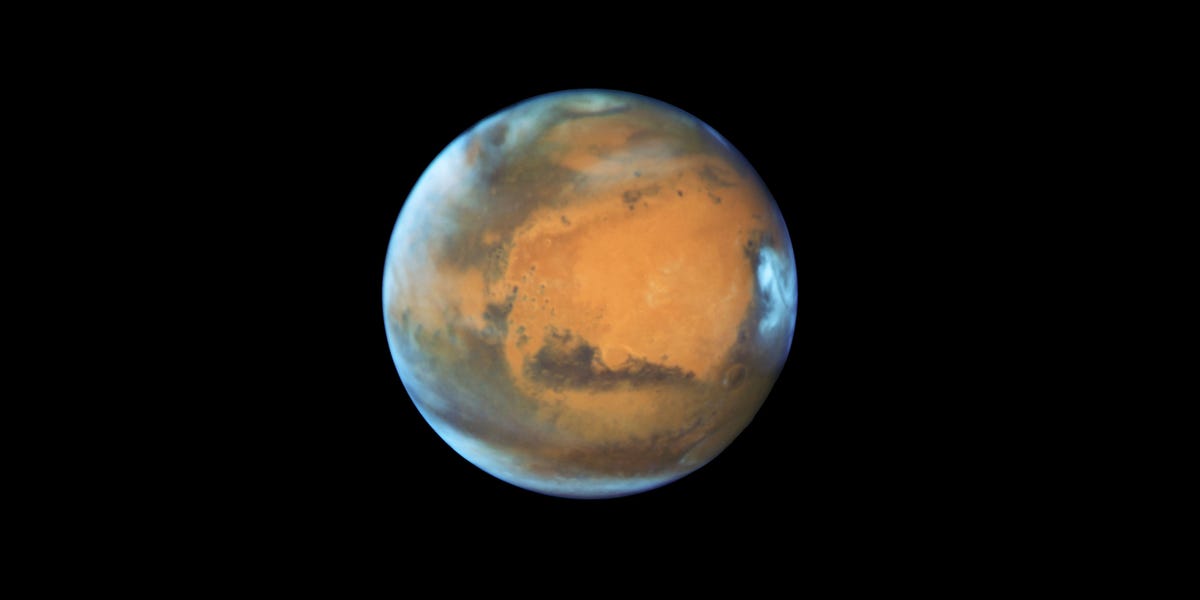
Martian snow is most closely associated with polar regions. NASA’s Phoenix lander observed falling water-ice snow near the north pole, while Mars Reconnaissance Orbiter data showed carbon-dioxide snowfall near the south pole. These are the places where temperatures become cold enough for ice to form and persist, at least seasonally. The Red Planet’s poles are not just scenic caps in telescope images; they are active climate records.
The south polar region is especially important for dry-ice snow. Mars’ south polar residual cap is the only place where frozen carbon dioxide persists on the surface year-round. Seasonal carbon-dioxide deposits also expand during winter, creating bright frost-covered landscapes that can look surprisingly wintry in spacecraft images.
That said, frost is more common than true snowfall. NASA notes that both water and carbon dioxide can form frost on Mars, and frost appears more widely across the planet than snow. Viking landers saw water frost decades ago, and NASA’s Odyssey orbiter has observed frost forming and vanishing in morning sunlight.
Martian Weather: Thin Air, Big Drama
Mars weather is not “boring desert weather.” It is more like desert weather after being sent through a cosmic freezer and sprinkled with dust. The Martian atmosphere is thin, so heat escapes easily. Temperatures can swing dramatically, and the sky often looks hazy and reddish because of suspended dust. Mars can also have clouds, fog, frost, dust storms, and seasonal ice deposits.
Because Mars has such low air pressure, liquid water cannot remain stable on the surface for long. That matters because snow and ice are part of the larger story of water on Mars. Today, water exists mostly as ice: in polar caps, underground deposits, frost, clouds, and possibly briny seasonal flows. Snow is not just a charming weather event; it is a clue in the planet’s long, complicated water history.
How Scientists Know Snow Falls on Mars
Scientists do not need to build a tiny snowman on Mars to prove snowfall exists, although let us admit that would be excellent for morale. Instead, they use instruments on landers and orbiters. Phoenix used a lidar, a laser-based instrument, to detect particles falling from clouds. Mars Reconnaissance Orbiter used infrared measurements to study cloud particles, temperatures, and atmospheric structure.
Orbital instruments can tell whether clouds contain water ice or carbon-dioxide ice by studying how particles absorb and emit light. The Mars Climate Sounder, for example, measured cloud properties and helped scientists determine that carbon-dioxide particles were large enough to fall. This is a detective story told in wavelengths, particle sizes, and temperature profilesnot footprints in the snow.
The Role of Nighttime Snowstorms
Research published in Nature Geoscience found that localized convective snowstorms may occur in Martian cloudy regions at night. In the simulations, water-ice cloud particles cool after sunset, triggering atmospheric instability and fast snow precipitation. These “ice microbursts” could help explain observations from Phoenix and the mixing layers detected by orbiters.
That sounds intense because it is. Martian snow is not necessarily a gentle, postcard-style fall. Some of it may happen quickly, locally, and at night, driven by cold cloud particles and descending currents. Mars may be quiet, but when it whispers, it does so in physics.
Why Mars Snow Matters
Snow on Mars matters because it connects climate, geology, water, and future exploration. Every flakeor microscopic frozen cubehelps scientists understand how material moves between the atmosphere and the surface. Mars is not frozen in time. It is still changing, season by season and year by year.
Mars Odyssey has helped show that water ice moves among polar caps, the atmosphere, the surface, frost, clouds, and ground ice. Understanding this movement helps scientists reconstruct the planet’s past climate and prepare for future human missions. Water ice could be useful for astronauts, not as a luxury snow-cone ingredient, but as a resource for drinking water, oxygen, and possibly fuel production.
Snow and frost also reshape the Martian surface. Seasonal carbon-dioxide frost has been linked to gullies, dunes, gas-driven eruptions, and shifting material. NASA observations suggest some gullies form during winter through carbon-dioxide frost activity rather than liquid water. That is a major lesson: on Mars, landscapes can look water-carved but be shaped by dry ice doing extremely strange things.
Does Martian Snow Mean There Is Life?
Snow on Mars does not prove life exists there. That deserves a giant scientific underline. However, Martian ice is important in the search for habitable environments. NASA-supported research has proposed that dusty water ice could create protected spots where tiny amounts of meltwater might form below the surface under certain conditions. No actual evidence of life has been found on Mars, but ice remains one of the most interesting places to investigate.
This is where Mars becomes both exciting and humbling. The presence of snow and ice tells us that water has not disappeared from the planet. It has changed form, retreated underground, cycled through the air, and hidden in polar and mid-latitude deposits. Mars is dry, but not empty. Cold, but not simple.
What Would Martian Snow Look Like?
If you could safely stand on Mars during a snowfallwhich, to be clear, you cannot do in sneakers and a hoodieyou might not see fluffy flakes drifting past your visor. Water-ice snow may be sparse and may vanish before landing. Dry-ice snow particles could be tiny, cube-like crystals. Frost may be easier to see than snowfall itself, spreading over dunes, crater slopes, and polar terrain in bright patches.
Spacecraft images show Mars wearing winter in unexpected ways: dunes capped with frost, crater slopes glowing in enhanced color, polygonal ground split by ice, and seasonal deposits that vanish with the returning Sun. It is not a ski resort. There are no pine trees, cocoa stands, or questionable rental boots. But it is a real winter world, shaped by ice and atmosphere.
Common Myths About Snow on Mars
Myth 1: Mars Is Too Dry for Snow
Mars is dry compared with Earth, but it still has water vapor, clouds, frost, and ice. It can produce water-ice snow under the right conditions. The planet also has abundant carbon dioxide, which can freeze into dry-ice snow and frost.
Myth 2: Martian Snow Is Just Like Earth Snow
Nope. Earth snow is water ice. Martian snow can be water ice or carbon dioxide ice. The snowflakes can be tiny, the air is thin, and much of the process happens in polar or nighttime conditions. Mars always brings its own recipe.
Myth 3: Snow Means Mars Has Surface Lakes Today
Snow and ice do not mean Mars has stable lakes or rivers today. NASA explains that Mars’ atmosphere is too thin for liquid water to last long on the surface. The planet had a much wetter past, but modern Mars is mostly a world of ice, vapor, frost, and dust.
Experience: What Learning About Martian Snow Feels Like
The first experience many people have with the idea of snow on Mars is disbelief. It feels like hearing that a cactus owns a raincoat. Mars has been marketed in our imagination as the Red Planet: rusty, dry, empty, and dramatic. So when you learn that snow can fall there, your brain pauses for a second and asks, “Excuse me, what kind of snow are we talking about?” That question is the perfect doorway into planetary science.
Looking at Mars winter images is an oddly emotional experience. You know the scene is not Earth, yet it triggers familiar feelings: cold mornings, pale frost, quiet landscapes, the strange calm after weather has passed through. Then the details pull you back into alien territory. The frost may be carbon dioxide. The snowflakes may be microscopic cubes. The sky may be butterscotch-red instead of blue. The “winter wonderland” is beautiful, but it is also brutally cold, low-pressure, and unbreathable. Mars gives you nostalgia and then immediately asks you to wear a pressure suit.
For students, teachers, science writers, and curious readers, Martian snow is one of those topics that makes space feel less distant. It is easier to imagine weather than orbital mechanics. A person may not instantly understand atmospheric spectroscopy, but they understand clouds. They understand frost. They understand the surprise of looking outside and seeing a familiar world changed overnight. Martian snow uses that familiarity as a bridge, then carries the reader into deeper ideas: sublimation, polar caps, climate cycles, ice deposits, and the search for past habitability.
A simple classroom or at-home comparison can make the concept even more memorable. Think about a cold glass forming condensation, freezer frost appearing on a surface, or dry ice turning into fog at a demonstration. These everyday moments are not the same as Mars, but they help explain how temperature, pressure, and phase changes matter. On Earth, water usually melts before evaporating. On Mars, ice can often skip the liquid stage and become vapor. That one difference changes the whole personality of snow.
Writing or reading about snow on Mars also changes how you think about exploration. Future astronauts will not just be landing on a static desert. They will enter a planet with seasons, icy deposits, dust storms, morning frost, and weather patterns that affect equipment, power systems, mobility, and survival planning. Snow is not just pretty; it is practical data. Where ice forms, how it moves, and when it disappears could shape landing site choices, resource planning, and scientific priorities.
The best part of learning about Martian snow is that it makes Mars feel both more familiar and more mysterious. It reminds us that planets are not single-word descriptions. Mars is not merely “red.” It is icy, dusty, windy, ancient, active, and still capable of surprising us. Snow can fall on Mars, and somehow that fact makes the Red Planet feel a little closerwhile also making it wonderfully, stubbornly alien.
Conclusion
Snow can fall on Mars, but it does so by Martian rules. NASA’s Phoenix lander detected water-ice snow falling from clouds near the north pole, while Mars Reconnaissance Orbiter observations revealed evidence of carbon-dioxide snowfall near the south pole. Because Mars has a thin atmosphere, extreme cold, and a climate dominated by carbon dioxide, snow there is not a copy of Earth snow. It may vanish before landing, settle as dry ice, form frost, or contribute to seasonal polar caps.
That makes Martian snow more than a fun fact. It is a window into the Red Planet’s atmosphere, climate history, water cycle, surface activity, and future exploration potential. In other words, Mars may be cold, dry, and dustybut it still knows how to make weather interesting.