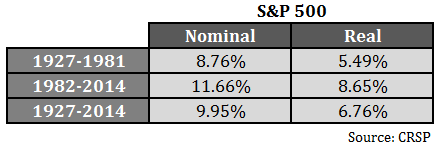

Ask a room full of investors whether the U.S. stock market has been “normal” since the 1980s, and you will get the financial equivalent of a Thanksgiving argument: someone quotes Warren Buffett, someone mentions the Federal Reserve, someone blames tech stocks, and one person quietly checks their brokerage app under the table. The question matters because the answer shapes how people save, retire, build portfolios, and emotionally survive the next market tantrum.
Since the early 1980s, U.S. equitiesespecially the S&P 500have delivered extraordinary returns compared with many other assets and compared with several earlier periods of American financial history. Investors who bought broad U.S. stocks during the scary days of double-digit inflation, sky-high interest rates, and gloomy magazine covers were rewarded handsomely over the following decades. But were those returns a repeatable reward for patience, or were they a rare cocktail of falling interest rates, rising valuations, globalization, tax cuts, technological dominance, and expanding profit margins?
The honest answer is: both. The stock market’s long-term enginecorporate earnings growth, dividends, productivity, and risk-takinghas been real. But the return environment since the 1980s also benefited from several powerful tailwinds that cannot simply be assumed forever. In other words, the market was not fake, but it may have been unusually well-fed.
The 1980s Starting Point: A Market Built on Fear, Not Euphoria
To understand why returns after the 1980s look so impressive, you have to begin with how unattractive stocks felt at the time. The late 1970s and early 1980s were not exactly a motivational poster for investors. Inflation was high, interest rates were painful, recession fears were everywhere, and equities had spent years disappointing anyone who believed in the “stocks for the long run” sermon.
By 1982, the U.S. stock market was priced for a very different world than the one investors know today. Valuations were low, dividend yields were higher, and many households preferred cash, bonds, real estate, or anything that did not require watching the Dow Jones Industrial Average behave like a caffeinated raccoon. This matters because future returns are heavily influenced by starting prices. Buying great companies at depressed valuations is not the same as buying great companies after everyone has already decided they are great.
The Federal Reserve’s aggressive inflation fight under Paul Volcker created short-term pain but helped reset the economic foundation. As inflation gradually came under control, interest rates began a long decline. That decline was one of the most important forces behind the strong stock and bond returns that followed.
Why Falling Interest Rates Supercharged Stock Returns
Interest rates are not just background music for Wall Street. They are the gravity system of finance. When rates fall, future corporate profits become more valuable in present terms. Bonds become less competitive with stocks. Borrowing becomes cheaper. Consumers and businesses often gain confidence. Valuation multiples can expand, sometimes dramatically.
From the early 1980s through the 2020s, investors lived through one of the greatest bond bull markets in modern history. The federal funds rate and long-term Treasury yields fell from extreme levels to historically low levels. That did not just help bondholders. It also helped stock investors because lower discount rates supported higher price-to-earnings ratios.
This is a major reason the post-1980 period can look exceptional. Stock returns were not powered only by companies earning more money. They were also powered by investors becoming willing to pay more for each dollar of earnings. That multiple expansion is wonderful while it lasts, but it is not an endless vending machine. Eventually, someone kicks it and asks why the snacks cost so much.
The S&P 500 Became a Different Kind of Index
When people talk about “the stock market,” they often mean the S&P 500. That index is widely used because it represents about 500 leading large-cap U.S. companies and a large share of the investable American equity market. But the S&P 500 of the 1980s was not the S&P 500 of today.
The modern index is more global, more technology-heavy, more intangible-asset-driven, and more concentrated in highly profitable companies. Apple, Microsoft, Nvidia, Amazon, Alphabet, Meta, and other mega-cap firms have reshaped the market’s earnings profile. These businesses often have high margins, global scale, powerful network effects, and balance sheets that look like they were designed by someone allergic to debt crises.
That transformation helped lift returns, but it also raises a key question: are investors paying for durable innovation or extrapolating the best chapter of the book? Technology can create enormous wealth, but high expectations can make even excellent companies vulnerable to disappointing returns if prices already reflect perfection.
Valuation Expansion: The Quiet Giant Behind the Numbers
One reason stock market returns since the 1980s may be an aberration is valuation expansion. Measures such as the cyclically adjusted price-to-earnings ratio, often associated with Robert Shiller, show that U.S. stocks were much cheaper around the early 1980s than they have been in many recent years.
When valuations rise over decades, investors receive an extra boost beyond earnings growth and dividends. Imagine buying a house when everyone hates houses, then selling it decades later when buyers are lining up with preapproval letters and emotional support lattes. The house may have improved, yes. But the neighborhood’s popularity did a lot of work too.
High valuations do not guarantee a crash. Markets can stay expensive for years, especially when dominant companies produce impressive earnings growth. But high starting valuations usually reduce long-term expected returns. They pull future gains into the present. That is delightful for current account balances and less delightful for new money entering the market.
Corporate Profits and Margins: The Real Business Boom
It would be unfair to say post-1980 returns were just financial engineering or lower rates. U.S. corporations genuinely became more profitable. Profit margins expanded as companies benefited from globalization, software, automation, stronger brands, lower effective tax rates, scalable business models, and the rising importance of intellectual property.
A railroad, steel mill, or department-store chain can be a fine business, but scaling it often requires heavy physical investment. A software platform can add customers at much lower marginal cost. That shift matters. The U.S. market increasingly tilted toward businesses that could generate more profit from fewer physical assets.
Still, margins are not magic. They can face pressure from wage growth, regulation, taxes, competition, higher interest expense, trade frictions, or simple mean reversion. Investors who assume today’s elevated margins are permanent may be right in some sectors and too optimistic in others. The market rarely sends a calendar invite before changing the rules.
Buybacks Changed the Return Formula
Another major post-1980 development was the rise of share repurchases. Dividends used to be the dominant way companies returned cash to shareholders. Over time, buybacks became increasingly important. When companies repurchase shares, they reduce share count, which can increase earnings per share even if total company earnings grow more slowly.
Buybacks are not automatically good or bad. They can be excellent when companies repurchase undervalued stock after funding productive investment. They can be questionable when management buys expensive shares mainly to flatter per-share metrics. Either way, the buyback era helped shape modern equity returns and changed how investors experience corporate cash flows.
The shift also complicates comparisons with earlier decades. A lower dividend yield today does not necessarily mean shareholders receive less cash overall, because buybacks may substitute for dividends. But buybacks are more flexible and less visible, which makes investor behavior more dependent on total-return thinking rather than income alone.
Was the Post-1980 Bull Market Just Luck?
No. Calling it luck ignores the real economic progress behind the numbers. The U.S. economy produced world-class companies, deep capital markets, strong property rights, entrepreneurial culture, and repeated waves of innovation. From personal computers to the internet, cloud computing, smartphones, digital advertising, e-commerce, biotech, semiconductors, and artificial intelligence, American companies captured enormous value.
But it was not purely skill, either. Investors also benefited from timing. The early 1980s offered unusually attractive starting conditions: low valuations, high yields, and widespread pessimism. Later decades added lower inflation, declining rates, expanding global markets, falling corporate tax burdens, and rising margins. That combination is hard to recreate on demand.
So the best description is not “fake” or “normal.” It is “historically favorable.” The market rewarded patience, but patience happened to be sitting in a very comfortable chair.
Comparing the 1980s-to-Today Era With Longer Market History
Long-term U.S. stock returns have historically been strong even before the 1980s. Equities have usually beaten cash and bonds over long horizons because shareholders take more risk. They absorb recessions, crashes, inflation scares, wars, policy mistakes, banking problems, and the occasional CEO who thinks “strategic transformation” means buying something wildly overpriced.
However, the pace of returns matters. If investors expect every future 20- or 30-year period to resemble the strongest parts of the post-1980 era, they may be disappointed. Long-run equity returns come from three broad sources: dividend yield, earnings growth, and valuation change. Dividend yields are lower than they were decades ago. Earnings growth may remain healthy, but it is unlikely to accelerate forever. Valuation expansion from cheap to expensive cannot repeat unless the market first becomes cheap again.
This does not mean stocks are doomed. It means investors should separate “stocks are a good long-term asset” from “stocks will repeat the exact returns of the last four decades.” The first statement is reasonable. The second is a little too confident, like packing sunglasses for every day of a month-long trip to Seattle.
The Role of Inflation: The Market’s Uninvited Dinner Guest
Inflation is one of the most important variables in this debate. The early 1980s began with inflation fear. The following decades largely benefited from disinflation, meaning inflation rates came down over time. That helped interest rates fall and valuations rise.
If the future brings structurally higher inflation than the 1990s, 2000s, and 2010s, investors may not enjoy the same valuation support. Higher inflation can pressure profit margins, raise discount rates, and make bonds more competitive. It can also create uncertainty, and markets charge a fee for uncertainty. Unfortunately, the fee is not listed clearly on the menu.
That said, equities can still serve as a partial inflation hedge over long periods because companies can raise prices, grow nominal revenues, and own real productive assets. The problem is the transition. Stocks may handle moderate inflation over time, but sudden inflation shocks can be rough on valuations.
What Current Return Forecasts Suggest
Many major investment firms now publish capital market assumptions that expect more modest U.S. equity returns over the next decade than investors enjoyed during the strongest post-1980 periods. Forecasts vary, and nobody owns a crystal ball with a Bloomberg terminal attached, but the message is consistent: starting valuations matter, and high prices usually lower future returns.
Some forecasts still expect U.S. stocks to produce positive nominal returns, especially if earnings growth remains resilient. But several outlooks suggest that bonds, international equities, value stocks, or smaller companies may look more competitive than they did when U.S. mega-cap growth dominated everything in sight.
This does not mean investors should abandon U.S. stocks. It means they should avoid building a financial plan that requires heroic returns. If your retirement plan only works if the market repeats one of the best multi-decade runs in history, the plan may need a second draftand maybe fewer yacht assumptions.
Are Stock Market Returns Since the 1980s an Aberration?
Yes, in several important ways. The period since the 1980s was unusually favorable because it began with low valuations and high interest rates, then enjoyed decades of falling rates, declining inflation, expanding valuations, rising profit margins, globalization, technology leadership, and shareholder-friendly capital allocation.
But no, in the sense that strong equity returns are not a historical accident. Stocks are ownership claims on productive businesses. Over long periods, businesses that innovate, earn profits, reinvest wisely, and return cash to shareholders can create real wealth. The U.S. market has done that exceptionally well.
The practical answer is more nuanced: the direction of post-1980 returns was not an aberration, but the magnitude may have been. Future investors should expect stocks to remain important, but they should not assume the same mix of tailwinds will blow forever. Trees do not grow to the sky, even if Wall Street occasionally builds a spreadsheet suggesting they might.
What Investors Should Learn From This
1. Respect Starting Valuations
Valuation is not a short-term timing tool. Expensive markets can become more expensive, and cheap markets can become cheaper. But over 10-, 15-, and 20-year periods, starting valuations matter a great deal. Investors should understand whether they are buying future earnings at a bargain, a fair price, or a champagne-on-a-Tuesday price.
2. Diversification Is Not Boring; It Is Adult Supervision
The U.S. stock market has been a superstar, but portfolios should not depend on one country, one style, one sector, or seven giant companies wearing capes. International stocks, bonds, cash reserves, value stocks, small caps, and other diversifiers may feel unnecessary during a U.S. bull market. They tend to become interesting right after everyone wishes they had owned more of them.
3. Lower Future Returns Do Not Mean Bad Future Returns
A world of 5% to 7% annualized equity returns is not a tragedy. It just requires realistic savings rates, disciplined rebalancing, cost control, and patience. The danger is not lower returns by themselves. The danger is assuming high returns, spending like they are guaranteed, and then discovering math has filed a complaint.
Experience-Based Reflections: Living Through the Question
Anyone who has watched markets for more than a few years learns that returns are never just numbers. They are emotions wearing percentage signs. The debate over whether stock market returns since the 1980s are an aberration becomes much clearer when you imagine real investors living through different moments in market history.
Picture an investor in 1982. Inflation had damaged confidence, interest rates were intimidating, and stocks had spent years testing people’s patience. Buying equities then required courage, or at least the ability to ignore terrifying headlines. That investor did not feel like they were standing at the beginning of a legendary bull market. They probably felt like they were doing something mildly irresponsible.
Now picture an investor in the late 1990s. Technology stocks were soaring, the internet was changing everything, and traditional valuation warnings sounded old-fashioned. Many investors learned that innovation can be real while prices can still become ridiculous. A great story does not automatically equal a great investment if everyone has already paid for the ending.
Then came the 2008 financial crisis. Investors who believed stocks only went up because “the long term always works” discovered that the long term includes some very unpleasant Tuesdays. Portfolios were cut sharply, banks failed or nearly failed, and fear returned with a megaphone. Yet investors who stayed diversified and kept contributing were eventually rewarded. The lesson was not that risk had disappeared. The lesson was that risk is the entry fee.
The 2010s created a different lesson. Low interest rates made stocks look attractive, technology giants became profit machines, and passive investing grew rapidly. Many investors began to believe that buying the S&P 500 was not just a strategy but a personality trait. For a long stretch, that confidence was rewarded. But the longer a trend works, the easier it becomes to confuse a cycle with a law of nature.
The 2020s added even more complexity. A pandemic crash, massive policy support, inflation shock, rate hikes, artificial intelligence enthusiasm, and renewed debate over valuations all arrived in rapid sequence. Investors had to process years of market history in what felt like one extremely rude group chat. The experience showed that markets can recover faster than expected, fall harder than expected, and change leadership without asking permission.
From personal investing experience, the most useful takeaway is humility. Nobody knows whether the next 40 years will look like the last 40. Investors can study history, compare valuations, review interest-rate regimes, and analyze profit margins, but the future still enjoys surprising people. That does not make planning useless. It makes flexible planning essential.
A smart investor does not need to predict whether post-1980 returns were a once-in-a-lifetime miracle. They need a portfolio that can survive if returns are lower, participate if returns are strong, and avoid emotional decisions when markets behave badly. That means saving consistently, keeping costs low, diversifying globally, holding enough safe assets for near-term needs, and refusing to turn every market headline into a personal emergency.
The post-1980 market may have been unusually generous, but generosity is not a financial plan. Treat those returns as a wonderful chapter in market history, not a guaranteed subscription. The future may still reward equity investors, but probably not in a straight line, and probably not with the exact same drivers. In investing, as in life, the sequel is rarely identical to the original. Sometimes it is worse, sometimes better, and sometimes it adds a confusing new character named “higher discount rates.”
Conclusion
So, are stock market returns since the 1980s an aberration? The best answer is that they were partly exceptional and partly earned. The U.S. stock market benefited from a rare alignment of favorable starting valuations, falling interest rates, lower inflation, rising corporate profitability, globalization, technological leadership, and shareholder-friendly policies. Those forces helped create one of the most impressive wealth-building periods in modern financial history.
But investors should not assume the future will automatically replay the same movie. Stocks can still be powerful long-term assets, yet future returns may be more modest if valuations remain high, rates stay elevated, profit margins face pressure, or market leadership narrows. The winning approach is not pessimism. It is realism: build portfolios that do not require miracles, stay diversified, and let compounding work without demanding that history perform an encore on command.