“Best Reveal of the Night”: Damson Idris Stuns With Dramatic F1-Inspired Unveiling at Met Gala 2025

At an event where a hat can have its own publicist and a cape may require zoning approval, Damson Idris still managed to create one of the most talked-about moments of the 2025 Met Gala. The actor did not simply arrive on the carpet. He staged an entrance, built suspense, changed costumes, and turned the Metropolitan Museum of Art steps into a glamorous pit lane.
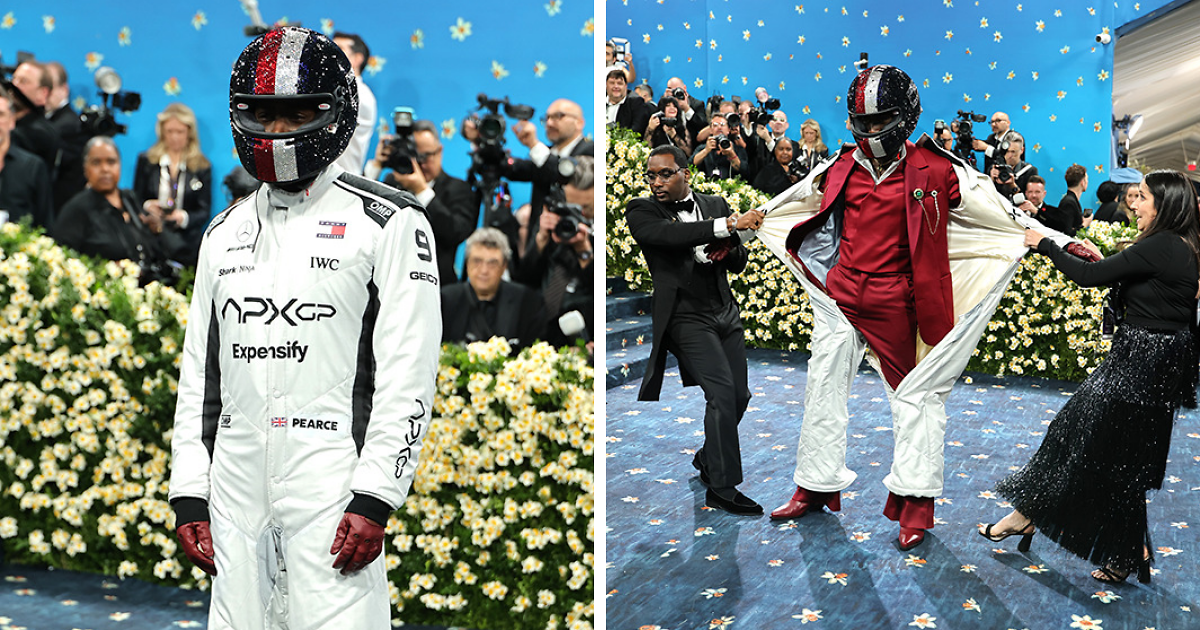
Idris arrived in Formula 1-inspired racing gear, complete with a crystal-covered helmet and a fictional APXGP race-car connection from F1 The Movie. Then, in a carefully choreographed reveal, assistants removed the outer racing suit to expose a sharply tailored red Tommy Hilfiger ensemble beneath it. The transformation was fast, theatrical, and perfectly engineered for a room full of cameras. In a night filled with extravagant fashion, Idris delivered something rarer: a memorable plot twist.
From the Racetrack to the Met Steps
The Met Gala has never been a place for quiet entrances. Still, Damson Idris’s arrival on May 5, 2025, had the energy of a movie premiere, a fashion campaign, and a Formula 1 starting grid packed into a few minutes.
He appeared in a fitted white racing suit designed by Tommy Hilfiger, styled with sponsor-style patches and a bold red, white, and black helmet. The helmet was covered in nearly 20,000 hand-placed Swarovski crystals, because apparently regular sparkle was not going to meet the assignment. The high-shine accessory concealed Idris’s face at first, creating a few seconds of mystery before photographers realized who was behind the visor.
The racing look was connected to Idris’s role as Joshua Pearce in F1 The Movie, where he plays an ambitious rookie driver for the fictional APXGP team. The Met Gala appearance turned that character connection into a live fashion story: Idris was not merely promoting a movie; he was using the visual language of racing to create a red-carpet narrative.
The White Racing Suit Was the Opening Scene
The outer suit worked because it looked intentional rather than random. It had the clean, technical silhouette associated with modern motorsport, but the crystal-covered helmet pushed it into gala territory. It was sporty, futuristic, and slightly mysteriouslike a driver who had taken a wrong turn and ended up at fashion’s most exclusive dinner party.
For a few moments, the racing outfit appeared to be the final look. That uncertainty was part of the magic. The Met Gala carpet is crowded with elaborate clothing, so a single outfit can disappear faster than a champagne tray at an after-party. Idris avoided that problem by making the first look only the beginning.
The Dramatic Reveal That Changed Everything
Then came the main event. Two assistants stepped in and pulled away the racing suit, revealing a rich red three-piece outfit underneath. Suddenly, Idris went from cinematic driver to polished dandy in seconds.
The reveal exposed a custom rouge tuxedo by Tommy Hilfiger, featuring a contemporary interpretation of Tommy Tartan. The jacket included red-and-gold tartan elements, satin lapels, and ornate jacquard detailing. Idris paired it with a matching vest, white shirt, flared tuxedo trousers, gloves, and a green gemstone brooch that gave the entire look an additional layer of personality.
It was a classic reveal structure: mystery, tension, surprise, reward. But unlike a costume-change stunt that exists only for social media clips, Idris’s second look had a genuine relationship to the gala’s dress code and cultural theme. The showmanship did not replace the fashion. It delivered the fashion.
Why the Red Suit Was More Than a Second Outfit
The red suit did not just provide a visual contrast to the white racing uniform. It shifted the meaning of the entire appearance. The white suit represented speed, performance, technology, and modern celebrity. The red tuxedo represented tailoring, craft, heritage, and self-presentation.
That contrast made the transformation feel symbolic. Idris moved from the world of racing uniforms into the world of dandyism and bespoke suiting. In other words, he did not merely change clothes. He changed genres.
How Damson Idris Matched the “Superfine” Met Gala Theme
The 2025 Met Gala celebrated Superfine: Tailoring Black Style, an exhibition exploring more than 300 years of Black style through the lens of dandyism. The theme examined how clothing, tailoring, accessories, and self-presentation have shaped Black identity across the Atlantic diaspora. It was not simply about wearing a nice suit. It was about the cultural power of choosing how to be seen.
The dress code, “Tailored for You,” encouraged guests to interpret suiting and personal style in their own way. Idris did that with unusual precision. His final look had the sharpness of traditional formalwear, but it was not conservative. The flared trousers, tartan pattern, deep red palette, custom jewelry, and theatrical reveal gave the suit its own personality.
That is why the outfit landed so well. The tuxedo was tailored, but it was not timid. It respected the structure of classic menswear while refusing to behave like a standard black-tie uniform. The look had the confidence of someone who knows the rules and has decided to upgrade them.
Black Dandyism Is About More Than Looking Expensive
Black dandyism is often misunderstood as simply dressing extravagantly. In reality, it has deep cultural roots tied to expression, dignity, resistance, identity, and the politics of visibility. Across generations, tailored fashion has been used by Black creatives, artists, musicians, activists, and everyday people to communicate ambition and individuality in spaces that often tried to limit both.
Idris’s red Tommy Hilfiger suit fit this wider context because it embraced polish without becoming stiff. It used tailoring as a statement. The tartan, satin, jewelry, and rich red color all suggested pleasure in dressing well, but also control over the story being told.
His look did not try to recreate historical Black dandyism literally. Instead, it translated some of its values into a contemporary red-carpet language: precision, confidence, elegance, individuality, and a refusal to blend into the background.
The Tommy Hilfiger Details That Made the Look Work
Tommy Hilfiger’s role in the moment was more substantial than placing a logo on a racing suit. The designer created both outfits as two parts of one larger visual idea. The first look brought in the high-speed world of F1 The Movie; the second interpreted the Met Gala’s tailoring theme through a modern version of the brand’s tartan identity.
The tuxedo’s construction mattered. The gold-accented tartan did not feel flat or costume-like. It added texture and depth, while the satin lapels kept the outfit rooted in eveningwear. According to Hilfiger’s description of the design process, the ensemble incorporated gold beading, custom buttons, a striped interior lining, a satin trouser stripe, and a slight flare at the knee. Those small details prevented the look from becoming just “red suit, but louder.”
The result was somewhere between classic American tailoring, modern red-carpet glamour, and a little bit of rock-star confidence. It had enough structure for the Met Gala and enough personality to survive the internet’s brutally short attention span.
The Jewelry Added a Personal Layer
Idris completed the look with pieces from his jewelry brand, DIDRIS, including a custom green gemstone brooch. The accessory introduced a contrasting color to the red ensemble and helped make the tuxedo feel personal rather than purely promotional.
DIDRIS was inspired in part by Idris’s mother and her long-held interest in jewelry. That background gave the accessories a deeper meaning than a standard celebrity endorsement. The brooch was not just a shiny finishing touch; it connected the fashion moment to family, memory, and the actor’s growing creative identity beyond film.
Why the F1-Inspired Met Gala Look Became So Memorable
Fashion moments become memorable when they answer three questions at once: What are we looking at? Why does it matter? And what happens next? Idris’s outfit reveal succeeded because it had a clear answer to all three.
First, the visual was instantly understandable. A race suit, helmet, and car connection made the Formula 1 inspiration obvious. Second, the reveal connected directly to Idris’s upcoming film role. Third, the final suit met the Met Gala’s tailoring brief while still feeling unexpected.
That combination made the appearance highly shareable without feeling empty. There was a movie connection, a fashion story, a personal jewelry element, and a cultural link to the evening’s celebration of Black style. The reveal was dramatic, but it was also organized. Every piece had a job.
In a world where celebrity fashion can sometimes feel like a game of “who can wear the largest object without falling over,” Idris’s approach had narrative discipline. He gave the audience spectacle, then gave the spectacle a reason to exist.
What Stylists and Fashion Fans Can Learn From the Reveal
Damson Idris’s Met Gala appearance offers a useful reminder for anyone interested in red-carpet fashion: a strong look does not need twenty unrelated ideas. It needs one clear concept, excellent execution, and a few memorable details.
The Formula 1 theme was not scattered across every inch of the final outfit. Instead, it appeared in the entrance, the racing suit, the helmet, and the APXGP connection. Once the tuxedo was revealed, the story shifted toward tailoring and dandyism. The fashion moved forward rather than getting stuck in one gimmick.
There is also a lesson in contrast. White racing gear gave the deep red tuxedo more impact. The helmet created mystery, making the reveal feel bigger. The clean technical lines of the outer suit made the rich textures of the tartan jacket stand out even more.
For everyday style, nobody needs a Swarovski helmet or assistants stationed nearby to remove outerwear on command. But the underlying principle still works: start with a simple base, choose one personal statement piece, and make sure every element belongs to the same story.
The Experience of Watching a Red-Carpet Reveal in Real Time
A great fashion reveal does something unusual: it turns clothing into live entertainment. Watching Damson Idris’s Met Gala transformation was not the same as seeing a photo of a suit the next morning. The suspense mattered. The helmet mattered. The pause before the assistants stepped in mattered. In a few seconds, the audience experienced a mini-story with a beginning, middle, and very well-dressed ending.
That is the special experience of a red-carpet reveal. Before the change happens, viewers become detectives. Who is under the helmet? Is the racing suit the real outfit? Is this a character costume, a joke, a fashion statement, or all three? The unanswered questions pull people closer. Even viewers who do not follow Formula 1 or know every detail of the Met Gala theme can understand the basic drama of waiting for the reveal.
When the white racing suit came away and the red tartan tuxedo appeared, the experience shifted from curiosity to payoff. Suddenly, the first look made sense. The race suit was not a detour. It was the runway to the final outfit. This is why the reveal felt satisfying rather than confusing. It rewarded people for paying attention.
There is also something joyful about seeing fashion treated as performance. Red carpets can sometimes become predictable: celebrity steps out, camera flashes, everyone identifies the designer, and the internet begins ranking the result before the guest reaches the stairs. Idris interrupted that rhythm. His entrance introduced movement, timing, and surprise. It had the energy of theater, but without needing a full stage or a ten-minute monologue about the symbolism of a left shoe.
For people watching at home, this kind of moment creates a shared experience. Social media clips spread quickly because the reveal works even without sound. You can watch the costume change on a muted screen and still understand the story. The white suit becomes red. The unknown figure becomes Damson Idris. The driver becomes the dandy. That visual clarity is one reason the moment traveled so far beyond the Met Gala carpet.
The reveal also shows why people still care about major fashion events. Beneath the celebrity names and designer labels, the best red-carpet appearances create small cultural moments. They give viewers something to react to, debate, admire, parody, and remember. Someone sees the helmet and thinks it is too much. Someone else sees the tartan suit and decides it is exactly enough. Both reactions are part of the experience.
Most importantly, Idris’s unveiling demonstrated that fashion can be playful without being shallow. The spectacle was fun, but the final look still engaged with the night’s larger focus on tailoring and Black style. That balance is difficult to achieve. A reveal can easily become louder than the clothes beneath it. Here, the reveal made people look more closely at the tailoring, the jewelry, and the story behind the outfit.
That is why the moment felt bigger than a viral red-carpet clip. It was an example of fashion working in real time: a little mystery, a little humor, a lot of craft, and one sharply tailored landing.
Final Thoughts
Damson Idris’s Met Gala 2025 look proved that a red-carpet outfit can be cinematic, stylish, and culturally aware at the same time. The Formula 1-inspired racing suit created intrigue, but the red Tommy Hilfiger tuxedo delivered the lasting image. With a crystal-covered helmet, carefully designed tartan tailoring, and personal DIDRIS jewelry, Idris turned a fashion entrance into a fully realized performance.
Calling it the “best reveal of the night” may be subjective, but the reason the phrase stuck is easy to understand. Idris gave the Met Gala what it always wants: a look with drama, personality, craftsmanship, and enough confidence to make a staircase feel like a finish line.
Note: The phrase “best reveal of the night” reflects public and media reaction to the moment, not an official Met Gala award or ranking.