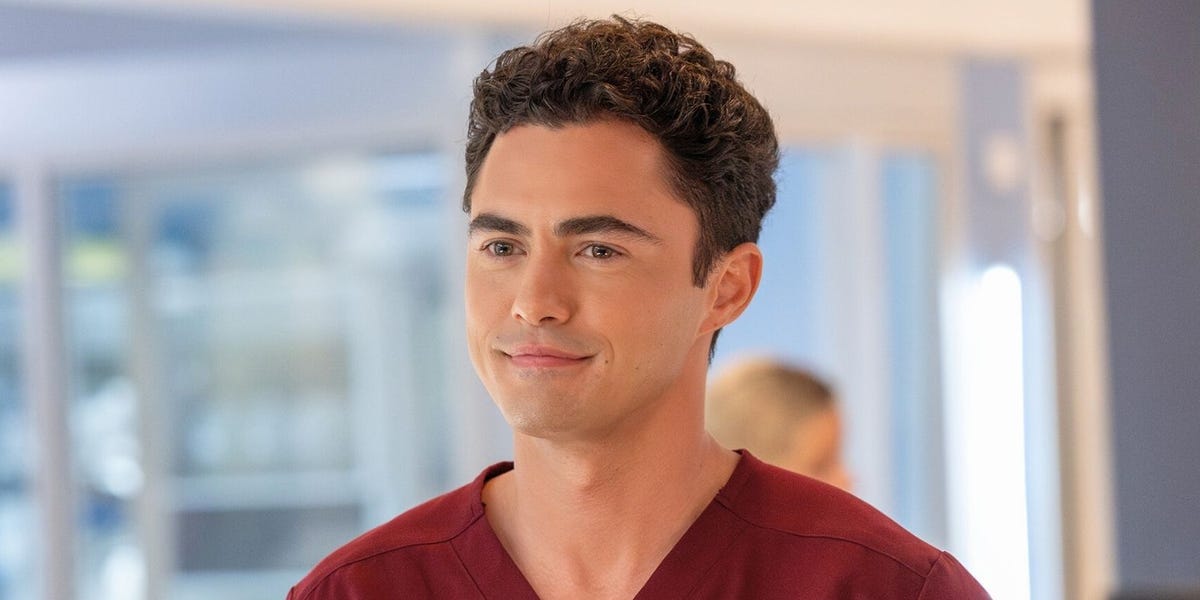

For viewers who knew Darren Barnet before he put on scrubs, one scene in Chicago Med delivered the television equivalent of a doctor tapping your knee and discovering your nostalgia reflex still works perfectly. During the Season 11 episode “The Story of Us,” Barnet’s Dr. John Frost met a patient’s mother who was convinced she recognized him from a very different show. Her description did not match Frost’s fictional acting career. It matched Never Have I Ever, the Netflix comedy that made Barnet famous as Paxton Hall-Yoshida.
The moment was brief, playful, and delightfully awkward. It also worked on several levels at once. For casual Chicago Med viewers, it was a joke about Frost’s unusual past as a child actor. For longtime Barnet fans, it was an unmistakable wink at Paxton, Devi Vishwakumar, teenage longing, grief, romantic chaos, and the apparently immortal cultural memory of Paxton taking off his shirt.
Barnet knew exactly what the writers were doing. Before the episode aired on November 5, 2025, he teased TikTok followers that a fun Never Have I Ever Easter egg was coming, sounding like a friend struggling not to reveal where the surprise cake is hidden.
What Was the Darren Barnet Easter Egg on ‘Chicago Med’?
A Patient’s Mother Recognizes the Wrong Television Star
In the scene, a woman asks Dr. Frost whether he used to be an actor. That question is perfectly reasonable within the world of Chicago Med, because Frost really was a television performer before becoming a pediatric emergency medicine resident. The conversation takes a meta turn when she describes a program about a teenage girl grieving her father and wanting to sleep with Frost’s character.
That is clearly a compressed, cheeky description of Never Have I Ever. The Netflix series follows Devi, an ambitious and impulsive teenager trying to rebuild her life after the sudden death of her father. Among her many goals is pursuing Paxton Hall-Yoshida, the popular swimmer played by Barnet. Their relationship becomes one point of the show’s central love triangle, along with Devi’s academically competitive connection to Ben Gross.
Frost denies being the actor she remembers. He explains that his old series was instead a fictional time-travel adventure called Nick of Time, involving two teenagers and a magical backpack. The mother remains unimpressed. Somewhere in the multiverse, that backpack is probably wondering why Netflix never called.
Barnet’s Advance Reaction Made the Payoff Even Better
Barnet did not wait for fans to discover the reference entirely on their own. In a social-media video posted before the broadcast, he encouraged people who had watched Never Have I Ever to tune in to Chicago Med. He deliberately stopped short of explaining the scene, preserving the surprise while making it obvious that the two shows were about to share a tiny patch of television DNA.
That enthusiasm matters. Actors sometimes spend years trying to escape the role that first made them widely recognizable. Barnet, however, treated the reference as affectionate rather than embarrassing. His response suggested that he can appreciate Paxton’s place in his career while still moving forward as Dr. Frost. The joke did not drag him backward; it showed how far he had traveled.
Why the Joke Fits Dr. John Frost So Well
Frost Already Has a Show-Business Backstory
The Easter egg did not arrive from nowhere. Chicago Med established that Frost had been a young television star before entering medicine. That unusual history initially supplied light comedy, as colleagues learned that the charming new doctor once had a fan base and a recognizable face. Yet the series gradually revealed that his childhood in entertainment carried emotional damage, complicated relationships, and painful questions about the adults who were supposed to protect him.
This makes the Never Have I Ever reference smarter than a random celebrity cameo joke. The writers could place Barnet’s real career inside a conversation that was already natural for Frost. The audience gets a laugh, but the character remains intact. Frost is not suddenly Darren Barnet wearing a lab coat. He is still a doctor whose past happens to create the perfect opening for a sly crossover-that-is-not-technically-a-crossover.
The Humor Also Highlights Frost’s Discomfort With Fame
Frost’s response is funny because he cannot fully control how other people interpret him. He has built an adult identity around medicine, compassion, and competence, yet strangers may still reduce him to an image from his youth. Barnet has faced a milder real-world version of that challenge. Many viewers first encountered him as the handsome high-school swimmer who occupied a large percentage of Devi’s imagination and an equally large percentage of the internet’s reaction GIFs.
On Chicago Med, Barnet plays a professional whose appeal is not just romantic. Frost is effective with frightened children because he listens, adjusts his approach, and recognizes when a young patient needs an advocate. His charm remains, but it has a purpose beyond making hallways suddenly feel warmer. The Easter egg works because audiences can see both identities at once: the former teen heartthrob and the increasingly layered dramatic actor.
From Paxton Hall-Yoshida to Dr. John Frost
‘Never Have I Ever’ Made Barnet a Breakout Star
When Never Have I Ever premiered in 2020, Paxton was introduced as Devi’s seemingly impossible crush. The character could easily have remained a glossy high-school fantasy with excellent hair and suspiciously convenient access to swimming pools. Instead, the series gave him insecurity, family history, academic struggles, cultural identity, and a gradual understanding that popularity is not a substitute for direction.
Barnet helped turn that development into one of the show’s strongest arcs. Paxton became more than the attractive option in a love triangle. He learned to work harder, confronted the assumptions people made about him, explored his Japanese American heritage, and discovered that being admired was different from being understood. Those layers made the character memorable long after the final season arrived in 2023.
The role also carried personal significance. Barnet has discussed how his Japanese heritage became part of Paxton after members of the creative team heard him speaking Japanese. That decision eventually led to a storyline involving Paxton’s family history and the incarceration of Japanese Americans during World War II. Fans responded not merely to the romance but to the representation and vulnerability beneath it.
Barnet Had Already Built a Varied Television Résumé
Paxton was Barnet’s breakthrough, but not his first television role. Earlier appearances included This Is Us, Criminal Minds, S.W.A.T., Family Reunion, and Agents of S.H.I.E.L.D. He later moved through romantic comedy, action, animation, and voice work in projects including Love Hard, Anyone but You, Road House, and Blue Eye Samurai.
That range makes Frost feel like a genuine next chapter. A weekly medical drama demands technical dialogue, urgent cases, distressed families, and gradual ensemble storytelling. There are fewer slow-motion pool exits and considerably more conversations beginning with, “We need to operate.”
‘Chicago Med’ Lets Him Combine Charm With Heavier Material
Barnet joined Chicago Med as a series regular in Season 10. Frost entered Gaffney Chicago Medical Center as a pediatric specialist with an easy smile and an immediate instinct for connecting with young patients. Over time, the role opened into more difficult territory, particularly as the show examined his childhood fame and the exploitation surrounding it.
The contrast is important. Barnet’s earlier screen image made him an effective choice for a doctor whose charisma can disarm children, parents, and coworkers. Yet the character also gives him room to explore guardedness, unresolved trauma, anger, tenderness, and the fear of being known too well. The face audiences recognize becomes part of the storytelling rather than a distraction from it.
Why Fans Loved the ‘Never Have I Ever’ Reference
It Rewarded Viewers Without Excluding Newcomers
The best Easter eggs operate on two tracks. A new viewer should be able to understand the immediate scene, while an invested fan receives an extra layer of pleasure. This Chicago Med moment succeeds because the basic joke is clear even without knowledge of Paxton: Frost was an actor, and someone has mistaken him for a star from another show. Fans of Never Have I Ever, meanwhile, recognize every loaded detail.
The writers also avoided turning the episode into a promotional detour. No one shouts the Netflix title. Maitreyi Ramakrishnan does not roll through the emergency-room doors demanding a complicated romantic diagnosis. The scene lasts long enough to trigger recognition and then returns to the medical story. It is fan service with portion control.
The Joke Connects Two Different Stages of Barnet’s Career
For many actors, a breakout character becomes both a gift and a label. Audiences build affection around a familiar performance, then need time to accept the performer in a different genre. By acknowledging Paxton directly, Chicago Med removes the tension. The show effectively tells viewers, “Yes, we know who this is. Now watch what else he can do.”
That confidence makes the joke feel generous. It honors the audience that followed Barnet from Netflix to NBC while protecting Frost as his own character. It also reflects a broader truth about modern television viewing: fans do not keep shows in separate boxes. They bring memories, memes, favorite scenes, and old character loyalties with them.
The Viewer Experience: Why This Tiny Scene Feels So Satisfying
Watching an actor move from one defining role to another can feel strangely personal. A viewer may spend four seasons associating Barnet with Paxton’s red Jeep, guarded smile, evolving confidence, and complicated place in Devi’s romantic life. Then the same face appears in a busy emergency department, speaking medical language and calming a terrified child. The brain needs a second to update its files. Apparently, Paxton completed medical school while nobody was looking.
The Easter egg turns that moment of adjustment into part of the entertainment. Instead of pretending Barnet arrives on Chicago Med without cultural baggage, the episode invites viewers to enjoy the baggage. The recognition becomes communal: the patient’s mother says what many audience members were thinking, although she says it with far less restraint and considerably more interest in his abs.
There is also a satisfying emotional reversal. In Never Have I Ever, Paxton is often the person being projected upon. Devi initially sees him as the answer to a fantasy rather than a complete human being. His character arc requires him to become more than the image everyone has created. Frost faces a similar problem from another direction. His former television fame means people may think they know him because they remember the boy he played. In both roles, Barnet portrays men pushing against a surface-level identity.
That parallel gives the joke more weight than it appears to have. It is funny because the reference is obvious, but it is resonant because both characters deal with recognition, expectation, and the distance between public image and private reality. Paxton learns that popularity cannot tell him who he is. Frost learns that changing careers cannot automatically erase what happened to him. Barnet’s performances link those ideas without making the characters interchangeable.
The experience is a reminder that an actor’s career is not a clean series of erased chalkboards. Each role leaves traces. A successful performer can resist being trapped by a famous character without acting ashamed of that character. Barnet’s amused reaction to the Easter egg demonstrates the healthiest version of that relationship. He can celebrate Paxton, laugh with the fans, and still ask viewers to meet him somewhere new.
It also shows why small moments matter in long-running television. Medical dramas depend on emergencies, ethical conflicts, romances, departures, and enough alarming monitor noises to make every hospital visitor nervous. A brief joke can release pressure and strengthen the audience’s bond with a newer character. Here, the joke says that Frost has a past, Barnet has a past, and the show is clever enough to let those histories briefly overlap.
Most importantly, the scene feels affectionate. It does not mock Never Have I Ever or treat Paxton as a youthful mistake. It remembers the series as fans do: funny, emotionally messy, culturally significant, and powered by characters who were more complicated than their first impressions. The Easter egg gives viewers permission to miss that world while enjoying Barnet’s growth beyond it.
Conclusion: A Smart Nod to the Past and a Confident Step Forward
Darren Barnet’s Chicago Med Easter egg succeeds because it is more than a recognizable reference. It fits Dr. John Frost’s established history, rewards fans of Never Have I Ever, and captures Barnet’s transition from teen-comedy heartthrob to dramatic network regular. His enthusiastic pre-episode reaction made it clear that he understood the joke and welcomed the connection.
Paxton Hall-Yoshida remains an important part of Barnet’s television legacy, but Dr. Frost proves that recognition does not have to become confinement. Sometimes the best way to move beyond an old role is not to run from it. Sometimes you let a patient’s mother describe the entire premise, deny everything with a straight face, and return to saving lives.
Note: This article contains mild plot details from Chicago Med Season 11 and general references to Never Have I Ever.