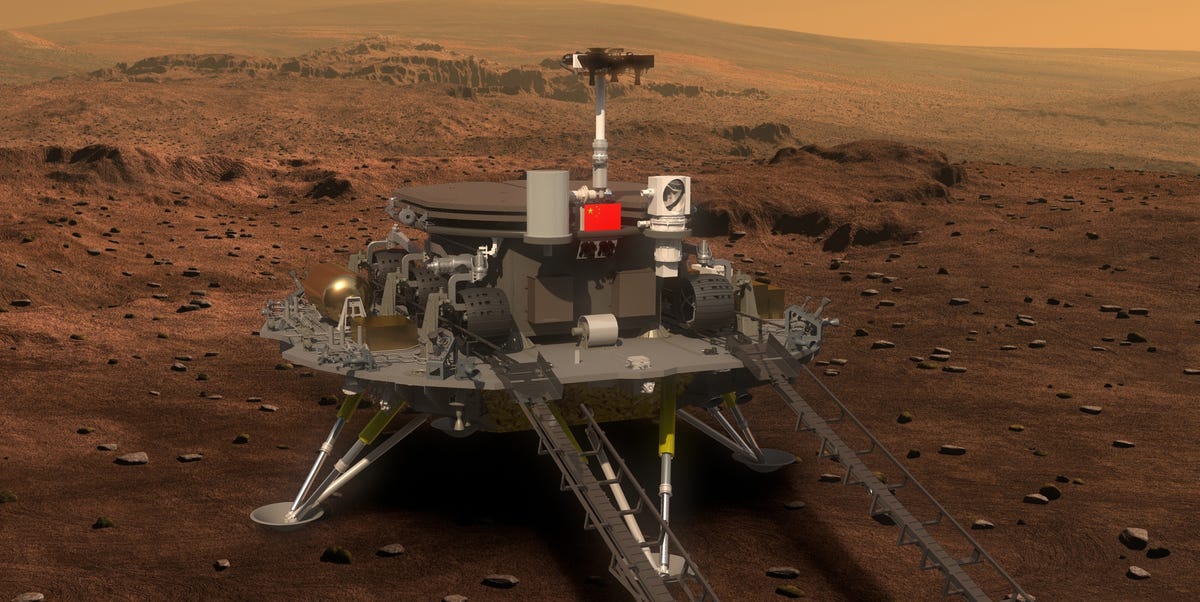

The phrase China Mars Mission Launch sounds like the opening line of a science-fiction blockbuster, preferably one with dramatic music and at least one engineer staring heroically at a monitor. But in real life, China’s Mars launch story is even more interesting because it was not fiction, not a trailer, and definitely not a rehearsal. On July 23, 2020, China launched Tianwen-1, its first independent mission to Mars, aboard a Long March 5 rocket from the Wenchang Space Launch Center on Hainan Island.
That single launch carried an ambitious package: an orbiter, a lander, and the Zhurong rover. In other words, China did not simply knock on Mars’ door. It arrived with luggage, instruments, wheels, cameras, radar, and a very serious plan. The mission entered Mars orbit in February 2021, and Zhurong successfully landed in Utopia Planitia in May 2021, giving China a major place in the small club of nations that have operated on the Martian surface.
For readers searching for a clear explanation of the China Mars mission launch, this guide covers what launched, why it mattered, what the mission found, and how it connects to China’s next major Mars goal: returning samples from the Red Planet to Earth through the planned Tianwen-3 mission.
Why the China Mars Mission Launch Mattered
Space history is full of bold announcements, delayed schedules, and rockets that occasionally behave like toddlers with fire underneath them. That is why Tianwen-1 stood out. China attempted a complex Mars mission that combined three difficult objectives: orbiting Mars, landing safely, and deploying a rover. Any one of those tasks is hard. Doing all three in one mission is the aerospace equivalent of cooking Thanksgiving dinner, filing taxes, and assembling flat-pack furniture at the same time.
Tianwen-1 mattered because it showed that China had moved from Earth-orbit and lunar achievements into deep-space planetary exploration. The country had already built momentum through its Chang’e lunar missions, including landing on the far side of the Moon and returning lunar samples. Mars, however, is a different level of challenge. The planet is far away, communication delays are unavoidable, the atmosphere is thin but still dangerous, and landing there has humbled many missions from many nations.
The China Mars mission launch also happened during a remarkable 2020 Mars launch window. The United Arab Emirates launched the Hope orbiter, China launched Tianwen-1, and NASA launched the Perseverance rover. Three missions left Earth for Mars within days of one another because Earth and Mars line up favorably about every 26 months. When that window opens, space agencies move quickly. When it closes, everyone waits, checks the budget, and pretends not to stare at the calendar.
How Tianwen-1 Launched Toward Mars
Tianwen-1 lifted off on a Long March 5 heavy-lift rocket, one of China’s most powerful launch vehicles. The launch site, Wenchang Space Launch Center, is located on Hainan Island, a southern coastal location that gives rockets an advantage from Earth’s rotation and offers safer downrange flight paths over water.
The mission name “Tianwen” is often translated as “Questions to Heaven,” a poetic reference that fits Mars exploration surprisingly well. Mars has always been a planet of questions. Did it once have lakes, rivers, or oceans? Could microbial life have existed there? Where did the water go? Why did Mars become cold, dry, and dusty enough to make a desert look like a spa retreat?
The Long March 5 Rocket’s Role
The Long March 5 was essential because Tianwen-1 was a large, multi-part spacecraft. Sending an orbiter, lander, and rover together required serious launch power. The rocket placed the spacecraft on an interplanetary trajectory, beginning a journey of roughly seven months to Mars.
Once in space, Tianwen-1 had to perform course corrections, maintain communication with Earth, manage power, and survive the harsh deep-space environment. Launch day gets the fireworks, but the cruise phase is where spacecraft quietly prove whether they are disciplined travelers or expensive metal drama queens.
Why Mars Launch Windows Matter
Mars missions do not launch whenever a space agency feels emotionally ready. They launch when orbital mechanics allows a relatively efficient path from Earth to Mars. This alignment occurs about every 26 months. Missing the window can mean waiting more than two years for another good chance.
This is why 2020 became such a crowded year for Mars exploration. Tianwen-1 was part of a larger wave of robotic missions that reflected growing international interest in Mars science, planetary defense, human exploration planning, and national prestige. The Red Planet was no longer just NASA’s playground; it was becoming a global destination.
What China Sent to Mars
Tianwen-1 was not a simple flyby probe. It was a carefully designed mission system with several major components, each serving a different role in the larger exploration plan.
The Orbiter
The orbiter’s job was to enter orbit around Mars, map the planet, study its atmosphere and surface, and support communications with the lander and rover. It carried instruments for imaging, mineral analysis, magnetic-field studies, and space-environment measurements. By orbiting Mars first, Tianwen-1 could scout the landing region before attempting the dangerous descent.
The Lander
The lander carried Zhurong through the final stages of descent. Landing on Mars requires surviving high-speed entry, extreme heating, parachute deployment, powered descent, and final touchdown. Mars is rude in a very specific way: its atmosphere is thick enough to create heat and turbulence, but too thin to slow a spacecraft easily. It is the planet that says, “Good luck,” and then turns off half the safety features.
The Zhurong Rover
Zhurong, named after a fire god in Chinese mythology, rolled onto the Martian surface after landing in Utopia Planitia. The rover was designed for a planned mission of about 90 Martian sols, but it operated beyond its initial target. It carried cameras, radar, a magnetic-field detector, a weather station, and instruments for studying surface composition.
The rover’s ground-penetrating radar was especially important because it allowed scientists to look beneath the surface. On Mars, the best stories are not always sitting politely on top of the soil. Some are buried under dust, ice, sediment, and billions of years of planetary silence.
From Launch to Mars Orbit and Landing
After its July 2020 launch, Tianwen-1 reached Mars in February 2021. Instead of immediately sending the lander down, the spacecraft first entered orbit and spent time studying possible landing areas. This was a cautious and intelligent strategy. Mars landing sites must balance scientific interest with engineering safety. A place can be geologically fascinating but still be a terrible parking spot for a rover.
China selected Utopia Planitia, a vast impact basin in Mars’ northern hemisphere. This region has long interested scientists because it may preserve evidence of ancient water, buried ice, sedimentary processes, and climate change. NASA’s Viking 2 lander also touched down in Utopia Planitia in 1976, making the region a historically important neighborhood in Martian exploration. Admittedly, “neighborhood” is generous when your nearest neighbor is a decades-old robot and the local weather report is mostly dust.
On May 14, 2021, the lander and rover successfully reached the surface. Days later, Zhurong rolled down from the landing platform and began exploring. The successful landing made China one of the few nations to achieve a functioning spacecraft on Mars’ surface and only the second country to operate a rover there successfully after the United States.
What Zhurong Found on Mars
The science from Tianwen-1 and Zhurong has added valuable data to the global Mars research community. While the mission did not discover Martian life waving from behind a rock, it did contribute to some of the biggest questions in planetary science: where water existed, how long it lasted, and what Mars’ surface and subsurface can reveal about the planet’s past.
Evidence Related to Water Activity
Zhurong data has supported research suggesting that water-related processes may have shaped parts of Utopia Planitia more recently than once assumed. Scientists have studied features such as crusts, cracks, ridges, hydrated minerals, and dune surfaces to understand whether liquid water, brines, frost, or ice-related processes played a role.
It is important to be precise: these findings do not mean Zhurong found a sparkling Martian lake ready for kayaking. Mars is still cold, dry, and hostile on the surface. But signs of past or relatively recent water activity matter because water is central to understanding habitability. On Earth, where there is water, life often finds a way to become everyone’s problem. On Mars, scientists are still asking whether life ever had that chance.
Buried Structures Beneath Utopia Planitia
Ground-penetrating radar data from Zhurong has revealed layered and buried structures beneath the rover’s path. Some research has interpreted subsurface patterns as evidence of buried polygonal terrain or ancient environmental changes. Such structures may preserve clues about freeze-thaw cycles, sediment deposition, ice, or long-term climate shifts.
This is where Mars becomes less like a red desert postcard and more like a geological archive. The surface is only the cover page. Radar gives scientists a way to read a few pages underneath, even if the handwriting is several billion years old and written in dust.
Possible Ancient Shoreline Clues
Data from Zhurong, Tianwen-1, and other Mars orbiters has contributed to studies discussing whether Mars once had an ancient ocean in its northern lowlands. Some researchers have identified features that may be consistent with shorelines, sediment channels, troughs, or other water-shaped landforms. The ancient-ocean idea remains debated, but Zhurong’s observations have strengthened the scientific conversation.
If Mars once had beaches, they were not exactly vacation-ready. No umbrellas, no seafood shacks, no questionable tourist T-shirts. But ancient Martian shorelines would be scientifically extraordinary because they would suggest that Mars once had stable surface water for long periods, potentially creating environments where microbial life might have emerged.
Why the China Mars Mission Launch Changed Space Competition
The China Mars mission launch was not only a science event. It was also a geopolitical signal. Space exploration has always blended curiosity, technology, national ambition, and a little bit of cosmic bragging. Tianwen-1 showed that China could plan and execute a sophisticated interplanetary mission on a global stage.
For the United States, Europe, India, Japan, the United Arab Emirates, and other spacefaring nations, China’s Mars success became part of a broader shift. Planetary exploration is no longer dominated by one country. More nations are developing deep-space capability, and that means more data, more competition, and more pressure to move faster.
This competition can be productive. Space races are expensive, but they often accelerate innovation. Better rockets, improved navigation, advanced robotics, autonomous landing systems, and international science partnerships can all benefit from ambitious goals. The challenge is making sure competition does not limit scientific openness. Mars is too big, too complex, and too important for one country to understand alone.
Tianwen-3: China’s Next Major Mars Launch Goal
After Tianwen-1, the next phrase to watch is Tianwen-3 Mars sample return. China has discussed plans to launch Tianwen-3 around 2028, with the goal of returning Martian samples to Earth around 2031. The mission is expected to use a two-launch architecture, likely involving Long March 5 rockets, with one spacecraft carrying landing and ascent systems and another supporting orbital return operations.
If successful, Tianwen-3 could become the first mission to bring samples directly from Mars to Earth. That would be a scientific milestone of enormous importance. Laboratories on Earth can analyze rocks with instruments far more powerful than anything a rover can carry. Returned samples could help scientists study Martian geology, climate history, possible organic chemistry, and the question that refuses to retire: did Mars ever host life?
NASA’s Perseverance rover has already collected carefully selected samples in Jezero Crater, but the future of the U.S.-European Mars Sample Return campaign has faced cost, schedule, and budget uncertainty. This has made China’s Tianwen-3 timeline especially significant. The race is not only about who gets there first; it is about who can return the right samples safely, document them properly, and make the science useful for the world.
What the Mission Means for Mars Science
Tianwen-1 gave scientists another set of eyes, wheels, and instruments on Mars. That matters because Mars is not one simple environment. It has volcanoes, basins, canyons, polar ice, ancient lakebeds, possible shorelines, buried ice, dust storms, and chemistry that changes from region to region. Studying one landing site is valuable, but studying many sites is how researchers build a complete planetary story.
Zhurong’s exploration of Utopia Planitia complements NASA rover work in places like Gale Crater and Jezero Crater. Curiosity has studied ancient habitable environments in Gale. Perseverance has investigated delta deposits in Jezero. Zhurong added data from a northern lowland region linked to major questions about ancient water and climate. Together, these missions help scientists compare different Martian environments across time.
The China Mars mission launch also demonstrated the value of combining orbital and surface exploration. Orbiters provide context, mapping, communication, and long-term monitoring. Rovers provide local detail, ground truth, and close-up measurements. A Mars mission with both capabilities can connect the wide-angle view with the dirt-under-the-wheels reality.
Challenges China Faced on the Road to Mars
Launching to Mars is difficult. Landing is worse. Operating on Mars is a daily test of patience, engineering, and dust management. Zhurong eventually entered hibernation, and later reporting suggested dust accumulation and seasonal conditions may have affected its ability to wake and continue operations. That is not unusual on Mars. Dust is the planet’s unofficial personality trait.
Solar-powered spacecraft must manage power carefully, especially when dust reduces sunlight. Rovers also face extreme temperature swings, communication delays, rough terrain, and mechanical wear. Every meter of movement is planned with caution. Nobody wants a billion-dollar robot to get stuck because it tried to take a shortcut like a teenager with a new driver’s license.
Still, even with these challenges, Zhurong exceeded its original mission expectations and returned valuable science. That is a successful outcome for a first independent Mars surface mission.
Experience Notes: Following a China Mars Mission Launch Like a Space Fan
Watching a China Mars mission launch is a different kind of experience from reading about it later. On paper, the timeline looks neat: rocket launches, spacecraft cruises, Mars orbit insertion, landing, rover deployment, science operations. In real time, it feels more like waiting for a very expensive message in a bottle to cross the solar system.
The first experience is anticipation. A Mars launch window creates urgency because everyone knows the clock is not flexible. If a technical issue delays a mission beyond the window, the next good opportunity may be more than two years away. That makes launch day feel heavier than a normal rocket launch. It is not just “try again next week.” It is “try again after Earth and Mars finish their orbital choreography.” Space is beautiful, but it does not care about your production schedule.
The second experience is awe at the scale. A rocket leaves Earth in minutes, but the mission takes months to reach Mars. During that cruise, the spacecraft is traveling through deep space with no repair crew, no roadside assistance, and absolutely no option to pull over and ask for directions. Engineers must rely on tracking, commands, simulations, and careful planning. For ordinary viewers, this creates a strange emotional gap: the launch is dramatic, then everything becomes quiet. But that quiet is the sound of a mission doing its job.
The third experience is tension during arrival. Mars orbit insertion is one of those events where the spacecraft must perform a critical engine burn at exactly the right time. Too little braking, and it can miss Mars. Too much, and the mission is in trouble. When Tianwen-1 entered Mars orbit, it was a major proof point that China could navigate deep-space operations with precision.
The fourth experience is landing anxiety. Mars landings are famously difficult because the spacecraft must survive entry, descent, and landing with limited real-time help from Earth. By the time people on Earth receive confirmation, the landing has already happened. That delay makes the moment surreal. Everyone is waiting for news from the past. It is like refreshing your inbox for a message that decides whether a robot survived another planet.
The final experience is discovery. Once Zhurong began operating, the mission shifted from engineering triumph to scientific patience. Rover science is not usually one giant revelation. It is a steady process of images, measurements, radar profiles, mineral readings, and careful interpretation. The excitement comes from watching small pieces build into a bigger story: Mars had water, Mars changed dramatically, and Mars may still preserve clues beneath its dusty surface.
For students, writers, space fans, and casual readers, the China Mars mission launch is a reminder that exploration is not only about flags, rockets, or headlines. It is about asking better questions. Tianwen means “questions to heaven,” and that may be the most honest mission name imaginable. Mars does not give easy answers. It gives clues, silence, dust, and just enough mystery to keep humanity launching machines across millions of miles.
Conclusion
The China Mars mission launch was a turning point in modern planetary exploration. Tianwen-1 proved that China could launch, navigate, orbit, land, and operate on Mars with a single ambitious mission. Zhurong’s work in Utopia Planitia expanded scientific understanding of Martian geology, possible water-related activity, and the planet’s ancient environmental history.
The mission also changed the global conversation. Mars exploration is now more competitive, more international, and more urgent. With Tianwen-3 planned around 2028, China may soon attempt one of the hardest prizes in space science: bringing Martian samples back to Earth. Whether viewed as a scientific milestone, a geopolitical signal, or a giant leap for robotic exploration, the China Mars mission launch deserves its place among the most important space achievements of the 21st century.
SEO Tags