
Note: This article is written for informational and editorial purposes. Scroll saws, CNC add-ons, rotating workholding, and powered cutting tools should be used only with proper training, eye protection, dust control, machine guards, and careful supervision in a safe workshop environment.
When a Scroll Saw Learns a New Dance
A regular scroll saw is already one of the most charming tools in a woodshop. It does not roar like a table saw or chew through boards like an angry beaver with a power bill. Instead, it hums, wiggles a thin blade up and down, and patiently cuts delicate curves, fretwork, ornaments, puzzles, inlays, and tiny details that make people say, “Wait, you made that?”
Now add CNC motion to the picture. Instead of pushing a flat board around by hand, imagine a wooden dowel being slowly rotated while also moving sideways past the blade. The result is not just a cut. It is a spiral. Better yet, it can become a nested wooden helix: one flowing shape inside another, the kind of object that looks like a magic trick, a math lesson, and a high-end craft fair item all met for coffee.
That is the appeal behind a CNC scroll saw add-on designed to cut beautiful wooden spirals. It combines the gentle, fine-cutting nature of a scroll saw with the repeatable movement of computer-controlled axes. The concept is simple enough to admire in one sentence: rotate the workpiece, translate it through the blade, and let the geometry do the showing off. The result is a wooden spiral that can unwind, interlock, nest, or become sculptural art.
What Is a CNC Scroll Saw Add-On?
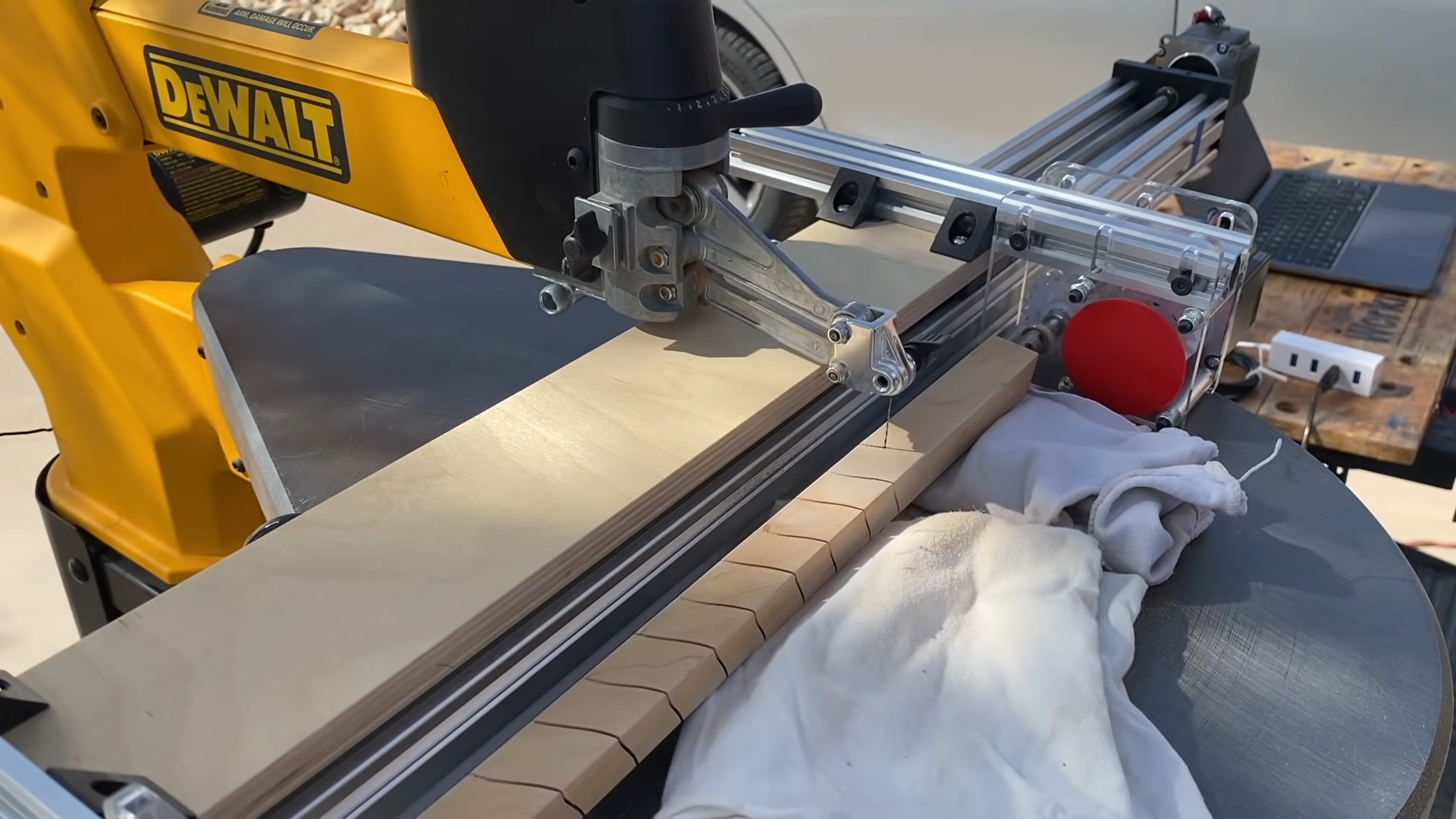
A CNC scroll saw add-on is not necessarily a whole new machine. In many hobby builds, it is an attachment or jig that works with an existing scroll saw. The scroll saw still provides the cutting action. The add-on controls how the wood moves through that cutting action.
In a spiral-cutting setup, the workpiece is often a dowel or round blank held in a rotating headstock. A linear slide moves the workpiece in a controlled direction while a motor turns it. These two motions create a helical path. If the rotation and travel are synchronized, the blade cuts a consistent spiral groove down the length of the wood. Change the ratio between rotation and linear movement, and the spiral changes its pitch. In plain English: more twist, less twist, tighter coil, looser coil. Woodworking meets choreography.
The Basic Motion: Rotation Plus Translation
The magic comes from two coordinated movements. First, the dowel rotates. Second, it advances past the scroll saw blade. The blade does not need to carve like a router bit; it simply cuts along the path created by the moving stock. This is why the project feels so clever. It uses a familiar tool in a slightly unfamiliar way.
A CNC controller, stepper motors, drivers, and G-code can coordinate the movement. The machine does not “know” it is making art. It is just following programmed motion. The human, of course, gets to take all the credit, preferably while nodding modestly and hiding the pile of test pieces behind the bench.
Why Wooden Spirals Are So Visually Addictive
Wooden spirals are satisfying because they show motion in a still object. The grain wraps, the shadows shift, and the form seems to twist even while sitting on a table. A well-cut spiral can look like a screw, a vine, a double helix, a puzzle, a sculptural wand, or a fidget object for people who appreciate sawdust more than plastic.
Nested spirals are even more interesting. When one spiral is cut inside another, the finished piece can appear impossible at first glance. Viewers instinctively ask how the inner form got there. The answer is not sorcery, although the first successful cut may make the maker feel like a wizard wearing safety glasses.
Because the pattern is mathematical, small changes create dramatically different results. A tight pitch produces a dense, spring-like look. A wider pitch feels elegant and airy. A tapered blank can create a spiral that changes personality from one end to the other. Two contrasting woods can be cut separately and paired together for a light-and-dark effect. With careful finishing, the piece can become a desk sculpture, ornament, handle, toy, display object, or conversation starter.
Why Use a Scroll Saw Instead of a CNC Router?
A CNC router is usually the first machine people think of when they hear “CNC woodworking.” Routers are excellent for carving, pocketing, engraving, sign-making, and cutting profiles. But a scroll saw has a different personality. It uses a thin blade rather than a spinning cutter, which means the kerf can be narrow and the cutting action can be delicate.
For spiral work, that narrow blade is part of the appeal. The scroll saw can slice through the dowel while removing less material than a router bit would. It also avoids the router’s high-speed carving approach, which can be overkill for certain delicate wooden forms. A scroll saw is not better at everything, of course. It is not a universal wizard machine. It is more like a specialist with very neat handwriting.
Scroll Saw Strengths
Scroll saws are loved for intricate curves, tight details, inside cuts, ornaments, puzzles, and fretwork. Spiral blades, in particular, can cut in multiple directions without requiring the workpiece to be turned as much by hand. That matters when the wood is being controlled by a jig instead of by the operator’s fingers. The blade’s ability to cut on a changing path helps make spiral cutting practical.
CNC Strengths
CNC motion adds repeatability. Once the movement is dialed in, the machine can follow the same pattern again. This is valuable when experimenting with matching spiral parts, nested forms, or decorative pieces that need consistent geometry. It also allows makers to test design changes by adjusting motion values rather than reinventing the entire jig every time.
The Role of Spiral Scroll Saw Blades
Spiral scroll saw blades are twisted so their teeth can cut in all directions around the blade. That feature makes them popular for complex fretwork and patterns with sudden changes of direction. In a CNC scroll saw add-on, a spiral blade can be especially useful because the workpiece’s motion may not always approach the blade in the traditional front-facing way.
However, spiral blades are not magic noodles of perfection. They may leave more fuzz on the underside of the cut than some standard blades, and they can feel less precise until properly tensioned. Blade tension, speed, wood species, grain direction, feed rate, and workpiece support all affect the final result. A beautiful spiral is rarely born on the first attempt. It usually arrives after a few practice cuts, a little sanding, and one quiet moment of staring at the machine as if it personally owes you an apology.
Blade Tension Matters
Good blade tension helps the cut stay predictable. Too little tension can cause blade wandering, angled cuts, or breakage. Too much tension may also increase the chance of snapping or slipping. Experienced scroll saw users often develop a feel for proper tension, sometimes comparing the sound of a tensioned blade to plucking a small string. The goal is control, not drama.
Material Choice Matters Too
Close-grained hardwoods can produce crisp spirals, while softer woods may cut easily but require more cleanup. Dowels with straight, consistent grain tend to behave better than mystery sticks rescued from the corner of the garage. Plywood, laminated blanks, and contrasting wood combinations can also create interesting effects, but every material introduces its own cutting and finishing quirks.
How the CNC Scroll Saw Spiral Concept Works
At the heart of the concept is coordinated motion. A stepper-driven linear slide moves the workpiece along one axis. A geared or motorized rotary holder turns the wood. The scroll saw blade passes through a starting hole or entry point and cuts as the stock moves. The cut gradually winds around the blank, forming a helix.
In many maker-style designs, the controller can be based on familiar hobby CNC electronics, such as an Arduino-compatible board, a CNC shield, stepper drivers, and GRBL-style motion control. G-code tells the system how far to move and how much to rotate. While the electronics may sound intimidating, the idea is the same as any CNC process: commands become motion, motion becomes geometry, and geometry becomes something you can put on a shelf and casually pretend was easy.
Pitch, Diameter, and Stability
The pitch of the spiral depends on the relationship between rotation and linear travel. A slow rotation with faster travel makes a stretched spiral. Faster rotation with slower travel makes a tighter spiral. The diameter of the dowel also changes the look and the structural strength of the final piece.
Stability is a major design concern. As the spiral cut progresses, the remaining wood becomes more flexible. That can lead to wobble, chatter, or uneven pressure near the blade. Good support, careful speed selection, and conservative cutting reduce the chance of turning a promising blank into artisanal firewood.
Design Ideas for Wooden Spiral Projects
The CNC scroll saw add-on is exciting because it turns a simple cylinder into a field of possibilities. A plain dowel becomes kinetic-looking sculpture. A tapered blank becomes an elegant twist. A pair of contrasting spirals can become a double-helix display. A carefully finished piece can look surprisingly premium, even if it began life as a humble stick minding its own business.
1. Nested Helix Art Objects
Nested wooden spirals are ideal as display pieces. They invite people to pick them up, rotate them, and ask questions. A clear oil finish can emphasize the grain, while a satin topcoat keeps the piece touchable without making it look plastic.
2. Fidget and Desk Toys
Some spiral cuts can unwind or move in a pleasing way. These make excellent desk toys for makers, engineers, teachers, and anyone who likes objects that feel smarter than they need to be. The key is smooth sanding and rounded edges, because nobody wants a fidget toy with splinters and attitude.
3. Decorative Handles
Spiral-cut handles can be used for ornamental projects, display props, walking-stick details, magic-wand-style crafts, or custom tool handles where strength requirements are modest. The form is eye-catching, but the maker should consider grain direction and structural load before using a spiral piece where durability is critical.
4. Educational Models
A wooden helix can be a great classroom or makerspace demonstration. It connects geometry, mechanical motion, CNC control, woodworking, and design thinking in one object. Students can see how changing a ratio changes the physical result. That is far more memorable than staring at a formula until it apologizes.
Safety and Setup Considerations
A CNC scroll saw add-on is fascinating, but it should not be treated casually. It combines a cutting blade, moving axes, rotating stock, electronics, and dust. That means safety planning matters as much as the design itself.
Eye protection is essential because small chips and broken blade fragments can travel quickly. Dust collection or local ventilation helps control fine particles. Loose sleeves, jewelry, dangling cords, and long hair should stay away from moving parts. The machine should be powered off before adjustments, blade changes, or inspection. The work area should be clear, stable, and well lit.
Another important point is restraint. A homemade CNC add-on should be tested slowly, carefully, and with noncritical material. The goal is not to prove bravery. The goal is to produce clean spirals while keeping fingers, tools, and dignity intact.
Do Not Ignore Wobble
Wobble is not just annoying; it can affect cut quality and safety. Long, thin pieces may flex as the spiral separates. If the blank begins to whip, chatter, or vibrate excessively, the setup needs attention. Better support, slower feed, sharper blades, or a different blank may be required.
Finishing Is Part of the Build
The cut is only half the story. Spirals often need careful sanding, fuzz removal, edge softening, and finishing. Small files, flexible sanding strips, and patience are useful. The right finish depends on the project: oil for a natural feel, shellac for quick warmth, lacquer for a crisp display look, or water-based finish when low odor and clarity are priorities.
Why Makers Love This Kind of Hybrid Tool
The CNC scroll saw add-on is a perfect example of maker thinking. It does not ask, “What is this tool supposed to do?” It asks, “What else could this tool do if we politely tricked it?” That mindset drives many great workshop inventions. Jigs, fixtures, adapters, and oddball attachments often extend a tool far beyond its catalog description.
There is also something deeply satisfying about using CNC for a task that still feels handmade. The computer controls the motion, but the project remains tactile. You choose the wood, prepare the blank, tune the saw, clean the cut, sand the surface, and apply the finish. The machine provides repeatability. The maker provides judgment.
That balance is why the project feels more poetic than industrial. A router table may produce perfect signage. A laser may burn flawless patterns. But a scroll-saw-cut wooden spiral has a softer charm. It carries visible grain, delicate kerf lines, and the slight suspense of a thin blade doing something clever.
Common Challenges When Cutting Wooden Spirals
The most common challenge is blade wandering. If the blade is dull, poorly tensioned, or pushed too aggressively, the cut may drift. With a spiral project, drift can compound over the length of the blank, causing uneven spacing or a spiral that looks like it had too much coffee.
Another challenge is tear-out and fuzz. Spiral blades can be wonderfully flexible in cutting direction, but they may leave fibers that need cleanup. This is especially true with softwoods or open-grained material. Choosing the right blade, reducing feed pressure, and sanding carefully can make a big difference.
Workholding is also critical. The dowel must be aligned with the rotary axis, and the rotary axis must cooperate with the linear slide. If the blank is off-center, the cut may vary in depth. If the slide has play, the pattern may become inconsistent. If the headstock lacks grip, the workpiece can slip and ruin the pitch.
Finally, there is the issue of patience. Spiral cutting looks mesmerizing, but it rewards slow testing. Successful makers often treat early cuts as calibration pieces. They test a pitch, observe the behavior, adjust the motion, improve support, and try again. The scrap bin is not a graveyard; it is a research department with splinters.
Practical Experience: What It Feels Like to Make CNC Scroll Saw Spirals
The first experience with a CNC scroll saw spiral cutter is usually a mix of excitement, suspicion, and the strong feeling that the woodshop has become a tiny robotics lab. You begin with a simple blank, but the setup makes it feel special. The dowel is held in place, the blade is threaded through the starting point, and the motion system waits for its instructions. Nothing dramatic has happened yet, but the project already has stage presence.
The first run teaches humility. Even if the design is sound, the wood may flex, the blade may complain, or the spiral may come out too tight, too loose, or just slightly weird. That is normal. The early attempts are not failures; they are wooden notes from the machine saying, “Here is what I understood.” The maker’s job is to listen. Slower movement may improve control. A different blade may reduce fuzz. A better-supported blank may stop the wobble. A cleaner entry hole may help the cut begin without drama.
One of the best lessons is that the machine does not replace craftsmanship. CNC motion can repeat a path, but it cannot choose beautiful grain, feel blade tension, notice a strange vibration, or decide when a piece needs more sanding. Those choices belong to the person at the bench. The final spiral looks technical, but it succeeds because of human judgment.
Another memorable experience is the reveal. During the cut, the project may look awkward. The dowel turns slowly, sawdust gathers, and the spiral shape is not always obvious at first. Then the cut opens up. The helix begins to separate visually. Light passes through the gaps. Suddenly, a plain piece of wood looks like it has been untwisted from the inside. It is a small workshop magic trick, and yes, you may feel the need to show everyone within a 20-foot radius, including the dog.
Finishing the spiral is its own quiet adventure. Sanding between the curves takes patience, especially on nested pieces. Flexible abrasives help, but rushing can flatten crisp edges or leave scratch marks. A light oil finish can make the grain glow and highlight the twist. A satin clear coat can protect the surface while keeping the object pleasant to handle. The best finish is the one that supports the illusion of motion without burying the natural texture of the wood.
The most useful experience-based advice is to start simple. Use a straight, consistent blank. Choose a moderate spiral pitch. Make test cuts before trying exotic hardwood or laminated showpieces. Keep notes about blade type, speed, feed, material, and results. After a few attempts, patterns emerge. You learn which woods behave politely and which ones act like they were raised by raccoons. You learn how much sanding is realistic. You learn that small changes in motion can create big visual changes.
In the end, the CNC scroll saw add-on is not just about cutting spirals. It is about exploring the sweet spot between old-school woodworking and digital control. It gives the scroll saw a new trick, gives CNC a softer artistic side, and gives makers one more reason to disappear into the shop “for ten minutes” and return three hours later covered in dust, holding a wooden helix, and grinning like they just discovered fire.
Conclusion: A Clever Add-On With Serious Creative Potential
A CNC scroll saw add-on that cuts beautiful wooden spirals is more than a novelty. It is a smart blend of motion control, woodworking skill, and creative jig design. By rotating and translating a dowel through a scroll saw blade, the setup can produce nested helices, decorative spirals, kinetic-looking art pieces, educational models, and custom wooden objects that feel both handmade and engineered.
The best part is not just the finished spiral. It is the process of discovery. Each adjustment changes the result. Each wood species behaves differently. Each successful cut proves that familiar tools can still surprise us when makers ask unusual questions. The scroll saw may be a classic workshop tool, but with CNC help, it can twist wood into forms that look almost impossible.
For woodworkers, makers, CNC hobbyists, and curious tinkerers, this kind of project is a reminder that innovation does not always require a brand-new machine. Sometimes it starts with an old tool, a clever jig, a little code, and the dangerous phrase every maker knows too well: “I wonder what would happen if…”
SEO Tags