
Note: This article is for educational purposes only and should not replace care from a licensed medical professional. Crusted scabies can spread quickly and often needs prompt, prescription-based treatment.
If classic scabies is the annoying party crasher of skin conditions, crusted scabies is the version that shows up with a marching band, a fog machine, and absolutely no respect for personal boundaries. It is a severe form of scabies caused by the same mite, Sarcoptes scabiei, but it behaves very differently. Instead of a relatively small number of mites causing intense itching and a rash, crusted scabies involves a massive mite burden and thick, crusted skin changes that can cover large areas of the body.
That sounds dramatic because it is. Crusted scabies is not just “regular scabies, but with extra flakes.” It is more contagious, more difficult to treat, and more likely to trigger outbreaks in places where people live closely together, such as nursing homes, long-term care facilities, and other group settings. It can also be missed at first because some people with crusted scabies have surprisingly mild itching, which is about as helpful as a smoke detector that whispers.
This guide explains what crusted scabies is, how to recognize the symptoms, who is most at risk, how doctors diagnose it, and what treatment usually involves. It also covers what families, caregivers, and facilities should know, because in real life, this condition rarely affects just one person’s calendar.
What is crusted scabies?
Crusted scabies, sometimes called Norwegian scabies, is a severe infestation of the skin by scabies mites. The mites burrow into the upper layer of the skin, but in crusted scabies the number of mites becomes extremely high. That heavy mite load leads to thick scaling, crusting, and hyperkeratotic plaques that can affect the hands, feet, scalp, nails, trunk, or more widespread areas of the body.
Unlike classic scabies, which often involves a relatively small number of mites, crusted scabies may involve hundreds, thousands, or even far more organisms on the skin. That matters because the more mites there are, the easier the condition spreads through direct contact and contaminated clothing, bedding, towels, upholstered furniture, or shared surroundings.
Another important point: crusted scabies is not a sign of poor hygiene. It is more commonly linked to immune system problems, older age, neurologic disease, reduced ability to feel itching or scratch, disability, or situations where diagnosis is delayed. In other words, it is not about being “unclean.” It is about vulnerability, biology, and timing.
How is crusted scabies different from regular scabies?
The difference comes down to severity, appearance, and how contagious it is. Classic scabies usually causes intense nighttime itching, small papules, and thin burrows in common spots like the wrists, finger webs, waistline, and groin. Crusted scabies can still cause itching, but in some cases the itch is mild or oddly absent. That lack of dramatic itching can fool people into thinking the problem is eczema, psoriasis, a fungal rash, dermatitis, or “just dry skin having a bad week.”
Crusted scabies also looks different. The skin may become thick, scaly, cracked, or covered with grayish, yellowish, or brown crusts. The nails can thicken or become crumbly. The palms and soles may look rough and heavily scaled. In severe cases, the rash spreads widely and the skin can become inflamed, fissured, and vulnerable to bacterial infection.
From a public health standpoint, this form is a bigger deal because it is much more contagious than ordinary scabies. Classic scabies usually spreads after prolonged skin-to-skin contact. Crusted scabies can spread more easily because crusts and scales may contain many mites, and those mites may contaminate fabrics or surfaces in the person’s environment.
Symptoms of crusted scabies
Common signs to watch for
- Thick crusts or plaques on the skin
- Scaly, rough, or warty-looking patches
- Redness or widespread inflammation
- Cracks or fissures in the skin
- Mild itching, severe itching, or sometimes surprisingly little itching
- Nail thickening, nail debris, or distorted nails
- Skin changes on the hands, feet, scalp, elbows, knees, trunk, or widespread body areas
Some people also develop the more familiar scabies pattern, including burrows or smaller itchy bumps. Others mainly show heavy crusting. That is one reason crusted scabies can be misdiagnosed early on. It does not always read like a textbook. Sometimes it reads like a mystery novel with a skin biopsy cameo.
Who is more likely to develop it?
Crusted scabies is more likely in people whose immune systems are weakened, including some people with HIV, certain cancers, organ transplants, or immunosuppressive treatments. It is also seen more often in older adults, people with neurologic conditions, people with limited mobility, and those who may not feel or report itching normally. Delayed recognition is another major factor. When treatment is postponed, the mite population has time to multiply and turn a manageable problem into a full-blown skin emergency.
How doctors diagnose crusted scabies
Diagnosis usually starts with a close skin exam and a review of symptoms, living situation, exposure history, and risk factors. A clinician may suspect crusted scabies when they see thick hyperkeratotic or crusted lesions, especially in someone who lives in a facility, has an immune issue, or has had a rash that failed to improve with standard eczema treatments.
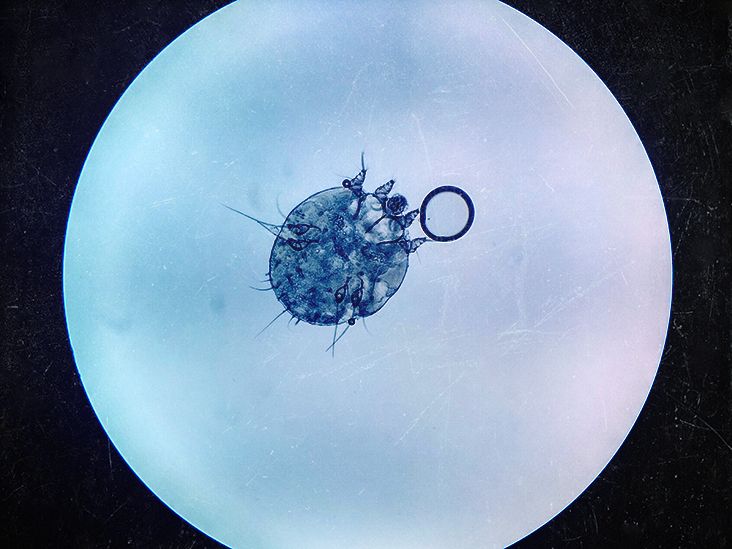
Because crusted scabies can mimic other skin conditions, doctors often confirm the diagnosis with skin scrapings. The sample can be examined under a microscope to look for mites, eggs, or fecal material. In some cases, additional tools such as dermoscopy or biopsy may be considered, especially if the picture is confusing or the patient has overlapping skin disease.
Diagnosis matters not only for the patient but also for everyone around them. If crusted scabies is found in a household, care facility, or institutional setting, close contacts may need evaluation and treatment. Outbreak control becomes part of the medical plan, not an optional bonus feature.
Treatment for crusted scabies
Treatment is usually more aggressive than it is for classic scabies. In many cases, doctors use a combination approach rather than relying on a single medication. That often includes a prescription topical scabicide, such as permethrin 5% cream, along with oral ivermectin. The exact schedule depends on severity, body involvement, age, medical history, pregnancy status, and clinician judgment.
Topical treatment
Topical therapy is applied carefully to the skin and may need repeated use. In crusted scabies, doctors may recommend more frequent application than they would for ordinary scabies, because the thick crusts make it harder for medication to reach where mites are hiding. The cream usually needs to cover the entire body as directed, and sometimes that includes the scalp, hairline, ears, nails, and skin folds, depending on the person’s age and the doctor’s instructions.
Oral treatment
Oral ivermectin is commonly used along with topical treatment in crusted scabies. It helps target the infestation systemically, which is useful when the mite burden is high or the skin involvement is extensive. The number and timing of doses vary. This is not a one-size-fits-all situation, so the prescribing clinician sets the regimen.
Keratolytics and skin care
Because the skin can become very thick and crusted, keratolytic treatments may also be used to help soften and remove scale. That step can improve penetration of topical medication. Supportive skin care matters too. Gentle cleansing, careful nail care, and treating cracked or irritated skin can improve comfort and support healing.
What about itching after treatment?
Itching does not always disappear overnight. Even when the mites are gone, the immune system may keep reacting for a while. That lingering itch can make people think the treatment failed, even when it worked. Doctors may recommend soothing skin care or anti-itch measures during recovery. The key is follow-up, especially if symptoms persist, worsen, or new lesions keep appearing.
Do close contacts need treatment too?
Usually, yes. Because crusted scabies is highly contagious, household members, sexual partners, caregivers, and other close contacts often need treatment at the same time, even if they do not have symptoms yet. Waiting for symptoms can be a recipe for reinfestation, and nobody wants to play medical ping-pong with mites.
In group settings, healthcare teams may identify exposed residents or staff, recommend simultaneous treatment, and put infection-control measures in place. This can include gloves, gowns, dedicated laundry handling, cleaning protocols, and temporary contact precautions until treatment is completed and the patient is no longer considered infectious.
Environmental cleaning and prevention
Treatment is not just about skin. It is also about the environment. Clothes, bedding, and towels used recently should usually be washed in hot water and dried using heat, or otherwise handled according to medical guidance. Items that cannot be washed may be sealed away for a period recommended by the clinician or facility protocol.
Vacuuming upholstered furniture and mattresses may also be advised, especially in cases with heavy shedding of crusts. Personal items should not be shared until treatment is finished. In healthcare or long-term care settings, environmental services and infection-control staff often become key members of the anti-mite task force.
Complications of crusted scabies
The biggest complications come from delayed diagnosis and secondary infection. Damaged skin can let bacteria in, which may lead to impetigo, cellulitis, or more serious skin and soft tissue infections. In frail adults or medically complex patients, that can become a much bigger problem than the scabies itself.
Another complication is social and emotional distress. People may feel embarrassed, isolated, or stigmatized. Families can panic. Staff can worry about outbreaks. The word “contagious” has a way of clearing a room emotionally even before it clears the room physically. Good education helps reduce shame and improve cooperation with treatment.
When to see a doctor right away
Seek medical care promptly if you or someone you care for has thick crusted skin lesions, a rapidly spreading rash, nail changes, skin cracking, or possible scabies exposure in a high-risk setting. Urgent evaluation is especially important if the person is elderly, immunocompromised, living in a care facility, or has signs of skin infection such as warmth, pus, increasing pain, or fever.
Do not try to manage suspected crusted scabies with random over-the-counter experiments and hopeful vibes. This form usually needs prescription treatment and careful follow-up.
Frequently asked questions
Is crusted scabies the same as eczema?
No. It can look similar at first, especially when the skin is thick, scaly, and inflamed, but the cause is completely different. Eczema is an inflammatory skin condition. Crusted scabies is a mite infestation.
Can you have crusted scabies without intense itching?
Yes. That is one reason it can be missed. Some people itch a lot, while others have mild itching or unexpectedly little itch despite a heavy infestation.
Will it go away on its own?
No. Scabies does not usually disappear without treatment, and crusted scabies in particular can worsen, spread, and cause outbreaks.
Is one treatment enough?
Often not. Crusted scabies commonly needs repeated therapy and close follow-up, with treatment for contacts and environmental cleaning as part of the plan.
What real-life experiences with crusted scabies often look like
In real life, crusted scabies rarely begins with someone cheerfully announcing, “Good morning, I seem to have a severe mite infestation.” It usually starts with confusion. A person develops thick, flaky, irritated skin. Maybe they have been told it looks like eczema. Maybe they are treated for psoriasis, dry skin, dermatitis, or a fungal rash. Moisturizers are tried. Steroid creams are tried. The rash keeps going, and the puzzle gets stranger.
One common experience is delay. Families may notice that the skin is getting rougher and more crusted, especially on the hands, feet, elbows, or scalp, but because the itching is not always dramatic, the condition does not feel urgent at first. Then someone else in the home starts itching. Or a caregiver develops a rash. Suddenly the story changes from “odd skin problem” to “why is this spreading?”
For caregivers, especially those helping older adults or people with limited mobility, the experience can be exhausting. Applying prescription cream to the entire body is not exactly a spa treatment. It takes time, patience, gloves, good lighting, clean linens, and usually a second person who is willing to help without saying, “Wow, this is a lot.” Nail care, laundry, bedding changes, and repeated treatment days can make the whole process feel like a part-time job with terrible branding.
In facilities such as nursing homes or rehabilitation centers, crusted scabies can create a domino effect. One patient is diagnosed, then staff must ask who had contact, who needs evaluation, which linens need handling, and whether other residents have unexplained rashes. Infection-control teams may step in quickly. Staff may wear gowns and gloves. Families may be worried. Administrators may discover that nothing wakes up a meeting schedule faster than the phrase “possible outbreak.”
Patients often describe a mix of discomfort and embarrassment. The skin may feel tight, sore, itchy, or just “wrong.” Thick crusts can crack and snag on clothing. Nail changes can be frustrating. Some people feel ashamed because they assume scabies means poor hygiene, even though that is not true. Reassurance matters. Clear explanations matter. People do better when they understand that this is a medical condition, not a moral failure and definitely not a cleanliness scorecard.
There is also the emotional whiplash of treatment. Many people expect instant results, but recovery is often gradual. The crusting improves step by step. Itching may linger. Skin may stay irritated even after the mites are controlled. Follow-up appointments can feel repetitive, but they are important. In successful cases, what people remember most is not just the medication. It is the coordination: treating everyone at the right time, cleaning the environment, sticking to instructions, and getting a correct diagnosis after a frustrating stretch of uncertainty.
The practical lesson from these experiences is simple. If a scaly, crusted rash is not responding as expected, especially in someone who is older, immunocompromised, or living in close-contact settings, it is worth thinking beyond the usual suspects. Sometimes the “dry skin” that refuses to cooperate is not being stubborn. Sometimes it is sending up a tiny, crusty flare for help.
Final takeaway
Crusted scabies is a severe and highly contagious form of scabies that deserves quick attention. It can look very different from classic scabies, and it does not always come with dramatic itching. Thick crusts, scaling, nail changes, and widespread skin involvement should raise suspicion, especially in high-risk individuals. Because diagnosis may be delayed and treatment often requires combination therapy, this is a condition where early medical care really matters.
The good news is that it can be treated. The less-fun news is that treatment usually involves more than one person, more than one step, and more laundry than anyone requested. Still, with proper diagnosis, prescription therapy, contact management, and environmental cleaning, the condition can be brought under control and outbreaks can be prevented.