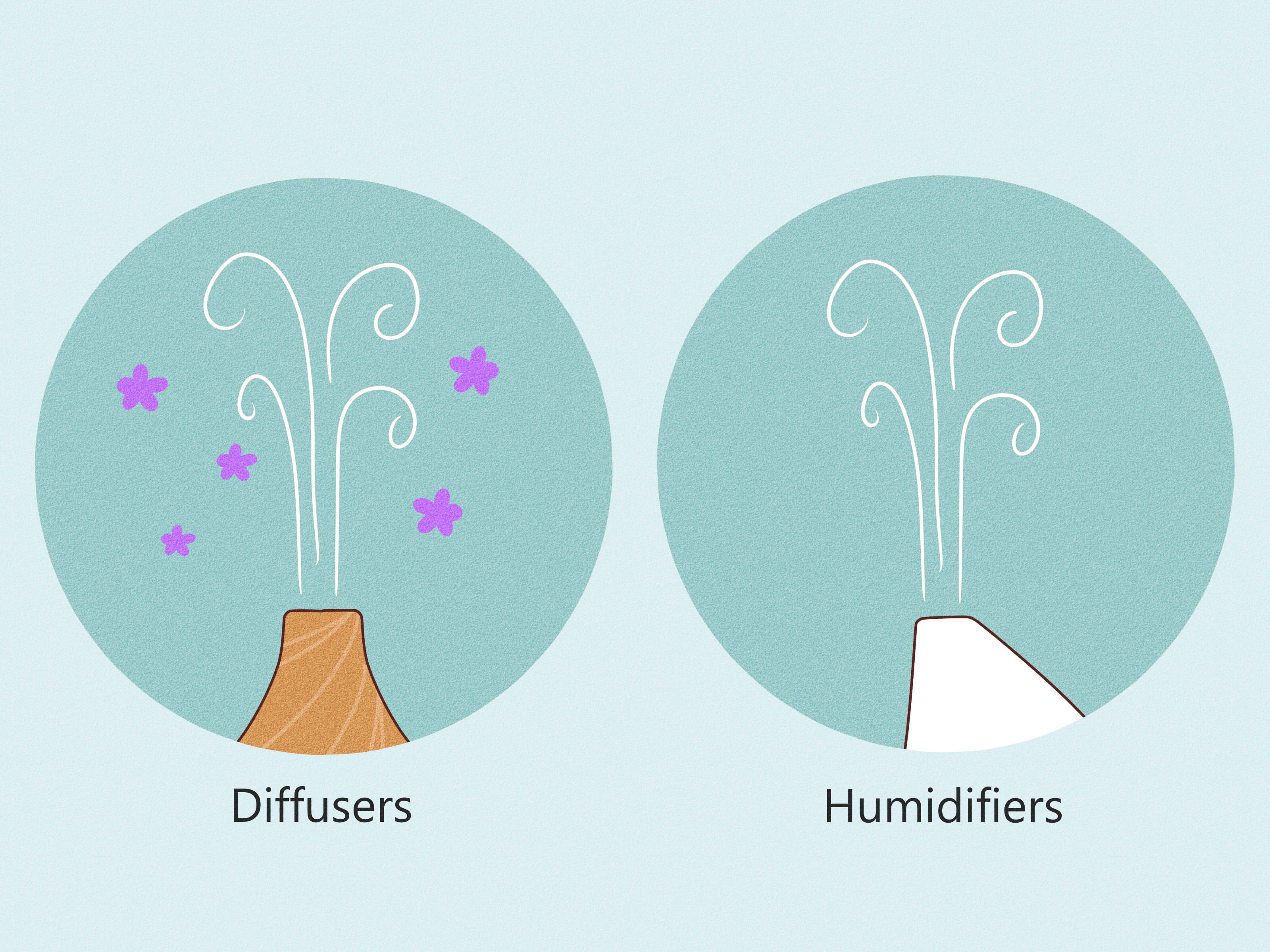

A diffuser and a humidifier can look suspiciously alike. Both may sit on a nightstand, hold water, glow like a tiny spaceship, and release a visible mist. That resemblance has caused more than a few shoppers to assume they perform the same job.
They do not. A humidifier is designed to increase the moisture level in the air. A diffuser is primarily designed to spread fragrance or essential oils through a room. Some ultrasonic diffusers release a small amount of water vapor, but their limited capacity and output generally make them poor substitutes for true humidifiers.
Choosing between a diffuser and a humidifier therefore depends on the problem you are trying to solve. Dry skin and static electricity call for humidity. A desire to make the bedroom smell like lavender instead of last night’s takeout calls for a diffuser. This guide explains how both devices work, their benefits and drawbacks, and how to use them safely.
Diffuser vs Humidifier: The Quick Answer
The simplest difference is purpose:
- A diffuser distributes aroma. It disperses essential oils or fragrance into the surrounding air.
- A humidifier distributes moisture. It releases water vapor or mist to raise the relative humidity of a room.
A diffuser may contain only 3 to 17 ounces of water and operate intermittently. A room humidifier commonly has a much larger tank and is engineered to release enough moisture to measurably change indoor humidity. The U.S. Environmental Protection Agency recommends using a hygrometer and keeping indoor relative humidity below 50% to discourage excessive biological growth.
| Feature | Diffuser | Humidifier |
|---|---|---|
| Primary purpose | Disperse scent or essential oils | Increase indoor humidity |
| Typical reservoir | Small | Medium to large |
| Effect on room humidity | Usually minimal | Measurable when properly sized |
| Essential oil use | Yes, when designed for it | Usually no unless specifically approved |
| Best for | Fragrance and personal ambiance | Dry indoor air |
| Main maintenance issue | Oil residue | Mineral deposits, bacteria and mold |
What Is a Diffuser?
A diffuser is a device that releases aromatic compounds into the air. Most household models are marketed for use with essential oils, although compatible liquids vary. Always follow the device instructions rather than pouring in whichever scented potion happens to be within reach.
Essential oils are concentrated plant extracts made by pressing or steaming plant materials such as leaves, bark, flowers and fruit. Their aromas may contribute to a relaxing or pleasant environment, but research supporting many broad therapeutic claims remains limited or mixed. A diffuser should not be treated as a cure for insomnia, anxiety, infections or respiratory disease.
Common Types of Diffusers
Ultrasonic diffusers combine water with several drops of essential oil. A vibrating plate breaks the mixture into a fine mist. These are the models most easily confused with humidifiers, although their moisture output is usually much lower.
Nebulizing diffusers use pressurized air to atomize essential oil without water. They can produce a stronger aroma, use oil more quickly and may be overwhelming in small or poorly ventilated rooms.
Evaporative diffusers move air across a scented pad or filter. As the oil evaporates, its aromatic compounds enter the room.
Heat diffusers gently warm the oil to encourage evaporation. They are often quiet, although heating may alter some of the oil’s aromatic characteristics.
Reed diffusers require no electricity. Reeds absorb scented liquid from an open container and gradually release the fragrance. Because the liquid may include concentrated oils and alcohol, reed diffusers should remain securely out of the reach of children and pets.
What Is a Humidifier?
A humidifier is an appliance that adds moisture to dry indoor air. It can be useful when heating or air-conditioning systems reduce relative humidity enough to cause dry skin, chapped lips, nasal irritation, static electricity or uncomfortable airways.
Maintaining an appropriate humidity level may help keep the nose and throat more comfortable, loosen thick mucus and reduce dryness-related sleep interruptions. However, a humidifier is not a treatment for the underlying cause of an infection, allergy, asthma flare or chronic respiratory condition.
Common Types of Humidifiers
Ultrasonic humidifiers use high-frequency vibrations to produce cool mist. They are generally quiet, but minerals in tap water may be released as fine “white dust.” Distilled or demineralized water can reduce this problem.
Impeller humidifiers use a rotating disk to throw water against a diffuser that breaks it into small droplets. Like ultrasonic models, they can disperse substances found in the tank.
Evaporative humidifiers use a fan to pull air through a damp wick or filter. The water evaporates naturally and the moistened air is circulated into the room. Filters require replacement or cleaning.
Steam vaporizers and warm-mist humidifiers heat water before releasing steam or cooled warm mist. Heating can reduce mineral dispersal, but hot water and steam create a burn hazard, particularly around children.
Whole-house humidifiers connect to a home’s HVAC system and serve multiple rooms. They can provide more consistent control but require professional sizing, installation and ongoing maintenance.
The Most Important Differences
1. Their Intended Results Are Different
A diffuser changes how a room smells. A humidifier changes how much water vapor the room contains. That distinction matters because a visible cloud of mist does not automatically mean a device is significantly affecting relative humidity.
A small diffuser may make the air immediately above it feel slightly damp, but it usually cannot compensate for dry air throughout a bedroom. Conversely, a plain humidifier will not produce an aromatherapy experience unless it includes a separate manufacturer-approved fragrance tray or oil compartment.
2. Their Water Capacity and Output Differ
Diffusers are commonly designed for a few hours of aromatic mist. Humidifiers are designed to deliver a specified moisture output across a stated room size. Tank size alone does not determine effectiveness, so compare the manufacturer’s recommended square footage and output rating.
Buying a unit that is too small may do little beyond creating an impressive puddle-sized weather system around the nightstand. Buying one that is excessively powerful can lead to condensation and overhumidification.
3. They Require Different Cleaning Routines
Diffusers accumulate oily residue that can affect aroma and clog internal parts. Most should be emptied and wiped after use, with deeper cleaning performed according to the manufacturer’s directions.
Humidifiers demand stricter water hygiene. Standing water can support microbial growth, while tap-water minerals can collect as scale or become airborne in some cool-mist models. EPA guidance advises emptying, drying and refilling portable units daily, using low-mineral water, and thoroughly cleaning them at least every third day.
4. Their Health Considerations Are Not the Same
A properly maintained humidifier may make dry air more comfortable. A poorly maintained one can distribute bacteria, mold, mineral particles or cleaning residues. More humidity is not always better, either. Consistently damp conditions can encourage mold, dust mites and other unwanted biological growth.
Diffusers introduce aromatic chemicals rather than meaningful humidity. Essential oils can cause headaches, coughing, throat irritation, allergic reactions or shortness of breath in sensitive individuals. People with asthma or chronic obstructive pulmonary disease may be particularly susceptible to strong fragrances and airborne irritants.
5. Essential Oils Are Usually Incompatible With Humidifiers
Do not place essential oils directly into a humidifier unless its instructions explicitly permit it. Oil can degrade plastic, damage filters, coat sensors and interfere with mist-producing components. It may also disperse concentrated aromatic compounds in a way the machine was not designed to control.
Combination devices do exist, but they normally keep the oil separate from the main water reservoir. A small aroma tray does not mean the entire tank is ready for a peppermint bath.
Can a Diffuser Work as a Humidifier?
An ultrasonic diffuser technically releases some moisture because it uses water to carry oil into the air. In practical terms, however, most diffusers are too small to manage room humidity effectively.
Suppose a bedroom is uncomfortably dry and measures 12 by 14 feet. A 100-milliliter diffuser may operate for several hours, but it releases only a modest amount of water. A correctly sized humidifier may hold several liters and operate according to a humidistat or adjustable output setting. These are entirely different performance levels.
Use a hygrometer instead of guessing. When relative humidity is already between roughly 30% and 50%, additional humidification may be unnecessary. When it falls below that range and dryness is causing discomfort, a properly sized humidifier is the more appropriate tool.
Can a Humidifier Work as a Diffuser?
A standard humidifier should not be converted into a diffuser through optimism and several drops of eucalyptus oil. If the manual says to use water only, use water only.
A model with a dedicated aroma pad or essential-oil compartment may provide both functions without allowing oil to contact the primary reservoir or internal water system. Even then, fragrance output may be milder than that of a dedicated diffuser.
Which Device Should You Choose?
Choose a Humidifier When:
- A hygrometer confirms that your indoor air is too dry.
- You experience dryness-related chapped lips, irritated nasal passages or static electricity.
- Your bedroom becomes especially dry during winter heating season.
- You want measurable humidity control across a defined room size.
- You are prepared to empty, dry and clean the appliance frequently.
Choose a Diffuser When:
- Your main goal is fragrance rather than moisture.
- You enjoy brief, controlled aromatherapy sessions.
- No household member is sensitive to the selected scent.
- You can use the device in a ventilated area.
- You can store the oils securely away from children and animals.
Choose Neither When:
- The room is already humid or shows condensation and mold.
- Fragrances trigger asthma, migraines, nausea or breathing discomfort.
- You cannot commit to the required cleaning routine.
- A child or pet can easily reach or overturn the device.
Safety Tips for Humidifiers
Start by measuring the room with a hygrometer. Keep relative humidity within a moderate range and reduce the setting if condensation appears on windows, walls or furniture.
Use distilled or demineralized water when recommended, especially in ultrasonic and impeller models. Empty the reservoir daily, wipe reachable surfaces dry and refill it with fresh water. Follow the manufacturer’s cleaning and filter-replacement schedule, and rinse thoroughly after using any approved cleaning product.
Place the appliance on a stable, water-resistant surface with space around the mist outlet. Keep warm-mist units away from children, bedding and traffic areas. Stop using any unit that smells musty, develops slime or produces unexplained residue until it has been properly cleaned.
Safety Tips for Diffusers
Use the smallest oil quantity recommended by the manufacturer and operate the diffuser intermittently in a ventilated room. Stop if anyone develops coughing, wheezing, headache, dizziness, throat irritation or nausea.
Never swallow essential oils. Keep bottles and open reed diffusers locked away from children. “Natural” describes an origin, not a guarantee that a concentrated substance is harmless. Essential oils may cause irritation, allergic reactions or poisoning when misused.
Pet owners should be especially cautious. Do not allow pets to contact spilled oils or knock over a diffuser. The ASPCA advises that animals with breathing problems may be better off without diffused oils, and birds can be particularly vulnerable because of their sensitive respiratory systems. Consult a veterinarian before using essential oils around pets.
Real-World Experience: What Living With Each Device Feels Like
The practical difference between a diffuser and a humidifier becomes obvious after several days of normal use. Imagine starting with a small ultrasonic diffuser beside the bed. You fill the reservoir to its narrow line, add a few drops of lavender oil and press the mist button. Within minutes, the fragrance becomes noticeable around the bed. The soft bubbling noise and optional light can make the room feel calmer, especially during an evening reading routine.
By the following morning, however, the diffuser has not solved the cracked-lip problem. The room still feels dry, and a hygrometer shows nearly the same humidity reading as the night before. The diffuser worked perfectly; it simply completed the job it was designed to do. It delivered scent, not climate control.
The next experiment involves a room-sized cool-mist humidifier. The tank is larger, heavier and slightly less graceful to carry when full. After several hours, the hygrometer rises from 27% to 39%. Nasal dryness feels less noticeable, static shocks become less frequent and the air no longer has that aggressively crispy winter quality.
The benefits come with chores. Every morning, the remaining water must be discarded rather than treated like a perpetual indoor pond. The reservoir needs time to drain and dry. Mineral scale becomes visible if tap water is used, and white dust may appear on dark furniture around certain ultrasonic models. Switching to distilled water helps, although buying and storing jugs introduces another small household task.
Placement also matters. Set a humidifier too close to a wall, curtain or wooden nightstand, and moisture may collect where it should not. Set it on the floor behind furniture, and the mist may not circulate efficiently. A stable elevated surface with open space generally produces a better result.
A diffuser presents a different learning curve. Adding more oil does not necessarily create a more enjoyable room. Two or three drops might provide a gentle scent, while ten drops can turn the bedroom into an unsolicited peppermint convention. Visitors, partners and pets may react differently, so fragrance intensity should be judged by the most sensitive occupant, not the person enthusiastically holding the oil bottle.
Cleaning experiences differ as well. A diffuser can develop sticky residue, particularly when oils are left sitting between uses. Old oil also contaminates new blends. Lemon followed by lavender may sound charming, but when mixed with last week’s peppermint residue, the result can resemble a confused household cleaner. Emptying and wiping the diffuser after each session keeps the scent more predictable.
The most convenient arrangement for someone who wants both humidity and aroma is often two separate devices. The humidifier can operate only when the hygrometer indicates dry conditions. The diffuser can run briefly when fragrance is desired. Separate controls prevent unnecessary scent exposure, keep oil away from the humidifier’s water system and make troubleshooting easier.
Combination models may save space, but they should still provide separate, clearly labeled systems for water and fragrance. The manual deserves more attention than the product’s mood-light photography. Confirm the recommended room size, cleaning procedure, compatible oils and replacement-part availability before purchasing.
In everyday use, the winning device is not the one with the prettiest mist plume. It is the one that solves the actual problem without creating a maintenance routine you will immediately abandon. A humidifier rewards consistent cleaning. A diffuser rewards restraint. Both work best when treated as appliances rather than magical tabletop clouds.
Final Verdict
In the diffuser vs humidifier comparison, neither device is universally better. They belong to different categories despite their similar appearance.
Buy a humidifier when measured indoor humidity is low and you need to add moisture to a room. Select a model that matches the room size, use appropriate water and commit to regular cleaning. Buy a diffuser when your goal is controlled fragrance and everyone in the household can tolerate the selected aroma.
Do not expect a diffuser to correct seriously dry air, and do not pour essential oils into an ordinary humidifier. When both moisture and aroma are desired, separate devicesor a properly designed combination unit with separate systemsoffer the safest and most controllable approach.