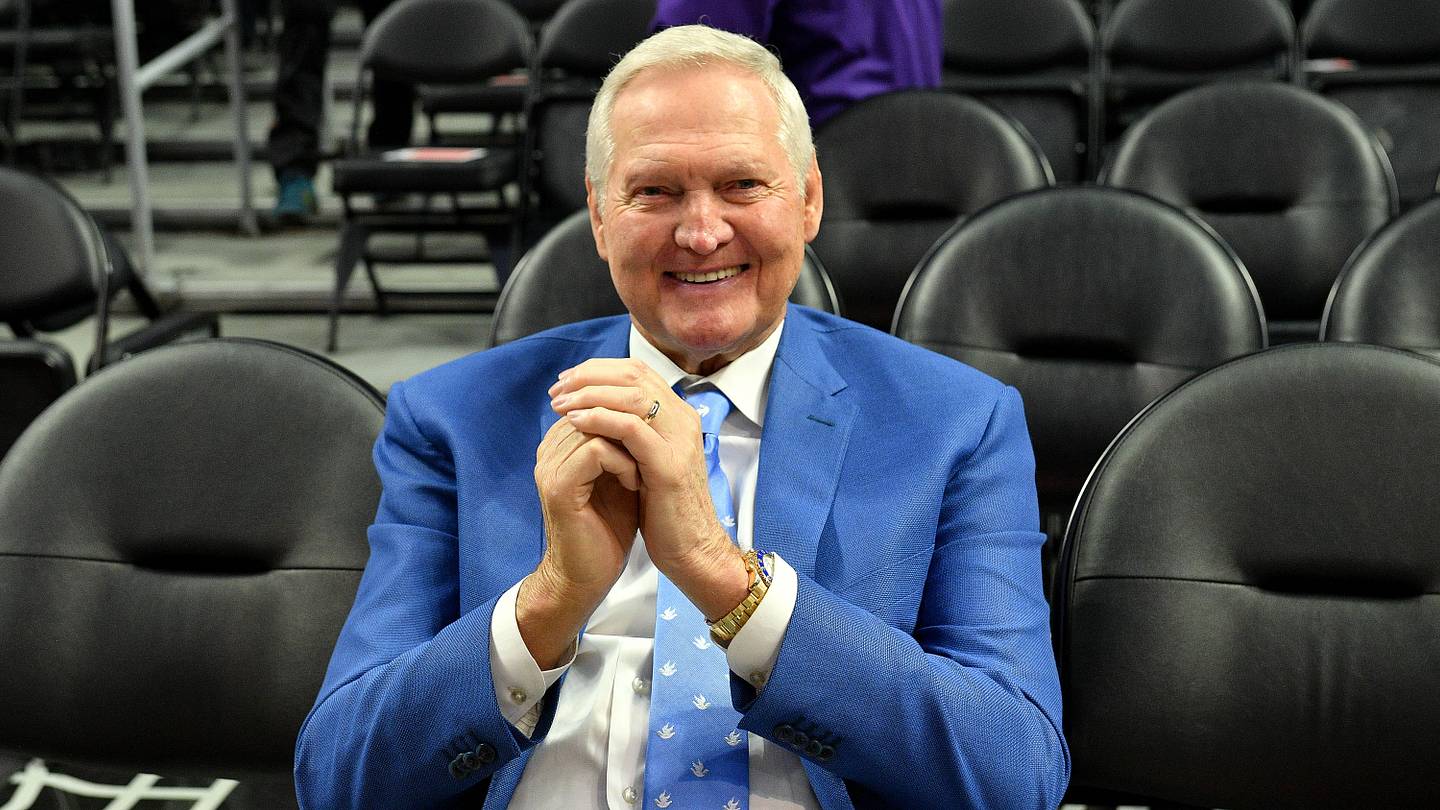

The short answer is no: Jerry West did not receive royalties for being the inspiration behind the NBA logo. The longer answer is far more interesting, because it involves a legendary player, a brilliant designer, a famous photograph, a league that preferred mystery over paperwork, and one of the most recognizable sports symbols ever created. In other words, it is classic NBA dramaonly this time, nobody needed a referee review.
For decades, basketball fans have asked the same question: if Jerry West is “The Logo,” does he get paid every time the NBA logo appears on a jersey, a sock, a basketball, a video game, or a hoodie worn by someone who has never practiced a left-hand dribble in their life? It sounds logical. The logo is everywhere. West’s silhouette is everywhere. The NBA is a global business. Surely there must be a royalty check somewhere, right?
Not quite. Although designer Alan Siegel has openly said that the famous silhouette was based on a photograph of Jerry West, the NBA has historically avoided officially declaring that the logo is West. That careful distance is one major reason West never collected royalties tied to the logo. The league’s position helped the symbol remain an institutional brand mark rather than a player endorsement, a personal likeness deal, or a never-ending licensing negotiation.
The Simple Answer: No, Jerry West Did Not Get NBA Logo Royalties
Jerry West was not paid ongoing royalties for the NBA logo. There is no public record of West receiving a percentage of NBA merchandise sales, licensing fees, apparel revenue, broadcast graphics, or any other income connected to the logo. The logo may look like him, move like him, and carry his basketball DNA, but it was not treated like a personal endorsement deal.
That distinction matters. Royalties usually come from a contract. A musician gets royalties because a song is registered, licensed, and monetized under an agreement. An actor may earn residuals because their contract says so. An athlete may earn licensing income when their name, image, or likeness is formally used in a commercial product. In West’s case, the NBA logo was created as a league identity, not as a Jerry West product.
The odd part is that everybody in basketball culture knows the connection. West’s nickname, “The Logo,” did not appear out of thin air like a loose ball bouncing into the expensive seats. Fans, writers, players, and even many official NBA-related stories have acknowledged the link. Still, the NBA’s traditional reluctance to say “yes, that is Jerry West” has kept the matter legally and financially clean for the league.
How Jerry West Became the Face of the NBA Without Really Becoming “The Face”
The current NBA logo was designed in 1969 by Alan Siegel, a respected branding expert whose work helped shape modern sports identity. At the time, the league wanted a cleaner, stronger, more professional look. The NBA was competing for attention, fighting for television relevance, and trying to strengthen its image in the same broad cultural moment when Major League Baseball had rolled out a powerful red, white, and blue logo of its own.
Siegel searched through photo archives from Sport Magazine and found a dynamic image of Jerry West dribbling. The photograph, taken by Wen Roberts, had the ingredients a designer dreams about: vertical movement, balance, grace, and instant readability. West was not dunking, flexing, pointing, yelling, or celebrating. He was in motion, controlling the ball, leaning forward as if the next play already existed in his mind.
That is why the image worked. The NBA logo is not just a picture of a basketball player. It is a tiny story. A white silhouette slices between red and blue blocks, ball in hand, body moving with purpose. It suggests speed, control, competition, and elegance. You do not need to know Jerry West to understand the symbol. But once you do know it is based on West, it becomes almost impossible not to see him.
Why the NBA Never Fully Embraced the Jerry West Identification
The NBA’s cautious stance has long fueled the royalty question. If the league officially admitted the player was Jerry West, would that create legal complications? Could West or his estate claim compensation? Would the photographer’s rights become part of the conversation? Would the league be tying its entire brand to one specific person forever?
Those questions help explain why the NBA has historically preferred ambiguity. A logo that represents “the league” is simpler than a logo that represents “one former Lakers guard.” That does not diminish West’s greatness. It simply shows how major sports brands think. A league wants its primary logo to belong to every team, every fan, every broadcast partner, and every future generation. If the symbol becomes too officially attached to one individual, the brand can feel less universal.
There is also the matter of likeness rights. In modern sports, an athlete’s name, image, and likeness are valuable assets. Today, if a league intentionally built a logo from a player’s photograph, lawyers would likely be involved before the first sketch left the conference room. In 1969, the culture around athlete branding was very different. Players were famous, but they did not control their commercial identities the way stars do today.
Did Jerry West Ever Want the Money?
West’s relationship with the logo was complicated. He was honored by the association, but he also seemed uncomfortable with the attention. That makes sense if you understand Jerry West’s personality. He was fiercely competitive, deeply self-critical, and not exactly the type to dance into a room shouting, “Please admire my silhouette.”
West sometimes joked about the lack of money. He also suggested that if he had received royalties, he would have wanted to do something meaningful with them. But the public record does not show him pursuing a major legal battle against the league over the logo. In many ways, that restraint fits his reputation: proud, intense, uncomfortable with praise, and more focused on basketball excellence than personal branding.
There is a small irony here. The one player whose outline became the NBA’s global symbol was also one of the least likely superstars to enjoy being treated like a symbol. Many modern athletes build brands around themselves with surgical precision. West came from a different era, when stars earned less money, had fewer marketing channels, and were often expected to let the game speak for them. In West’s case, the game spoke so loudly that it became a logo.
What About Alan Siegel? Did the Designer Get Rich From the Logo?
Alan Siegel did not become a billionaire from the NBA logo either. He has said he charged $14,000 for the assignment. That may sound low today, especially considering the logo has appeared on merchandise worth enormous sums over many decades. But in the context of the time, the job was a prestigious branding project, not a royalty-based ownership deal.
This is another reminder that iconic creative work does not always produce iconic paydays for the people who created it. A designer can make a symbol that lives forever and still be paid a flat fee. A player can inspire that symbol and still receive no royalties. Meanwhile, the brand itself can grow into a worldwide commercial machine. Business, like basketball, rewards positioning. Sometimes the person who sets the perfect screen does not show up in the box score.
Why Jerry West Was the Perfect NBA Logo Model
Even if the NBA wanted an anonymous figure, Jerry West was an ideal source. He represented skill, competitiveness, and professionalism. During his playing career with the Los Angeles Lakers, West became one of the greatest guards in basketball history. He was a 14-time All-Star, a 12-time All-NBA selection, an NBA champion in 1972, and the only player to win NBA Finals MVP while playing for the losing team, which is both amazing and painfully on-brand for a man associated with near-misses and impossible standards.
West was also known as “Mr. Clutch,” a nickname earned through late-game brilliance. His famous long shot in the 1970 NBA Finals against the New York Knicks remains one of the legendary moments of the sport. Before the three-point line, that shot counted for only two points. Somewhere, every modern analytics nerd just fainted into a spreadsheet.
After his playing career, West became an elite executive. He helped build championship teams with the Lakers, influenced the construction of the Showtime era, played a major role in the acquisition of Kobe Bryant, and later contributed to winning organizations beyond Los Angeles. So while the logo captures West as a player, his total basketball legacy is much larger than a silhouette.
Could Jerry West’s Estate Ever Claim Royalties?
In theory, public figures and their estates can have rights connected to likeness and commercial use. In practice, the Jerry West NBA logo situation is difficult because the mark has existed for more than half a century, the league has traditionally avoided official identification, and the image is stylized rather than a detailed portrait. The logo is a white silhouette, not a photograph of West’s face.
That does not mean the connection is imaginary. It means the legal pathway to royalties would be complex. A successful claim would likely require proving commercial use of West’s identifiable likeness, overcoming the long history of the logo’s use, and dealing with the fact that the NBA has treated the figure as generic. The longer a brand mark exists without a formal challenge or royalty agreement, the harder it may be to unwind.
There is also a practical issue: the NBA logo is not simply one product. It is the master symbol of a league, used across teams, broadcasts, digital platforms, uniforms, courts, official merchandise, and international marketing. Turning that into a personal royalty stream would be complicated, expensive, and probably something the league has spent decades avoiding with the same determination a coach uses to avoid admitting he should have called timeout.
Why Fans Still Care About the Royalty Question
The question “Does Jerry West get royalties for being the NBA logo?” continues to attract attention because it feels like a fairness puzzle. If a person’s image helped create billions of impressions and countless licensed products, shouldn’t that person be compensated? From a fan’s emotional perspective, the answer feels obvious. From a contract and branding perspective, it is much less simple.
Fans also care because West’s story highlights how much sports business has changed. Today’s stars understand brand equity. LeBron James, Stephen Curry, Kevin Durant, and other modern athletes operate in a world of signature shoes, media companies, production deals, equity stakes, and social platforms. A modern Jerry West might have representation ready before the first logo sketch was approved.
But West came from a period when athletes had less leverage. His highest playing salary has often been reported as modest compared with modern NBA contracts. Today, even role players can earn more in a season than many legends earned in their entire playing careers. That context makes the logo question feel even sharper. West helped define the image of a league that eventually became far richer than the world he played in.
Should the NBA Change the Logo?
Every few years, the debate returns: should the NBA update the logo? Some fans have argued for Kobe Bryant. Others have suggested Michael Jordan, LeBron James, Kareem Abdul-Jabbar, Bill Russell, or a completely new abstract design. The argument usually grows louder after major moments of reflection, such as the death of a beloved player or a league anniversary.
There are emotional reasons to change the logo, but there are powerful branding reasons not to. The current logo is simple, flexible, instantly recognized, and deeply embedded in global sports culture. Changing it would be like changing the shape of the Coca-Cola bottle or telling baseball caps they now have to be triangles. Technically possible? Sure. Wise? That is another question.
The logo also works because it is not overly literal. It does not show a face. It does not lock the NBA into one team, era, race, style, or superstar personality. Even if it began with Jerry West, it now functions as a symbol of the sport itself. That is the strange magic of great branding: the origin matters, but the meaning expands over time.
The Real Value of Being “The Logo”
If Jerry West did not get royalties, what did he get? He received a form of immortality that money cannot exactly buy. His silhouette became attached to the league’s identity. His movement became the visual shorthand for professional basketball. His nickname became one of the most unusual honors in sports history.
That does not pay like a licensing agreement, and it does not solve the fairness debate. But it is still extraordinary. Many players win rings. Some win MVPs. A few become statues. Almost nobody becomes the logo of an entire league. West’s silhouette is stamped into basketball history in a way that even many more commercially famous stars will never match.
The uncomfortable truth is that the NBA logo gave West endless recognition without endless compensation. That makes the story both inspiring and slightly awkward. It is a tribute, a branding masterpiece, a legal dodge, and a sports trivia answer all at once. Very few things in basketball contain that many layers without being called a zone defense.
Fan and Writer Experiences With the Jerry West Logo Question
One reason this topic stays popular is that it creates an immediate reaction. Ask a room full of basketball fans whether Jerry West got royalties for the NBA logo, and someone will almost always say, “He had to, right?” The assumption is natural. People see the logo on official merchandise and connect it with modern endorsement culture. In today’s world, where athletes monetize everything from sneakers to podcasts to pregame tunnel outfits, it feels almost impossible that the person behind the NBA’s most famous image would not receive a cut.
That surprise is part of the experience. The topic works well in sports conversations because it begins as trivia but quickly becomes a discussion about fairness, history, and business. A casual fan may start by asking a simple yes-or-no question. Five minutes later, the conversation has somehow moved into likeness rights, 1960s player salaries, the ABA-NBA rivalry, Kobe Bryant logo proposals, and whether a silhouette can legally count as a person. That is a lot of mileage from one white dribbling figure.
For writers, the Jerry West logo story is especially useful because it bridges eras. It connects old-school basketball with modern sports marketing. It introduces younger fans to West’s greatness without sounding like a dusty history lecture. Instead of saying, “Please appreciate this legendary guard from the 1960s,” the story says, “You already see him every time you watch the NBA.” That is a much stronger hook. It turns a historical figure into something familiar.
For longtime fans, the logo can feel personal. Many grew up seeing it on trading cards, warm-up jackets, basketballs, video games, and TV broadcasts. They may not have watched West play live, but they inherited his outline as part of basketball’s visual language. The logo was there before many fans knew team salary caps existed, before they understood playoff seeding, and definitely before they learned that “load management” could start an argument at any barbershop in America.
The royalty question also makes people think about how athletes from different generations were treated. Modern stars are businesses unto themselves. Older stars often helped build leagues before the biggest money arrived. Jerry West’s situation captures that gap perfectly. He gave the NBA a visual identity, even unintentionally, but he did not benefit from it the way a modern athlete might. That contrast can feel unfair, even if the legal explanation makes sense.
There is also a branding lesson here for anyone outside sports. A great logo does not need to explain itself. The NBA logo works because it is simple, emotional, and active. It does not show a scoreboard, a hoop, a sneaker, or a mascot spinning a basketball on one finger. It shows motion. That motion came from Jerry West, and that is why the design still feels alive decades later.
In the end, the experience of learning this story is a little like watching a slow-motion replay. At first, you notice the obvious part: Jerry West inspired the logo. Then you notice the details: the photograph, the designer, the NBA’s careful silence, the lack of royalties, West’s discomfort, and the logo’s massive cultural reach. By the time the replay ends, the answer is clear. No, Jerry West did not get royalties for being the NBA logo. But in basketball memory, he received something rare: a permanent place in the sport’s daily vocabulary.
Conclusion: No Royalties, But an Unmatched Legacy
So, does Jerry West get royalties for being the NBA logo? No. He did not receive ongoing royalty payments for the logo, largely because the NBA treated the figure as an anonymous league symbol rather than an officially licensed image of Jerry West. Alan Siegel based the design on a photograph of West, but the league’s careful ambiguity helped prevent the logo from becoming a personal likeness deal.
Still, the absence of royalties does not erase West’s importance. If anything, it makes the story more fascinating. Jerry West became the NBA’s most visible invisible man: officially unnamed, unofficially recognized, commercially everywhere, and historically unforgettable. The logo did not make him great. He was already great. But it turned one moment of movement into a symbol that outlived box scores, contracts, and even generations of superstars.
Note: This article is based on widely reported information from major U.S. basketball, business, sports history, and design sources, including NBA-related reporting, interviews with logo designer Alan Siegel, and historical coverage of Jerry West’s career and legacy.