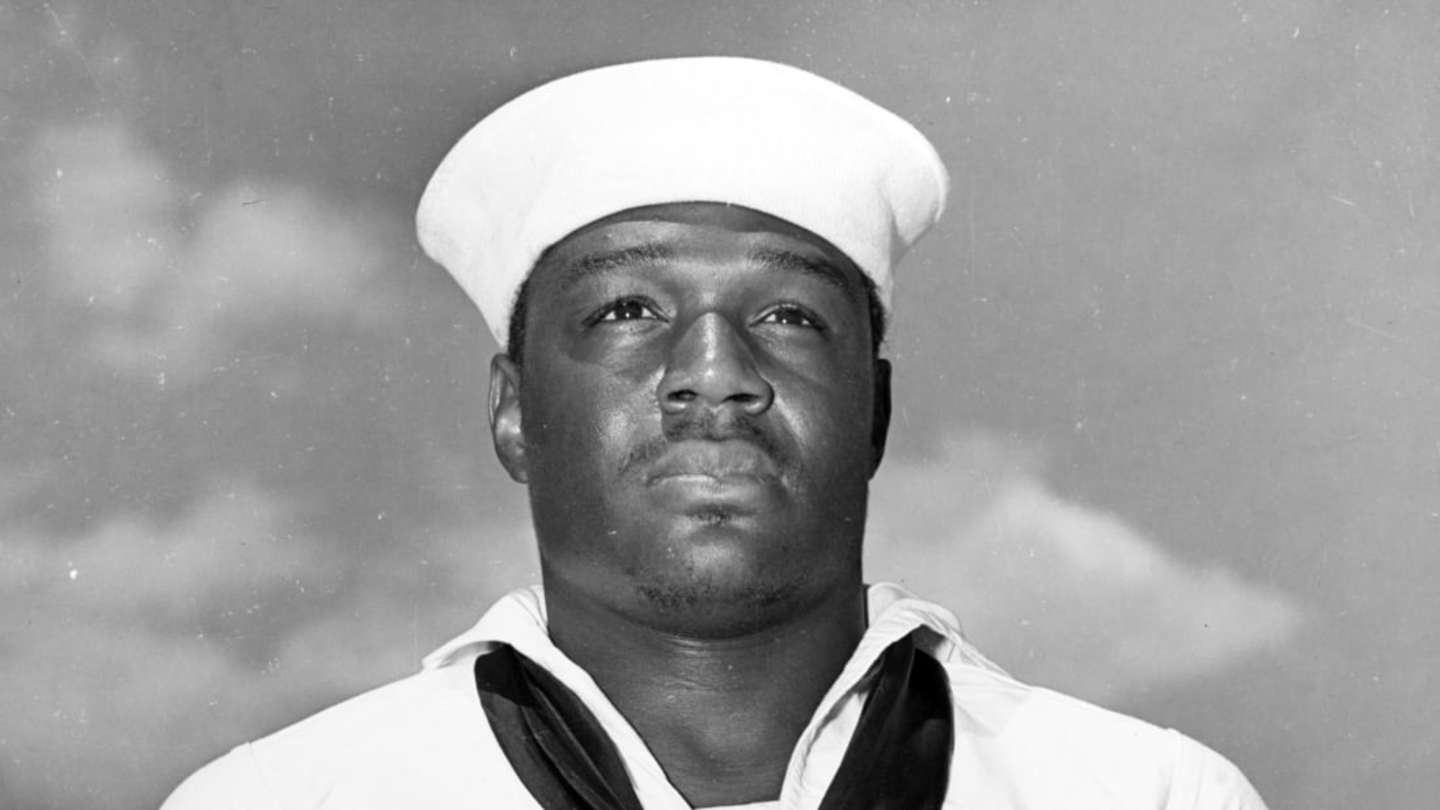

History loves uniforms with shiny buttons, polished speeches, and people who look like they were born to stand in front of statues. Doris Miller was not one of those people. He was a young Black sailor from Waco, Texas, serving in a segregated Navy that mostly allowed men like him to cook, clean, carry trays, and stay far away from the spotlight. Then Pearl Harbor happened, and history had to make room.
On December 7, 1941, while bombs fell and the battleship USS West Virginia burned around him, Miller did not wait for a grand invitation from fate. He helped move wounded sailors, assisted his dying captain, and took over an unattended anti-aircraft gun even though he had not been formally trained to use it. In that terrible, chaotic morning, the Navy’s job description for him collapsed. Character took over.
That is why Doris “Dorie” Miller still matters. His story is not just about wartime bravery. It is also about race, service, dignity, and the strange way a nation can ask for your loyalty while still denying you full respect. If you want a Pearl Harbor story with courage, contradiction, and a hero who did not fit the old Hollywood mold, pull up a chair. Doris Miller earned that chair long ago.
Who Was Doris Miller Before Pearl Harbor?
Doris Miller was born on October 12, 1919, in the Waco area of Texas, where he grew up in a working-class family during hard years that did not exactly hand out luxury starter packs. He helped on the family farm, worked odd jobs, and developed a reputation for being strong, steady, and athletic. He also boxed, which turns out to be useful preparation for life in general, even if it does not usually show up on a résumé under “future war hero.”
In 1939, Miller enlisted in the U.S. Navy. For Black Americans of his era, military service came with a cruel asterisk. The country asked for service, but the system still ran on segregation. In the Navy, Black sailors were largely restricted to the steward’s branch, which meant food service, laundry, cleaning, and personal support duties rather than the technical and combat assignments more commonly available to white sailors.
That detail matters because it explains why Miller’s story hit so hard. He was not supposed to be the guy on the gun. He was not supposed to be one of the faces of wartime courage. The structure around him had already decided what kind of service counted and what kind of service did not. Miller would prove, in the loudest possible way, that the structure was wrong.
Before Pearl Harbor, he served on ships including the USS Pyro and later the USS West Virginia. Shipmates knew him as “Dorie.” He was well liked, physically imposing, and good enough in the boxing ring to become a heavyweight champion aboard ship. That sounds like a fun detail from a movie montage, but it also hints at something deeper: Miller had discipline, nerve, and presence. When the crisis came, those traits did not suddenly appear. They were already there, waiting for history to test them.
December 7, 1941: When the Rules Burned Away
The Morning That Changed Everything
On the morning of the Japanese attack on Pearl Harbor, Miller was aboard the USS West Virginia. He had started the day doing ordinary duties. Then came the alarms, explosions, smoke, wreckage, and confusion that turned an ordinary Sunday into one of the most infamous days in American history.
Miller first headed toward his battle station, but the area had been wrecked by torpedo damage. So he did what real heroes often do: he stopped worrying about what the paper said and started doing what the moment required. He helped move injured sailors to safety and assisted Captain Mervyn Bennion, who had been mortally wounded. That alone would have been an act of courage under catastrophic conditions.
The Gun He Was Never Supposed to Fire
Then came the moment that made his name famous. Miller moved to an anti-aircraft gun position and helped load ammunition. After that, he took over an unattended .50-caliber Browning machine gun and fired at attacking Japanese aircraft. He had not received the sort of formal gunnery training that white sailors in combat ratings were more likely to get. That was part of the injustice of the segregated Navy. Still, he fired anyway.
Later accounts credited him with hitting enemy aircraft, though the exact number has long been debated. What is not debated is the larger point: in the middle of a devastating surprise attack, Miller fought back. He kept firing until he ran out of ammunition and the order came to abandon ship.
This is where the story becomes larger than one man and one gun. Pearl Harbor exposed military unpreparedness, but Miller’s actions also exposed something else: the absurdity of a racist system that limited Black sailors to service roles while still depending on their courage when everything fell apart. He was good enough to help save the ship when bombs were dropping, but under normal rules he was not considered worthy of equal opportunity. That contradiction hangs over his story like smoke over the harbor.
Why Doris Miller’s Heroism Mattered So Much
America needed heroes after Pearl Harbor. It needed proof that people had stood up in the chaos, that courage had survived the blast. Miller’s actions gave the nation exactly that. But for Black Americans, his example meant even more. He was not simply a sailor who behaved bravely. He became living evidence that patriotism, discipline, and valor had never been the exclusive property of the people who held power.
News of his actions spread, though not instantly or perfectly. Early coverage did not always identify him properly, which says plenty about the era all by itself. Once his identity became widely known, Black newspapers, civil rights advocates, and community leaders treated his story as both inspiration and argument. Here was a man who had done everything the nation could ask under fire. So why was the nation still treating Black servicemembers as second-class participants in their own military?
That question gave Miller’s heroism unusual political force. He was not just celebrated as a Pearl Harbor hero. He became part of a broader case for dignity, fairness, and military change. His bravery challenged the logic of segregation without needing a single speech from a podium. His life made the argument by itself.
The Navy Cross, National Fame, and a Complicated Kind of Recognition
On May 27, 1942, Admiral Chester W. Nimitz presented Doris Miller with the Navy Cross at Pearl Harbor. He became the first African American to receive that decoration. It was a major honor, and the ceremony mattered symbolically. A young Black sailor who had been confined by segregation now stood before one of the Navy’s highest leaders as a nationally recognized hero.
But recognition in wartime America could be complicated. Miller’s story was useful to the government as a symbol of courage and national unity, yet the segregated system that had limited him was still very much alive. In other words, the nation was happy to admire the hero while moving more slowly on the injustice that shaped his life. America has always had a talent for giving standing ovations while dragging its feet.
Miller was later sent on a war-bond tour, becoming the first African American included on that type of Navy speaking campaign. His image also appeared in wartime recruiting material, including the famous “Above and beyond the call of duty” poster. His face had become recognizable. His name had become shorthand for bravery.
Yet by many accounts, Miller himself was not especially interested in celebrity. He had not raced into danger because he wanted a poster. He had done it because people needed help and the enemy was attacking. That difference matters. Some people chase legend. Others become legends because they never had time to chase anything except the next necessary act.
A Hero in a Segregated Navy
To understand Doris Miller fully, you have to keep two truths in view at the same time. First, he was a genuine American war hero. Second, he became that hero inside a system built to limit him because of his race. If you tell only the first truth, the story becomes neat and patriotic but incomplete. If you tell only the second, you miss the scale of his courage. The real power of Miller’s legacy lives in the tension between both.
Miller did not defeat segregation by himself, and it would be unfair to turn his life into a tidy fable where one heroic act magically fixes a broken institution. Real history is messier than that. But his example helped shift public imagination. It became harder to claim that Black servicemembers were unfit for broader responsibilities when one of the most admired men of Pearl Harbor was a Black mess attendant who had stepped into combat under fire.
In that sense, Miller’s place in American history reaches beyond Pearl Harbor. He belongs in the larger story of Black military service, the Double Victory spirit of fighting tyranny abroad while demanding equality at home, and the long pressure campaign that eventually pushed the armed forces toward desegregation.
The Final Chapter: USS Liscome Bay
Doris Miller’s story did not end with applause, medals, and newspaper headlines. In 1943, he returned to active wartime service aboard the escort carrier USS Liscome Bay. On November 24, 1943, during operations connected to the Battle of Makin in the Gilbert Islands, the ship was struck by a Japanese torpedo. A catastrophic explosion followed, and the carrier sank quickly.
Miller was among those killed. He was just 24 years old.
That fact lands like a door shutting. It reminds us that his story is not a motivational poster with perfect lighting. It is war history, and war rarely hands out clean endings. Miller survived the day that made him famous, only to die later in a campaign that fewer casual readers remember. That too is part of the truth. Heroism does not guarantee a long life, a peaceful retirement, or a final chapter wrapped in patriotic ribbon.
But his death did not erase what he had already changed. By then, his image had entered the national memory. His example continued to inspire Black Americans, service members, historians, and families trying to understand what courage looks like when the world has not yet decided to treat you fairly.
Why Doris Miller Still Matters Today
Doris Miller still matters because his story sits at the crossroads of bravery and justice. He represents the best kind of military heroism: practical, immediate, unscripted, and rooted in service to others. But he also forces us to confront a harder truth about the United States during World War II. The nation asked Black Americans to defend democracy while denying them full equality.
That is why modern remembrance of Miller is so important. Memorials in Waco honor him. Museums and archives preserve his image and story. The Navy named a future aircraft carrier, USS Doris Miller (CVN-81), in his honor, a remarkable legacy for a man who once served in one of the few roles the segregated Navy would permit him to hold.
And maybe that is the most powerful part of all. The young sailor once confined to serving meals now has his name attached to one of the most powerful symbols in the fleet. History cannot undo the unfairness he lived through, but it can tell the truth about it. Better yet, it can make sure he is remembered not as a footnote, but as exactly what he was: a brave American whose actions at Pearl Harbor forced the country to look again at who gets called a hero.
Experiences That Make Doris Miller’s Story Feel Real
Reading about Doris Miller in a history book is one thing. Standing in a place tied to his story is something else entirely. At Pearl Harbor, the scale of the attack becomes more than a date you memorized for a quiz. The water, the ships, the distances between decks and guns, the sense of exposure in the harbor, all of it helps you understand that Miller was not acting in some neat cinematic frame. He was moving through smoke, noise, fear, and confusion while trying to keep other men alive. That physical setting changes the story from “famous hero moment” into “real human being making impossible choices under pressure.”
The same is true in Waco, where the Doris Miller Memorial gives his legacy a hometown gravity. It reminds visitors that before he became a national symbol, he was a son, a worker, a young man from Texas, and someone whose life might easily have remained ordinary if history had not exploded around him. Memorials do not just honor the dead. At their best, they shrink the distance between then and now. They whisper that the people in these stories were not made of marble when they started out.
There is also a powerful emotional experience in learning about Miller through the lens of segregation. It is one thing to admire bravery in battle. It is another to realize that the man showing that bravery served in an institution that limited him because he was Black. That contradiction can make modern readers uncomfortable, and honestly, it should. Good history is not supposed to tuck us in and dim the lights. It is supposed to tell the truth. Miller’s life pushes people to wrestle with patriotism in a mature way, one that includes both pride and honesty.
Teachers, students, museum visitors, and families often come away from Miller’s story with a similar reaction: surprise first, then respect, then reflection. Surprise that such a central figure is not always given the same household-name status as other World War II heroes. Respect for the raw courage of what he actually did on December 7. Reflection on how many other stories were minimized because of race, class, or the habits of official memory.
Even the smallest details can make the experience feel immediate. The image of Miller carrying wounded sailors. The anti-aircraft gun he was never meant to use. The Navy Cross ceremony in Pearl Harbor. The war-bond tour that celebrated him while the country still struggled to see Black Americans as full equals. The later loss of USS Liscome Bay, which adds a sobering reminder that heroism did not protect him from the ordinary cruelty of war.
In the end, the most meaningful experience connected to Doris Miller may be this: realizing that courage does not always come from the people society expects to glorify. Sometimes it comes from the man assigned to the margins. Sometimes the person history tried to overlook becomes the one history cannot explain without. Miller’s story still lands because it is not just about Pearl Harbor. It is about what America was, what it claimed to be, and what people like Doris Miller forced it to become.
Conclusion
Doris Miller did not set out to become a symbol. He set out to serve, survive, and help others in the middle of one of the most shocking attacks in American history. Yet his actions at Pearl Harbor turned him into far more than a decorated sailor. He became a measure of courage, a challenge to segregation, and a lasting figure in both naval history and civil rights memory.
Plenty of heroic stories sound polished after eighty-plus years of retelling. Miller’s still feels urgent. Maybe that is because it carries more than valor. It carries friction, injustice, grit, and the stubborn truth that greatness can emerge from places power never thought to look. That is why Doris Miller remains unforgettable. Not because he fit the image of a hero, but because he shattered it.