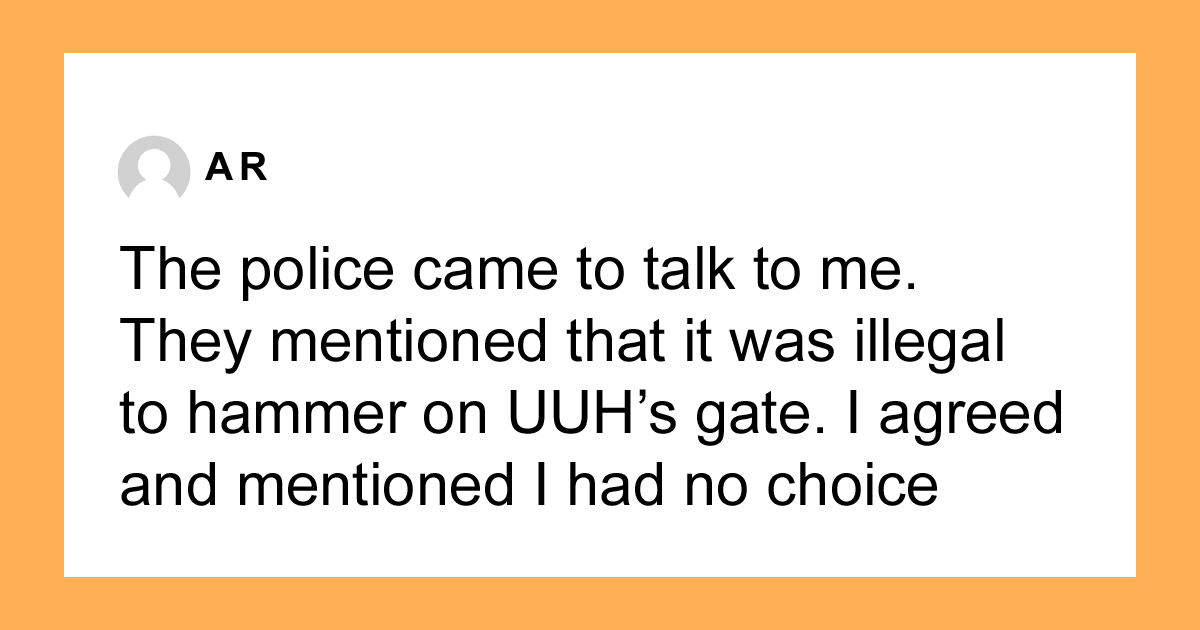
Hey Pandas, AITA For Using A Hammer On My Neighbor’s Gate After 3 Years Of 24/7 Noise Harassment?

There are neighbor problems, and then there are neighbor problems that turn your peaceful home into a low-budget percussion festival. A squeaky gate at noon? Annoying. A metal gate clanging at 2:14 a.m., 4:03 a.m., and again during the one nap your body begged for? That is not “community living.” That is a villain origin story with hinges.
So here is the big AITA-style question: after three years of nonstop noise harassment, sleep loss, stress, and ignored complaints, are you the jerk for finally using a hammer on your neighbor’s gate? Emotionally, many exhausted readers will understand the impulse. Legally and practically, however, swinging a hammer at someone else’s property is where the story stops being “relatable” and starts flirting with “please do not explain this to a judge while wearing pajamas.”
This article breaks down the situation with a clear verdict, practical neighbor noise advice, legal context, and real-life experience-based lessons for anyone dealing with loud neighbors, gate slamming, barking dogs, late-night parties, driveway drama, or the mysterious upstairs person who apparently owns bowling shoes made of bricks.
The AITA Verdict: Understandable? Yes. Smart? Not Really.
If the hammer was used to damage the gate, the answer is: YTA for the action, but not for reaching your breaking point. That distinction matters. Chronic noise can be genuinely harmful. It can wreck sleep, spike stress, ruin concentration, and make your home feel less like a sanctuary and more like a badly managed bus station.
But once you damage, dent, jam, loosen, remove, or otherwise “teach a lesson” to someone else’s gate, you give the noisy neighbor a gift wrapped in legal tape. Suddenly the conversation shifts from “their noise is unreasonable” to “you damaged their property.” Even if they have been inconsiderate for years, your hammer moment becomes the shiny object everyone stares at.
The better verdict is: ESH if the neighbor has truly been harassing you with 24/7 noise, but your retaliation may make your case harder to win. Noise harassment should be handled through documentation, complaints, mediation, landlord or HOA action, and legal remediesnot hardware-store rage therapy.
Why 24/7 Noise Harassment Feels So Personal
Noise is not just sound. It is an invasion of attention. You can close the curtains on a bad view, but you cannot close your ears without looking like you are preparing for takeoff. Chronic noise follows you into sleep, work calls, family dinners, and that one sacred moment when the coffee is hot and nobody has asked you where the scissors are.
Common neighbor noise problems include:
- Metal gates slamming repeatedly
- Dogs barking for hours
- Loud music or parties late at night
- Shouting, arguments, or outdoor speakers
- Construction outside permitted hours
- Dragging furniture, stomping, or impact noise
- Cars revving, alarms, or driveway activity
Over time, the problem becomes bigger than the decibel level. It becomes anticipation. You start waiting for the next slam. You pause movies because you think you heard it. You wake up before the sound because your brain has become a tiny, miserable security guard. That is why chronic noise disputes become emotional so quickly.
When Noise Becomes More Than “Normal Neighbor Stuff”
Every neighborhood has some noise. Kids play. Dogs bark. Garbage trucks exist because civilization has not yet invented silent trash teleportation. The law usually does not punish ordinary, occasional, reasonable noise.
The key words are excessive, repeated, unreasonable, and disruptive. A gate that bangs once when someone comes home is life. A gate slammed deliberately every few minutes during quiet hours may become a nuisance. A dog barking at the mail carrier is normal. A dog barking all night while the owner shrugs like the moon personally requested it is a different matter.
In many U.S. communities, noise rules are local. Cities and counties often have ordinances that set quiet hours, regulate construction times, restrict amplified sound, or allow residents to report chronic noise. Some places use decibel limits. Others focus on whether sound is plainly audible beyond a property line or whether it disturbs reasonable use of a home.
The Problem With Taking a Hammer to the Gate
Let’s be honest: the hammer probably felt symbolic. After three years of being ignored, the gate may have stopped being a gate and become a metallic monster with hinges. But symbolism does not help much when the other person can point to a dent, broken latch, bent frame, or security camera clip.
Damaging another person’s property can be treated as vandalism, criminal mischief, malicious mischief, or property damage depending on the state and circumstances. Even a small repair bill can create civil liability. A larger amount of damage can make the situation far more serious. If the neighbor claims they felt threatened, the hammer also changes the emotional temperature of the dispute.
That is the cruel irony of retaliation: it may feel like justice for three seconds, then weaken your position for three months. It gives the noisy neighbor a counter-complaint, a police report, or a reason to paint themselves as the victim. Congratulations, the gate is now quieter and your paperwork is louder.
What You Should Do Instead of Hammer Justice
1. Start a Noise Log
A noise log is boring, which is exactly why it works. Write down the date, time, duration, type of noise, and how it affected you. “Gate slammed 18 times between 11:40 p.m. and 12:15 a.m.; woke household twice” is more useful than “They are driving me insane,” even if both are spiritually accurate.
Include patterns. Does it happen during quiet hours? Does it happen after you complain? Is it tied to a specific gate, dog, car, speaker, or person? Specificity turns frustration into evidence.
2. Record Carefully and Legally
Short videos or audio clips can help show frequency and volume, but be careful. Do not trespass, point cameras into private areas, or record conversations where local law may require consent. Recording the sound from your own property is usually safer than playing amateur spy with a hoodie and a bush.
3. Try One Calm Written Message
A written message can be more effective than a heated face-to-face confrontation. Keep it short and factual. For example:
Hi, I wanted to ask if you could please secure the gate so it does not slam repeatedly, especially after 10 p.m. It has been waking us up several nights a week. I would appreciate it if we could solve this calmly. Thank you.
Notice what is missing: insults, threats, dramatic punctuation, and the phrase “I have watched enough true crime to know how this ends.” Calm writing creates a record and shows that you attempted a reasonable solution.
4. Check Local Noise Ordinances
Search your city or county website for “noise ordinance,” “quiet hours,” “neighbor noise complaint,” or “code enforcement.” Many cities allow non-emergency reports through 311, police non-emergency lines, code enforcement offices, animal control, or neighborhood services.
If the issue is a gate, fence, or structure, there may also be property maintenance rules. A loose metal gate that slams all night may be both a noise problem and a maintenance problem. Sometimes the least dramatic solution is a latch, rubber bumper, soft-close hinge, or basic human decency. Sadly, only three of those can be purchased at a hardware store.
5. Use Mediation Before Litigation
Mediation gives both sides a neutral third party who can help create a practical agreement. It is especially useful when neighbors must keep living beside each other. A mediator may help the parties agree on quiet hours, repairs, dog management, gate padding, parking routines, or communication boundaries.
Mediation is not magic. It will not transform a nightmare neighbor into a scented candle. But it can produce written agreements and reduce the chance of escalation.
6. Escalate Through the Right Channels
If polite communication fails, escalate in a structured way:
- Contact a landlord or property manager if the neighbor rents.
- Report violations to an HOA or condo board if rules apply.
- Use 311 or code enforcement for local noise complaints.
- Call the non-emergency police line for repeated late-night disturbances.
- Consult a local attorney if the issue is severe, targeted, or long-running.
For lawsuits, neighbor noise cases often depend on proving that the conduct is substantial, unreasonable, and interferes with your ability to use and enjoy your home. That is where your log, recordings, written messages, official complaints, and witness statements become important.
Is It Noise Harassment or Just a Bad Neighbor?
Noise harassment usually involves more than ordinary annoyance. It may include intentional, repeated, targeted behavior designed to disturb or intimidate. Examples might include slamming the gate immediately after you ask for quiet, blasting music toward your house, revving engines outside your bedroom, or creating noise whenever you enter your yard.
Proving intent is difficult. That is why documentation matters. A pattern can speak loudly, even when the neighbor pretends the gate just happens to perform a drum solo every time your lights go off.
However, avoid labeling everything harassment too early. In some disputes, neighbors are careless rather than malicious. A loose latch, untrained dog, thin wall, or heavy-footed teenager may create misery without an evil master plan. The solution may still require enforcement, but understanding the difference helps you choose the right response.
How to Protect Your Peace While the Dispute Continues
Legal and complaint processes can take time, so protect your nervous system in the meantime. Try white noise machines, fans, earplugs, acoustic curtains, weatherstripping, rugs, or bedroom rearrangement. These fixes are not fairyou should not have to redesign your life around someone else’s gate. But temporary relief matters.
Also consider emotional boundaries. Do not monitor the neighbor all day. Do not refresh your camera footage like it is a stock portfolio. Do not rehearse arguments in the shower until the shampoo bottle knows your case law. Chronic noise can make you hypervigilant, and hypervigilance can make the problem feel even bigger.
Give yourself scheduled “action windows.” For example, update the log once per day, make official complaints once per week if needed, and otherwise focus on normal life. You are trying to reclaim your home, not become the unpaid curator of the Museum of Annoying Gate Sounds.
What If You Already Used the Hammer?
If the hammer incident already happened, stop escalating immediately. Do not go back for round two. Do not leave notes that sound like movie dialogue. Do not post threats online. Your goal now is damage control.
Take these steps:
- Document your history of complaints and the noise pattern.
- Write down exactly what happened while your memory is fresh.
- Avoid direct confrontation with the neighbor.
- If there was property damage, consider seeking local legal advice.
- Resume only lawful complaint channels from this point forward.
If no damage occurred and the hammer was used only to knock, tap, or alert them, it may still have looked threatening. In neighbor disputes, optics matter. A tired person holding a hammer at a gate rarely looks like “a reasonable citizen pursuing peaceful resolution.” It looks like the beginning of a local news segment.
Specific Examples of Better Responses
The Slamming Gate
Send a written request asking the neighbor to install a rubber stop, latch, hinge adjustment, or soft-close device. If ignored, report repeated nighttime slamming to code enforcement or the appropriate local office. Include dates and times.
The Barking Dog
Record the duration and frequency from your own property. Contact animal control if the barking violates local rules. If the owner rents, notify the landlord. Keep the message focused on the disturbance, not your opinion of the dog’s personality.
The Late-Night Party House
For occasional parties, a polite request may work. For repeated loud gatherings during quiet hours, use non-emergency reporting. If alcohol, threats, or unsafe behavior are involved, prioritize safety and avoid personal confrontation.
The Retaliatory Noise Maker
If noise increases after you complain, document the timing. Retaliatory patterns are important. Do not retaliate back. A noise war is like a glitter bomb: once opened, nobody comes out clean.
So, Are You the Asshole?
You are not wrong for being angry. You are not dramatic for wanting sleep. You are not oversensitive for expecting a home that does not sound like a medieval drawbridge with commitment issues. Three years of 24/7 noise can grind down even the most patient person.
But using a hammer on your neighbor’s gate is the wrong move. It shifts attention away from their conduct and toward yours. It can create legal risk, escalate the conflict, and make future complaints look less credible. The winning strategy is boring but powerful: document, communicate once calmly, report through proper channels, use mediation, and seek legal advice if the nuisance is severe.
In AITA terms: NTA for being at the end of your rope. YTA, lightly to seriously depending on damage, for choosing the hammer. The neighbor may still be the bigger problem, but the hammer is not your best witness.
Experience-Based Lessons From Long Neighbor Noise Disputes
Anyone who has lived through a long neighbor noise dispute knows the strangest part is not the sound itself. It is how quickly the sound becomes part of your daily nervous system. At first, you think, “That gate is loud.” After a few months, you think, “There it is again.” After three years, you can identify the gate by mood, wind speed, and emotional damage. It becomes the soundtrack to brushing your teeth, answering emails, and trying not to develop a personal feud with a hinge.
The first lesson is that early action matters. Many people wait too long because they want to be nice. They tell themselves the neighbor will notice. They assume the problem is temporary. They do not want to be “that person.” Unfortunately, some neighbors interpret silence as permission. A calm note in the first few weeks can prevent a three-year saga where everyone has memorized each other’s porch habits.
The second lesson is that anger is a terrible project manager. Anger gives bold instructions and terrible follow-through. It says, “March over there.” It says, “Bang on the gate.” It says, “Let’s make this unforgettable.” Then it disappears and leaves you with consequences, screenshots, security footage, and a neighbor who now has a story that begins with, “They came at my gate with a hammer.” Before acting, give yourself a cooling-off rule. Wait ten minutes. Drink water. Write the furious message in your notes app, then delete the parts that would embarrass you in court.
The third lesson is that records beat rants. A neighbor dispute often becomes a credibility contest. The person with a clear timeline, reasonable messages, official reports, and consistent documentation usually sounds more trustworthy than the person who says, “Everyone knows they are awful.” Your feelings are valid, but evidence is portable. It can travel to a landlord, HOA, city office, mediator, attorney, or court.
The fourth lesson is that solutions should be specific. “Stop being loud” is too vague. “Please add a rubber bumper to the metal gate so it does not slam after 10 p.m.” is specific. “Please bring the dogs inside after 9 p.m.” is specific. “Please do not use outdoor speakers facing our bedroom wall” is specific. Specific requests are harder to dismiss and easier to enforce.
The fifth lesson is to protect your peace even before the neighbor changes. This is unfair, yes. You should not have to buy earplugs because someone else treats a gate like a cymbal. But sleep matters more than moral symmetry. White noise, weatherstripping, rugs, acoustic curtains, and room rearrangement can reduce the daily damage while the bigger process moves forward. Think of these as a temporary shield, not surrender.
The sixth lesson is that public shaming rarely solves private noise. Posting online may feel satisfying, and AITA-style communities can provide emotional validation, but your local code enforcement officer will not be impressed by 800 comments calling your neighbor “Gatezilla.” Use online spaces to vent carefully, not to threaten, identify, or escalate. The internet is a megaphone with a memory.
The final lesson is simple: you want peace, not victory theater. The goal is not to win the loudest argument. The goal is to sleep, work, relax, and live in your home without bracing for the next bang. The best path may feel slow, but it keeps you credible. Put down the hammer, pick up the paper trail, and let the gate be the neighbor’s problemnot your criminal defense subplot.
Conclusion
Neighbor noise disputes can push reasonable people into unreasonable fantasies. After years of gate slamming, barking, shouting, or nonstop disruption, even a calm person may begin looking at a hammer like it is a customer service representative. But the smartest response is not retaliation. It is evidence, calm communication, formal complaints, mediation, and legal guidance when needed.
If your neighbor has created a chronic noise nuisance, you deserve to pursue relief. You deserve sleep. You deserve a home that does not come with unwanted sound effects. Just do not hand your neighbor the easiest counterargument by damaging their property. In the long game of neighbor disputes, the person who stays factual, documented, and lawful usually has the stronger case.
SEO Tags
Note: This article is for general informational and entertainment purposes only. Local noise laws, property damage rules, and nuisance remedies vary by city and state, so readers should check local ordinances or consult a qualified professional for advice about a specific dispute.