
Low pool pH is one of those tiny numbers that can create surprisingly big drama. One day your water looks fine, and the next your eyes sting, your ladder looks suspiciously tired, and your chlorine is working like it forgot to drink coffee. The good news? Learning how to raise pH in a pool is not complicated once you understand what pH does, what chemicals actually raise it, and why guessing is the pool-care equivalent of throwing spaghetti at a calculator.
In simple terms, pH measures how acidic or basic your pool water is. For most residential swimming pools, the sweet spot is around 7.2 to 7.8, with many owners aiming for 7.4 to 7.6. When pH drops too low, the water becomes acidic. That can irritate swimmers, corrode metal parts, etch plaster, weaken vinyl liners over time, and make your pool feel less like a backyard vacation and more like a science experiment with floaties.
This guide walks you through 12 practical steps to raise pool pH safely, including how to test, calculate pool volume, choose between soda ash and baking soda, add chemicals correctly, avoid cloudy water, and keep your pH from crashing again.
What Causes Low pH in a Pool?
Before you start adding anything, it helps to know why your pH is low in the first place. Common causes include heavy rain, lots of fresh water added to the pool, acidic chlorine products, low total alkalinity, high swimmer load, leaves and organic debris, and overly aggressive acid treatments. Saltwater pools can also experience pH movement, though they often trend upward rather than downward depending on aeration and system behavior.
Low pH is often connected to low total alkalinity. Think of alkalinity as the pool’s shock absorber. If alkalinity is too low, pH can swing wildly. If alkalinity is in range, pH tends to behave more politely. Pools, sadly, do not come with manners, so testing is required.
How to Raise pH in Pool: 12 Steps
Step 1: Test the Pool Water First
Never raise pH based on vibes. Vibes are for playlists, not water chemistry. Use a reliable pool test kit, digital tester, or fresh test strips to measure pH, free chlorine, total alkalinity, and ideally calcium hardness and cyanuric acid. Test strips are convenient, but liquid drop kits are often more precise for regular maintenance.
If your pH is below 7.2, it is time to correct it. If it is between 7.2 and 7.8, you may not need to raise it at all. If it is above 7.8, stop right there; you need a lowering strategy, not pH increaser.
Step 2: Confirm Total Alkalinity
Total alkalinity matters because it controls how stable your pH will be after adjustment. A common target range for residential pools is about 80 to 120 parts per million, although product labels and pool types may vary. If alkalinity is very low, your pH may drop again soon after you raise it.
If pH is low but alkalinity is normal, soda ash is usually the better choice. If both pH and alkalinity are low, baking soda may be useful first because it raises alkalinity more strongly while gently nudging pH upward.
Step 3: Calculate Your Pool Volume
Accurate dosing depends on knowing how many gallons of water you are treating. If you guess wildly, you may overshoot and end up chasing pH all weekend like it owes you money.
For a rectangular pool, use this formula: length × width × average depth × 7.48 = gallons. For a round pool, use: diameter × diameter × average depth × 5.9 = gallons. For an oval pool, use: length × width × average depth × 5.9 = gallons.
For example, a 16-by-32-foot rectangular pool with an average depth of 5 feet holds about 19,149 gallons. That number matters because a dose for 10,000 gallons is not the same as a dose for 20,000 gallons.
Step 4: Choose the Right pH Increaser
The most common product used to raise pH in a pool is sodium carbonate, better known as soda ash or pH increaser. It raises pH quickly and also increases total alkalinity slightly. This makes it ideal when the pH is low but alkalinity is already close to the right range.
Baking soda, or sodium bicarbonate, is different. It is better for raising total alkalinity and has a smaller effect on pH. Borax can also raise pH with less impact on alkalinity than soda ash, but it is less commonly used by beginners because dosing requires more care.
Step 5: Read the Product Label
Pool chemicals are not all packaged with the exact same strength or dosing instructions. Always follow the label on your specific product. A common guideline for soda ash is roughly 6 ounces per 10,000 gallons to raise pH by about 0.2 units, but water chemistry can change the result.
If your pH is extremely low, do not dump in a mountain of chemical at once. Raise it gradually. Pool water appreciates subtlety, even if your uncle Gary does not.
Step 6: Turn On the Pump
Before adding pH increaser, make sure your pool pump is running. Good circulation helps distribute the chemical evenly and prevents concentrated areas from sitting on the pool surface or floor. Poor circulation can cause cloudy water, staining, or uneven test results.
Open return jets if needed and allow the water to move. If your pool has dead spots, brush those areas after dosing to help mix the water.
Step 7: Pre-Dissolve Soda Ash in a Bucket
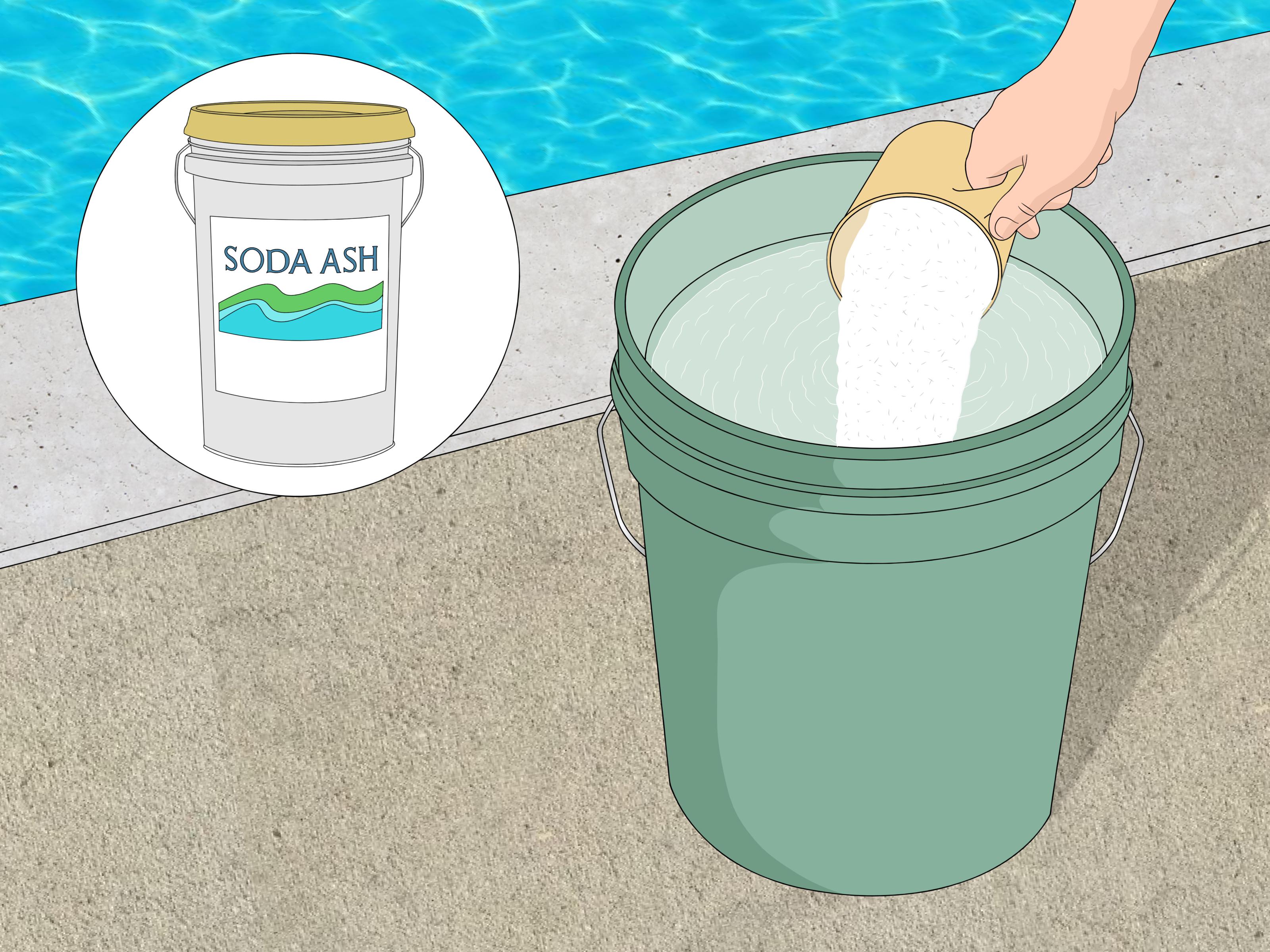
For best results, pre-dissolve soda ash in a clean plastic bucket filled with pool water. Add water first, then slowly add the chemical. Never add water to a pile of chemical, and never mix different pool chemicals together in the same bucket.
Stir carefully with a clean plastic or wooden tool until most of the product dissolves. Wear gloves and eye protection. Pool care is glamorous, but not “chemical splash in the eyeball” glamorous.
Step 8: Add the Solution Slowly Around the Pool
Pour the dissolved pH increaser slowly around the perimeter of the pool, especially near return jets where circulation is strongest. Avoid dumping it all in one place. A slow, even application helps reduce cloudiness and prevents the chemical from settling.
If you are treating an above-ground pool or a small pool, be extra careful with dosage. Smaller water volumes react quickly, so a little extra chemical can move the pH more than expected.
Step 9: Brush the Pool
After adding pH increaser, brush the pool walls and floor. This helps dissolve any remaining particles and improves circulation. It also gives you a chance to inspect the pool surface for stains, scale, algae, or debris.
Brushing is one of the most underrated pool maintenance habits. It is simple, cheap, and effective. Also, it makes you look like you know exactly what you are doing, which is half the battle in backyard pool ownership.
Step 10: Let the Water Circulate
Allow the pump to run for several hours after adding pH increaser. Many pool owners wait at least 4 to 6 hours before retesting, though some situations may require longer circulation. Larger pools, cloudy water, low flow, or poor circulation zones may need more time.
Do not add more pH increaser immediately just because the first test looks unchanged after a few minutes. Pool chemicals need time to mix. Patience here saves you from accidentally turning a low-pH problem into a high-pH problem.
Step 11: Retest and Adjust in Small Increments
Once the water has circulated, retest pH and total alkalinity. If pH is still low, repeat the process with a smaller dose. Aim for controlled progress rather than a dramatic leap. The goal is balance, not fireworks.
If pH rises but alkalinity becomes too high, you may need a separate alkalinity-management approach later. If pH refuses to stay up, check for low alkalinity, frequent acid addition, heavy rain dilution, or source water issues.
Step 12: Keep pH Stable With Regular Maintenance
Once your pool pH is in range, test it at least weekly during swimming season and more often after storms, heavy use, water additions, or chemical treatments. Clean debris quickly, maintain proper chlorine levels, and keep total alkalinity in range.
A pool that is tested regularly is easier and cheaper to manage. A pool ignored for three weeks becomes a swamp with invoices. Choose wisely.
How Much Soda Ash Should You Add?
Dosage depends on pool volume, current pH, target pH, alkalinity, temperature, and the product you use. As a general starting point, many pool-care references suggest adding about 6 ounces of soda ash per 10,000 gallons to raise pH by roughly 0.2. However, this is only a guideline. Always follow your product label and retest before adding more.
For example, if you have a 20,000-gallon pool with a pH of 7.0 and want to reach 7.4, you might add a partial dose, circulate, retest, and repeat if needed. Staged dosing is safer than trying to fix everything in one heroic pour.
Soda Ash vs. Baking Soda: Which One Should You Use?
Use soda ash when your main problem is low pH. It raises pH more directly and works faster than baking soda. Use baking soda when your total alkalinity is low and you need to stabilize the water first. Baking soda may raise pH slightly, but it is not the strongest tool for a fast pH correction.
Here is the simple version: soda ash is the pH elevator; baking soda is the alkalinity bodyguard. Both are useful, but they are not identical.
Can You Raise Pool pH Without Chemicals?
Yes, sometimes. Aeration can raise pH without adding much alkalinity. You can aerate water by pointing return jets upward, running fountains, using waterfalls, turning on deck jets, or increasing water movement at the surface. Aeration works because it helps carbon dioxide leave the water, which can allow pH to rise.
Aeration is slower than soda ash, but it can be useful when pH is low and alkalinity is already high. It is also a good option for pool owners who want a gentler adjustment. The downside is that it may take many hours or even days, depending on your pool and equipment.
Common Mistakes When Raising Pool pH
The first mistake is adding too much product at once. Overshooting pH can lead to cloudy water, scaling, reduced chlorine efficiency, and another round of chemical correction. The second mistake is ignoring total alkalinity. If alkalinity is too low, pH may drop again quickly.
Another common mistake is adding chemicals with the pump off. This can leave concentrated chemical in one area. Finally, do not mix pool chemicals together. Add one chemical at a time, let it circulate, and retest before adding another.
When Is It Safe to Swim After Raising pH?
In general, wait until the pool has circulated properly and test results show pH and sanitizer levels are in the recommended range. Many product labels advise waiting several hours after adding chemicals. Follow the label, keep the pump running, and do not let swimmers enter if pH, chlorine, or water clarity is unsafe.
If the water is cloudy, you cannot see the bottom, or chemical levels are out of range, keep everyone out. A safe pool should be clear, balanced, and properly sanitized.
Real-World Experience: What Raising Pool pH Usually Looks Like
In real backyard life, raising pool pH rarely happens in a perfect little textbook moment. It usually starts with someone noticing that the pool “feels weird.” Maybe swimmers complain about stinging eyes. Maybe the water looks clear but strangely dull. Maybe the test strip shows a color that appears to be somewhere between “low pH” and “ancient mustard.” That is when the smart pool owner slows down and tests again instead of panic-buying every chemical in aisle seven.
One common experience is discovering that the pH is low after a major rainstorm. Rainwater can dilute the pool and push chemistry out of balance, especially when total alkalinity is already low. In that situation, a pool owner might test pH at 7.0 and alkalinity at 60 ppm. Adding soda ash alone may raise pH temporarily, but the water still lacks buffering strength. A better plan may be to correct alkalinity first with baking soda, circulate, retest, and then fine-tune pH with soda ash if needed.
Another common scenario happens after adding too much acid to lower high pH. This is the classic “I fixed it until it broke” pool moment. The pH was 8.0, so acid was added. Then a little more. Then maybe one more splash for good luck. Suddenly the pH is 6.8, and the pool has gone from slightly basic to cranky lemonade. The best fix is not revenge dosing with soda ash. It is measured correction: calculate the pool volume, add a partial dose, circulate, brush, retest, and repeat only if necessary.
Many pool owners also learn that cloudy water after soda ash is not always a disaster. It can happen when too much is added too fast, when calcium hardness is high, when alkalinity is high, or when the product is dumped directly into one area. Pre-dissolving the chemical, adding it slowly, and brushing afterward can make a big difference. If cloudiness appears, keep the pump running, check filter pressure, and give the pool time to clear before making more changes.
The most useful habit is keeping a small pool log. Write down the date, pH, alkalinity, chlorine, what you added, and how the water looked the next day. After a month, patterns appear. You may notice that pH drops after storms, after heavy use, or after adding certain chlorine products. That information saves money and reduces guesswork. Pool care becomes less mysterious when you stop treating each test result like a surprise party.
The best experience-based advice is simple: make small changes, keep the water moving, and retest before adding more. Pool chemistry rewards patience. Rush it, and you may spend Saturday correcting the correction. Go slowly, and your pool will usually settle into that clear, comfortable, cannonball-ready zone everyone wants.
Conclusion
Raising pH in a pool is a straightforward job when you follow the right order: test first, check alkalinity, calculate pool volume, choose the correct product, add it slowly with the pump running, circulate, brush, and retest. Soda ash is usually the best choice for raising low pH directly, while baking soda is better when low alkalinity is part of the problem.
The goal is not to make pool chemistry complicated. The goal is to keep the water comfortable, clear, and safe while protecting your pool surfaces and equipment. Once you understand how pH and alkalinity work together, pool care becomes much less intimidating. You may not become the neighborhood water wizard overnight, but your pool will stop acting like a moody science fair project.
Note: Always follow the instructions on your specific pool chemical label, wear protective gear when handling chemicals, never mix chemicals together, and keep swimmers out of the water until pH and sanitizer levels test within the safe range.