
Important note: This article is for general education only. In a real emergency, call 911 immediately, follow the instructions from the dispatcher, and use the automated external defibrillator exactly as it tells you. An AED is designed for ordinary people, not just medical professionals, which is excellent news for anyone whose medical résumé currently says “watched three hospital dramas and owns a first-aid kit.”
What Is a Defibrillator?
A defibrillator is a device that can send an electric shock to the heart when a dangerous rhythm prevents the heart from pumping blood effectively. The type most people see in airports, schools, gyms, offices, malls, and public buildings is called an automated external defibrillator, or AED. It is portable, computerized, and built to talk you through the emergency in clear voice prompts.
The key word is “automated.” You do not have to diagnose the heart rhythm yourself. The AED checks the rhythm after the pads are attached. If a shock is needed, it tells you. If a shock is not needed, it will not randomly zap someone like a badly behaved sci-fi gadget. Modern AEDs are designed with safety checks, simple diagrams, adhesive pads, and voice instructions so bystanders can act quickly while emergency medical services are on the way.
When Should You Use an AED?
Use an AED when a person appears to be in sudden cardiac arrest. The typical signs are sudden collapse, unresponsiveness, and absent or abnormal breathing. Abnormal breathing may look like gasping, snorting, or irregular breaths; this is not normal breathing. If you are unsure, call 911 and let the dispatcher guide you.
A heart attack and cardiac arrest are not the same. A heart attack is often a blood-flow problem. Cardiac arrest is an electrical problem where the heart suddenly stops pumping effectively. A heart attack can lead to cardiac arrest, but not every person having chest pain needs an AED shock. The AED decides whether a shockable rhythm is present. Your job is to recognize the emergency, call for help, start CPR, and follow the AED prompts.
How to Use a Defibrillator: 11 Steps
1. Check the Scene for Safety
Before rushing in, take one quick look around. Is there traffic? Water? Fire? Exposed wires? A falling object? An angry treadmill still running like it has a grudge? You cannot help if you become the second emergency. If the area is unsafe, move only if you can do so without putting yourself or the person in greater danger. Otherwise, call 911 and follow dispatcher instructions.
2. Check Responsiveness
Tap the person’s shoulder and shout clearly, “Are you okay?” Do not shake hard, especially if there may be a head, neck, or spine injury. Look for normal movement, normal breathing, or a response. If the person does not respond, treat the situation as an emergency.
This is the moment to be loud. Emergencies are not the time for polite whispering. Point to a specific person and say, “You, call 911.” Point to another person and say, “You, get the AED.” Clear instructions help people move instead of forming a worried circle of human question marks.
3. Call 911 Immediately
If you are alone and have a phone, call 911 first. Put the phone on speaker so the dispatcher can guide you while your hands are free. Tell the dispatcher your location, what happened, whether the person is responsive, and whether normal breathing is present.
If other people are nearby, send one person to call 911 and another to get the AED. In many public buildings, AEDs are mounted in wall cabinets with a heart symbol or a sign that says “AED.” They may be near elevators, lobbies, gyms, pools, auditoriums, security desks, or main entrances.
4. Start CPR While the AED Is Coming
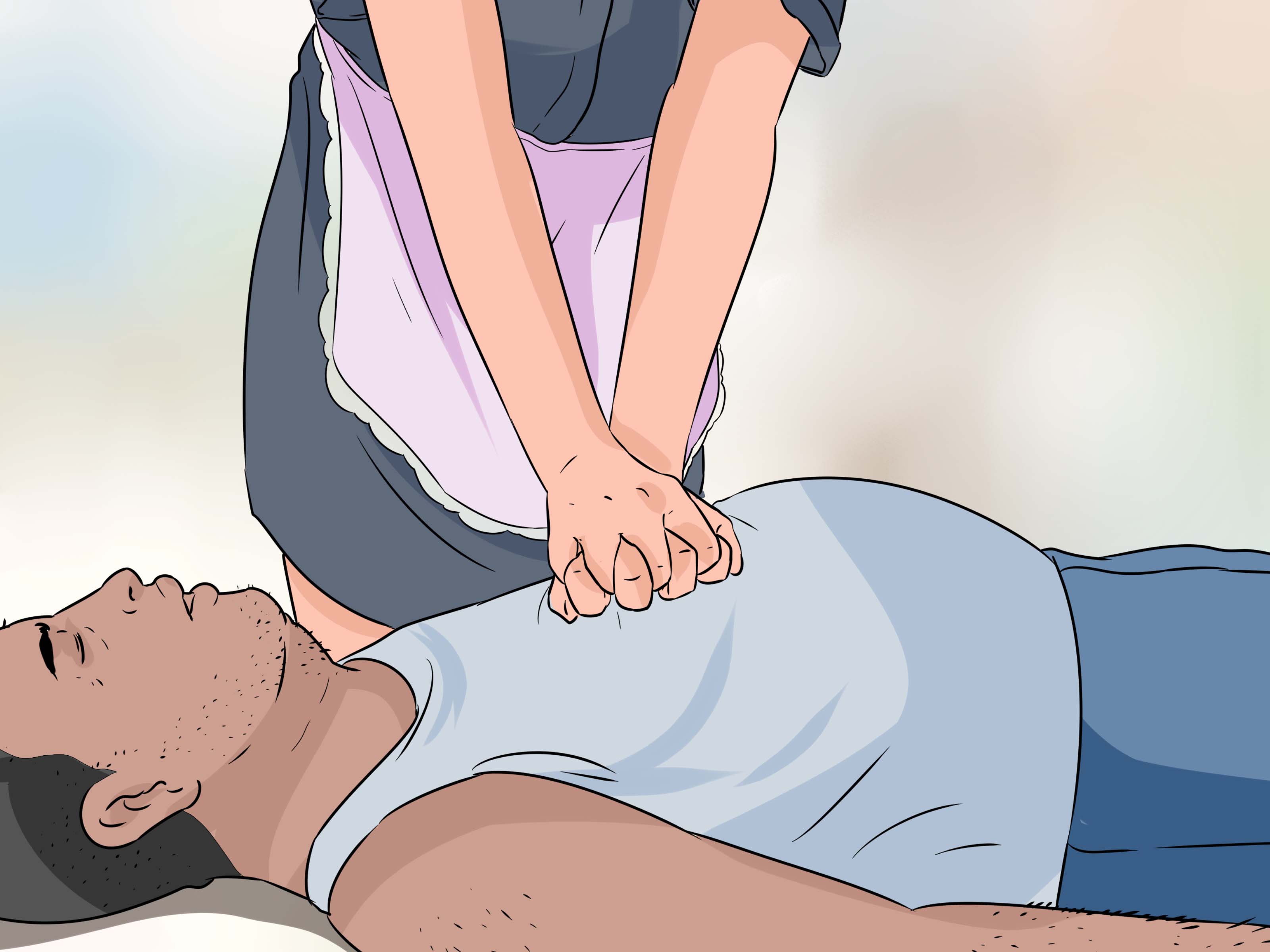
If the person is unresponsive and not breathing normally, begin chest compressions. Place the heel of one hand in the center of the chest, place your other hand on top, keep your arms straight, and push hard and fast. For adults and teens, aim for 100 to 120 compressions per minute. Let the chest fully recoil after each push.
If you are not trained in rescue breaths, hands-only CPR is better than doing nothing. If you are trained and comfortable, use the standard pattern of 30 compressions followed by 2 breaths. The important thing is to keep blood moving until the AED arrives and emergency responders take over.
5. Turn On the AED
As soon as the AED arrives, turn it on. Some devices have a large power button. Others turn on automatically when you open the lid. Once powered, the AED will begin giving voice instructions. Follow them exactly. The machine is calm, focused, and never distracted by panic, which is why it is the best speaker in the room.
Do not stop CPR for longer than necessary. If two rescuers are present, one person can continue compressions while the other opens the AED and prepares the pads.
6. Expose and Prepare the Chest
The AED pads must stick directly to bare skin. Remove or cut away clothing from the chest. Many AED kits include scissors, a razor, gloves, and a small towel. If the chest is wet, dry it quickly. If there is heavy chest hair where the pads need to stick, use the razor if available. If the pads will not adhere because of hair, some AED kits include an extra pad set; one set may be used quickly to remove hair, then the second set can be applied.
Do not place AED pads over medication patches. If you see a patch where a pad needs to go, remove it with gloves if possible and wipe the area before applying the pad. Also avoid placing a pad directly over a visible implanted device, such as a pacemaker bump under the skin. Place the pad slightly away from it while still following the diagram.
7. Attach the AED Pads Correctly
Open the pad package and look at the pictures on the pads. For adults, one pad usually goes on the upper right side of the chest, below the collarbone. The other goes on the lower left side of the chest, a few inches below the armpit. This position allows the shock to travel through the heart.
Press the pads firmly so they stick well. Poor pad contact can delay the AED’s analysis. If the AED says to check pads, press them down, make sure the connector is plugged in, and confirm the pads are on bare, dry skin.
8. Let the AED Analyze the Heart Rhythm
Once the pads are attached, the AED will analyze the person’s heart rhythm. During this step, nobody should touch the person. Say loudly, “Clear!” and look to make sure everyone has moved back. Touching the person during analysis can interfere with the AED’s reading.
The AED may say “analyzing heart rhythm,” “do not touch the patient,” or similar words. Stay calm and wait for the next instruction. The device will decide whether a shock is advised.
9. Deliver a Shock Only If the AED Tells You To
If the AED says a shock is advised, make sure everyone is clear. Say, “Clear!” again. Check quickly from head to toe to ensure no one is touching the person. If you are using a semi-automatic AED, press the flashing shock button when instructed. If you are using a fully automatic AED, it may deliver the shock on its own after warning everyone to stand clear.
Do not press the shock button unless the AED tells you to. The AED is not a motivational tool, a reset button, or a dramatic movie prop. It is a medical device with a specific job.
10. Resume CPR Immediately After the Shock
After a shock is delivered, resume chest compressions immediately unless the AED or emergency dispatcher tells you otherwise. Do not pause to check for a pulse unless you are trained and instructed. Long pauses reduce the quality of resuscitation.
The AED will usually guide you through cycles of CPR and rhythm checks. After about two minutes of CPR, it may tell you to stop so it can analyze again. Continue following the prompts until emergency medical services arrive, the person shows clear signs of life, the scene becomes unsafe, or you are physically unable to continue.
11. Continue Until Professional Help Takes Over
When emergency responders arrive, keep going until they tell you to stop. Tell them what happened, when CPR started, when the AED was attached, whether shocks were delivered, and any details you noticed. If you do not remember everything, that is okay. In emergencies, the brain sometimes files information in a drawer labeled “fog and adrenaline.” Share what you can.
Leave the AED pads attached. Emergency responders may use the same pads or connect the person to their own equipment. Step back when asked, and follow instructions.
Special Situations: Children, Water, Metal, and Crowded Places
Using an AED on a Child
For children, use pediatric AED pads if available. Some AEDs have a child setting or a pediatric key. If pediatric pads are not available, use adult pads, but make sure the pads do not touch each other. For small children, one pad may go on the center of the chest and the other on the center of the back. Always follow the diagrams on the pads and the AED’s voice instructions.
Using an AED Near Water
If the person is lying in water, move them to a dry area if it is safe to do so. Dry the chest before applying pads. A damp floor does not automatically prevent AED use, but the chest must be dry enough for the pads to stick properly. Keep bystanders from touching the person during analysis and shock delivery.
Using an AED on Metal Surfaces
An AED can often be used if the person is on a metal surface, such as bleachers, as long as the pads are placed correctly and no one is touching the person during shock delivery. The main rule remains the same: clear the person before analysis and shock.
Managing a Crowd
Crowds are common in public emergencies. Give simple jobs: “Call 911,” “Bring the AED,” “Meet the ambulance outside,” “Keep people back,” and “Tell me when two minutes pass.” People usually want to help; they just need a task. A calm bystander with a clear job is far more useful than a dozen people filming from seven angles.
Common Mistakes to Avoid
Waiting too long to use the AED: Do not save the AED for “later.” Use it as soon as it arrives.
Stopping CPR for too long: Keep pauses short. The AED will tell you when to stop touching the person.
Putting pads over clothing: Pads must go on bare skin.
Touching the person during analysis or shock: Always clear the person.
Assuming you need certification to help: Training is strongly recommended, but public-access AEDs are designed for lay rescuers. In an emergency, follow the AED and dispatcher instructions.
Why AED Training Still Matters
Although AEDs are designed for public use, CPR and AED training can make you faster, calmer, and more confident. A class teaches you how to recognize cardiac arrest, perform high-quality chest compressions, use rescue breaths when appropriate, place pads correctly, and work with other rescuers. Many workplaces, schools, gyms, churches, and community centers offer or host CPR/AED courses.
Training also helps reduce hesitation. Many people freeze because they worry about doing something wrong. The truth is simple: when someone is in cardiac arrest, doing nothing is the worst option. Calling 911, starting CPR, and using an AED can give the person a better chance while professional help is on the way.
Practical Experiences and Real-World Lessons About Using a Defibrillator
In CPR/AED training scenarios, one pattern appears again and again: people are less afraid of the AED after they hear it speak. Before the lid opens, the device feels mysterious. After it starts giving commands, it becomes more like a calm coach with batteries. It says what to do, when to stop, when to stand clear, and when to resume CPR. That voice guidance is one reason AEDs are so valuable in public spaces.
A common experience in workplace drills is the “Where is the AED?” problem. Employees may know the building has one, but not where it lives. During an emergency, “somewhere near the lobby, maybe behind that plant from 2009” is not a great location strategy. Offices, schools, gyms, and stores should place AEDs in visible, accessible areas and mark them clearly. Staff should know the fastest route to reach the device. A short AED tour during onboarding can be more useful than another 40-slide presentation about the break room microwave.
Another lesson comes from sports settings. Coaches and parents often prepare for sprains, dehydration, and minor injuries, but sudden cardiac arrest can happen without warning. Athletic facilities should have a cardiac emergency response plan: who calls 911, who gets the AED, who starts CPR, who opens gates or doors for EMS, and who manages the crowd. In a real event, planning saves seconds, and seconds matter.
Public places create their own challenges. Airports, malls, and schools may be noisy. The AED voice prompts can be harder to hear, so one person should repeat the instructions loudly. Another person can keep the area clear. If the AED says, “Do not touch the patient,” the rescuer can repeat, “Nobody touch them.” Simple repetition helps everyone stay coordinated.
People also worry about hurting the person. That fear is understandable, but cardiac arrest is already life-threatening. Chest compressions may feel forceful, and the AED may feel intimidating, yet both are emergency actions intended to preserve life until professionals arrive. The AED will not deliver a shock unless it detects a rhythm that calls for one. That built-in analysis is what makes the device appropriate for public use.
One of the best habits is to mentally rehearse the first minute: check safety, check response, call 911, send for the AED, start CPR, turn on the AED, follow prompts. You do not need to memorize every technical detail like you are preparing for a medical trivia championship. You need a clear sequence and the courage to begin.
Finally, AED experiences show that teamwork matters. The person doing compressions gets tired quickly. Switching rescuers, when possible, keeps compressions strong. Someone else can handle the AED. Another can talk to the dispatcher. Another can guide EMS to the scene. A good response is not about one hero doing everything; it is about ordinary people doing useful things quickly.
Conclusion
Learning how to use a defibrillator is not just a nice safety skill; it is a practical way to be ready for one of the most time-sensitive emergencies a person can face. The steps are straightforward: check safety, call 911, start CPR, turn on the AED, attach the pads, clear the person, follow the prompts, and keep going until help arrives. You do not need to be fearless. You only need to act.
An AED is built to guide you. It analyzes the heart rhythm, tells you whether a shock is needed, and walks you through CPR cycles. Pairing fast CPR with early AED use gives a person in sudden cardiac arrest a better chance of survival. So the next time you enter a gym, school, airport, office, or community center, take five seconds to spot the AED. It may be the most important wall-mounted box you ever notice.