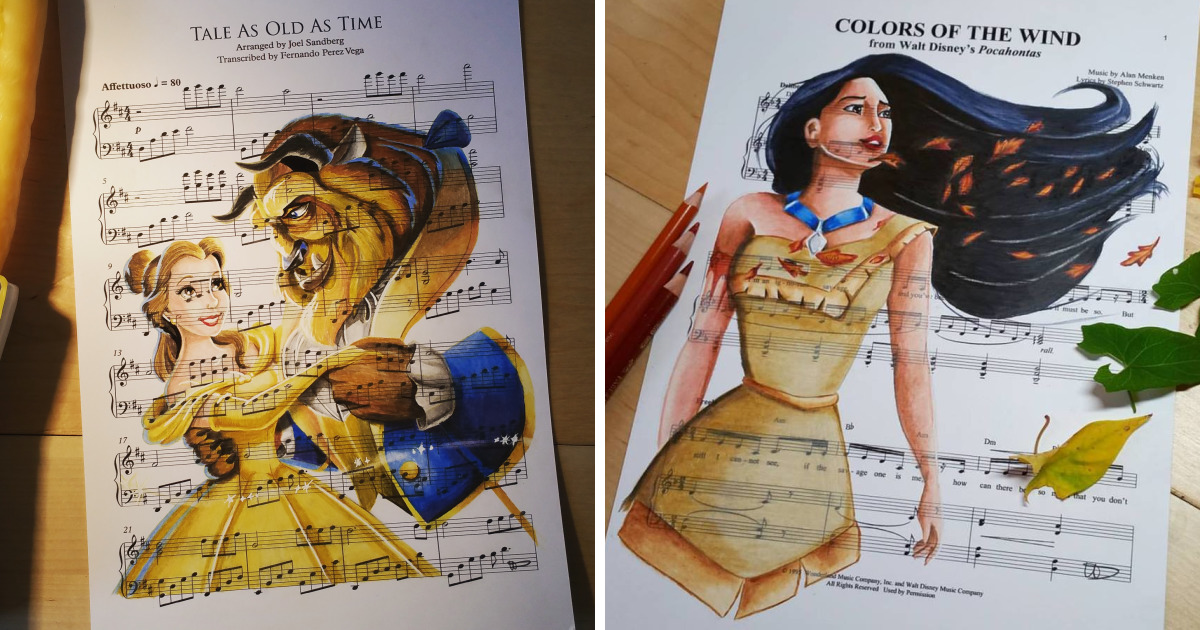

Some people frame movie posters. Some people collect vinyl. Some people can identify a Disney song from the first three piano notes and then pretend they are “totally normal” about it. I, apparently, am the person who looks at a sheet of music and thinks, “This needs a dragon, a mermaid, a flying carpet, or at least one emotionally complicated forest spirit.”
Drawing scenes from famous animated movies on the music sheets of their theme songs is the kind of idea that sounds simple until you try it. Then it becomes a tiny artistic obstacle course: the paper is already full, the notes are precious, the characters must be recognizable, and every pencil stroke has to respect the rhythm underneath it. The result, when it works, is a layered piece of fan art where music and image stop politely standing in separate corners and finally dance together.
This style of sheet music art is especially powerful because animated movies already live in two places at once: the eye and the ear. We remember Ariel through waves and melody, Simba through sunrise and song, Woody through friendship and a guitar-like warmth, Chihiro through quiet wonder, and Miguel from Coco through color, family, and music that feels like memory wearing a fancy jacket. When those scenes are drawn directly over their songs, the page becomes more than paper. It becomes a small portal with treble clefs.
Why Animated Movie Music Makes the Perfect Canvas
Animated films are rarely quiet little wallflowers. They sing, swell, whisper, crash, float, and occasionally burst into full chorus like everyone in the room has just discovered caffeine. That makes their sheet music visually exciting before the drawing even begins. Staff lines create structure. Notes create movement. Rests create breathing room. Dynamics hint at emotion. A dramatic crescendo can feel like a hill; a run of eighth notes can look like wind, water, or footsteps.
The best animated theme songs are not just background decoration. They are narrative engines. A song can introduce a character’s dream, explain a world, mark a transformation, or punch the audience gently but firmly in the feelings. In classic Disney animation, songs often reveal what characters cannot yet say in ordinary dialogue. In Pixar films, music frequently works like emotional glue, holding together humor, loss, friendship, and the occasional existential crisis caused by toys, robots, rats, or feelings with excellent color design.
That is why music sheets make such meaningful surfaces. They are not blank pages. They already contain the emotional blueprint of the movie. Drawing on them is a bit like sketching on top of a heartbeat.
The Magic of Combining Visual Art and Film Music
At first glance, sheet music and animation seem like different languages. One is read by musicians, the other by viewers. But both are built from timing. A melody depends on spacing, tempo, and emphasis. Animation depends on frames, movement, anticipation, and rhythm. When a character leaps, pauses, blinks, or turns, the animator is thinking musically even without a violin in sight.
This is why a drawing of an animated scene on music paper feels strangely natural. The staff lines guide the eye the way a storyboard guides a camera. The notes become part of the atmosphere. A cluster of notation can become falling snow, sea foam, stars, jungle leaves, city lights, or magical dust. A long curved slur can echo a dragon’s wing, a wave, a cape, or a character’s hair on a very ambitious humidity day.
In a finished piece, the viewer can almost “hear” the drawing. Even without playing the notes, the title and melody trigger memory. A scene from The Lion King on music from “Circle of Life” feels different from the same scene on ordinary sketch paper. The music gives the image gravity. It reminds us that animation is not only seen; it is felt through sound.
Choosing the Right Movie Scene
The first rule is simple: choose a scene that the music already knows. If the sheet contains a soaring theme, the drawing should probably not be a character standing awkwardly near a lamp unless that lamp has deep symbolic meaning and a surprisingly good agent.
Iconic Silhouettes Work Best
Scenes with strong silhouettes are perfect for sheet music art. Think of a lion cub lifted against a sunrise, a girl standing before a glowing bathhouse, a flying carpet sweeping across the sky, a cowboy doll and a space ranger framed by a child’s room, or a young musician holding a guitar under marigold-colored light. These images can be recognized even when the drawing is simplified, which matters because sheet music is already visually busy.
Emotion Matters More Than Detail
The goal is not to copy every eyelash, sparkle, leaf, and architectural doodad. The goal is to capture the emotional temperature of the scene. A Frozen drawing might emphasize isolation, movement, and icy curves. A Moana piece might focus on ocean motion and horizon lines. A How to Train Your Dragon scene might use sweeping shapes to suggest flight and trust. A Beauty and the Beast image might lean into candlelight, ballroom curves, and a sense of elegance that politely refuses to be casual.
Famous Animated Movies That Inspire Sheet Music Art
Some animated films practically beg to be turned into music sheet drawings. Fantasia is the grandparent of this entire idea: a film built around making music visible. Its legacy makes it a natural reference point for any artist who wants to blend sound and image. Drawing a scene inspired by Fantasia on a classical score feels like returning the artwork to its natural habitat.
Disney Renaissance films are also rich territory. The Little Mermaid, Beauty and the Beast, Aladdin, and The Lion King each have instantly recognizable musical identities. A mermaid leaning toward the surface, a ballroom scene, a carpet ride, or a savanna sunrise can sit beautifully over the printed music because the songs already carry the mood. The page becomes part illustration, part memory trigger, and part “please do not make me sing this in public because I absolutely will.”
Pixar offers a slightly different emotional palette. Toy Story is perfect for warm nostalgia and friendship. Up lends itself to tender compositions with balloons, houses, and quiet longing. Coco is almost too perfect for this concept because music is not just part of the film; it is central to the story’s identity. Drawing Miguel, guitars, marigold bridges, or family silhouettes over music paper feels like the page is doing exactly what it was born to do.
Studio Ghibli films create another kind of magic. Their music often feels airy, reflective, and deeply visual. A drawing inspired by Spirited Away, My Neighbor Totoro, or Howl’s Moving Castle can use softer lines, open space, and gentle shading. The challenge is restraint. Ghibli-inspired art does not need to shout; it can whisper and still rearrange your entire soul before lunch.
The Artistic Process: From Music Sheet to Finished Drawing
The process usually begins with choosing the right sheet music. The front page is often the most attractive because it may include the song title, composer credit, or a layout with visual balance. But interior pages can also work well, especially if the notation has enough open space for a central figure.
Next comes composition. Before touching the final page, it helps to sketch thumbnails. This step prevents the classic tragedy known as “I drew the dragon beautifully, but now its face is directly on top of four measures of tiny notes and it looks like it ate a piano.” A light pencil plan helps place the main character, background, shadows, and highlights without fighting the music underneath.
After that, the artist decides how much of the music should remain visible. Some pieces let the notes show through the sky or background. Others use the notation as texture inside clothing, clouds, water, or magical light. The balance is important. Cover too much, and the page becomes ordinary fan art. Cover too little, and the drawing may look unfinished. The sweet spot is where the viewer can enjoy both the scene and the score.
Materials That Work Well
Colored pencils are a favorite choice because they offer control, layering, and a softer finish. They also behave politely on printed paper, which is more than can be said for some markers that barge through the page like they own the place. Fine liners can help define silhouettes, but heavy ink should be used carefully. Watercolor can look beautiful, but only if the paper is thick enough to survive without curling into a dramatic potato chip.
Some artists print sheet music onto Bristol board or heavier drawing paper to make the surface more durable. This allows for richer color and cleaner blending. It also gives the final artwork a more professional finish, especially if the piece will be scanned, framed, or sold as a print.
Why Fans Connect With This Kind of Art
Movie fans love this art style because it combines two kinds of nostalgia. The image reminds them of the scene, while the music reminds them of how the scene felt. That double memory is powerful. A regular drawing may say, “Remember this movie?” A drawing on the theme song says, “Remember the exact moment your heart became a tiny emotional pancake?”
There is also something charming about the physicality of sheet music. In a streaming world, printed notation feels tactile and old-school. It belongs to piano benches, choir rooms, music stands, school recitals, and that one family member who insists they can sight-read anything and then immediately regrets saying so. Using sheet music as a canvas gives the artwork a handmade warmth that digital fan art sometimes struggles to capture.
For musicians, the appeal is even stronger. They can read the notes and understand the hidden structure beneath the image. For non-musicians, the notation still works visually. It becomes pattern, rhythm, and atmosphere. Nobody has to know what a dotted quarter note does to appreciate that it looks fancy and emotionally responsible.
Creative Examples and Design Ideas
A Little Mermaid piece could place Ariel near the top of the page, reaching upward as the staff lines become waves below her. Blue and green pencil layers could leave the black notes visible like bubbles or sea plants. The music itself would feel submerged.
An Aladdin design might use a sweeping diagonal composition, with a magic carpet cutting across the page and the notes becoming stars behind it. Gold accents could highlight the skyline, while deep purples and blues create a night-sky mood.
A Toy Story drawing could use the famous cloud-wallpaper feeling as a soft background, letting the printed notation peek through the clouds. Woody and Buzz could stand near the lower staff lines, giving the sense that the song is lifting them into the viewer’s memory.
For Coco, warm oranges, pinks, and purples can transform the music sheet into a celebration of family and remembrance. A guitar shape works beautifully because it mirrors the subject of the score itself. Add marigold petals around the notes, and suddenly the page looks like it has been invited to a very emotional party.
A Spirited Away piece can be quieter. Chihiro’s small figure, a train over water, or the bathhouse glowing in the distance can be drawn with delicate lines. The sheet music becomes mist, reflection, and silence. This is the kind of artwork that says a lot without needing to wave a giant glitter wand.
SEO Value: Why This Topic Works for Art Blogs
From a content strategy perspective, “animated movie sheet music art” is a highly engaging topic because it touches several search interests at once: fan art, movie music, animation nostalgia, drawing ideas, sheet music crafts, and unique wall art. It appeals to artists, musicians, collectors, Disney fans, Pixar fans, anime fans, and people who clicked “just to look” and are now emotionally invested.
The title “I Draw Scenes From Famous Animated Movies On Music Sheets Of Their Theme Songs” is long, but it is also wonderfully specific. It tells readers exactly what they will get. Search engines like clarity, and humans like curiosity. This title offers both. It also naturally includes strong keywords such as “animated movies,” “music sheets,” “theme songs,” “draw scenes,” and “famous animated movies.”
For Google and Bing, the article works best when supported by descriptive headings, original commentary, and examples. Rather than stuffing the phrase “animated movie sheet music art” into every paragraph like a parrot with an SEO internship, the keywords should appear naturally. Related terms such as “movie theme songs,” “fan art,” “colored pencil drawing,” “music-inspired artwork,” and “animation art” help build relevance without making the article sound like it was written by a robot trapped in a craft store.
Tips for Artists Who Want to Try It
Start with a movie you genuinely love. Passion matters because detailed drawing takes patience, and patience is much easier when you are not muttering, “Why did I choose this castle with seventy-eight windows?” Choose one main scene and simplify it. Let the music sheet participate in the design instead of treating it like a background you must defeat.
Use light pencil first. Test your colors on a spare print. Keep the strongest contrast around the focal point, usually the character’s face, silhouette, or central action. Leave some notes visible because they are the soul of the concept. Most importantly, do not panic when the drawing looks strange halfway through. Art has an awkward teenage phase. Keep going.
If you plan to publish or sell your work, be mindful of copyright and licensing. Fan art can be a loving tribute, but famous characters, film images, and songs are protected creative properties. Personal practice, commentary, and transformative artwork may be handled differently from commercial products, so artists should understand permissions, fair use considerations, and platform rules before selling prints or merchandise.
My Experience Drawing Movie Scenes on Music Sheets
The first time I tried drawing on a music sheet, I underestimated the page completely. I thought, “It already has lines. How hard can this be?” That sentence has caused problems in many areas of human history, including furniture assembly, baking, and my personal relationship with perspective. The page looked elegant before I touched it, and suddenly I had to make my drawing worthy of the music. No pressure, just a tiny artistic exam administered by a treble clef.
I began by choosing a scene from a beloved animated film, one with a clear emotional shape. I printed the sheet music on heavier paper because regular printer paper felt too fragile. Then I sketched lightly, trying to place the main figure where the notes would not fight the face. This is where I learned a valuable lesson: music notation is beautiful, but it has absolutely no concern for your character’s eyes. If a note lands in the wrong place, your hero may look like they have been attacked by a very tiny musical insect.
Coloring was the most satisfying part. The notes underneath created texture I could not have invented on a blank page. In sky areas, they felt like movement. In shadows, they added depth. In magical scenes, they looked like sparks or secret symbols. I found myself choosing colors based not only on the film scene but also on the mood of the song. A bright adventure theme wanted warmer highlights and sharper contrast. A quiet emotional melody needed softer edges and more breathing room.
The hardest part was knowing when to stop. Because sheet music is already detailed, too much drawing can make the page feel crowded. I had to remind myself that empty space is not laziness; it is design wearing a calm outfit. Leaving parts of the score untouched made the artwork stronger. It allowed the viewer to recognize the song as part of the piece, not just as paper underneath it.
Sharing the finished artwork was surprisingly emotional. People responded with their own memories: the first time they saw the movie, the song they played in school band, the scene that made them cry, the character they still secretly adore. That is when I realized this art form is not only about technical skill. It is about shared memory. A music sheet drawing gives people two ways to enter the same story: through the image they recognize and the melody they remember.
Over time, I learned that every movie requires a different artistic approach. A big musical number needs energy and motion. A gentle lullaby needs restraint. A comic scene can handle playful exaggeration. A dramatic scene needs contrast and confidence. The sheet music becomes a collaborator. Sometimes it behaves beautifully. Sometimes it places a cluster of notes exactly where I wanted a clean highlight, and I have to negotiate like an exhausted diplomat.
Still, that challenge is what makes the process fun. Drawing on music sheets forces me to think more carefully about composition, emotion, and storytelling. It reminds me that animated movies are built from many art forms working together: drawing, acting, music, writing, design, editing, and sound. When I place a scene on the page of its theme song, I am not just making fan art. I am celebrating the invisible teamwork that made the film unforgettable in the first place.
Conclusion
Drawing scenes from famous animated movies on music sheets of their theme songs is a beautiful collision of nostalgia, craft, and storytelling. It turns a familiar score into a visual memory and gives beloved characters a new home among the notes that helped make them iconic. Whether the subject is a mermaid dreaming of land, a lion stepping into destiny, a toy promising friendship, or a young musician following family history through song, the combination feels deeply personal.
This kind of artwork works because animation and music have always belonged together. One gives movement to images; the other gives emotion to movement. Put them on the same page, and suddenly a simple sheet of paper becomes a small cinematic universe. It may not sing out loud, but if you look closely enough, you can almost hear it.
Note: This article is written as original, publish-ready content in standard American English and is based on real information about animation, film music, fan art, sheet music, and creative drawing practices.