
Some people collect sneakers, vintage lunch boxes, or oddly specific coffee mugs that say things like “Don’t talk to me until Tuesday.” I collect tiny ideas. A funny facial expression from a cartoon villain. The color palette of a 1990s cereal commercial. The heroic drama of a movie poster. The emotional power of a character wearing socks that absolutely do not match. That is the magic behind cute, clever, pop culture-inspired illustrations: they begin with everyday references and turn them into something fresh, charming, and unexpectedly personal.
Creating illustrations inspired by pop culture is not just about drawing a character with big eyes and hoping nostalgia does the heavy lifting. It is a thoughtful mix of visual storytelling, humor, design, cultural awareness, and artistic restraint. The best pieces feel familiar without feeling copied. They wink at the audience without poking them in the eye. They say, “You know this feeling,” instead of “Here is a famous thing wearing a hat.”
In this article, we will explore why cute illustrations work so well, how pop culture fuels creativity, what makes clever visual ideas memorable, and how artists can build a recognizable style while respecting originality and intellectual property. Consider this a friendly studio tour, minus the paint-stained hoodie and the suspicious number of half-finished sketchbooks.
Why Cute Illustrations Have Serious Creative Power
Cute art may look soft, but do not underestimate it. Cuteness is a design strategy with emotional muscle. Rounded shapes, warm colors, tiny details, and expressive faces can make an illustration feel instantly approachable. That matters because audiences often decide within seconds whether they want to stop scrolling, click, share, save, or keep moving like a caffeinated squirrel.
In visual communication, illustration helps translate ideas into images people can quickly understand. A cute drawing can simplify a complicated feeling: anxiety becomes a nervous little cloud; confidence becomes a tiny astronaut planting a flag on a cupcake; burnout becomes a toaster wearing sunglasses and refusing to toast. These images are playful, but they carry meaning.
Cuteness Makes Ideas Easier to Love
Cute illustrations lower the emotional barrier between artist and viewer. A serious topic can feel less intimidating when it arrives as a friendly character, a soft shape, or a humorous scene. This is why cute editorial illustrations, stickers, enamel pins, greeting cards, digital avatars, and social media graphics often perform well. They are not demanding attention with a megaphone. They are tapping politely on the screen and saying, “Hi, I made your feelings into a potato.”
The best cute artwork also avoids becoming bland. A style can be adorable and still have attitude. It can be sweet without being sugary. The trick is to pair softness with specificity: a character’s nervous eyebrow, a tiny coffee stain, a ridiculous accessory, or a pose that tells a story. Cute becomes memorable when it has personality.
What “Pop Culture-Inspired” Really Means
Pop culture-inspired illustration draws energy from the movies, music, shows, games, comics, memes, fashion, toys, celebrities, and internet moments that shape everyday conversation. Pop Art did something similar decades ago, borrowing from advertising, comic books, consumer goods, and mass media to question what “fine art” could be. Today’s illustrators continue that conversation in digital form, using references that feel recognizable to modern audiences.
But inspiration is not the same as duplication. A strong pop culture-inspired illustration does not need to trace, clone, or rely on someone else’s character design. Instead, it can borrow a mood, a genre, a trope, a color language, or a shared cultural memory. Think “space opera drama,” “retro arcade chaos,” “teen movie hallway energy,” “superhero landing pose,” or “rom-com meet-cute at a haunted laundromat.” That last one is free. Please make it weird.
Familiarity Is the Door; Originality Is the Room
Pop culture references work because they create instant connection. When people recognize the vibe, they feel invited in. But once they arrive, the artwork needs to offer something new. A clever twist, unexpected character, funny mashup, emotional angle, or unique style turns a reference into an original experience.
For example, instead of drawing a famous wizard exactly as seen on screen, an artist might create an original raccoon librarian in a magical checkout desk scene. Instead of copying a superhero, the artist might draw a tiny plant wearing a cape and dramatically saving a fallen pencil. The audience gets the cultural rhythm without needing a direct copy.
The Sweet Spot: Cute Plus Clever
Cute gets attention. Clever earns the save. When an illustration is both adorable and smart, it gives viewers two rewards: an emotional smile and a mental click. That click is the little moment when the viewer understands the joke, notices the reference, or catches the hidden detail. It is the difference between “That is nice” and “Wait, the ghost is using a dating app for haunted houses? Incredible.”
Clever illustration often comes from contrast. Combine two ideas that do not usually belong together: a dramatic movie poster and a sleepy houseplant, a fantasy quest and a grocery list, a sci-fi robot and a fear of group projects. The more specific the contrast, the better the result. Broad ideas can feel generic, but precise ideas feel handmade.
How to Build a Clever Concept
A useful process is to begin with three layers: reference, emotion, and twist. The reference might be a genre like horror movies, superhero comics, or retro games. The emotion might be tiredness, joy, jealousy, nostalgia, or social awkwardness. The twist is the unexpected connection. A horror-inspired illustration about Monday morning could become a tiny vampire hiding from an alarm clock. A superhero-inspired piece about self-care could show a caped toothbrush protecting a kingdom of molars.
Good concepts usually sound a little silly at first. That is normal. Silly is often where originality takes off its shoes and gets comfortable.
Design Ingredients That Make Cute Pop Culture-Inspired Art Work
Behind every charming illustration is a pile of design decisions wearing a fake mustache. Composition, color, line weight, scale, typography, texture, and negative space all shape how the viewer reads the image. Even when a drawing looks simple, the design thinking behind it may be surprisingly complex.
1. Shape Language
Rounded shapes usually feel friendly, soft, and approachable. Sharp angles can add energy, danger, sarcasm, or drama. A cute villain might have a round body but tiny triangular eyebrows. A cozy robot might be built from rectangles with softened corners. Shape language helps viewers understand a character before they read a single caption.
2. Color Palette
Color is one of the fastest ways to suggest a pop culture mood. Neon pinks and electric blues can suggest arcade nostalgia or cyberpunk flavor. Warm oranges and browns may feel retro, cozy, or autumnal. Limited palettes often make illustrations look more polished because they force every color to do a job. A palette should not look like a box of crayons exploded during a talent show.
3. Expressive Faces
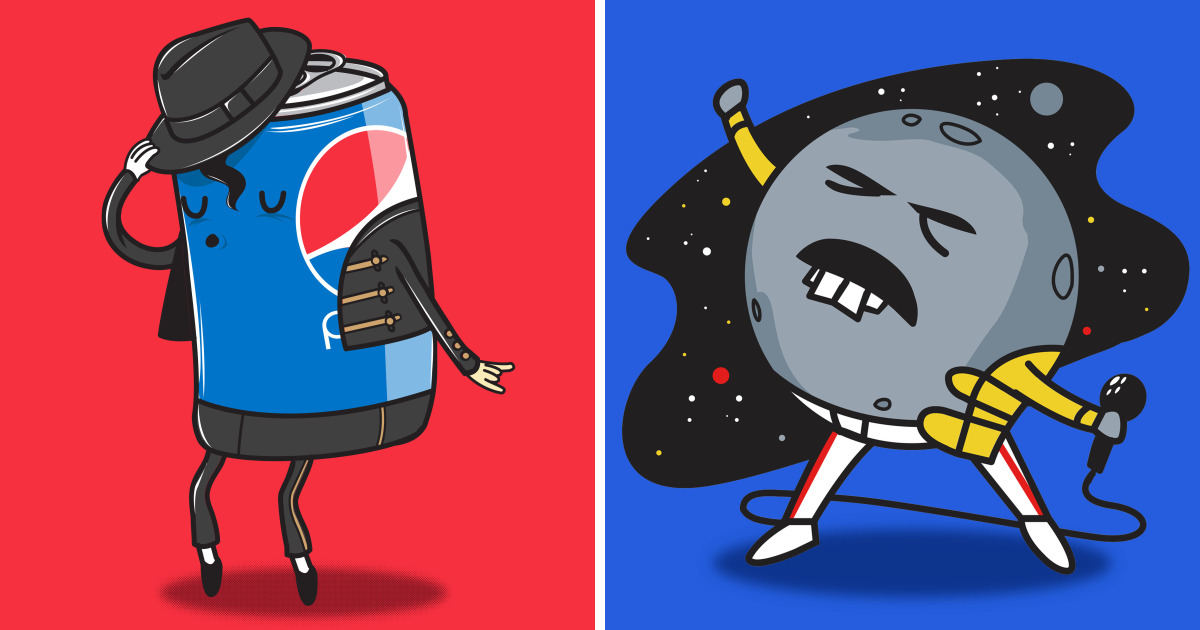
A tiny face can carry a whole story. Dot eyes, raised eyebrows, little frowns, and overdramatic tears can turn an object into a character. A mug becomes exhausted. A slice of pizza becomes suspicious. A spaceship becomes emotionally unavailable. Faces are especially useful in cute illustration because they make even ordinary objects feel alive.
4. Visual Easter Eggs
Pop culture-inspired art loves tiny details. Background posters, hidden symbols, funny labels, and miniature props reward viewers who look closely. Easter eggs create rewatch value for an illustration. Yes, drawings can have rewatch value. We are living in the future, and apparently the future has stickers.
Balancing Nostalgia and Freshness
Nostalgia is powerful because it brings memory into the present. A color scheme may remind someone of Saturday morning cartoons. A chunky pixel style may bring back old video games. A hand-lettered title may recall vintage movie posters or comic book covers. Nostalgia gives art emotional shorthand.
However, nostalgia can become stale if it only repeats what people already know. The goal is not to trap viewers in the past like a decorative time capsule. The goal is to remix memory into something alive. A retro style feels fresh when it includes modern humor, inclusive characters, personal storytelling, or unexpected formats like animated stickers, short-form videos, digital prints, profile icons, or wearable art.
Make the Reference Personal
One way to avoid generic nostalgia is to filter the reference through personal experience. Maybe old monster movies remind you of staying up late with cousins. Maybe video games remind you of losing repeatedly but with confidence. Maybe sitcoms remind you of family dinners where everyone talked over each other like a badly mixed podcast. Personal details make art feel specific, and specificity is where charm lives.
Social Media Changed the Illustration Game
Digital platforms have made illustration more visible, more shareable, and more competitive. Artists can now post sketches, process videos, finished pieces, shop updates, portfolio projects, and behind-the-scenes experiments without waiting for a gallery, publisher, or mysterious gatekeeper named Harold. Visual platforms reward clarity and personality, but they also reward consistency.
For illustrators, that means developing a recognizable visual voice matters. The more clearly people can identify your work, the easier it becomes to build an audience. This does not mean drawing the same thing forever. It means creating a consistent creative fingerprint: color habits, humor style, character shapes, line quality, themes, or storytelling approach.
Make Art That Works at Small Sizes
Many people first see illustrations on a phone screen. That makes readability essential. Strong silhouettes, clear contrast, simple compositions, and expressive focal points help art survive the tiny-screen test. If an illustration only works when viewed at the size of a dining table, social media may gently fold it into a digital napkin.
Originality, Fan Art, and Copyright Awareness
Pop culture-inspired art lives near a legal and ethical fence, so artists should know where they are standing. Copyright protects original creative works, and fan art that uses protected characters, logos, names, or exact designs can raise intellectual property issues, especially when sold commercially. Fair use exists in U.S. law, but it is not a magic invisibility cloak. Courts consider factors such as purpose, nature of the work, amount used, and market effect.
This is why many professional artists focus on transformation, parody, commentary, original characters, licensed work, public-domain material, or broad genre references rather than direct copying. A clever illustration can celebrate pop culture without relying on someone else’s protected assets. In fact, constraints often make the work better. When you cannot simply copy the famous robot, you invent a toaster with trust issues. Art improves immediately.
Practical Ways to Stay Original
Use references as research, not as tracing paper. Build mood boards around colors, emotions, eras, shapes, and themes rather than exact character details. Change the setting, message, character type, and visual language. Add your own commentary or humor. Create original mascots. When selling work, be especially careful with names, logos, catchphrases, and recognizable likenesses. When in doubt, seek permission or legal guidance.
Why Character Design Is the Heart of Cute Illustration
Characters give viewers someone to root for, laugh at, or emotionally adopt. A cute character does not have to be a human, animal, or fantasy creature. It can be a cloud, a coffee cup, a battery icon, a mushroom, a tiny planet, or a pencil that has seen too much. The key is giving the character a clear personality.
Start with a simple question: what does this character want? A sleepy ghost wants five more minutes. A brave dumpling wants to join a knightly order. A dramatic lemon wants revenge against iced tea. Desire creates story, and story creates connection.
Give Every Character a Tiny Problem
A character becomes funnier and more relatable when it faces a tiny problem. Not world-ending danger, necessarily. Sometimes the problem is a hat that keeps falling off. Sometimes it is stage fright. Sometimes it is the emotional burden of being the last cookie. Small problems are perfect for cute illustrations because they create immediate stakes without overwhelming the viewer.
The Role of Humor in Pop Culture-Inspired Illustration
Humor is a shortcut to connection. It helps art feel human. A clever caption, a visual pun, an absurd prop, or a dramatic expression can turn a simple drawing into something people want to send to a friend. The best humor often comes from exaggeration. Make the tiny thing heroic. Make the ordinary thing dramatic. Make the villain surprisingly polite.
Pop culture gives artists a shared comedy toolbox: movie tropes, fantasy quests, sci-fi warnings, superhero poses, reality-show confessionals, detective boards, musical montages, and “chosen one” narratives. Applying those tropes to everyday life creates instant fun. A houseplant receiving a prophecy from a watering can? That is art history, probably.
How to Develop a Personal Illustration Style
Style is not something artists discover under a couch cushion. It develops through repetition, experimentation, taste, and problem-solving. Many artists begin by imitating what they admire, but growth happens when they start combining influences and making decisions that feel natural to them.
Study Without Cloning
Study the artists, films, comics, games, posters, toys, and animations that inspire you. Notice what you like: thick outlines, flat colors, limited shading, exaggerated poses, cozy textures, dramatic lighting, or playful lettering. Then ask how you can translate those preferences into your own visual system.
Create Rules for Yourself
Personal style often becomes stronger when you set creative rules. Maybe every character has oversized shoes. Maybe every illustration uses three main colors. Maybe backgrounds are minimal. Maybe all monsters are friendly unless they are hungry, in which case they are still friendly but less patient. Rules create consistency, and consistency helps viewers recognize your work.
From Sketchbook to Finished Illustration
A cute, clever illustration usually starts messy. The first sketch may look like a confused bean wearing accessories. That is fine. The creative process often moves through rough thumbnails, stronger sketches, value studies, color tests, final line work, texture, and polish.
Thumbnails are especially helpful because they let you test ideas quickly. Instead of spending four hours rendering a concept that does not work, you can draw ten tiny versions and choose the strongest one. Think of thumbnails as speed dating for ideas. Some are charming. Some are disasters. One might be marriage material.
Ask Three Questions Before Finishing
Before calling an illustration done, ask: Is the idea clear? Is the focal point strong? Does the image feel like me? If the answer to any question is no, revise. Sometimes the fix is small: a clearer silhouette, fewer background details, stronger color contrast, or a funnier expression. Revision is not failure. Revision is where the illustration gets its haircut and learns manners.
Turning Illustrations Into Products and Portfolio Pieces
Cute pop culture-inspired illustrations can become prints, stickers, pins, apparel graphics, editorial art, social posts, book covers, packaging concepts, greeting cards, or portfolio projects. Each format has different needs. A sticker needs a bold outline and simple shape. A print can hold more detail. A portfolio project should show concept development, not just the final image smiling politely at the bottom of the page.
When preparing artwork for sale, artists should think about file resolution, color profiles, readability, licensing, product mockups, and marketplace rules. A beautiful illustration can lose impact if printed too dark, cropped awkwardly, or listed with confusing descriptions. Presentation matters. Even the cutest frog wizard deserves proper packaging.
Why Audiences Connect With This Kind of Art
People love cute, clever, pop culture-inspired illustrations because they feel like small emotional souvenirs. They capture a joke, memory, fandom feeling, personal mood, or cultural moment in a format that is easy to enjoy. They can be funny without being mean, nostalgic without being dusty, and stylish without being cold.
At their best, these illustrations become tiny mirrors. Viewers see their own habits, memories, favorite genres, and private jokes reflected back with warmth. That is why someone might save an illustration of a tired dragon drinking coffee or buy a sticker of a dramatic raccoon detective. It is not only about the drawing. It is about recognition.
500 Extra Words: My Experience Creating Cute, Clever, Pop Culture-Inspired Illustrations
Creating this kind of work feels like hosting a tiny party where nostalgia, humor, design, and chaos all show up wearing matching sunglasses. My favorite part is the beginning, when the idea is still half-formed and slightly ridiculous. I might start with a phrase like “space cowboy cupcake” or “haunted houseplant” and let the sketchbook decide whether the concept has legs. Sometimes it does. Sometimes it has tentacles. Either way, we continue.
The first lesson I learned is that simple does not mean easy. A cute illustration may use fewer lines, but every line has to work harder. One eyebrow can change the whole mood. One color can make the piece feel cozy instead of chaotic. One tiny prop can explain the joke faster than a long caption. When an illustration looks effortless, it usually means the artist quietly wrestled with twenty awkward versions first.
I also learned that cleverness should support the image, not hijack it. Early on, it is tempting to pack every joke, reference, and visual pun into one piece. The result can feel like a crowded elevator full of punchlines. Now I try to choose one main idea and let the supporting details orbit around it. If the central joke is a nervous ghost preparing for a job interview, the background details can be simple: a mirror, a résumé, a motivational poster that says “Boo-lieve in yourself.” Yes, it is terrible. Yes, I would absolutely draw it.
Another important experience is learning how to reference pop culture responsibly. The goal is to capture a feeling, not photocopy someone else’s world. I enjoy drawing from genres more than direct characters: the dramatic lighting of fantasy posters, the chunky shapes of retro game design, the bold action of superhero covers, or the cozy clutter of animated family kitchens. That approach gives the audience something familiar while leaving room for original characters and stories.
Feedback has also shaped the way I work. Sometimes viewers notice the smallest details, like a background sticker or a tiny character holding an even tinier snack. Those reactions remind me that illustration is not only about technical skill. It is about generosity. Adding a little extra charm gives people a reason to linger.
The most rewarding part is when someone says, “This feels like me.” That sentence is creative rocket fuel. It means the drawing traveled from my sketchbook into someone else’s memory. Maybe they connected with the anxious coffee cup, the brave mushroom knight, or the tired little alien trying to understand human email. Whatever the subject, the emotional bridge is the real artwork.
In the end, I love creating cute, clever, pop culture-inspired illustrations because they make ordinary feelings more visible and more fun. They turn stress into a monster with a lunchbox. They turn nostalgia into a color palette. They turn a tiny joke into something people can keep, share, wear, or smile at during a very long Tuesday. And honestly, if art can make Tuesday slightly less Tuesday, it is doing noble work.
Conclusion: Small Drawings, Big Personality
Cute, clever, pop culture-inspired illustrations prove that playful art can still be smart, strategic, and emotionally meaningful. They combine the instant familiarity of pop culture with the originality of personal style. They use humor, color, character design, and visual storytelling to create work that feels both accessible and memorable.
The strongest illustrations do more than reference what people already love. They reinterpret it. They add personality, surprise, and heart. Whether the final artwork becomes a sticker, poster, portfolio project, editorial image, or digital post, the goal is the same: make people pause, smile, and feel like the artist understands their wonderfully strange little corner of the universe.
Note: This article is original, publication-ready content inspired by real design, illustration, visual culture, digital platform, and copyright best practices. Artists should always verify usage rights before selling artwork that references protected characters, brands, logos, or entertainment properties.