
For years, military laser weapons lived in that awkward neighborhood between “astonishing future capability” and “PowerPoint with a very confident font.” Then DE M-SHORAD rolled onto a Stryker, burned its way through drone targets, deployed with soldiers, and suddenly the Army’s laser weapon stopped sounding like sci-fi and started sounding like procurement with attitude.
Still, the real story is a little more complicated than pew-pew, mission accomplished. DE M-SHORAD is absolutely one of the Army’s most important steps toward practical directed-energy warfare. But it is also a case study in how hard it is to turn a flashy concept into a battlefield system that can survive heat, dust, movement, maintenance headaches, and the universal soldier review category known as: “Yeah, but does it actually work when things get ugly?”
This is where the system gets interesting. DE M-SHORAD is not just a laser truck. It is the Army’s attempt to build a mobile short-range air defense platform that can keep pace with maneuver forces, defend against drones and some other aerial threats, and do it at a cost-per-shot that doesn’t make accountants cry into their spreadsheets.
What DE M-SHORAD Actually Is
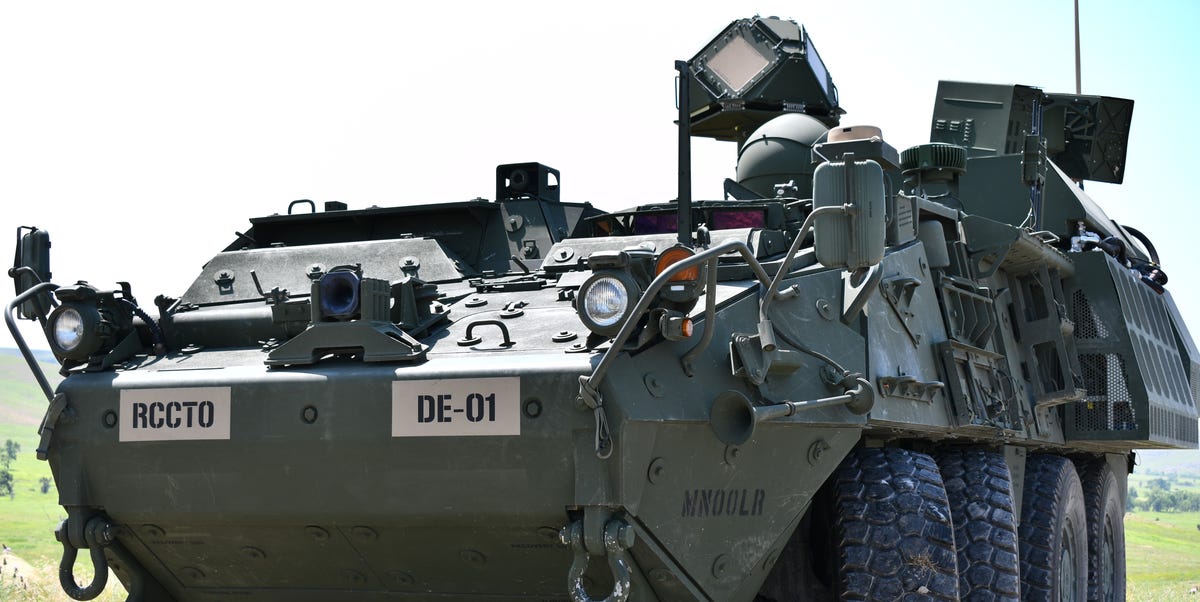
DE M-SHORAD stands for Directed Energy Maneuver-Short Range Air Defense. In plain English, it is a laser-based air defense weapon mounted on a Stryker armored vehicle. The idea is simple enough: take a mobile platform that can move with Army units and give it a high-energy laser capable of defeating small to medium drones and helping counter short-range aerial threats.
The “maneuver” part matters. This is not a fixed-site experiment meant to guard one gate forever like a grumpy futuristic scarecrow. It is meant to travel with Army formations and protect them while they move. That is a much tougher job. A laser system on a static base has one set of engineering problems. A laser system bouncing around on a tactical vehicle in heat, dirt, and constant motion has a much longer argument with physics.
DE M-SHORAD sits inside the broader M-SHORAD family. The Army’s kinetic M-SHORAD version, now called the SGT STOUT, uses guns, missiles, and onboard sensors on a Stryker to defend maneuver units against low-altitude threats. DE M-SHORAD was designed as the directed-energy companion to that kinetic capability, not a magical replacement for it.
Why the Army Wanted a Laser on a Stryker
The short answer is drones. The slightly longer answer is: too many drones, too cheap, too fast, too persistent, and too annoying to keep shooting at with expensive missiles forever.
Recent wars and regional conflicts have hammered home one uncomfortable truth: small unmanned aircraft are no longer niche gadgets. They are everywhere. They scout, they spot artillery, they harass bases, they swarm, and in some cases they fly straight into targets like unpleasant airborne lawn darts. If your answer to every cheap drone is a pricey interceptor, you eventually lose the cost exchange even if you win the engagement.
That is where directed energy starts looking attractive. A high-energy laser promises deep “magazine depth,” a relatively low marginal cost per shot, rapid engagement, and the ability to apply force with precision. In theory, that makes it ideal for the counter-drone mission. In practice, theory has to survive dust, heat, power demands, and the fact that battlefields are not clean laboratories with perfect weather and obedient targets.
How DE M-SHORAD Works in Plain English
The basic sequence is detect, track, aim, hold, and destroy. Sensors identify a threat. The system tracks it. The beam director keeps the laser focused on a precise point long enough to damage the target’s structure, optics, control surfaces, electronics, or some combination of all four. It is less “movie ray gun” and more “very intense, very disciplined application of energy to a very unlucky machine.”
The Army has described DE M-SHORAD as a 50-kilowatt-class laser system integrated onto a Stryker-based vehicle. Public reporting and official test material indicate that the prototype relied on substantial onboard power, batteries, cooling, and thermal management to make the weapon viable on a moving platform. That detail sounds boring until you realize it is basically the entire engineering boss fight. A battlefield laser is not just about making a beam. It is about creating, storing, controlling, cooling, and repeatedly using enough energy without cooking your own vehicle into a tragic metal casserole.
The Army has also framed directed-energy systems as a complement to kinetic air defense, which makes sense. Lasers can be outstanding for some targets and engagement windows, but they do not make missiles and guns obsolete. If weather reduces beam quality, if line-of-sight is blocked, or if the target set changes, traditional weapons still matter. The future of air defense is layered, not laser-only.
The Road From Concept to Battlefield
DE M-SHORAD did not appear overnight. The Army pushed the effort hard beginning in 2019, moving unusually fast by defense-acquisition standards, which is saying something because “fast” in Pentagon language usually still requires coffee and patience. By 2021, the Army had already taken the laser-equipped Stryker through a combat shoot-off meant to expose soldiers to the system, gather feedback, and refine what a real operational laser vehicle ought to look like.
That early phase mattered because it shifted DE M-SHORAD from abstract promise to soldier-centered experimentation. The Army was not merely asking whether the laser could burn a target. It was asking whether troops could train on it quickly, whether the interface made sense, whether the vehicle could support the system in realistic conditions, and whether the concept belonged in a maneuver force at all.
By 2023, reporting from live-fire testing at Yuma Proving Ground suggested the prototypes were very effective against Group 1, Group 2, and Group 3 drones. That was a significant milestone. Shooting down drones with a laser is the part everyone notices, and understandably so. It is dramatic, visible, and futuristic enough to make half the internet type “Star Wars is real now.” But even then, the Army was already acknowledging that success against drones did not automatically mean every harder target set was solved.
Rockets, artillery, and mortars pose different timing and engagement challenges. A laser may need sustained dwell time on target, excellent tracking, and favorable conditions. A drone can still be a dangerous target, but it is not the same as defeating every incoming threat profile the Army worries about.
What Happened in Real Deployments
The program’s most important milestone may have been the moment it left the test world and entered the real one. The Army delivered four prototype vehicles to 4th Battalion, 60th Air Defense Artillery Regiment, then gave them an urgent materiel release and air transport certification. In early 2024, those DE M-SHORAD prototypes deployed to the Middle East, where the Army used them to support operations and learn how the system behaved in a brutally relevant environment.
That was a big deal. It meant the Army was no longer asking only, “Can the laser work?” It was asking, “Can the laser work there?” There, in this case, means dust, heat, maintenance pressure, tactical movement, field handling, limited supply depth, and the sort of atmospheric conditions that do not care how elegant your engineering brief looked back home.
And this is where the story gets refreshingly honest. Soldier feedback and Army testimony suggested the 50-kilowatt class system was challenging to integrate on a vehicle that has to move constantly. Heat dissipation, electronics, reliability, wear and tear, and beam performance in dusty conditions all became real concerns. That is not failure. That is what learning looks like when the classroom is mean.
In June 2025, the Army returned to Fort Sill for a significant training and live-fire event in which DE M-SHORAD prototypes operated alongside kinetic systems. That exercise helped develop tactics, techniques, and procedures for mixing directed-energy and traditional air-defense effects. In other words, the Army was not just testing whether the laser could kill a target. It was testing how humans should actually fight with it.
So Is DE M-SHORAD Operational or Not?
Yes, and also not in the way people often assume.
If “operational” means soldiers received it, trained with it, deployed it, and used it to shape real Army air-defense thinking, then yes, DE M-SHORAD is very real and very consequential. It moved far beyond the demo phase.
If “operational” means the Army has fully committed to mass fielding this exact system as a long-term program of record, then no. That is the twist. Official test reporting indicates the Army is no longer pursuing DE M-SHORAD itself as a program of record. Instead, it is using the lessons from those prototypes to inform a follow-on effort called Enduring High Energy Laser, or E-HEL.
That may sound like bad news, but it is better read as a sign of maturation. DE M-SHORAD’s mission was to teach the Army what works, what breaks, what soldiers hate, what engineers underestimated, and what the next production-worthy laser system should look like. In that sense, DE M-SHORAD may be most important not as the final product, but as the prototype that forced the Army to stop daydreaming and start learning.
What Makes the System So Promising
1. It attacks the drone-cost problem
Countering a cheap drone with an expensive missile is not a sustainable long-term habit. A laser offers a much more attractive cost-per-engagement model once the system is fielded and maintained properly.
2. It gives maneuver forces mobile protection
DE M-SHORAD is built on a Stryker because the Army does not just need air defense at fixed installations. It needs protection that can move with formations in the field.
3. It expands layered air defense
The laser adds another tool to the kit. That matters because no single weapon solves every air threat under every condition.
4. It pushes the Army toward future battlefield realities
Even if the exact prototype changes, the institutional shift is already underway. Directed energy is no longer a side hobby. It is part of how the Army is thinking about modern air defense.
What Still Makes It Hard
Lasers have one huge public-relations advantage and one equally huge engineering problem: they look simple from the outside. Point, click, zap. Easy. Except not even slightly.
High-energy lasers remain limited by line of sight and by atmospheric conditions such as dust, fog, rain, smoke, and other obscurants. Beam quality matters. Thermal management matters. Power generation matters. Vehicle integration matters. Maintenance matters. If you have to baby a battlefield laser like a rare orchid, you do not have a battlefield laser. You have a science project with deployment orders.
The Army’s own feedback loop seems to have surfaced exactly those issues. Making a 50-kilowatt-class laser work on a moving tactical vehicle is not simply a matter of bolting hardware onto a Stryker and hoping for a patriotic miracle. The system has to survive field abuse, sustain its beam, cool itself, recharge, and still be trusted by crews who would very much prefer not to discover flaws during a bad afternoon.
That is why the Army has been exploring different power classes, configurations, and future procurement paths. The question is not merely “How powerful is the laser?” The better question is “What laser is powerful enough, reliable enough, rugged enough, and affordable enough for the mission?”
Why DE M-SHORAD Matters Even If the Name Changes
Because military revolutions rarely arrive as neat, finished products. They show up as awkward, useful, frustrating prototypes that teach armies how to think differently.
DE M-SHORAD has already done three important things. First, it proved that a mobile Army laser could move beyond slide decks and into soldier hands. Second, it exposed the real-world problems that must be solved before large-scale fielding makes sense. Third, it helped shift laser weapons from “interesting future option” to “serious component of the air-defense roadmap.”
So yes, the Army’s laser weapon is finally here. But “here” does not mean complete. It means present, tested, deployed, criticized, improved, and impossible to dismiss.
Additional Perspective: What the DE M-SHORAD Experience Probably Feels Like in the Field
If you are imagining the DE M-SHORAD experience as a soldier casually pulling up, pressing a glowing red button, and watching enemy drones vanish in cinematic silence, let’s gently lower expectations back to Earth. The real experience is likely far more technical, demanding, and mentally crowded.
For the crew, operating a laser air-defense vehicle probably feels less like starring in a sci-fi movie and more like managing a high-speed chain of decisions under pressure. Detection, identification, target priority, tracking stability, dwell time, environmental conditions, power state, thermal limits, and coordination with neighboring systems all matter. That is a lot to process before anyone gets to the satisfying part where the target stops flying.
There is also the emotional shift that comes with trusting a weapon that behaves differently from familiar guns and missiles. Traditional air-defense weapons offer visible cues: launch, recoil, smoke, blast, impact. A laser engagement is subtler. The target may wobble, lose lift, burn through, or simply drop. To experienced crews, that can eventually become normal. Early on, though, it likely requires a retraining of instincts. A weapon that works quietly still has to earn confidence loudly.
For maintainers, the experience is probably even more revealing. Keeping a high-energy laser alive on a tactical vehicle is a test of patience and discipline. Dust contamination, thermal wear, vibration, electronic complexity, and replacement-part logistics all become daily realities. In that sense, DE M-SHORAD is not just teaching the Army how to shoot lasers. It is teaching the Army how to sustain them, which is a much less glamorous sentence and a much more important one.
Commanders experience the system differently. To them, DE M-SHORAD is not just a weapon; it is a choice inside a layered defense plan. Do you use the laser against a cheaper drone and save kinetic interceptors for harder targets? Do you place it where visibility is best, or where the threat is heaviest? How much risk do you accept from weather? When do you hand engagements off to another system? The “experience” at that level is about confidence, doctrine, and judgment.
Then there is the battlefield psychology. A directed-energy weapon changes the feel of defense. A formation that knows it has a deep-magazine counter-drone option may operate with more freedom. At the same time, a formation that discovers the laser is degraded by dust or overstressed by movement learns another timeless military lesson: every new capability arrives with fine print.
And perhaps that is the most honest way to describe the DE M-SHORAD experience overall. It is not the experience of perfection. It is the experience of transition. Soldiers, testers, engineers, and leaders are all learning what happens when a futuristic idea meets real tactical conditions. Some lessons are encouraging. Some are humbling. All of them are valuable.
That is why DE M-SHORAD matters beyond the headline. It represents the messy middle stage of military innovation, where a weapon is no longer hypothetical, but not yet effortless either. In a strange way, that makes it more impressive. Anyone can promise the future. Much fewer programs are willing to drag the future into the dirt, shake it around on a Stryker, and ask soldiers what still needs fixing.
Conclusion
DE M-SHORAD is the Army’s clearest sign yet that laser air defense has crossed from theory into fielded experimentation with real tactical value. The system has shot down drone targets, deployed with troops, and helped the Army learn how directed-energy weapons might fit into layered air defense for maneuver forces. That alone is a milestone.
But the bigger lesson is even more useful. DE M-SHORAD has shown that battlefield lasers are not miracle gadgets. They are serious military systems with serious advantages and equally serious constraints. The Army now has the hard-earned data to build something more durable, more sustainable, and more production-ready. So if DE M-SHORAD feels like the beginning rather than the end, that is because it is. And for the Army’s laser future, that may be exactly the right kind of arrival.