Jon Stewart Laments That Dick Cheney Didn’t Live To See The Newest GOP War of Choice

Note: This article analyzes a satirical political segment and uses the phrase “war of choice” as a criticism commonly applied to discretionary military escalation, not as an official government label.
Jon Stewart Finds the Iraq War Rerun Button
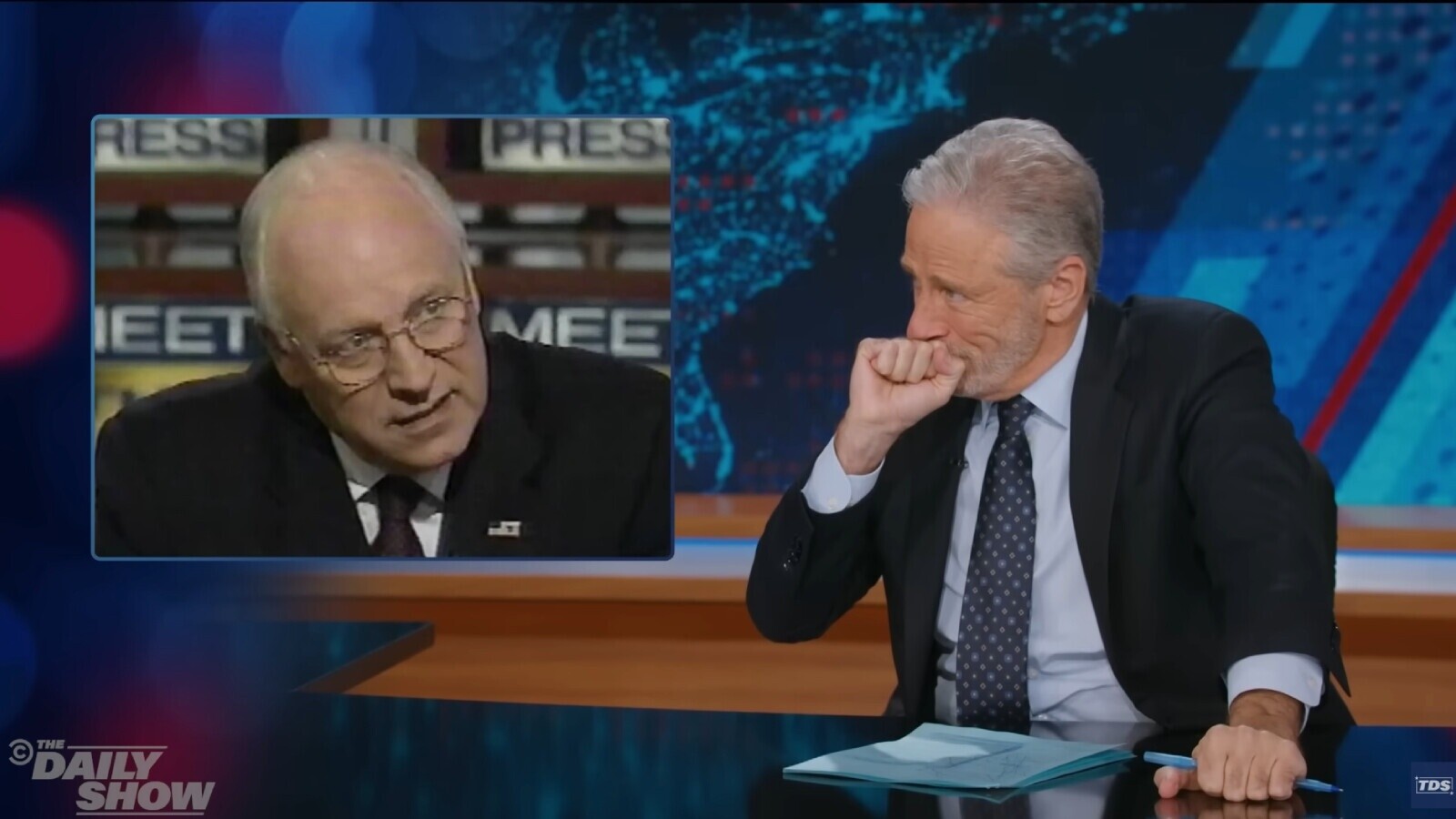
Jon Stewart has spent enough time watching Washington sell wars to know when the old sales brochure has been pulled out of the drawer, dusted off, and handed to a new cast of cable-news characters. In his December 2025 return to familiar territory on The Daily Show, Stewart reacted to the Trump administration’s escalating pressure on Venezuela with the expression of a man who had ordered a sandwich and somehow received the 2003 Iraq War with extra déjà vu.
The segment began in peak Stewart fashion: a joke about Donald Trump receiving FIFA’s newly created Peace Prize at the 2026 World Cup draw, a trophy so strange-looking that Stewart treated it less like an international honor and more like a prop from a billionaire’s emotional-support gift shop. But the punchline quickly darkened. Almost immediately after the “peace” spectacle, news coverage turned to the possibility of U.S. military action against Venezuela, regime-change talk, drug-war framing, and a large military buildup in the Caribbean.
That contrast gave Stewart his central target: the gap between branding and behavior. A president celebrated as a peacemaker while his administration talks like it is rehearsing for a new foreign intervention is exactly the sort of absurdity late-night comedy was built to process. Unfortunately, it is also exactly the sort of absurdity American foreign policy has produced before.
Why Dick Cheney Became the Ghost in the Joke
The headline’s dark joke works because Dick Cheney remains one of the most recognizable symbols of the Iraq War era. Cheney, who died on November 3, 2025, at age 84, was remembered by major news outlets as a powerful and polarizing former vice president who helped push the United States toward the 2003 invasion of Iraq. He was a leading voice warning about Iraq’s alleged weapons of mass destruction, weapons that were never found.
Stewart did not need to deliver a graduate seminar on neoconservatism to make the connection. The Cheney reference carries a whole political mood: confident warnings, grave studio lighting, “existential threat” language, quick pivots from uncertainty to certainty, and the ever-popular promise that military action will be swift, clarifying, and morally uncomplicated. History, being rude, rarely cooperates.
Cheney’s legacy is complicated even among conservatives. He was a lifelong Republican power player, a former defense secretary, a former Halliburton executive, and arguably the most influential vice president in modern U.S. history. Yet by the end of his life, he had broken sharply with Donald Trump and even supported Kamala Harris in 2024. That twist makes Stewart’s joke sharper. The new GOP may reject Cheney’s old party manners, but when it comes to selling a conflict abroad, Stewart suggested, it still knows how to hum the old tune.
The Venezuela Push and the Iraq War Echo
The Trump administration framed its Venezuela campaign around drug trafficking, cartels, and national security. Reuters reported in December 2025 that U.S. troops had carried out at least 21 strikes on alleged drug boats in the Caribbean and Pacific since early September, killing at least 83 people, while lawmakers from both parties pushed for a war-powers vote if the administration attacked Venezuela directly. AP later reported that the House rejected resolutions meant to limit Trump’s military campaign against Venezuela and drug cartels, even as Congress questioned the legal basis and ultimate goals of the operation.
Those facts are what made Stewart’s Iraq comparison land. In the early 2000s, Americans were told that Saddam Hussein represented an urgent threat, that intelligence justified action, that freedom and democracy could spread outward, and that the conflict would not become the swamp it obviously became. In 2025, Stewart saw similar rhetorical furniture being rearranged: Venezuela as an urgent danger, Nicolás Maduro as a threat to the hemisphere, drug networks as a war-level enemy, and military escalation as the only serious response.
The details are different, of course. Venezuela is not Iraq. Fentanyl and drug trafficking are not weapons of mass destruction. A Caribbean military buildup is not the same as the 2003 invasion of Baghdad. But Stewart’s argument was not that history repeats itself like a photocopier. It was that Washington often repeats the same persuasion tactics: simplify the enemy, inflate the threat, blur the legal authority, dismiss critics as naïve, and promise that the hard part will somehow be easy.
Comedy as a Warning System
Stewart has always been most effective when he uses jokes as a smoke alarm. The alarm is loud, annoying, and occasionally makes you want to throw a shoe at the ceiling, but it is not the source of the fire. In this case, the fire is the familiar American pattern of treating military force as a political shortcut.
What made the segment especially effective was its use of old Daily Show DNA. Stewart brought back the vibe of early-2000s media criticism: clip montages, side-by-side comparisons, and the weary disbelief of a host who remembers exactly how many respectable people were wrong last time. The joke was not simply “Trump is being hypocritical.” It was bigger than that. The joke was that the Republican movement that now claims to hate endless wars seemed, in Stewart’s view, to be building a new argument for one.
That is why the Cheney angle matters. Cheney became an emblem of conviction without correction. Even after the Iraq War’s justifications collapsed, he defended the invasion and the broader security state built around it. To invoke him in the Venezuela debate is to ask whether America has learned anything from the last round of confident war marketingor whether it has simply replaced the cast while keeping the script.
The “America First” Collision
One of Stewart’s strongest points was the collision between “America First” non-interventionist branding and the practical realities of military escalation. Trump’s political image has often leaned on skepticism toward nation-building and foreign entanglements. His supporters frequently contrast him with the Bush-era GOP, arguing that the old neoconservative appetite for regime change is gone.
But the Venezuela campaign complicated that message. If the United States threatens a foreign leader, deploys major forces nearby, strikes alleged targets, and hints at broader action, the line between counter-narcotics pressure and regime-change politics gets blurry fast. At some point, the phrase “we are not doing interventionism” begins to sound like a man standing in a swimming pool insisting he is not wet.
For SEO readers searching “Jon Stewart Venezuela Iraq comparison,” this is the heart of the story: Stewart was not merely mocking a single Trump contradiction. He was diagnosing a larger Republican identity crisis. Can a party claim to reject Iraq-style intervention while using Iraq-style arguments? Can it condemn the old foreign-policy establishment while borrowing its vocabulary? Can it call itself restrained while expanding military action without clear congressional authorization?
War Powers, Congress, and the Missing Adult in the Room
The constitutional issue is not a side dish; it is the entrée. Under the U.S. system, Congress has the authority to declare war, while presidents have often stretched executive power through limited strikes, emergency rationales, and national-security claims. That tension did not begin with Trump, and it will not end with him. Presidents from both parties have treated the War Powers Resolution like a speed bump: irritating, technically present, but not always allowed to slow the vehicle.
In the Venezuela case, lawmakers raised concerns about whether the administration had provided enough evidence, legal justification, and strategic clarity. Some wanted votes that would require congressional authorization before further escalation. Others argued the campaign was a necessary response to drug trafficking and cartel violence. The result was a debate that looked less like careful constitutional deliberation and more like Washington’s favorite group project: everyone talks, nobody owns the PowerPoint, and somehow the military has already started.
Stewart’s satire thrives in that vacuum. When elected officials decline to clearly explain where a military campaign begins, ends, or legally stands, comedians become translators of public confusion. That does not mean comedians replace policy experts. It means satire often notices when official language has become so polished that it no longer says anything useful.
Why the FIFA Peace Prize Joke Worked
The FIFA Peace Prize portion of Stewart’s monologue was more than comic decoration. It set up the hypocrisy. Trump being handed a peace-themed honor while U.S. policy moved toward potential military escalation created a visual contradiction too perfect for late-night television. It was diplomacy as pageantry, followed by cable-news drums.
Stewart’s joke about the award being created to appease Trump landed because it tapped into a recurring theme in coverage of his political style: symbolic flattery matters. Gold objects, ceremonial praise, public recognition, and grand stages are not just accessories; they are part of the performance. The absurdity is not that a powerful person likes awards. Most powerful people do. The absurdity is accepting a peace prize while the word “war” is wandering around the news cycle wearing a fake mustache.
That juxtaposition made the Venezuela discussion feel even more surreal. If the Iraq War era was sold with solemnity, the Venezuela moment seemed, at least in Stewart’s framing, to be sold with a strange mix of anti-war branding, influencer-era spectacle, cable outrage, and old-school interventionist logic. It was not exactly 2003 again. It was 2003 rebooted by people who also want better lighting for social media clips.
Media Memory and the Danger of Familiar Phrases
One of the most important lessons from the Iraq War is that language can prepare the public for action before the public realizes it is being prepared. Phrases like “existential threat,” “weapons,” “terror networks,” “freedom,” “democracy,” “regional transformation,” and “swift action” do not merely describe policy. They create emotional weather.
Stewart’s old specialty was exposing that weather system. He would place clips next to each other until the pattern became impossible to ignore. In the Venezuela segment, the pattern was the message. When public figures describe a foreign leader as uniquely dangerous, portray military force as clean and decisive, and suggest that critics are weak or unserious, the country is already halfway into the argument.
For American audiences, that should feel familiar enough to be uncomfortable. The Iraq War’s consequences were enormous: thousands of U.S. service members killed, far greater Iraqi casualties, regional instability, damaged U.S. credibility, and a long reckoning over intelligence failures. When Stewart jokes that Cheney missed the newest GOP war pitch, the humor depends on the pain of remembering how easily the last one was packaged.
Specific Examples That Make the Analogy Stick
1. The “Existential Threat” Frame
Before major interventions, leaders often portray the target as not merely bad but intolerable. In Iraq, Saddam Hussein was presented as a threat whose weapons and alleged terror links required urgent action. In the Venezuela debate, Maduro and related criminal networks were discussed in similarly sweeping national-security terms. The comparison is not exact, but the emotional architecture is similar.
2. The Promise of Transformation
Iraq was sold partly on the idea that removing Saddam could help transform the Middle East. Venezuela hawks have used language suggesting that action could reshape the region, weaken hostile networks, and produce democratic change. Again, the danger is not that transformation is always bad. The danger is pretending transformation is easy because the slogan fits on television.
3. The Legal Fog
The Iraq War had formal congressional authorization, though the intelligence basis was later discredited. The Venezuela campaign raised a different legal concern: whether continued strikes and possible action against Venezuelan territory required clearer congressional approval. In both cases, the public was asked to trust executive claims before the full picture was visible.
4. The Cable-News Drumbeat
Stewart’s critique has always included media behavior. Wars do not sell themselves. They are discussed, framed, repeated, simplified, and dramatized. Once television panels begin treating escalation as inevitable, the debate shifts from “Should this happen?” to “How dramatic will this be?” That shift is where democratic scrutiny goes to take a nap.
Experiences Related to the Topic: Watching the War Pitch Come Back Around
For many Americans who lived through the Iraq War years, Stewart’s Venezuela segment likely felt less like comedy and more like opening an old junk drawer and finding a live raccoon. The phrases were familiar. The pacing was familiar. The confidence was familiar. Even the media choreography felt familiar: officials make grave claims, friendly commentators amplify them, critics ask for evidence, and suddenly the critics are accused of not taking threats seriously enough.
One common experience is the feeling of déjà vu mixed with helplessness. People remember being told that Iraq had weapons of mass destruction. They remember the certainty. They remember the maps, the briefings, the grave faces, and the sense that respectable opinion had already made up its mind. Then they remember what came later: no WMD stockpiles, years of violence, shifting justifications, and a public debate that seemed to arrive after the most important decisions had already been made.
Another experience is generational. Older viewers may remember Stewart as one of the few mainstream comic voices willing to aggressively challenge the Iraq narrative in real time. Younger viewers, who know Iraq more as inherited history than lived memory, may see the Venezuela discussion as a test of whether America’s institutions learned the lesson their teachers keep mentioning in solemn tones. Spoiler alert: institutions are not famous for learning quickly. They are more famous for creating committees with impressive names.
There is also the experience of watching political identities flip. The same movement that spent years criticizing Bush-era nation-building can find itself defending military escalation when the president belongs to its team. Meanwhile, some Democrats who once trusted executive power under presidents from their party rediscover congressional authority with fresh enthusiasm. This is not unique to one side. Washington often treats principles like umbrellas: useful in a storm, forgotten in the cab.
For veterans and military families, the issue is even less abstract. Every phrase about “limited strikes” or “quick action” carries the possibility of deployment, injury, trauma, and loss. The people who sell conflicts rarely pay the highest price for them. That gap between rhetorical toughness and lived consequence is one reason Stewart’s comedy can feel cathartic. He says, in effect, what many people think when the war machine starts warming up: Haven’t we seen this episode?
Finally, there is the everyday citizen’s experience of trying to separate real security threats from political theater. Drug trafficking is real. Authoritarianism in Venezuela is real. Regional instability is real. But real problems do not automatically justify unclear wars. In fact, the more serious the problem, the more careful the public should be about evidence, authority, goals, costs, and exit plans. Stewart’s segment works because it does not ask viewers to laugh away danger. It asks them to laugh at the dangerous confidence of people who act as though asking questions is somehow unpatriotic.
Conclusion: Stewart’s Joke Is Really a Memory Test
Jon Stewart’s lament that Dick Cheney did not live to see the newest GOP “war of choice” is funny because it is cruel, and it is cruel because it is rooted in a painful political memory. Cheney symbolizes an era when certainty outran evidence and when war was marketed as necessity until its consequences became impossible to ignore. The Venezuela debate, as Stewart framed it, raised the fear that America’s political class may be capable of condemning the Iraq War’s results while recycling parts of its rhetoric.
The point is not that every military action becomes Iraq. The point is that every proposed military action deserves scrutiny before it becomes something larger than advertised. Stewart’s satire reminds viewers that the first casualty of war politics is often not truth itself, but humility. Once leaders stop saying “Here is what we know” and start saying “Only fools would doubt us,” the country should reach for the emergency brake.
In the end, the segment’s real target was not just Trump, Cheney, FIFA, Venezuela, or cable news. It was America’s astonishing ability to forget the last disaster just in time to audition for the next one. That may be hilarious on television. In foreign policy, it is a very expensive subscription plan.