
Milwaukee laser measures sit in that sweet spot between “I am tired of dragging a tape measure across the room” and “I do not want to spend Leica-level money just to find out how much flooring I need.” For 2025, Milwaukee’s laser distance meters remain a practical choice for contractors, remodelers, estimators, real estate pros, maintenance teams, and serious DIYers who want quick, repeatable measurements without turning every room into a tape-measure wrestling match.
The most popular Milwaukee laser measure models are the 65 ft, 150 ft, and 330 ft laser distance meters. The 150 ft model, Milwaukee 48-22-9802, is the best all-around pick for most indoor work. The 330 ft model, Milwaukee 48-22-9803, adds longer range, a 3-position auto-detecting lever, and digital auto-level functionality for more demanding measuring jobs. The 65 ft model is the budget-friendly option for quick room measurements, furniture planning, and basic home improvement tasks.
So, is a Milwaukee laser measure worth buying in 2025? Yes, especially if your work involves room dimensions, square footage, volume estimates, ceiling height, rough layouts, cabinet planning, paint calculations, flooring quotes, or quick jobsite checks. It is not a magical replacement for a tape measure in every situation, but it is one of those tools that makes you wonder why you waited so long to buy one. Like a good coffee maker, once it enters your daily routine, going back feels slightly barbaric.
Quick Verdict: Is the Milwaukee Laser Measure Worth It?
The Milwaukee laser measure is worth it if you value speed, accuracy, durability, and simple operation. The 150 ft version is the best choice for most homeowners and pros because it offers a strong mix of range, accuracy, readable display, and useful measuring modes without going overboard. The 330 ft model is better for large interiors, commercial spaces, long hallways, warehouses, exterior estimating, and pros who need digital auto-level support.
The biggest strengths are the rugged Milwaukee-style body, bright color display, real-time measurement mode, side-shot button, IP54 protection, and the ability to calculate distance, area, total area, and volume. The biggest weaknesses are limited outdoor visibility in bright sun, no obvious app-first workflow like some Bosch connected models, and the fact that a laser measure still cannot mark a board for a miter saw cut. Sorry, your tape measure is not retiring. It is just getting a roommate.
Milwaukee Laser Measure Models Compared
| Model | Range | Best For | Key Advantage |
|---|---|---|---|
| Milwaukee 48-22-9801 | 65 ft | DIY projects, small rooms, quick indoor measurements | Affordable and simple |
| Milwaukee 48-22-9802 | 150 ft | Contractors, remodelers, flooring, painting, estimating | Best balance of price and features |
| Milwaukee 48-22-9803 | 330 ft | Large spaces, commercial jobs, long-distance measuring | Digital auto-level and extended range |
For most buyers reading this Milwaukee Laser Measure Review 2025, the 150 ft model is the one to look at first. It has enough range for most houses, apartments, shops, offices, and remodeling projects. The 330 ft model is excellent, but many people will never use its full range unless they work in larger structures or need to measure long spans regularly.
Design and Build Quality
Milwaukee clearly designed these laser distance meters for jobsite use, not for living in a velvet-lined drawer next to a fountain pen. The housing has impact-resistant overmold protection, which gives the tool a sturdy feel and helps it survive normal bumps, drops, toolbox abuse, and the occasional “I set it somewhere and now it is under a pile of drywall screws” moment.
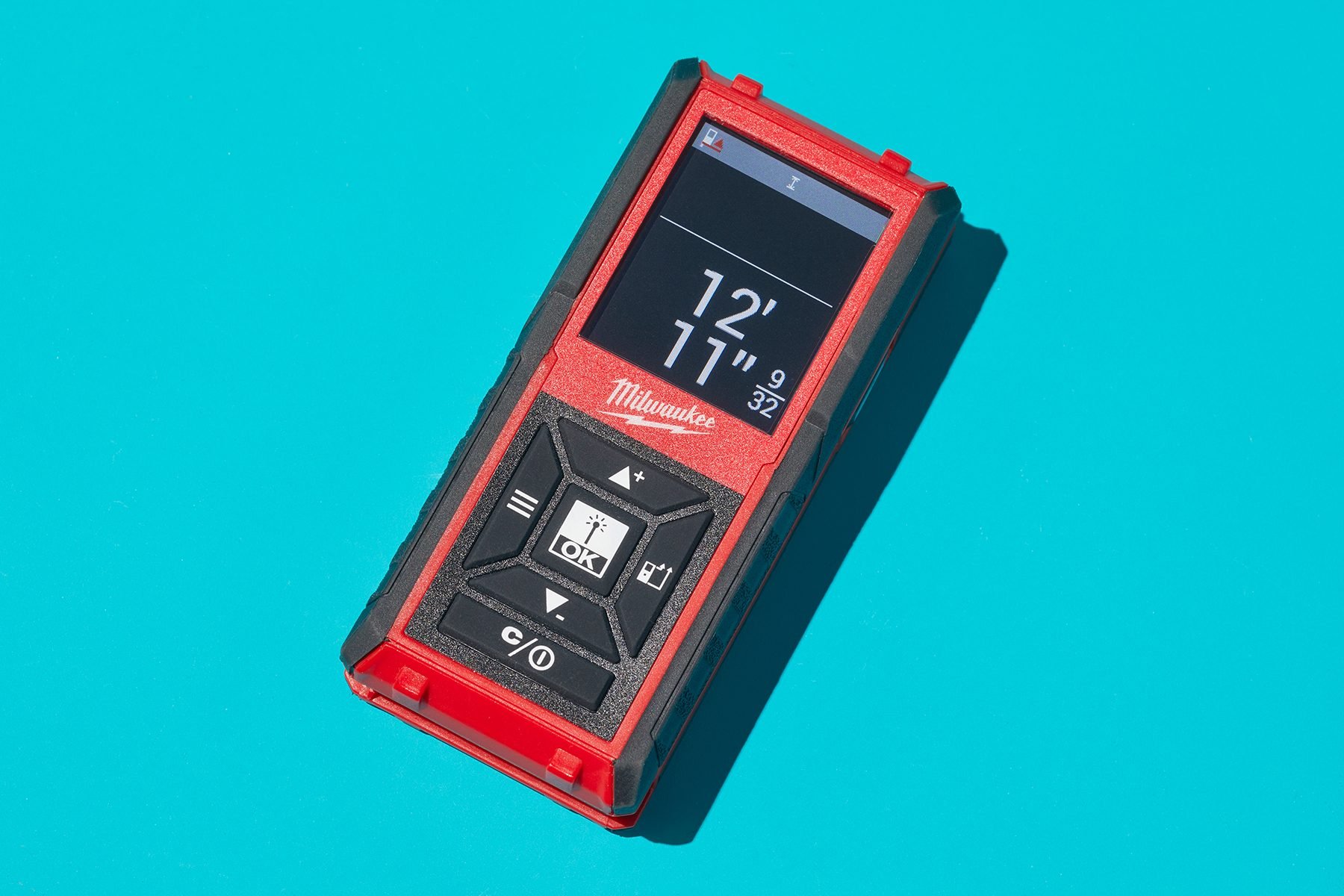
The 150 ft and 330 ft models use a 2-inch color screen that is much easier to read than tiny monochrome displays on cheaper laser measurers. This matters more than people think. A laser measure can be accurate all day long, but if the screen looks like a calculator from 1998, you will hate using it. Milwaukee’s display is clean, bright, and simple enough for fast measurements in low-light areas, utility rooms, basements, closets, and unfinished interiors.
The side-shot button is another smart detail. Instead of forcing your hand into an awkward position every time you measure from a wall, cabinet, or tight corner, the side button lets you take a reading from a more natural grip. It sounds minor until you use the tool above shoulder height or against trim. Then it becomes one of those features you silently appreciate and never mention at parties because, apparently, not everyone wants to discuss ergonomic measurement buttons over dinner.
Accuracy: How Reliable Is It?
The Milwaukee 150 ft and 330 ft laser distance meters are rated for accuracy up to plus or minus 1/16 inch. For estimating, room measurement, material planning, square footage, and general layout tasks, that is more than accurate enough. In practical terms, if you are measuring a bedroom for flooring, checking a ceiling height, estimating drywall sheets, or calculating paint coverage, a 1/16-inch tolerance is very strong.
However, it is important to understand where laser measures fit. A Milwaukee laser measure is excellent for capturing room dimensions quickly. It is not the tool you use to mark a 37 3/8-inch cabinet filler strip for a finish cut. For that, use a tape measure, square, and pencil. Laser measures are about fast distance capture, not replacing every traditional measuring habit in woodworking and carpentry.
Best Accuracy Conditions
The tool performs best when the laser hits a flat, hard, non-reflective target. Painted drywall, wood panels, interior doors, cabinets, concrete walls, tile, and finished surfaces usually work well. Measuring from wall to wall inside a room is where the Milwaukee laser measure feels almost effortless. Point, press, read, done. No bent tape, no helper, no “hold the end right thereno, thereno, the other there.”
Challenging Conditions
Like most red-beam laser distance meters, the Milwaukee can struggle outdoors in bright sunlight, especially over longer distances. Dark surfaces, glass, glossy tile, angled trim, crown molding, and uneven textures can also make readings harder. The laser needs a clean return signal. If the target surface scatters or reflects the beam strangely, accuracy may suffer or the tool may refuse the measurement entirely.
Features That Matter in Real Use
Continuous Real-Time Measurements
Continuous real-time measurement is one of the best features. As you move the tool, the reading updates automatically. This is useful when finding the shortest distance to a wall, checking clearances, measuring inside openings, or confirming whether a piece of furniture will fit before you drag it across the room and question your life choices.
Area and Volume Calculations
The Milwaukee laser measure can calculate area and volume, which is extremely helpful for painters, flooring installers, HVAC pros, property managers, and DIY remodelers. Measure length and width, and the tool can calculate square footage. Add height, and it can calculate volume. This saves time and reduces the chance of calculator mistakes, especially when you are moving through multiple rooms.
Memory Storage
The 150 ft and 330 ft models include memory storage for up to 30 readings. That is useful when walking through a jobsite, taking several measurements, and writing them down afterward. It is not as slick as Bluetooth syncing to an app, but it is practical and keeps the workflow simple.
Auto-Detecting Lever
The 150 ft model has a 2-position auto-detecting lever, while the 330 ft model uses a 3-position version. This lever helps the tool understand whether you are measuring from the back of the device, an edge, or a corner. For real-world measuring, that means fewer mental adjustments and fewer opportunities to accidentally subtract the wrong distance. That is good, because math errors on a jobsite have a special talent for becoming expensive.
Digital Auto-Level on the 330 ft Model
The 330 ft Milwaukee laser measure includes digital auto-level, which automatically takes a measurement when the tool reaches a level position. This is especially useful for longer distances, where a slight tilt can create a bigger error. If you regularly measure across large rooms, commercial interiors, warehouses, or long corridors, this feature makes the 330 ft model more attractive.
Milwaukee 150 ft vs 330 ft Laser Measure
The 150 ft model is the best Milwaukee laser measure for most buyers. It is compact, accurate, easy to use, and powerful enough for everyday interior measuring. It is ideal for flooring estimates, paint calculations, drywall planning, room layouts, window and door rough measurements, closet planning, and general remodeling work.
The 330 ft model is the better choice if you measure larger spaces or need the digital auto-level feature. It costs more, but the extra range and 3-position lever make sense for commercial contractors, facility managers, inspectors, architects, and serious pros who measure long distances regularly. If your work mostly happens inside bedrooms, kitchens, bathrooms, and living rooms, the 150 ft model is plenty. If your work involves warehouses, long hallways, large retail spaces, or exterior checks, the 330 ft model earns its keep.
Milwaukee Laser Measure vs Bosch, DeWalt, and Leica
Milwaukee competes well on durability, ease of use, and jobsite practicality. Compared with Bosch, Milwaukee’s interface feels straightforward and rugged, but Bosch has several connected and green-beam models that may appeal to users who want Bluetooth app integration, brighter laser visibility, or IP65-rated protection. Bosch’s MeasureOn workflow is especially appealing for users who want to organize measurements, photos, and project notes digitally.
Compared with DeWalt, Milwaukee feels very close in the contractor-friendly category. Both brands understand jobsite abuse and simple controls. DeWalt laser measurers often appeal to users already invested in DeWalt tools, while Milwaukee naturally fits users who already carry red tools in their bags and trucks.
Compared with Leica DISTO models, Milwaukee is usually the more approachable jobsite option. Leica is excellent for premium measuring, app-heavy workflows, and high-end precision features, but many contractors and DIYers simply do not need that level of sophistication. Milwaukee focuses on fast, durable, easy measuring without turning the tool into a tiny computer that requires a committee meeting.
Pros and Cons
Pros
- Strong plus or minus 1/16 inch accuracy on the 150 ft and 330 ft models
- Excellent 150 ft model for most interior projects
- 330 ft option for commercial and long-distance measuring
- Bright, readable 2-inch color display
- Side-shot button improves comfort in awkward positions
- Area, volume, total area, and continuous measurement modes
- Memory storage for up to 30 readings on higher models
- IP54 dust and water resistance
- Rugged overmold body feels jobsite-ready
Cons
- Red laser can be hard to see outdoors in bright sunlight
- Not a full replacement for a tape measure
- No standout Bluetooth workflow compared with connected Bosch models
- Cheaper laser measures may be enough for occasional DIY users
- 330 ft model may be overkill for basic home projects
Who Should Buy a Milwaukee Laser Measure?
You should buy a Milwaukee laser measure if you frequently measure rooms, walls, ceilings, openings, floors, or jobsite spaces. Flooring installers can quickly calculate square footage. Painters can estimate wall area. Remodelers can check room dimensions before ordering materials. Real estate professionals can measure rooms faster. Maintenance workers can verify clearances without dragging a tape across equipment. DIYers can plan furniture, shelves, cabinets, and home upgrades with less hassle.
The Milwaukee 150 ft laser distance meter is the best recommendation for most buyers in 2025. It has the right range, the right features, and enough durability for regular use. The 65 ft model is fine for simple home projects, but many users will outgrow it. The 330 ft model is excellent, but it is best for pros who truly need the extra distance and digital auto-level.
Buying Tips for 2025
Before buying, think about how far you actually measure. If most of your measurements are inside rooms under 50 ft, the 65 ft model may work. If you want one laser measure that handles almost everything around a home or jobsite, choose the 150 ft model. If you work in large buildings, choose the 330 ft model.
Also consider where you measure. Indoor users will be happy with Milwaukee’s red laser. Outdoor users who often work in bright sunlight may want to compare green-beam or viewfinder-equipped competitors. If you need app exports, project documentation, and photo markups, compare Milwaukee against connected Bosch and Leica options before buying.
Final Verdict
The Milwaukee laser measure lineup is still a strong buy in 2025. The 150 ft model is the best value for most users because it combines accurate measuring, useful calculation modes, a readable display, side-shot ergonomics, memory storage, and jobsite durability. The 330 ft model is worth the upgrade for pros who need longer range and digital auto-level. The 65 ft model is best for basic DIY measuring and budget shoppers.
Milwaukee did not build the flashiest laser measure on the market, and that is part of the appeal. These tools feel practical, tough, and focused. They measure quickly, calculate useful numbers, and survive normal jobsite life. If your current measuring process involves a floppy tape measure, a notepad, and muttering under your breath, a Milwaukee laser measure will feel like a small but satisfying upgrade.
Experience Notes: What It Feels Like to Use a Milwaukee Laser Measure
The everyday experience of using a Milwaukee laser measure is less about fancy technology and more about removing tiny annoyances from the workday. The first time you measure a room alone without walking a tape across the floor, you immediately understand the appeal. Instead of hooking the tape on trim, hoping it stays put, stepping backward, bending the blade, losing the hook, and starting over like a frustrated measuring-themed circus act, you point the laser at the opposite wall and press a button.
For interior estimates, the speed difference is noticeable. A room that might take several minutes with a tape can be measured in seconds. Length, width, height, square footage, and volume become easy to capture. This is especially useful when measuring multiple rooms in one visit. Painters can move from wall to wall quickly. Flooring contractors can check room sizes without kneeling every five seconds. Property managers can verify room dimensions while holding a phone, clipboard, or coffee that has gone tragically cold.
The 150 ft Milwaukee model feels especially natural in residential settings. It is small enough to carry in a tool pouch, but not so tiny that the buttons feel annoying. The display is easy to read, and the measurement modes are simple enough that you do not need to keep the manual taped to your forehead. The side-shot button becomes surprisingly useful when measuring against walls, inside closets, around cabinets, or above shoulder height. It reduces wrist twisting and makes the tool feel more professional than budget models.
In remodeling work, one of the best uses is quick verification. Need to know whether a vanity will fit between two walls? Measure it. Need to estimate how much baseboard a room needs? Measure the walls and add them. Need to check ceiling height before ordering storage cabinets? Done. The Milwaukee laser measure shines in these practical moments because it saves small chunks of time repeatedly. By the end of a project, those saved minutes add up.
There are still moments when a tape measure wins. If you are cutting lumber, trimming casing, setting reveals, or marking exact cut lines, grab the tape. A laser measure gives you the distance; it does not mark the material. Outdoor work can also be less smooth. In bright sunlight, the red dot can become difficult to see, especially at longer distances. A target card can help, but users who spend a lot of time outside may want to compare green-beam or viewfinder laser measures.
The most satisfying part of the Milwaukee laser measure experience is confidence. When used on the right surfaces and within the right conditions, it gives fast, repeatable readings. It reduces guesswork and makes estimates cleaner. It also makes you look slightly more prepared, which is always nice on a jobsite. No tool can fix bad planning, but this one can at least make measuring feel less like a chore and more like pushing the easy button.