19 Before And After Photos Showing How The Lives Of Bangladeshi Working Kids Changed After This Photographer Funded Their Education

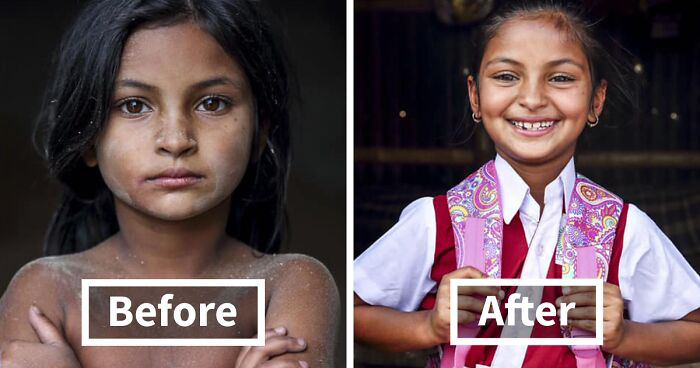
These are not “before and after” photos in the usual internet sense. There is no dramatic haircut, no suspiciously expensive skin-care routine, and definitely no ring light doing all the heavy lifting. Instead, the transformation here is bigger, tougher, and far more meaningful: it is the difference between a child working to survive and a child finally being allowed to learn.
The photo series connected to Bangladeshi photographer GMB Akash lands so hard because it does more than document poverty. It shows what happens when somebody looks at child labor and refuses to stop at sadness. Akash has spoken about helping families offset lost income so children could leave dangerous jobs and return to school. That shift matters because, in Bangladesh, as in many low-income settings, child labor is rarely just about cruelty in a cartoon-villain sense. It is usually about households making brutal math decisions with almost no good options. When a child’s earnings help pay for rice, rent, medicine, or school fees for siblings, “just send them to class” can sound simple from a distance and nearly impossible up close.
That is exactly why these images are so powerful. They are not just portraits of rescue. They are visual proof that education funding can interrupt a cycle that feels permanent when you are trapped inside it. The “before” is a child carrying bricks, sorting scrap, stitching fabric, hauling loads, or standing in a dusty workshop. The “after” is not magic. It is a uniform, a classroom, a notebook, a little more rest, a little more dignity, and a future that suddenly has verbs in it: learn, plan, grow, become.
And yes, the internet loves a transformation story. But this one comes with real moral weight. Bangladesh has made progress in education access over the years, while still struggling with hazardous child labor in sectors such as bricks, leather, garments, and other informal work. Add in poverty, economic shocks, climate pressure, school disruption, and gender inequality, and you get the kind of environment where a child can disappear from a classroom and reappear at a worksite before anyone with power reacts. That is what makes these 19 before-and-after photos feel less like a viral post and more like a challenge to the viewer: now that you have seen the difference, what are you going to do with that knowledge?
Why This Story Hits So Hard
At a glance, the series seems straightforward: a photographer helps working children go to school, then photographs the change. But the emotional force comes from the contrast between labor and learning. In one world, a child’s body is treated like an economic tool. In the other, a child’s mind is finally treated like it matters. That is not a minor improvement. That is a total rewrite of expectations.
What makes the project especially compelling is that it sits at the intersection of several truths. First, child labor is not solved by outrage alone. Second, education is not truly “free” for poor families when uniforms, transport, books, meals, and lost wages all carry a cost. Third, interventions work best when they support the family as well as the child. In other words, this is not a fairy tale about one heroic moment. It is a lesson in how change usually happens: practical help, sustained attention, and someone stubborn enough to believe a school desk beats a factory floor every time.
19 Transformations These Before-And-After Photos Seem To Capture
1. From Survival Shifts to School Mornings
The most obvious change is also the most profound. A working child’s day often starts with labor, noise, pressure, and adult expectations. A student’s day starts with attendance, books, classmates, and structure. One routine shrinks childhood. The other protects it.
2. From Brick Dust to Notebook Paper
In Bangladesh, hazardous work for children has been linked to hard physical sectors like brick production and other informal labor. The symbolic switch from dust-covered hands to pages full of handwriting says everything. It is a swap from physical exhaustion to intellectual possibility.
3. From Being “Useful” to Being Young
Poverty has a nasty habit of making children seem practical before they ever get to be playful. When a child earns money, families and employers may start seeing them as responsible little adults. Education pushes back on that idea and says, politely but firmly, “Actually, this person is still a kid.”
4. From Invisible Labor to Visible Identity
Working children are often seen only for what they produce: stitched seams, sorted waste, stacked goods, carried loads. Students, by contrast, are seen as individuals. A name on a roster, a face in class, a child with strengths, weaknesses, jokes, worries, and ambition. That shift is huge.
5. From Exhaustion to Attention
Children doing hard labor are tired. Not metaphorically tired. Bone-tired. The kind of tired that makes concentration feel like a luxury item. When they leave work and enter school, one quiet miracle begins to happen: they can actually focus long enough to learn, imagine, and participate.
6. From Family Crisis to Family Strategy
Many poor households depend on every available income stream, including a child’s wages. Funding education only works when it acknowledges that reality. Once financial pressure eases even a little, school stops looking like an impossible dream and starts becoming a family strategy for the future.
7. From Dangerous Workplaces to Safer Spaces
A classroom is not perfect, but compared with workshops, tanneries, brickfields, traffic-heavy streets, or cramped production floors, it is a radically safer environment. The “after” photo is not just cleaner. It often represents a child being physically further away from injury, toxic exposure, and exploitation.
8. From Shame to Pride
Children who work often internalize adult stress. They know when money is short. They know when they are behind. They know when other kids are in school and they are not. Education can replace that quiet shame with pride, not just in attendance, but in belonging.
9. From Interrupted Schooling to a Second Chance
Some children in labor have never attended school. Others dropped out. Either way, re-entry matters. Second-chance education programs, catch-up learning, and flexible support can turn “too late” into “not yet.” These photos remind us that academic recovery is possible when adults refuse fatalism.
10. From Short-Term Wages to Long-Term Earning Power
Child labor may generate immediate cash, but it usually locks families into low-wage futures. Schooling does not solve poverty overnight, but it improves literacy, confidence, mobility, and employability over time. The trade-off is painful in the short term and essential in the long term.
11. From Silent Endurance to Self-Expression
School gives children language. Not just grammar and spelling, but language for selfhood. They learn how to answer questions, explain thoughts, ask for help, and imagine goals. A child who can describe a dream out loud is already living in a different world from one who only survives in silence.
12. From Gendered Limits to Wider Possibilities
For girls in particular, education can interrupt several overlapping risks, including early marriage, lost autonomy, and economic dependency. When girls stay in school, the “after” image is not just academic. It can represent a delay of harmful expectations and the beginning of a broader horizon.
13. From Normalized Hardship to Public Discomfort
One of the most useful things photography can do is make people uncomfortable in the right direction. Child labor often becomes normalized because it is common. These before-and-after images break that normalization. They show that the status quo is not natural. It is simply tolerated.
14. From Charity Theater to Practical Intervention
This story stands out because the support appears to go beyond symbolic kindness. It is not just handing out a smile and moving on. It is addressing the exact barrier that keeps children working: money. That practicality makes the “after” believable instead of decorative.
15. From Witness Photography to Participatory Change
Photojournalism usually documents what is wrong. Here, it also participates in change. That creates a different emotional texture. The photographer is not merely saying, “Look how awful this is.” He is also asking, “What if I help alter the outcome?” That is a very different kind of image-making.
16. From Harsh Adult Spaces to Peer Community
Children belong with other children. That sounds obvious, yet child labor strips away peer life and replaces it with adult authority and adult pressure. School returns social development to the picture: friendships, group work, games, teasing, competition, and the simple joy of not being alone in struggle.
17. From Being Managed to Being Mentored
At work, a child is often told what to do faster, longer, and better. At school, a child has a chance to be guided instead of managed. Teachers, caseworkers, and community programs can help children build confidence, decision-making skills, and resilience. That matters just as much as grades do.
18. From Economic Shock to Protective Support
Recent years have shown how quickly children can be pulled into work when families face crisis. Pandemic losses, funding cuts, and climate-related hardship all increase pressure on children. The “after” photo, then, also represents a buffer against shocks that otherwise swallow childhood whole.
19. From A Single Photo Pair to a Bigger Social Question
Each before-and-after image tells one child’s story, but together they raise a larger question: if relatively targeted support can transform one life, what would happen if systems did this at scale? That is where the photos stop being inspiring and start becoming politically inconvenient.
What These Photos Reveal About Bangladesh, Poverty, and Education
The deeper story here is not just about 19 children. It is about a country balancing progress and pressure at the same time. Bangladesh has expanded educational access and built programs aimed at bringing vulnerable children into learning, yet child labor persists, especially in informal and hazardous sectors where enforcement is harder and poverty is closer than policy. That contradiction is important. A country can improve and still leave many children behind.
The photos also reveal a truth development experts repeat for a reason: the cost of schooling is not only what appears on a school receipt. It includes transportation, supplies, uniforms, lost household income, safety concerns, social norms, and whether a family believes school will actually lead somewhere better. If any of those pieces fail, a child can end up back at work. That is why successful interventions rarely focus on the classroom alone. They also reduce family pressure, build community trust, and create practical pathways for children to stay in school long enough for school to matter.
There is another layer too: not all children face the same obstacles. Boys may be pushed into wage labor faster during economic downturns. Girls may face pressure linked to domestic work, restricted mobility, or early marriage. Children in refugee settings face even steeper barriers, where lack of education is closely tied to exploitation risk. So while the photos feel personal, they also point to structural realities. Childhood is shaped not only by family love or individual grit, but by labor markets, public policy, social expectations, and whether anyone steps in before a child disappears into “just helping out.”
Extra Reflections: The Experience Behind a Story Like This
There is a particular kind of emotional whiplash in stories about working children who return to school. First comes the shock of the “before”: the child looks too small for the job, too tired for the hour, too serious for the age. Then comes the “after,” and the face seems to soften. Not because life has suddenly become easy, but because life has finally made room for something other than survival. That contrast is what stays with people.
Imagine the experience from the child’s side. A workplace teaches urgency. Do the task. Keep up. Don’t break anything. Don’t get yelled at. Don’t slow down. Don’t complain. School teaches a different rhythm. Sit. Listen. Repeat. Write. Ask. Try again. At first, that transition may not feel instantly joyful. A child who has worked may feel behind, embarrassed, older than classmates, or uncertain about belonging. Even sitting still can be a challenge when your body has learned to stay alert in adult spaces. So the “after” is not just a happy ending snapped in one frame. It is often an awkward, brave adjustment.
Now imagine the experience from the family’s side. People online love neat heroes and villains, but poverty almost never arranges itself that cleanly. Parents may know perfectly well that school is better than labor. They may still rely on a child’s earnings because the alternative is hunger, debt, eviction, or a younger sibling going without medicine. That is why financial support changes the emotional temperature inside a household. It creates breathing room. It gives parents permission to choose the future over the emergency of today. That choice should not require a miracle, yet for many families it does.
There is also the experience of the teacher, the social worker, or the caseworker who receives a child after labor has already taken a bite out of childhood. They are not starting with a blank slate. They may be working with trauma, fatigue, missed schooling, low confidence, and the very real risk that the child could be pulled out again. Their task is not only academic. It is restorative. They help rebuild trust in routines, in adults, in the idea that effort can lead somewhere worthwhile.
And then there is the experience of the viewer. These images ask us to slow down in a culture that usually scrolls past suffering unless it is packaged as spectacle. The reason the series resonates is that it does not stop at pain. It shows consequence, intervention, and possibility. That combination is rare. Plenty of stories tell us the world is broken. Fewer show, with plain visual honesty, that targeted support can alter a child’s path in visible ways.
Maybe that is the biggest lesson at the end of all this. These photos are emotional, yes. But they are not sentimental fluff wrapped in good intentions. They are evidence that childhood can be reopened. A child can move from labor to learning. A family can move from desperation to planning. A photograph can move from witness to action. And a viewer can move from “that’s heartbreaking” to “that should not be normal.” For a story told through faces, uniforms, dust, books, and posture, that is an extraordinary amount of truth packed into a frame.
Conclusion
The real power of “19 Before And After Photos Showing How The Lives Of Bangladeshi Working Kids Changed After This Photographer Funded Their Education” is that it turns a global issue into something unmistakably human. The series is not just about rescue. It is about what becomes possible when a child is treated as a student instead of a source of income. The photos remind us that education is not a soft, feel-good add-on. It is protection, dignity, mobility, and long-term economic sense all at once. In a world where child labor is too often explained away as inevitable, these images make a much stronger argument: change is possible, but only when somebody is willing to fund it, protect it, and keep showing up for it.
SEO Tags