
Preschool math does not have to live inside a worksheet, wear a bow tie, and speak in a serious voice. In fact, some of the best early math learning happens outside, where children are busy stepping over roots, collecting acorns, comparing sticks, and asking the kind of wild questions adults forget to ask. Is this rock heavier than that one? Why are these leaves different shapes? How many puddle jumps does it take to reach the fence?
That is exactly where nature and math in preschool make such a perfect team. Nature gives children real objects, real movement, real patterns, and real problems to solve. Math gives them words and ideas to organize what they notice. Put them together, and preschoolers are not “doing a lesson” so much as doing what children do best: exploring the world like tiny scientists with muddy shoes.
This is also why early childhood educators love outdoor math activities. Young children learn best through play, hands-on discovery, repetition, and conversation. A basket of pinecones can become a counting set. A row of pebbles can become a pattern. A garden path can turn into a measuring challenge. Suddenly, math is not abstract. It is touchable, visible, and delightfully impossible to keep clean.
Why Nature and Math Belong Together in Preschool
Preschool math is much bigger than recognizing numbers from one to ten. It includes sorting, comparing, measuring, noticing patterns, understanding space, describing position, estimating, and solving simple problems. Nature is basically a giant supply closet for all of that. It offers endless shapes, sizes, textures, distances, weights, quantities, and changes to observe.
When children work with natural materials, they are not only building early math skills. They are also developing language, self-regulation, attention, curiosity, and confidence. A child who lines up shells from smallest to largest is learning about measurement and order. A child who builds a stick bridge across a puddle is experimenting with length, balance, and spatial reasoning. A child who notices that flowers bloom in clusters is beginning to see pattern and quantity in a meaningful context.
Best of all, outdoor math in preschool feels purposeful. Children can see why they are counting, comparing, or measuring because the activity belongs to the moment. Nobody has to ask, “When will I ever use this?” The answer is: “Right now, because you want to know if your tower of bark pieces is taller than your friend’s.” That is preschool gold.
The Big Math Ideas Children Can Learn Outdoors
1. Counting and Quantity
Nature is full of countable treasures. Preschoolers can count leaves, stones, petals, bird calls, worms in the garden, or steps from the sandbox to the tree. The real learning happens when adults go beyond “say the numbers” and ask questions like, “How many do you have now?” “What happens if I add one more?” or “Who has fewer?”
These simple moments build one-to-one correspondence, number sense, and comparison. They also help children understand that numbers describe real amounts, not just a song they sing before snack time.
2. Sorting and Classifying
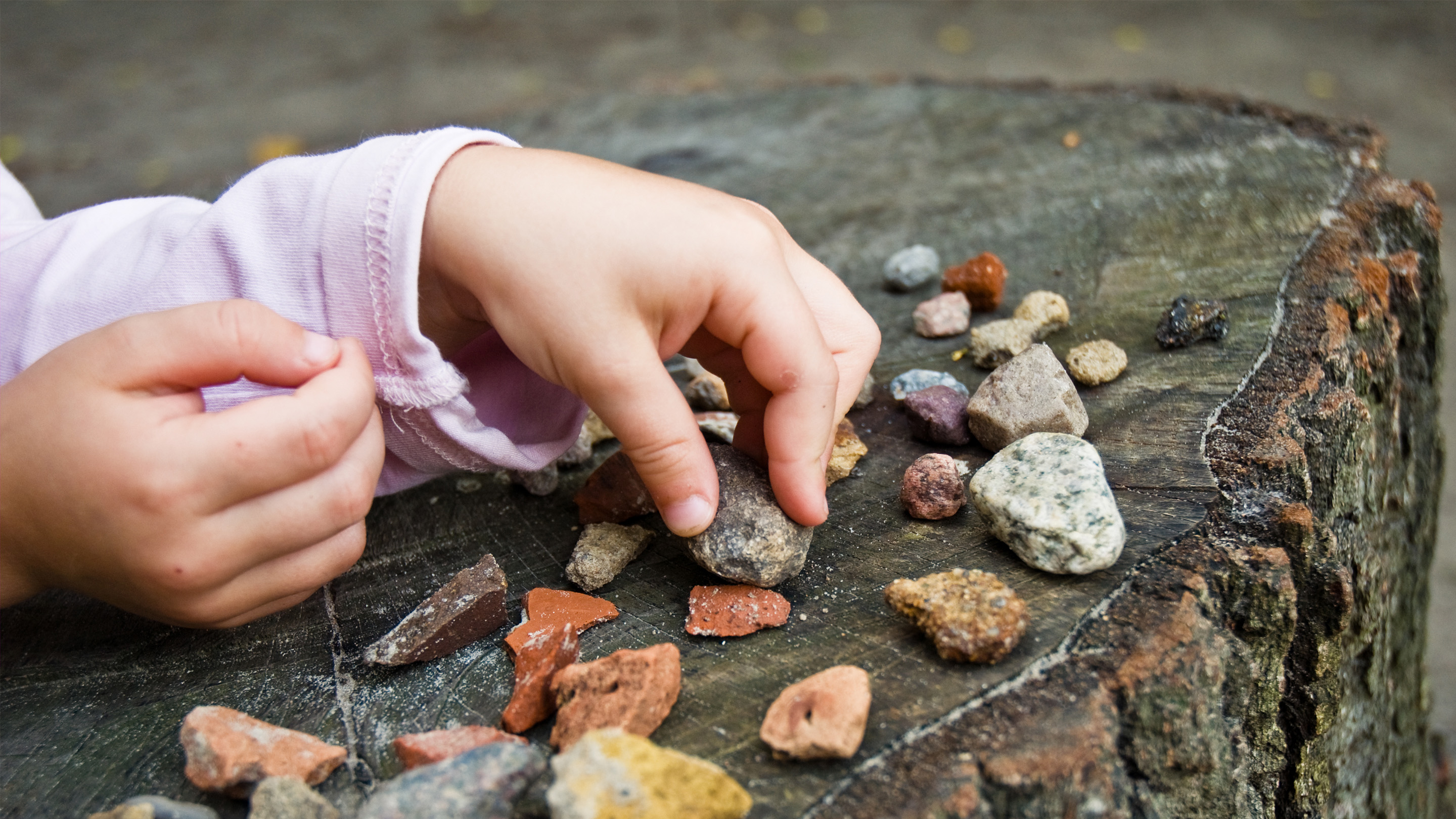
Preschoolers are natural sorters. Give them a pile of sticks, rocks, leaves, seed pods, and flower petals, and they will create order faster than most adults can organize a junk drawer. They may sort by color, size, texture, shape, or type. One child may group smooth rocks together while another makes piles of “pointy things” and “not pointy things.” Both are doing math.
Sorting supports logical thinking because it asks children to notice attributes and make rules. It also opens the door to science conversations. A leaf is no longer just a leaf. It becomes something long, short, dry, spotted, curved, or symmetrical.
3. Patterns
Patterns are everywhere outdoors. Children can spot them in flower petals, tree bark, garden rows, fence posts, shadows, and even the sequence of sounds they hear on a walk. They can also make their own patterns using pinecone-leaf-pinecone-leaf or rock-rock-stick, then explain what comes next.
Pattern activities help preschoolers predict, generalize, and notice structure. Those are big-deal math habits hiding inside very small objects.
4. Measurement
Measurement in preschool should be active and concrete. Nature gives children reasons to compare longer and shorter, heavier and lighter, taller and smaller, fuller and emptier. They can measure a stick against their forearm, compare the width of leaves, estimate how many pebbles long a bench is, or see which container holds more dirt or water.
Formal rulers can wait. At this stage, the goal is understanding the idea of measurement, not producing a flawless engineering report for a pinecone.
5. Shapes and Spatial Reasoning
Outdoor spaces are excellent for geometry. Children notice circles in tree rings, triangles in rooflines, rectangles in raised garden beds, and spirals in shells or seed heads. They also use spatial language constantly while moving: under, over, beside, behind, between, near, far, inside, and around.
Spatial reasoning matters because it helps children understand how objects fit together, move, rotate, stack, and relate to one another. That skill supports later math learning and everyday problem-solving. It also helps a child answer essential preschool questions like, “Will this giant branch fit into my wagon?”
6. Data and Observation
Yes, preschoolers can do simple data work, and no, they do not need a spreadsheet. They can graph favorite leaves by color, tally how many birds they spot, compare sunny days to rainy days, or chart which garden plants grew tallest over time. These activities introduce representation, comparison, and analysis in a way that feels playful instead of intimidating.
Benefits of Combining Nature and Math in Preschool
There are strong practical reasons to combine preschool nature activities with math learning. First, outdoor settings invite movement. Young children are not built to sit still for long stretches while discussing abstract ideas. They learn through their bodies. Walking, carrying, balancing, building, digging, and arranging all make learning more memorable.
Second, nature offers variety. A classroom manipulative usually stays the same. A pile of leaves changes with the weather. Shadows shift. Seeds sprout. Snow melts. Puddles shrink. That natural variation creates authentic opportunities to talk about change, quantity, sequence, and comparison.
Third, outdoor math supports language development. Children need words to describe what they see and do. When teachers and caregivers model phrases like “more than,” “shorter than,” “next to,” “same shape,” or “repeat the pattern,” children begin to connect vocabulary with action.
Finally, nature-based math often feels less stressful. Some children shut down when they think they are being “tested” on math. Hand them a basket and invite them to find three things that are longer than their hand, and suddenly they are all in. The math is still there. It is just wearing a more comfortable outfit.
How Teachers and Families Can Make It Work
Start with Questions, Not Lectures
The best adult move is often to ask instead of tell. Try questions such as, “Which pile has more?” “How could we sort these?” “What do you notice?” “What comes next in your pattern?” “How can we find out?” These prompts invite thinking without taking over the discovery.
Use Real Math Language Naturally
Children benefit from hearing precise but friendly language. Say “longer,” “shorter,” “equal,” “triangle,” “curved,” “estimate,” and “compare” in ordinary conversation. You are not trying to turn a preschool walk into graduate school. You are simply giving children the words that match their actions.
Keep Activities Open-Ended
There is rarely one correct way to explore math in nature. A child may sort leaves by size while another sorts them by texture. A child may count acorns in a line while another arranges them into groups. Open-ended tasks allow for creativity, differentiation, and genuine thinking.
Focus on Process Over Performance
Not every child will count perfectly or explain a pattern clearly on the first try. That is fine. In preschool, the point is to build understanding through repeated, joyful experiences. Think less “scorecard” and more “Let’s try that again with the giant maple leaves.”
10 Fun Nature and Math Activities for Preschool
1. Leaf Count Hunt
Ask children to collect five leaves, then compare who found more narrow leaves, more round leaves, or more leaves with smooth edges.
2. Stick Length Line-Up
Gather sticks and place them from shortest to longest. Then challenge children to find one that belongs in the middle.
3. Pinecone Pattern Path
Create repeating patterns with pinecones, stones, and leaves. Invite children to predict the next item and build a longer sequence.
4. Nature Shape Search
Go on a shape hunt outside. Look for circles, rectangles, triangles, spirals, and curves in both natural and built parts of the environment.
5. Pebble Measuring Game
Measure a bench, flower pot, or garden path using pebbles as nonstandard units. Then compare which object is longer or shorter.
6. Mud Kitchen Fractions Lite
Without getting formal, let children fill containers halfway, all the way, or almost full. This builds comparison and quantity language through messy play.
7. Garden Graph
Chart favorite vegetables, flower colors, or insect sightings. Use simple columns with pictures so children can compare categories visually.
8. Shadow Size Check
Observe how shadows change during the day. Compare which shadows are longer, shorter, wider, or narrower.
9. Nature Sorting Trays
Offer muffin tins or baskets and invite children to sort found objects by one rule, then by a different rule. Watching them change their minds is part of the fun.
10. Step-and-Count Trail
Estimate how many steps it takes to reach a tree, then count to check. Preschoolers love discovering that their feet can be measuring tools.
Common Mistakes to Avoid
One common mistake is making the activity too adult-directed. If every leaf must be counted in exactly the same way, the magic disappears. Another mistake is pushing formal math too early. Preschoolers do not need outdoor worksheets clipped to tiny boards like they are preparing for a forest tax audit.
It also helps to avoid treating nature as background decoration. The whole point is interaction. Children should touch, compare, move, build, collect, notice, and talk. And finally, do not underestimate repetition. Young children learn by revisiting the same ideas in new ways. A child who sorts rocks today may compare sizes tomorrow and make patterns next week. That is not repetition for the sake of repetition. That is learning getting deeper.
Experiences from the Preschool World: Where Nature and Math Come Alive
One of the most memorable preschool math moments often starts with something adults barely notice. A child crouches beside a patch of dirt, finds three tiny stones, then spots a fourth and gasps as if discovering treasure. Soon a small group gathers. They count out loud, trade stones, and argue cheerfully about who has “more.” Nobody announced a math block. Nobody rang a bell. Yet number sense is happening in real time, powered by curiosity and a little healthy competition over pebbles.
Another classic scene unfolds during a nature walk. Children collect leaves that are “huge,” “tiny,” “skinny,” or “crunchy,” and suddenly the class has enough material for a full sorting investigation. One child creates a pile of green leaves and a pile of brown leaves. Another ignores color completely and sorts by size. A third makes a category called “funny ones,” which, while not technically a textbook term, is actually a strong example of classification based on observed attributes. The follow-up conversation is where the math grows. Why did you put these together? How are they the same? Which group has the most?
Outdoor building is another rich source of experience. Give preschoolers sticks, bark, pinecones, and a mission like “make a house for a squirrel toy,” and math appears immediately. Children compare lengths, test balance, rotate pieces to fit, and rethink structures when walls collapse. Spatial reasoning, geometry, and problem-solving all show up wearing the disguise of pretend play. Also, there is usually one child who becomes the project manager for no official reason whatsoever.
Gardens create slower, deeper math experiences. Children can count seeds before planting, notice rows and spacing, compare plant heights over time, and graph which flowers bloom first. Because gardens change gradually, preschoolers begin to understand measurement and data as part of a story, not just a single activity. They can revisit the same bed week after week and ask better questions each time. Which plant grew taller? Which pot dried out faster? Which row has more sprouts now?
Puddle play deserves its own trophy. A puddle invites estimation, measurement, comparison, and experimentation with almost ridiculous efficiency. Children test which stick is long enough to reach across, how many jumps it takes to go around, or which boot print is bigger. They compare depths, watch ripples, and observe how water spreads. To adults, it may look like children are simply getting wet on purpose. To a math educator, it is a master class in applied learning with a very high chance of laundry.
Family experiences can be just as powerful. A parent walking through a park can ask a child to find two things shaped like circles, three rough objects, or a branch longer than their shoe. These tiny prompts build math talk without making the moment feel schoolish. In fact, some of the best early math learning happens when children do not realize anyone is “teaching” at all.
The beauty of nature and math in preschool is that it makes learning feel alive. Children are not memorizing ideas in isolation. They are discovering that math helps them describe the world they already love to explore. And once that happens, math stops being a subject sitting on a shelf. It becomes a tool for noticing, wondering, testing, and understanding. That is a pretty remarkable gift to give a four-year-old with muddy knees and a pocket full of acorns.
Conclusion
Nature and math in preschool are a natural match because both begin with observation. Children notice what is the same, what is different, what comes next, what fits, what grows, and what changes. Outdoors, those discoveries happen constantly. With the right questions, a little time, and plenty of room for play, ordinary moments become powerful early math experiences.
Whether you are a teacher planning an outdoor center or a parent walking through the neighborhood, you do not need fancy materials to support preschool math. You need curiosity, conversation, and the willingness to let children count the rocks, line up the sticks, compare the leaves, and splash in the puddle long enough to learn something real. Preferably before dinner. And preferably with spare socks.
Note: This article is formatted for direct web publishing, written in standard American English, and cleaned of placeholder citation artifacts or unnecessary publishing markup.