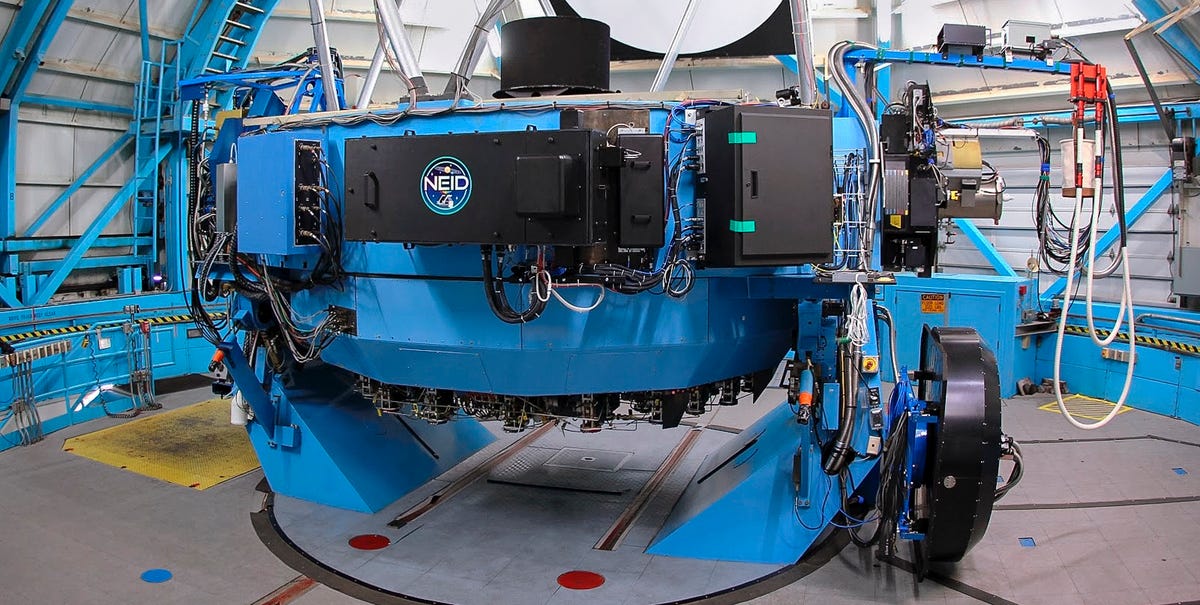

Some scientific instruments sound like they belong in a superhero movie. Others sound like something you might accidentally order with extra fries. NEID belongs in the first group. Often described as an “exoplanet scale,” NEID is not a giant bathroom scale floating in space, waiting for alien planets to step on and feel bad about holiday snacks. It is a highly precise astronomical spectrograph designed to help scientists measure the masses of worlds beyond our solar system.
The phrase NEID Exoplanet Scale is a friendly way to explain a very serious scientific job: weighing planets that are too far away to touch, photograph clearly, or casually visit with a clipboard. NEID does this by studying the tiny motion of stars. When a planet orbits a star, gravity makes both objects move around a shared center of mass. The planet goes around in a big loop. The star makes a much smaller wobble. NEID measures that wobble with extraordinary precision, allowing astronomers to estimate the planet’s mass.
NEID is short for NN-EXPLORE Exoplanet Investigations with Doppler Spectroscopy, and its name also comes from a Tohono O’odham word meaning “to see.” The instrument operates on the 3.5-meter WIYN Telescope at Kitt Peak National Observatory in Arizona and was developed through the NASA-NSF NN-EXPLORE partnership, with Penn State leading the instrument build.
What Is the NEID Exoplanet Scale?
The NEID Exoplanet Scale is not an official scale in the everyday sense. It is a powerful metaphor for how the NEID spectrograph helps “weigh” exoplanets. Instead of measuring pounds, kilograms, or the embarrassing emotional weight of forgetting someone’s birthday, NEID measures shifts in starlight. Those shifts reveal how fast a star moves toward and away from Earth as an orbiting planet tugs on it.
This technique is called the radial velocity method, also known as the Doppler wobble method. If you have ever heard an ambulance siren change pitch as it passes by, you already understand the basic idea. Sound waves stretch and compress depending on motion. Light behaves similarly. When a star moves slightly toward us, its spectral lines shift a little toward the blue end of the spectrum. When it moves away, those lines shift toward the red. NEID reads these shifts like a cosmic detective reading tiny footprints in starlight.
NASA explains that radial velocity measures changes in a star’s motion caused by gravitational tugs from orbiting planets. Caltech/IPAC’s NASA Exoplanet Archive also describes the method as an indirect way of detecting exoplanets by measuring the small reflex motion of a host star.
Why Exoplanet Mass Matters
Finding an exoplanet is exciting. Measuring its mass is where the story gets juicy. A planet’s size tells scientists how wide it is, but mass helps reveal what it may be made of. Combine mass with radius, and astronomers can estimate density. Density gives clues about whether a planet is rocky like Earth, gaseous like Neptune, or something in betweena category that sounds suspiciously like the universe refusing to keep things simple.
Many exoplanets are discovered by the transit method, where telescopes detect a tiny dip in starlight as a planet crosses in front of its star. Transits can reveal a planet’s radius and orbital period. But without mass, the planet’s identity remains incomplete. A world two times Earth’s size could be a rocky super-Earth, a mini-Neptune with a thick atmosphere, or a puffed-up oddball that makes planetary scientists reach for more coffee.
That is where NEID becomes valuable. It follows up on planet candidates discovered by missions such as TESS and helps determine whether those planets are dense, lightweight, massive, or surprisingly weird. In other words, TESS may point and say, “There is something there,” while NEID responds, “Let’s see what that something weighs.”
How NEID Measures a Star’s Wobble
NEID works by collecting starlight from the WIYN Telescope and sending it through optical fibers into a spectrograph housed in a specially controlled clean room. The instrument separates light into its component wavelengths, creating a spectrum full of dark absorption lines. These lines act like a barcode for the star. If the star moves, the barcode shifts ever so slightly.
The technical challenge is extreme. The stellar wobble caused by a large planet like Jupiter is much easier to detect than the wobble caused by a small rocky planet. According to the U.S. National Science Foundation, Jupiter induces a roughly 13-meter-per-second wobble on the Sun, while Earth induces a wobble of only about 9 centimeters per second. NEID’s single-measurement precision has already reached better than 25 centimeters per second, placing it among the most precise tools of its kind.
Penn State’s NEID team has described the instrument’s baseline radial velocity precision as 27.5 centimeters per secondroughly the crawling speed of a baby. That comparison is charming, but it is also deeply humbling. Imagine building a machine that can detect stellar motion slower than a determined infant heading toward an electrical outlet.
The Science Behind Doppler Spectroscopy
Stars Do Not Sit Still
It is tempting to imagine stars as fixed lanterns in the sky, but stars are constantly moving. They rotate, pulse, flare, and respond gravitationally to planets around them. When a planet orbits, the star moves in a small counter-orbit. That motion is what NEID looks for.
The signal appears as a repeating pattern. If a star’s light shifts blue, then red, then blue again on a predictable schedule, scientists can model the motion and infer the presence of a planet. The size of the velocity shift helps estimate the planet’s minimum mass. The timing of the shift reveals the orbital period. With enough observations, the wobble becomes a planetary fingerprint.
Why Precision Is So Difficult
Measuring exoplanets is not like weighing apples at a grocery store. Stars are noisy. Starspots, magnetic activity, surface convection, and flares can all create signals that imitate or distort planetary wobbles. Even Earth’s own motion around the Sun must be corrected. A spectrograph must be stable enough that the instrument itself does not introduce false shifts.
NEID was designed as a complete radial velocity system, using an ultra-stable environment, advanced optics, fiber optics, and wavelength calibration technology. WIYN describes the spectrograph as sealed in a vacuum chamber and maintained at extremely stable temperatures, with calibration sources that include a laser frequency comb.
NEID and the Search for Earth-Like Worlds
The dream behind NEID is not merely to find giant planets roasting close to their stars, although those worlds are scientifically valuable and wonderfully dramatic. The larger goal is to improve the search for smaller, potentially rocky planets around nearby stars. These are the planets that make people lean forward: worlds that might have surfaces, atmospheres, seasons, and maybe even conditions where liquid water could exist.
To be clear, NEID does not directly photograph little blue-green planets and wave hello. It measures starlight. But those measurements help identify and characterize targets for future telescopes. A nearby rocky planet with a measured mass and known orbit could become a prime candidate for atmospheric studies by future observatories.
NEID also includes a solar telescope that allows it to observe the Sun as if it were a distant star. This helps researchers understand how stellar activity can affect radial velocity measurements. NASA notes that solar data can help scientists identify similar activity in observations of distant stars. That matters because when scientists hunt for tiny planetary signals, the star itself can be the biggest source of confusion.
Why NEID Is Different From Older Planet-Hunting Tools
Radial velocity is not new. It helped launch modern exoplanet science in 1995 with the discovery of 51 Pegasi b, the first confirmed exoplanet orbiting a Sun-like star. That planet is a hot Jupiter, a massive world orbiting very close to its star. Big planets create big stellar wobbles, which made them easier to detect with earlier instruments.
NEID belongs to a newer generation of extreme precision radial velocity instruments. Its mission is to push the method toward smaller and subtler signals. That requires more than a good mirror and a hopeful attitude. It requires mechanical stability, thermal stability, precise calibration, careful observing strategies, and sophisticated data analysis.
The instrument’s location also matters. Kitt Peak National Observatory offers access to dark skies and a long astronomical heritage. The WIYN Telescope gives NEID a strong observing platform, while the NASA-NSF partnership opens a portion of observing time to the broader U.S. astronomical community. NASA states that NN-EXPLORE makes 40% of WIYN time available through a Guest Observer program to support missions and initiatives such as Kepler, K2, TESS, and extreme precision radial velocity research.
The “Scale” Analogy: Helpful, But Not Perfect
Calling NEID an exoplanet scale is useful because it gives readers an instant mental image. A scale measures weight. NEID helps measure planetary mass. Simple enough, right? Mostly.
The catch is that NEID does not weigh planets directly. It measures the star’s motion, then scientists use physics and orbital models to estimate the planet’s mass. In many radial velocity cases, the result is a minimum mass because the orbital tilt may not be fully known. If the planet also transits, astronomers can better constrain the orbit and combine radius with mass to understand density.
So the NEID Exoplanet Scale is less like stepping onto a bathroom scale and more like watching a dance floor from ten miles away, noticing one dancer wobble slightly, and calculating the mass of their invisible dance partner. Science: somehow both elegant and ridiculous in the best possible way.
NEID, TESS, and the Bigger Exoplanet Ecosystem
Exoplanet science works best when different tools cooperate. Space telescopes such as TESS scan large areas of the sky looking for planetary transits. Ground-based spectrographs like NEID then help confirm and characterize some of those candidates. This teamwork is essential because no single method reveals everything.
Transit observations can tell scientists how large a planet is. Radial velocity observations can tell them how massive it is. Atmospheric spectroscopy can reveal chemical clues. Direct imaging may eventually capture certain planets as actual points of light. Together, these methods turn distant signals into meaningful planetary portraits.
NEID’s role is especially important for nearby stars. The closer the system, the more useful it may be for future study. A small planet around a nearby star with a known mass, radius, and orbit is not just another dot in a database. It is a possible target for the next era of exoplanet exploration.
What NEID Can Teach Us About Planet Formation
Mass measurements do more than classify planets. They help scientists test theories of planet formation and migration. Some planets form far from their stars and later move inward. Others may be sculpted by gravitational interactions with neighboring planets. Some systems are orderly. Others look like the universe shook a snow globe and walked away.
By measuring planetary masses and orbital patterns, NEID helps scientists understand how planetary systems evolve. Does a system contain tightly packed rocky planets? Are there hidden giant planets disturbing smaller worlds? Is a hot Jupiter in a tilted orbit because it migrated inward through a chaotic gravitational history? These are not small questions. They help place our own solar system in context.
Every new measurement adds a pixel to the larger picture. The more planets scientists weigh, the better they understand how common Earth-like planets may be, how often planetary systems resemble ours, and how often nature prefers stranger arrangements.
Challenges Facing the NEID Exoplanet Scale
Stellar Activity Can Mimic Planets
One of the biggest challenges in radial velocity science is stellar activity. A starspot rotating across the surface of a star can change the shape of spectral lines. Magnetic activity can introduce shifts. Flares can complicate the data. To an instrument chasing centimeter-per-second precision, stars are not quiet lamps. They are boiling, magnetic, noisy plasma spheres with main-character energy.
Earth-Like Signals Are Extremely Small
The Earth’s effect on the Sun is tiny compared with the signal from a giant planet. Detecting a true Earth analog around a Sun-like star requires measuring extremely small velocities over long periods. NEID is a major step toward that goal, but the search remains difficult. The instrument must be paired with careful target selection, repeated observations, and advanced modeling.
Weather and Time Still Matter
Ground-based astronomy has a classic enemy: clouds. Even the most advanced spectrograph cannot measure a star through bad weather. Long-term planet detection also requires patience. A planet in an Earth-like orbit takes about a year to complete one trip around its star, meaning scientists need repeated observations across many months or years.
Why the NEID Exoplanet Scale Matters to Regular Humans
You do not need to be an astrophysicist to appreciate why NEID matters. The search for exoplanets is really a search for perspective. For most of human history, people wondered whether planets existed around other stars. Today, scientists have confirmed thousands of them. The question has changed from “Are there other worlds?” to “What are those worlds like?”
Mass is one of the most important parts of that answer. A planet’s mass helps determine gravity, atmosphere retention, geology, and potential habitability. A small rocky planet may be more Earth-like than a gas-rich mini-Neptune. A dense world may suggest an iron-rich interior. A low-density planet may have a thick atmosphere. These details help transform exoplanets from catalog entries into real places in our imagination.
NEID brings us closer to understanding those places. It helps scientists sort the rocky from the gaseous, the promising from the puzzling, and the ordinary from the “please explain this immediately” category.
Experience: Understanding the NEID Exoplanet Scale From a Human Point of View
The first time many people hear about the NEID Exoplanet Scale, the idea sounds almost absurd. We cannot send a spacecraft to most exoplanets. We cannot land on them, scoop up soil, or ask a friendly alien park ranger for directions. Yet scientists can still estimate their masses by measuring tiny changes in starlight. That is the kind of fact that makes space science feel like magic wearing a lab coat.
A useful way to experience the concept is to imagine standing beside a quiet pond. If a fish swims under the surface, you may not see the fish directly, but you can notice ripples. The ripples tell you something moved. Bigger fish make different ripples than smaller fish. NEID does something similar, except the pond is starlight, the fish is an exoplanet, and the ripples are shifts in spectral lines so tiny that ordinary instruments would miss them completely.
For students, writers, and curious readers, NEID is a great reminder that science often advances by improving measurement. The planet was already there before anyone detected it. The star was already wobbling. The difference is that better instruments allow humans to notice what nature has been quietly doing all along. That is a powerful lesson: discovery is not always about going farther. Sometimes it is about seeing more carefully.
The NEID Exoplanet Scale also changes how we emotionally connect with distant planets. A confirmed exoplanet with a measured mass feels more real than a vague possibility. When scientists can say a planet is rocky, dense, lightweight, or massive, the imagination has something to hold onto. Suddenly the world is not just “a planet candidate.” It becomes a place with structure, gravity, and a story.
There is also something wonderfully humble about NEID’s work. The instrument does not shout. It listens. It waits for light from a star, splits it into a spectrum, and looks for a shift that may be smaller than the speed of a crawling baby. In an age where technology often feels loud, flashy, and impatient, NEID is a monument to patience. It proves that quiet precision can reveal entire worlds.
For anyone writing about space, teaching astronomy, or simply trying to understand why exoplanet research matters, NEID offers a perfect example of modern discovery. It combines engineering, physics, data science, astronomy, and human curiosity. It also gives us a charming phraseexoplanet scalethat turns a complex instrument into an image people can remember. No, NEID is not weighing alien planets on a giant silver platform. But in the grand poetic sense, it is helping humanity weigh the galaxy one wobbling star at a time.
Conclusion
The NEID Exoplanet Scale represents one of the most exciting tools in modern planet hunting. By measuring tiny Doppler shifts in starlight, NEID helps scientists estimate the masses of planets orbiting nearby stars. Those mass measurements are essential for understanding whether distant worlds are rocky, gaseous, dense, fluffy, familiar, or spectacularly strange.
Installed on the WIYN 3.5-meter Telescope at Kitt Peak National Observatory and supported by the NASA-NSF NN-EXPLORE partnership, NEID is part of a larger effort to move exoplanet science from discovery to characterization. The future of planet hunting is not just about counting worlds. It is about understanding them. NEID helps make that future measurable.
Note: This article synthesizes information from reputable U.S. science organizations and institutions, including NASA, NSF, Penn State, WIYN Observatory, NOIRLab, and Caltech/IPAC, to explain the NEID spectrograph and its role in exoplanet mass measurement.