
There are robot stories that feel like they came from a glossy Silicon Valley keynote, complete with dramatic lighting, mystery pricing, and the kind of music normally reserved for superhero trailers. Then there are open source humanoid robots: scrappy, printable, hackable, occasionally wobbly, and gloriously honest about the fact that making a machine walk, see, gesture, and not fall over like a caffeinated coat rack is hard.
The phrase “Open Source Humanoid Robot Is Awesom-o” sounds playful, and it should. It carries a wink toward pop culture, maker humor, and the old dream of building a robot friend without needing a billionaire’s lab. But behind the joke is a serious movement. Open source humanoid robots such as Poppy, InMoov, Reachy, and newer low-cost research platforms are changing how students, hobbyists, researchers, artists, and AI developers learn about robotics. Instead of keeping the robot locked behind patents, corporate secrecy, or a “contact sales” button that causes instant financial sweating, open source projects publish designs, code, documentation, and community knowledge.
That openness matters because humanoid robotics is not one technology. It is a chaotic orchestra of mechanical design, 3D printing, motors, sensors, embedded computing, control systems, computer vision, artificial intelligence, safety engineering, and user experience design. When a project is open, people can study the orchestra one instrument at a time. They can print a hand, test a servo, improve a gait, rewrite a behavior script, or teach the robot to wave without accidentally slapping the nearest coffee mug into next Tuesday.
What Makes an Open Source Humanoid Robot Different?
A humanoid robot is generally shaped to resemble the human body. It may have a head, torso, arms, hands, legs, cameras as “eyes,” microphones as “ears,” and software that helps it sense and respond to the world. Some humanoids are built for walking. Others are torso-based platforms focused on manipulation, communication, telepresence, or human-robot interaction. The “humanoid” label is less about passing for human and more about using a human-like form to work in human environments.
An open source humanoid robot adds a second idea: the plans are meant to be shared. In practice, this can include 3D-printable body files, CAD models, bills of materials, circuit diagrams, firmware, control software, sample behaviors, simulation tools, assembly instructions, and public repositories where contributors can report issues or suggest improvements. It is robotics with the hood open, the manual on the table, and a community nearby saying, “Yes, that clicking noise is probably the left shoulder servo. Welcome to the club.”
Closed humanoid robots can be impressive, polished, and commercially important. But open source humanoid robots are special because they turn robotics from a spectator sport into a workshop. A student can learn why balance is difficult. A teacher can use a robot arm to explain kinematics. A researcher can modify body proportions to study movement. A maker can print a replacement part rather than retire the whole machine. That is the awesom-o part: not perfection, but participation.
The Poppy Project: A Humanoid Robot Built for Learning
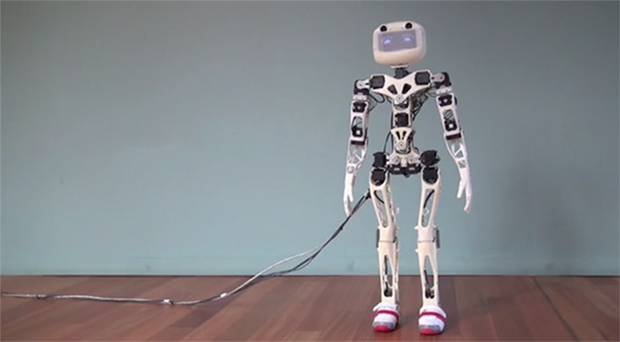
The Poppy Project is one of the best-known examples of an open source 3D-printed humanoid robotics platform. It began in the early 2010s in a research environment focused on learning, development, morphology, and human-robot interaction. Poppy Humanoid was designed to be modular, hackable, and reproducible. Instead of presenting the robot as a sealed magic box, the project encourages users to understand, modify, and share.
Poppy’s body is 3D printed, which makes it especially attractive for schools and labs that want to experiment without manufacturing custom metal parts. Its modular design means users can work with a full humanoid, a torso, an arm, or related educational robots. That flexibility matters. Not everyone needs a full walking humanoid to study robotics. Sometimes a single arm on a desk can teach more than a whole robot dramatically face-planting across the lab floor.
The Poppy ecosystem also shows why software is just as important as hardware. Robotics education becomes more powerful when learners can program movement, test behaviors, and connect sensors through accessible tools. Poppy has been associated with languages and environments such as Python, Snap-style visual programming, and robotics middleware. This makes it useful for different skill levels, from beginners exploring basic movement to researchers studying more advanced embodied intelligence.
InMoov: The Life-Size Robot You Can Print at Home
If Poppy is the elegant research platform, InMoov is the charismatic maker legend. Created by French designer Gaël Langevin, InMoov began with a 3D-printed prosthetic hand and grew into a life-size open source humanoid robot. The project became famous because it made a bold claim feel almost believable: with a home 3D printer, common electronic components, patience, and a heroic tolerance for troubleshooting, you could build a human-scale robot.
InMoov’s impact is not just mechanical. It became a symbol of what open source hardware can do when people around the world contribute. Makers have adapted InMoov for education, telepresence, art installations, prosthetics experiments, demonstrations, and AI-powered interaction. The robot’s hands, face, head, torso, and arms have inspired builders to explore anatomy, motion, design, and social robotics. InMoov also proves that a robot does not need to look like a billion-dollar moonshot to matter. Sometimes the most inspiring robot is the one with visible screws, printed parts, and a personality assembled one weekend at a time.
Recent maker coverage has also shown how InMoov continues to evolve with artificial intelligence. Facial expressions, vision, speech, local language models, and improved heads or hands turn the platform into an ongoing experiment. This is exactly what open source robotics does well: it does not freeze a project in time. It lets the robot grow weird little branches, some practical, some artistic, and some that make you say, “That is either the future or a very expensive puppet. Possibly both.”
Reachy, Hugging Face, and the New Age of Open Robotics
Open source humanoid robotics is no longer only a maker garage story. It is moving into the AI mainstream. Pollen Robotics developed Reachy, a humanoid-style robot platform known for expressive design, bimanual manipulation, and research use. Hugging Face, widely known for open AI tools and model sharing, acquired Pollen Robotics in 2025, signaling a serious push toward open robotics and embodied AI.
That shift is important because AI is giving robots new possibilities. Large language models, vision-language models, imitation learning, reinforcement learning, and shared robotics datasets can help robots interpret instructions, recognize objects, and learn from demonstrations. But a model alone cannot pick up a cup. It needs motors, sensors, grippers, calibration, safety layers, and a body that can survive real-world messiness. Open source robotics connects the software intelligence boom to physical machines.
Reachy Mini, a smaller desktop robot from the same ecosystem, illustrates another direction: affordable, programmable, expressive robots for developers and curious users. The idea of an app ecosystem for robots may sound like smartphones sprouting eyebrows, but it makes sense. If people can download, modify, and create robot behaviors, robotics becomes less like buying a finished appliance and more like joining a creative platform.
Why 3D Printing Changed the Robot Game
Before desktop 3D printing became common, building custom robot bodies required expensive fabrication, machining skills, or access to specialized equipment. That barrier kept many robotics ideas trapped in notebooks. 3D printing changed the equation. A designer can model a hand, upload the files, and let builders around the world produce the same part locally. If the finger breaks, print another finger. If the shoulder bracket needs improvement, revise it and share the new file.
This does not mean 3D printing solves everything. Printed plastic has limits. It can flex, crack, warp, or fail under repeated stress. High-load joints, walking legs, and gearboxes still demand careful design. But open source projects have become more sophisticated in how they use printed parts. Newer platforms experiment with modular gearboxes, accessible actuators, and designs that fit common printer build volumes. The goal is not to pretend plastic is titanium. The goal is to design honestly around available tools.
Software: The Robot’s Nervous System
Hardware makes the robot visible, but software makes it useful. Open source humanoid robots often depend on software frameworks that handle communication between sensors, motors, cameras, planning systems, and user interfaces. ROS, the Robot Operating System, is one of the most influential open source robotics ecosystems. It provides libraries and tools for building robot applications, from drivers to algorithms and visualization.
For humanoid robots, this software layer is critical. A simple movement such as reaching for an object may require camera input, object detection, coordinate transformation, motion planning, collision avoidance, grip control, and feedback from motors. In human terms, it is “grab the apple.” In robot terms, it is a graduate seminar with elbows.
Open frameworks help developers avoid reinventing every wheel, sensor bridge, and communication layer. They also allow projects to become interoperable. A lab can test an algorithm on one robot, adapt it to another, share the code, and improve the field as a whole. That is how open source robotics accelerates learning: not by making robotics easy, but by making hard problems more shareable.
Education: The Best Reason to Build a Robot That Sometimes Falls Over
Humanoid robots are fantastic teaching tools because they reveal how many disciplines must cooperate. A student working on an open source humanoid robot may learn CAD design in the morning, soldering after lunch, Python in the afternoon, and debugging motor jitter at midnight while questioning every life choice. That may sound dramatic, but it is also deeply educational.
Unlike a purely digital project, a robot gives immediate physical feedback. Bad code does not just print an error; it may make an arm twitch, a head rotate backward, or a knee buckle. This turns abstract concepts into memorable lessons. Torque becomes real when a joint cannot lift the forearm. Center of mass becomes real when the robot tips. Sensor noise becomes real when the camera confidently identifies a chair as a banana.
Open source humanoid robots are especially useful because learners can inspect the entire system. They are not limited to pushing buttons on a finished toy. They can ask why the part is shaped that way, why the servo overheats, why the walking gait fails, or why the robot’s “friendly wave” looks like it is challenging the room to a duel.
Real-World Uses: From Labs to Makerspaces
Open source humanoid robots are not yet doing everyone’s laundry, cooking dinner, and gently reminding us to drink water. The honest reality is that general-purpose humanoid robotics remains difficult. However, these robots are already useful in research, education, art, telepresence, prosthetics inspiration, human-robot interaction, and AI experimentation.
In research labs, humanoid platforms help scientists study manipulation, perception, learning, morphology, and embodied intelligence. In classrooms, they help students connect math and physics to real movement. In makerspaces, they encourage collaboration among people with different skills. In art and design, humanoid robots become expressive machines that challenge how we think about bodies, behavior, and technology.
Open robots are also valuable because they make limitations visible. A demo video can hide a lot. Open repositories, issue trackers, build logs, and community forums reveal the real state of the technology. That transparency is healthy. It keeps expectations grounded while still encouraging imagination.
The Challenges: Awesom-o, But Not Effortless-o
The open source humanoid robot movement is exciting, but it is not a shortcut around engineering reality. Builders still face cost, calibration, durability, power management, wiring complexity, documentation gaps, software dependency problems, and safety concerns. Humanoid forms are demanding because they pack many degrees of freedom into a compact body. More joints mean more possibilities, but also more things that can misbehave before breakfast.
Cost is another challenge. Open source does not always mean cheap. Designs may be free, but motors, sensors, controllers, batteries, fasteners, printers, and tools cost money. Some newer projects aim to reduce hardware prices dramatically by using common parts and 3D-printed components. That trend is promising, but builders should still budget realistically. A robot is not only the parts list; it is also spare parts, failed prints, replacement servos, and the mysterious box of screws that somehow never contains the screw you need.
Safety is equally important. A humanoid robot can pinch fingers, fall, overheat, or move unpredictably if poorly configured. Open source projects should encourage safe testing, emergency stops, current limits, stable stands, protective covers, and clear documentation. Robots are fun, but a robot arm swinging at face height is not a toy. It is a mechanical reminder that enthusiasm should wear safety glasses.
Why Open Source Humanoid Robots Matter for the Future
The future of humanoid robotics will likely include both closed commercial systems and open collaborative platforms. Closed systems may deliver polished products for factories, warehouses, hospitals, homes, and public spaces. Open systems will help the world understand, test, improve, and question those technologies. That balance matters.
As AI moves into physical machines, transparency becomes more than a nice feature. People will want to know how robots make decisions, what data they collect, how they can be modified, and whether their behavior can be audited. Open source approaches can support trust by letting researchers and developers inspect code, hardware designs, and data workflows. They also let smaller teams contribute ideas that might otherwise never reach the field.
In a practical sense, open source humanoid robots democratize robotics. They give more people a seat at the workbench. A high school robotics club can study a printed hand. A university lab can modify a torso. A hobbyist can build an expressive head. A software developer can test an AI model on a real body. The result is not one perfect robot. The result is a larger, more diverse robotics community.
Experience Section: What It Feels Like to Work With an Open Source Humanoid Robot
Working with an open source humanoid robot is a strange mix of science fair, engineering boot camp, and buddy comedy. The first experience is usually optimism. You see the photos, read the documentation, watch a video of the robot waving, and think, “I can build that.” Then the first 3D print takes nine hours, curls at the corner, and teaches you humility in a language made of melted plastic.
The second experience is discovery. You begin to understand why humanoid robots are hard. A hand is not just a hand. It is tendons, joints, cable routing, friction, grip geometry, motor limits, and control software. A head is not just a head. It is cameras, microphones, neck movement, facial expression, balance, and the delicate social question of whether your robot looks friendly or like it knows where the spare batteries are buried.
The third experience is community. This is where open source becomes powerful. When something fails, you are often not alone. Someone else has burned the same servo, printed the same part backward, fought the same driver issue, or discovered that a cable placed “temporarily” will absolutely become permanent unless labeled. Forums, repositories, build notes, and shared videos become part of the robot itself. The machine is not only plastic and code; it is collective memory.
Another memorable part of the experience is the first successful motion. It may be tiny. Maybe the robot turns its head toward a sound. Maybe a finger curls. Maybe an arm lifts smoothly for the first time. That moment feels enormous because it is physical proof that design, electricity, software, and patience have agreed to cooperate. The robot does not have to do parkour. A clean wave can feel like winning a tiny Nobel Prize in the category of “Things That Finally Worked.”
Of course, open source humanoid robots also teach emotional resilience. Robots fail in theatrical ways. They jitter. They drift. They forget calibration. They stare into the middle distance as if haunted by firmware. A walking robot may take one heroic step and then collapse with the dignity of a folding lawn chair. But every failure explains something. The ankle needs more torque. The center of mass is wrong. The PID values are too aggressive. The print tolerance is too loose. The battery voltage sags under load. The robot is not being difficult; it is being educational at high volume.
The best experience, though, is the feeling of creative ownership. With a closed robot, you are mostly a user. With an open source humanoid robot, you become part mechanic, part programmer, part designer, and part storyteller. You can change the face, improve the grip, add a sensor, rewrite a gesture, or teach it a new behavior. That freedom makes the robot feel less like a product and more like a living project. It is awesom-o not because it is flawless, but because it invites people to build the future with their own hands.
Conclusion
Open source humanoid robots are not magic assistants ready to replace your chores, your coworkers, or your uncle who insists he can fix the printer by yelling at it. They are something better: accessible gateways into one of the most exciting fields in technology. Projects such as Poppy, InMoov, Reachy, and emerging low-cost humanoid platforms prove that robotics can be studied, modified, shared, and improved by a global community.
The “Awesom-o” spirit is not about pretending every robot is perfect. It is about celebrating the messy, brilliant, collaborative process of building machines that move through the world. Open source humanoid robotics gives students, researchers, makers, and AI developers a chance to learn by doing. It turns curiosity into parts, parts into motion, and motion into understanding. That is more than awesome. That is awesom-o with a soldering iron.