
Lockdown turned ordinary life into a very strange still life. Streets emptied, calendars became decorative objects, and a trip to the grocery store suddenly required the strategic planning of a moon landing. For artists, however, the silence was not entirely empty. It became creative material: a place to examine fear, beauty, distance, absurdity, and the stubborn human habit of looking for hope even when the news cycle seemed determined to hide it.
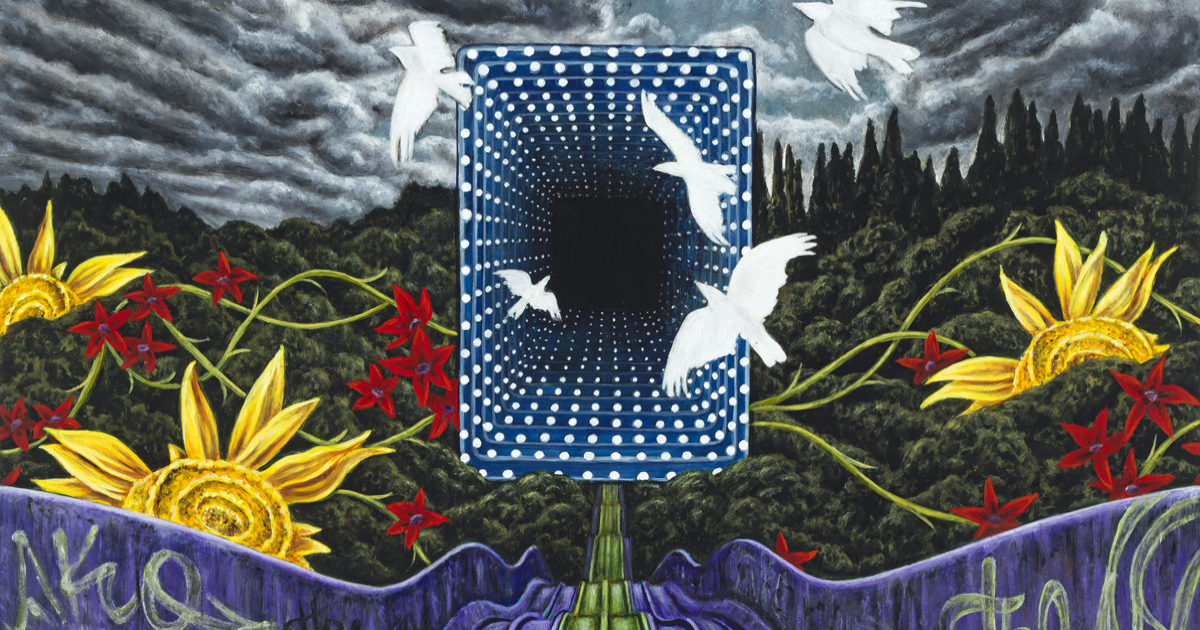
Chicago painter and installation artist Nicole Gordon responded to that atmosphere with pandemic-era paintings centered on serenity in isolation, acceptance, and the possibility that the world might be repairing itself while people waited indoors. Works including Apex, Caged, Wheel of Fortune, and Alice’s Garden do not function like literal news illustrations. There are no painted press conferences or heroic portraits of hand sanitizer. Instead, Gordon uses dreamlike landscapes, saturated color, unexpected objects, and visual tension to explore how an altered world feels from the inside.
When the Outside World Became an Interior Landscape
Much of pandemic life was defined by contradiction. Home represented safety, but it could also feel like a cage. Nature appeared unusually peaceful, yet the calm existed beside illness, grief, unemployment, and political tension. Digital tools kept people connected, but after the fifth video call of the day, even the friendliest screen could begin to resemble a tiny glowing aquarium.
That contradiction is fertile territory for contemporary surrealism. Rather than documenting lockdown through realistic domestic scenes, Gordon transforms emotional conditions into imagined environments. A landscape becomes a metaphor for private space. A misplaced object suggests disruption. A decorative surface attracts the eye before revealing something uneasy underneath it.
The result is pandemic art that does not shout its message. Beauty invites viewers closer, while the relationships among objects, symbols, and spaces quietly create instability. This approach reflects Gordon’s wider practice, in which fairy-tale settings and intense colors often conceal darker narratives about contemporary life.
Four Lockdown Paintings and the Ideas They Carry
The four featured works are not a linear diary, but together they form a compact emotional map. Their titles suggest confinement, chance, ascent, imagination, and renewal. Gordon created Apex and Wheel of Fortune in oil on panel, while Caged and Alice’s Garden were made in oil on Mylar. The polished craft contrasts with a world that had become anything but polished.
Apex: Searching for a High Point
The word “apex” implies a summit, peak, or moment of maximum intensity. During lockdown, reaching an apex could mean several things at once: the height of anxiety, the top of an emotional climb, or the hope that a crisis had finally reached the point after which conditions might improve.
Viewed through that lens, Apex is not necessarily about arriving triumphantly. A high position provides perspective, but it also exposes the distance below. The title leaves viewers wondering whether the peak represents achievement, danger, exhaustion, or simply a temporary pause before another uncertain journey.
Caged: Safety With Bars Around It
Caged carries the most direct lockdown association. Staying home helped protect public health, yet prolonged restriction also intensified loneliness, stress, and the feeling that personal space had been reduced to a few familiar rooms.
Confinement is not only architectural. It can be psychological, social, or spiritual. Someone may have plenty of square footage and still feel trapped by repetition, uncertainty, or separation from loved ones. Conversely, a small private space can become a sanctuary. The painting’s title asks when shelter becomes enclosure and when solitude changes from something imposed into something accepted.
Wheel of Fortune: Life Run by an Invisible Game Show
Few titles could better describe the randomness of the pandemic than Wheel of Fortune. Health, employment, household stability, access to care, and the ability to work remotely were distributed unevenly. One person discovered a peaceful home routine; another lost income, family members, or a sense of security. The wheel kept turning, but nobody could see the rules taped underneath it.
The wheel of fortune has also appeared throughout art history as a symbol of changing circumstances. It reminds viewers that control is temporary and that status can rise or collapse without warning. In the context of a lockdown painting, that ancient symbol suddenly feels very modern.
Alice’s Garden: Wonder After the Rabbit Hole
Alice’s Garden suggests curiosity, transformation, and a world whose logic has tilted. The title evokes the dreamlike disorientation associated with Alice’s adventures, while the garden introduces another idea: growth continues even when human plans stop.
Gardens became potent symbols during lockdown. They offered seasonal rhythm when weekdays blurred together, physical activity when life moved online, and evidence that change could be slow without being absent. A seed did not care whether someone had canceled a vacation or forgotten what day it was. It simply continued its quiet project.
Why Surrealism Made Sense During the Pandemic
Realism records what a room looks like. Surrealism can record what it feels like when that room is simultaneously an office, classroom, restaurant, gym, studio, and occasional place to stare dramatically out the window.
Pandemic life collapsed familiar categories. Private and public spaces blended. Time became stretchy. Everyday objects acquired new importance: masks, delivery boxes, laptop cameras, thermometers, and the mysterious final roll of toilet paper.
Gordon’s art was already suited to this altered reality. Her landscapes often combine decorative patterns, intense color, historical references, and objects borrowed from contemporary life. Galleries and artist profiles have described her paintings as dreamlike, absurd, and concerned with the loss of personal spaceideas that became sharply relevant when millions of people were physically separated.
Surrealism also avoids reducing the pandemic to one universal experience. Some people found time to create; others had no spare time at all. Some enjoyed solitude; others suffered deeply from it. Some homes were comfortable; others were crowded or unsafe. An ambiguous image can hold these competing realities more honestly than a tidy inspirational slogan.
Art as Evidence, Coping Tool, and Shared Memory
Artists across the United States documented the pandemic through paintings, photographs, protective masks, murals, installations, diaries, and digital experiments. The Smithsonian collected artist responses as part of an evolving historical record, while Chicago artists used everything from self-portraiture to public murals to process isolation and community anxiety.
Getty’s popular at-home art challenge revealed a lighter side of lockdown creativity. People used food, furniture, pets, household objects, and a heroic quantity of improvised costumes to recreate famous artworks. The project showed that art could support connection and humor even when museum doors were closed.
Research published through the National Library of Medicine has also examined how creative engagement supported coping and emotional well-being during COVID-19 isolation. That does not mean painting replaces professional care or magically erases grief. Art is not a prescription with “apply two brushstrokes daily” printed on the label.
Creative work can, however, provide structure, concentration, emotional expression, and a way to transform vague distress into something visible. A difficult feeling may remain difficult, but giving it a shape, color, or surface can make it easier to examine.
Art also preserves details that statistics cannot capture. Data can record infection rates, job losses, and economic decline, but it cannot fully communicate the sensation of waiting, the strange quiet of an empty city, or the intimacy of seeing family members through glass. Art keeps the emotional weather.
The Wider State of the Art World
The pandemic did not merely give artists new subject matter; it disrupted the systems supporting artistic work. Museums closed, exhibitions were postponed, teaching jobs disappeared, and independent artists lost income. National Endowment for the Arts data later showed that the American arts economy contracted sharply in 2020, although arts and culture remained a major economic sector.
Emergency programs from organizations such as Getty provided financial assistance to individual artists and nonprofit arts organizations facing immediate pressure. These efforts demonstrated both the economic vulnerability of creative workers and the importance of art to communities during periods of uncertainty.
This context adds weight to any polished artwork completed during lockdown. Making a painting could mean working amid family responsibilities, canceled opportunities, health fears, supply problems, and an uncertain professional future. The serene surface of a finished piece might conceal wet paint beside a laptop, a studio invaded by household life, and an artist trying to concentrate while the entire planet sent push notifications.
What These Paintings Say About Repair
The central idea connecting Gordon’s lockdown paintings is not destruction but repair. That distinction matters. Repair does not deny damage, and it does not necessarily restore everything to its previous condition. It acknowledges cracks, losses, and alterations while making continued life possible.
Nature offers a useful metaphor. A damaged landscape may recover unevenly. New growth appears beside scars. Some areas return quickly, while others change permanently. Emotional recovery from lockdown was similarly fragmented. It arrived through small moments: a reunion, a reopened studio, a meal shared without a screen, the return of background noise, or the strange realization that traffic could be both irritating and reassuring.
By finding beauty in solitude and unexpected places, these paintings avoid two easy conclusions. They do not claim lockdown was secretly wonderful, nor do they portray isolation as meaningless emptiness. Instead, they show that serenity can coexist with fear, acceptance can coexist with grief, and a wounded world can continue producing color.
My Experience of Creating Through a Year of Lockdown
The most difficult part of creating art during lockdown was not necessarily a shortage of ideas. It was the strange abundance of them. Every headline seemed symbolic. Every silent street looked staged. Ordinary objects carried emotional weight they had never requested. A closed door suggested both protection and exclusion. A window became a frame, a boundary, and occasionally the day’s main entertainment venue.
At first, the studio seemed certain to become a refuge. Sometimes it did. Isolation could create periods of deep concentration in which the physical steps of painting pushed anxiety into the background. Mixing colors, preparing a surface, following an edge, and deciding where a mark belonged required attention to the present moment.
On other days, the silence became noisy in its own way. The mind wandered toward case numbers, family concerns, canceled plans, and questions with no satisfying answers. Creativity did not always arrive like a lightning bolt. Sometimes it entered quietly after an hour of rearranging brushes and pretending that cleaning the studio counted as a bold artistic breakthrough.
The physical routine of painting restored a sense of sequence. Lockdown time often felt shapeless, but a painting still had stages. A surface needed preparation. Layers needed time to dry. Compositions could fail, change, and improve. Progress was not always dramatic, yet it remained visible.
In a year when many decisions were controlled by forces outside any individual’s influence, choosing the placement of an object or the temperature of a color felt surprisingly powerful. The canvas offered a limited space in which uncertainty could be reorganized without pretending it had disappeared.
Lockdown also encouraged greater attention to nearby beauty. Before the pandemic, familiar surroundings were easy to treat as background. Repetition sharpened observation. Changing light in one room, the geometry of bare branches, a neglected garden corner, or even the theatrical arrangement of groceries could become the beginning of an image.
The world had narrowed geographically but expanded visually. When movement was restricted, small variations became noticeable. A landscape did not need to be distant or dramatic to feel mysterious. It simply needed to be examined long enough for its ordinary appearance to loosen.
Humor helped as well. Without it, the absurdity of pandemic routines would have been exhausting. There was something undeniably surreal about discussing global catastrophe while someone’s video-call microphone refused to cooperate, or about treating a sourdough starter as a demanding new colleague.
Comic details prevented serious themes from becoming heavy-handed. They reflected the reality that people do not experience crisis in one emotional register. We worry, grieve, laugh, complain, adapt, and check the refrigerator again even though we already know exactly what is inside it.
The paintings gradually became less about documenting a particular month and more about accepting uncertainty. Acceptance did not mean approval or passivity. It meant understanding that no clean answer could be painted because no clean answer existed. Tension, confinement, luck, beauty, fear, and renewal all needed space within the same visual world.
Looking back at lockdown-era artwork, the paintings remain connected to the events surrounding their creation. Yet they also preserve the discipline of returning to the studio. Each completed piece became evidence that attention was still possible. The world was unstable, but a composition could be balanced. The future was unclear, but a color could be mixed precisely.
That contrast did not solve the crisis. It created a durable form for feelings that otherwise seemed impossible to hold.
Conclusion: A Painted Record of an Unsteady World
Apex, Caged, Wheel of Fortune, and Alice’s Garden capture more than the visible facts of lockdown. They explore its inner architecture: the boundaries between shelter and confinement, chance and control, escape and attention, damage and repair.
Through contemporary surrealism, Nicole Gordon transforms pandemic isolation into environments that are beautiful enough to enter and strange enough to remember. The paintings do not freeze the year into one simple message. They preserve its contradictions.
In these imagined spaces, serenity does not erase disruption, and hope does not require pretending everything is fine. The world can be frightening, ridiculous, wounded, and gorgeoussometimes before breakfast.
Note: This independent editorial article synthesizes the artist’s public statements with museum archives, arts-sector reporting, and peer-reviewed research about creative life during the COVID-19 pandemic. It was not written by or officially endorsed by Nicole Gordon.