
Note: This article is written for historical, preservation, and educational purposes. It explains Softguard SuperLok as a retrocomputing technology, not as a guide to bypassing software protections.
Before cloud licenses, activation servers, dongles, app stores, and “please verify you are not a robot” pop-ups, software companies had a simpler problem: people could copy floppy disks. Not “copy” in the abstract, philosophical sense. Literally copy. Put disk A in drive A, disk B in drive B, type a DOS command, and congratulations, you were suddenly running a tiny neighborhood software distribution empire from your bedroom.
That was the environment that gave rise to PC floppy copy protection, a fascinating arms race between software publishers, disk duplicators, hardware hackers, game crackers, office users, and increasingly annoyed legitimate customers. One of the most memorable systems from that era was Softguard SuperLok, often stylized as SUPERLoK. It was used by major software and game publishers during the 1980s and became especially interesting because it mixed ordinary DOS files with strange low-level floppy disk structures that normal copying tools could not reproduce.
Softguard SuperLok was not merely a “please don’t copy this” sticker with a stern corporate eyebrow. It was a technical system that tried to make an original floppy disk physically different from an ordinary duplicate. To understand why it mattered, we need to step back into a world where floppy disks were both the product, the delivery vehicle, the license key, and occasionally the villain.
What Was Softguard SuperLok?
Softguard SuperLok was a commercial floppy disk copy protection system for IBM PCs and compatibles. Softguard Systems appeared in the early 1980s, when the software industry was growing quickly and publishers were desperate to slow unauthorized copying. By the mid-1980s, SuperLok had become one of the better-known PC disk protection products, advertised to software companies that wanted to distribute protected floppy disks without building their own protection systems from scratch.
The basic idea was straightforward: a protected program would check for a special feature on the original disk. If the feature existed, the software ran. If it did not, the software refused to continue or requested the “original” disk. The trick was that this feature was not just a regular file. It lived in the low-level formatting of the disk, where normal DOS copy utilities were not designed to look.
In many SuperLok-protected PC titles, the visible files told only half the story. A game or application could appear to copy normally, yet still fail because the copy lacked the hidden physical signature on the disk. It was like photocopying a concert ticket and discovering the bouncer was checking for invisible ink. Very rude, very effective, and extremely 1980s.
Why Floppy Copy Protection Became Necessary
In the early PC market, software was commonly distributed on 5.25-inch and later 3.5-inch floppy disks. A standard 360 KB MS-DOS floppy used 40 cylinders, two sides, nine sectors per track, and 512 bytes per sector. DOS cared about the file system: directories, file allocation tables, file names, file sizes, and readable sectors. But a floppy disk contained more than just file data. It also included sector headers, gaps, sync bytes, address marks, checksums, and timing details that helped the floppy controller find and read data.
That difference created an opportunity. A normal DOS copy could duplicate the files but usually not the exact magnetic structure of a professionally mastered disk. Copy protection systems exploited that gap. They added unusual sector sizes, deliberate errors, duplicate sector IDs, weak bits, unreadable areas, overlapping sectors, or other patterns that a standard disk controller could detect but not easily write.
For publishers, this seemed like a brilliant solution. For users, it often felt like buying a car that refused to start unless the original showroom carpet was still in the trunk. Businesses needed backups. Gamers had fragile disks. Hard drives were becoming common. Clone PCs sometimes behaved differently from IBM machines. Copy protection promised security but often delivered a free side dish of support calls.
How SuperLok Worked in Practice
SuperLok’s implementation varied by publisher and version, but one of the best-known examples appears in Sierra On-Line’s early DOS adventure games. Sierra used SuperLok in titles such as King’s Quest, King’s Quest II, King’s Quest III, Space Quest, Space Quest II, Leisure Suit Larry in the Land of the Lounge Lizards, The Black Cauldron, and other AGI-era releases.
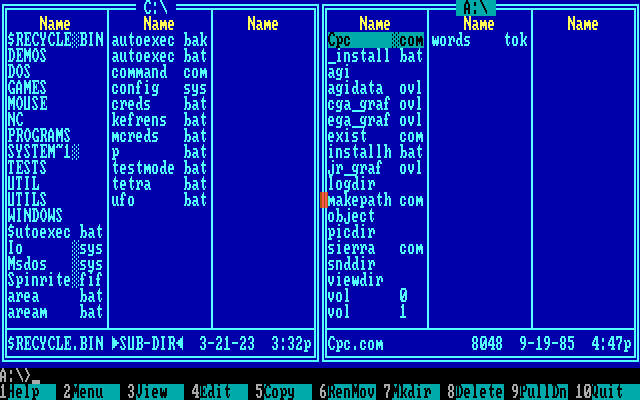
In these games, a hidden file commonly known as CPC.COM played an important role. The game’s loader would call this hidden component, which would check for the SuperLok-protected track on the original disk. In Sierra’s case, the key disk often used a special track, commonly described as track 6, side 0. If the check succeeded, the loader obtained a 128-byte key that helped decrypt the game’s executable component.
To the player, the process looked simple: insert the original disk, start the game, and proceed. To the machine, the process was more like a tiny ritual. The loader asked the floppy controller to read something that should not exist on an ordinary DOS-formatted copy. If the expected disk structure was present, the software unlocked. If not, the user saw a message asking for the original disk.
This is what made SuperLok interesting. It did not rely only on hiding a file or checking a serial number. It tied execution to a low-level disk structure that required specialized duplication equipment to reproduce reliably. For a software publisher in 1985, that was a tempting defense. For a preservationist in 2026, it is a puzzle box with magnetic dust on it.
The Special Track: Where the Magic Hid
The heart of many SuperLok disks was the protected track. A normal PC floppy track contains a predictable arrangement of sectors. SuperLok disrupted that predictability. Reports and preservation research describe SuperLok tracks using nonstandard sector sizes, overlapping sectors, and CRC errors in sector data fields. In some cases, a sector header could claim a size that did not match what a normal format expected. Other sectors could appear to occupy overlapping physical space on the track.
That sounds bizarre, but it was the point. A normal copy program asked DOS for files. DOS did not care about the weird geometry hiding beneath those files. Even lower-level disk copy tools often assumed the disk followed ordinary rules. SuperLok lived in the awkward space between “readable enough to authenticate” and “strange enough that your copy utility gives up and goes for coffee.”
Professional disk duplication machines could create these unusual structures. Ordinary PC floppy controllers were more limited when writing them. That gap gave SuperLok its power. A protected disk could be read by the software but not duplicated by standard consumer tools.
SuperLok 2.x, SuperLok 3.0, and the SuperLok Kit
SuperLok was not a single frozen design. It evolved. SuperLok 2.x versions became associated with Sierra’s protected DOS titles, while SuperLok 3.0 appeared in other software and games, including several Taito releases. Taito games associated with SuperLok-style protection include titles such as Arkanoid, Arkanoid II: Revenge of DOH, Bubble Bobble, Operation Wolf, QIX, Rastan, Renegade, and Sky Shark.
SuperLok 3.0 used a different loader approach in some cases and could be harder to analyze. Some protected titles used files with names that looked nothing like Sierra’s CPC.COM pattern. For example, Taito-style implementations have been associated with loader files using CML-style names. The concept remained familiar: the software expected something special from the disk, and a normal duplicate would not provide it.
Softguard also offered a SuperLok Kit, aimed at developers who needed a more accessible way to protect disks. The original professional SuperLok process required specialized duplication to place the protected track. The kit approach could be written with more ordinary PC hardware, but that convenience came with weaker protection. In plain English: the premium version had a better lock; the budget kit had a lock that still looked serious but maybe should not guard the Crown Jewels.
Why Sierra’s Use of SuperLok Became Famous
Sierra’s AGI adventure games are a major reason SuperLok remains discussed today. These games are beloved, heavily preserved, and technically interesting. They also arrived during a transitional period when PC users were moving from booters and floppy-only play toward hard drive installation.
SuperLok complicated that transition. A Sierra game might be installed to a hard drive, but the user still needed the original key disk to launch it. This made sense from a publisher’s perspective: the hard drive copy was allowed, but the original disk remained the proof of purchase. From a user’s perspective, it could feel silly. The whole point of a hard drive was not having to shuffle floppies like a casino dealer with beige hardware.
Sierra later released budget editions and compilations of some games without the original disk protection. By then, the market had begun to change. Players disliked fragile key disks. Support teams disliked compatibility complaints. Publishers discovered that strict disk protection could punish paying customers while only delaying determined crackers.
The Cat-and-Mouse Game with Copy Programs
SuperLok existed in a lively ecosystem of protection and anti-protection tools. Publishers used systems such as SuperLok, Formaster Copy-Lock, Vault PROLok, Electronic Arts Interlock, MicroProse protections, Rob Northen Copylock, weak-bit schemes, and other disk tricks. Meanwhile, copying tools became more sophisticated. Some programs tried to read disks below the DOS file level. Others used hardware assistance.
One famous example was the Central Point Software Copy II PC Option Board, a hardware add-on that could intercept floppy data at a lower level than ordinary software. Devices and techniques like this changed the battlefield. If a protection system depended on standard PC limitations, then hardware that bypassed those limitations could make yesterday’s “uncopyable” disk tomorrow’s afternoon project.
This is the recurring lesson of copy protection: every lock creates a locksmith. Sometimes the locksmith is a professional researcher. Sometimes it is a teenager with too much caffeine, a hex editor, and a suspiciously deep understanding of floppy controller behavior.
Why SuperLok Was Clever
SuperLok was clever because it understood the real weakness of ordinary copying. DOS copied files, not physical disk weirdness. By placing proof of authenticity outside the normal file system, SuperLok forced attackers to deal with the magnetic and controller-level structure of the disk.
It also blended multiple layers. The hidden file, the protected track, the encrypted executable, and the original disk check worked together. Even if a user copied the visible game files, the copy would still lack the authentication material. Even if the hidden file was discovered, it was not necessarily useful by itself because it expected to run in the correct context and interact with the original disk structure.
For legitimate software companies, this was attractive. SuperLok did not require rewriting the entire product. It could be integrated into a loader and distribution process. That made it a commercial solution rather than a one-off hacker trick.
Why SuperLok Was Also Fragile
At the same time, SuperLok showed the weakness of physical copy protection. It depended on drives, controllers, BIOS behavior, timing, disk condition, and operating environments. A slightly misaligned drive could produce errors. A faster clone machine could behave differently. A hard disk formatted in an unexpected way could break installation. Memory-resident utilities, unusual DOS configurations, networks, external devices, and third-party hardware could all introduce headaches.
That meant SuperLok had two enemies: pirates and customers. Pirates attacked it intentionally. Customers broke it accidentally. Guess which group called technical support more often?
This was not unique to Softguard. Disk-based copy protection across the industry had the same problem. A protection scheme could look brilliant in the lab and become a customer-service bonfire in the field. The more aggressively a disk deviated from standards, the more likely it was to annoy real users with real machines.
SuperLok and the Decline of Disk-Based DRM
By the late 1980s and early 1990s, many software companies moved away from heavy floppy-based copy protection. The reasons were practical. Hard drives became common. Corporate buyers disliked protected disks. Compatibility mattered more as PC clones multiplied. Software publishers began relying more on manuals, license agreements, serial numbers, registration cards, customer support, and later electronic activation.
Lotus, Microsoft, Borland, Sierra, and other major software names all faced the same industry question: how much inconvenience could customers tolerate in exchange for piracy prevention? The answer turned out to be “less than publishers hoped.” Copy protection that blocked casual copying was useful, but protection that blocked paying customers was brand damage wearing a trench coat.
Softguard’s business depended heavily on this copy-protection market. As publishers backed away from disk-based systems, the company’s relevance faded. SuperLok remains historically important not because it won forever, but because it captures a moment when software security was literally written into the strange geometry of a floppy disk.
Modern Preservation: Why SuperLok Still Matters
Today, SuperLok matters to retrocomputing enthusiasts, emulator developers, archivists, and digital preservation teams. Original disks are aging. Magnetic media degrades. Drives fail. Rubber belts dry out. Dust, mold, and time are not gentle librarians. If protected disks are not captured properly, a simple file copy may preserve the visible files while losing the protection data required to run the original software accurately.
That is why flux-level imaging tools are important. Devices such as KryoFlux and Greaseweazle can capture magnetic flux transitions instead of merely asking DOS for sectors. This allows archivists to record nonstandard tracks, damaged areas, odd timings, and copy-protection structures that conventional disk images may miss.
For emulators, SuperLok is also a test of authenticity. A simple emulator can load DOS files. A historically accurate emulator must model the floppy controller, disk rotation, sector layout, CRC behavior, track wrapping, and other details well enough that protected software behaves as it did on real hardware. In that sense, SuperLok is not just a protection system. It is a final exam for PC emulation.
Examples of SuperLok in the Wild
Sierra Adventure Games
Sierra’s early AGI games are the most famous examples for many PC gaming historians. The protection generally worked by using a hidden loader component to validate the original key disk and obtain data needed to decrypt the executable. Games could often be installed to a hard drive, but the original disk still had to be present when launching.
Taito Arcade Conversions
Taito’s DOS releases used SuperLok-style protection in several titles. These implementations are often discussed separately from Sierra’s because the loader files and protection behavior differ. They show that SuperLok was not just a Sierra curiosity; it was a commercial protection technology used across multiple publishers.
Business Software
SuperLok was not limited to games. Business applications also used disk-based protection, especially when publishers worried that one purchased copy could quietly spread through an entire office. This was a major concern in the age before network license servers and software audits became common.
What SuperLok Teaches About Software Security
The first lesson is that security is not only about cleverness. SuperLok was technically smart, but its success depended on implementation, user experience, duplication quality, hardware compatibility, and publisher support. A brilliant protection method could still fail if integrated lazily or if it caused too many false rejections.
The second lesson is that obscurity buys time, not immortality. SuperLok’s unusual tracks made casual copying difficult. They did not make analysis impossible. Once researchers and crackers understood the pattern, the protection became less mysterious.
The third lesson is that legitimate users are part of the security equation. If protection treats every customer like a suspect, customers eventually vote with their wallets, their complaints, or their extremely creative vocabulary.
The final lesson is that old DRM becomes tomorrow’s preservation problem. A protection system designed to prevent copying in 1986 can prevent archiving in 2026. That does not make the original goal irrational, but it does show why digital preservation needs careful legal, technical, and historical thinking.
Experiences and Reflections on PC Floppy Copy Protection: Softguard SuperLok
Working with or studying SuperLok today feels like opening a time capsule that fights back. On the surface, a protected floppy can look ordinary. You list the directory, see familiar DOS files, and think, “This will be easy.” That confidence usually lasts until the disk image refuses to boot, the game asks for the original disk, or the emulator behaves like it has just seen a ghost in track 6.
The most valuable experience with SuperLok is learning to respect the difference between a file copy and a disk preservation copy. A file copy answers the question, “What documents are visible to DOS?” A preservation copy asks, “What physical and logical behaviors did the entire disk contain?” SuperLok lives in the second question. If you ignore the hidden track structure, you may save the body of the disk while losing its fingerprint.
Another practical lesson is that old hardware has personality. Two floppy drives of the same general type may not behave identically. One drive reads a marginal disk without complaint; another sounds like it is chewing dry cereal and returns errors. Alignment matters. Disk condition matters. The controller matters. Even the patience of the person doing the imaging matters, because retrocomputing has a way of rewarding calm people and mocking the rest of us.
SuperLok also teaches humility. Modern users tend to think of copy protection as an online login or activation server. SuperLok reminds us that earlier engineers were already thinking deeply about trust, authentication, distribution, and adversarial behavior. They did not have cloud infrastructure, so they used magnetic geometry. That is both ingenious and slightly wild, like building a bank vault out of origami and timing pulses.
For writers, historians, and preservationists, the best approach is careful documentation. Record the disk type, title version, publisher, visible files, hidden files, imaging method, drive model, errors, and emulator behavior. A protected disk is not just a container for a game or application. It is evidence of how the software industry balanced piracy fears against customer convenience.
The human side is just as interesting. Imagine buying a game, installing it to your shiny new hard drive, and still needing to insert the original floppy every time. If the disk got damaged, your purchase could become a very small coaster. That frustration helped push publishers away from aggressive disk checks. SuperLok was clever, but customers wanted reliability. In the end, convenience became a stronger market force than magnetic trickery.
That is why Softguard SuperLok remains such a compelling topic. It is not only about defeating copies. It is about the messy relationship between technology, commerce, trust, and users who just wanted their adventure game to load before dinner.
Conclusion
PC Floppy Copy Protection: Softguard SuperLok is a perfect example of how inventive the early software industry became when floppy disks were easy to duplicate and piracy felt like an existential threat. SuperLok used hidden files, protected tracks, nonstandard sectors, overlapping data structures, and encryption-related checks to make ordinary copies fail. It appeared in well-known PC games and business software, helped define the disk protection arms race of the 1980s, and later became a challenge for preservationists and emulator developers.
Its legacy is mixed in the most interesting way. As a technical design, SuperLok was clever. As a customer experience, it could be annoying. As a preservation subject, it is invaluable. It reminds us that software history is not only stored in source code or screenshots. Sometimes it is hidden in the strange magnetic margins of a floppy disk, waiting for someone patient enough to listen.