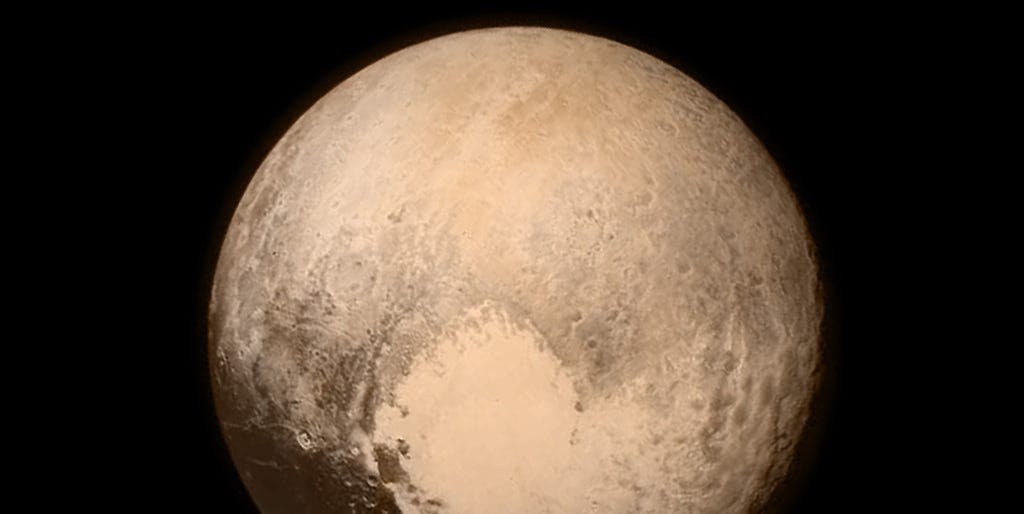

Pluto may be small enough to fit comfortably across the continental United States, but it has never been short on drama. It was discovered, promoted to planetary celebrity, demoted to dwarf planet, and then photographed wearing an enormous white heart. Now scientists think that famous feature may be the scar of an ancient collisionone so unusual that part of the object that struck Pluto could still be buried deep beneath the ice.
The leading explanation involves a slow, oblique collision with a planetary body roughly 450 miles wide. Instead of producing a tidy circular crater, the impact may have splashed, stretched, and embedded material across Pluto’s interior like a cosmic snowball hitting a frozen wall at an angle. The resulting basin later filled with brilliant nitrogen ice, transforming a geological wound into one of the most recognizable landscapes in the solar system.
Research basis: NASA, Johns Hopkins APL, University of Arizona, Nature Astronomy.
Pluto’s Heart Is Not One Simple Feature
The bright heart-shaped area is officially called Tombaugh Regio, honoring Clyde Tombaugh, the American astronomer who discovered Pluto in 1930. It stretches roughly 1,000 miles across and consists of two visually connected but geologically different lobes.
The western lobe is Sputnik Planitia, the smooth, intensely reflective plain that attracts most of the scientific attention. The eastern lobe is brighter than much of Pluto’s surrounding terrain but is covered by a thinner and less uniform layer of volatile ice.
Sputnik Planitia is not merely a white patch painted onto Pluto. It occupies a vast, pear-shaped depression approximately 1,200 by 2,000 kilometers across. Its central plains sit about two and a half miles below much of the neighboring surface. Those dimensions, its mountainous rim, and its elongated outline suggest that something enormous happened there.
The basin is filled mainly with nitrogen ice, along with smaller amounts of carbon monoxide and methane ice. Water ice forms much of Pluto’s rigid crust, behaving more like rock at the dwarf planet’s extremely low temperatures. In other words, Pluto has icy bedrock covered by softer, more mobile varieties of icea geological layer cake served at approximately minus 380 degrees Fahrenheit.
Research basis: University of Arizona and Nature Astronomy.
New Horizons Revealed a World Nobody Expected
Before NASA’s New Horizons spacecraft reached Pluto, even the best images showed little more than a blurry collection of light and dark areas. That changed on July 14, 2015, when the spacecraft flew past Pluto after a journey of more than nine years and roughly 3 billion miles.
The close-up images revealed mountains, glaciers, fractures, haze layers, possible cryovolcanic structures, dunes, and terrain ranging from ancient crater fields to surfaces that appeared geologically young. Pluto was not a frozen museum exhibit. It was complicated, active, and apparently determined to embarrass every textbook illustration that had portrayed it as a featureless snowball.
Sputnik Planitia delivered the biggest surprise. Its smooth surface contained almost no visible impact craters, meaning the exposed ice had been renewed relatively recently in geological terms. Polygon-shaped cells covered large portions of the plain, while glaciers appeared to flow into the basin from surrounding highlands.
These observations immediately raised two questions: What created such an enormous depression, and why did it end up in its peculiar location near the line connecting Pluto and its largest moon, Charon?
Research basis: NASA, JHUAPL and initial New Horizons results.
The Leading Theory: A Slow, Slanted Giant Impact
A 2024 study published in Nature Astronomy proposed an unusually detailed answer. Researchers from the University of Bern and the University of Arizona used three-dimensional computer simulations to recreate collisions between a young Pluto and large objects that may have occupied the early Kuiper Belt.
A Projectile About 450 Miles Wide
The simulations found that Sputnik Planitia’s shape could be reproduced when a differentiated ice-and-rock object approximately 730 kilometers, or about 450 miles, in diameter struck Pluto at low velocity. That is not a stray pebble. It is a world-sized projectile comparable in scale to some of the largest known asteroids and small moons.
The collision probably occurred early in Pluto’s history, when the Kuiper Belt contained more objects and planetary encounters were more common. Yet “giant impact” does not necessarily mean the sort of hypervelocity explosion associated with collisions closer to the Sun.
Objects in the distant solar system generally move more slowly relative to one another. Their impacts can therefore preserve details that would be erased in a faster, hotter collision. Material strength, impact angle, internal structure, and the difference between rock and ice become especially important.
The Impact Came in at an Angle
A direct hit normally produces a roughly circular crater. Sputnik Planitia is distinctly elongated, so researchers tested oblique collisions. One successful simulation involved an impact angle of approximately 30 degrees.
At that shallow angle, the impactor did not simply drill straight through Pluto’s outer layers. It spread material along its path, creating a basin with a teardrop or pear-shaped outline. Think less “cannonball through a window” and more “water balloon thrown sideways onto a sidewalk,” except both the balloon and sidewalk are hundreds of miles wide.
The simulated collision closely reproduced Sputnik Planitia’s broad morphology, including its unusual asymmetry. This is significant because earlier two-dimensional, head-on impact models could create a large basin but struggled to explain its elongated shape.
Research basis: peer-reviewed impact simulations and U.S. university reporting.
Pluto May Still Contain Part of the Object That Hit It
The most intriguing part of the new model lies beneath the surface. The impactor was probably differentiated, meaning it had a rocky core surrounded by an icy mantle. During the collision, much of its ice was disrupted, but its dense rocky core may have survived surprisingly intact.
Because Pluto’s interior was extremely cold and mechanically strong, the impact did not necessarily melt and mix everything together. The projectile’s rocky core may have penetrated Pluto’s ice shell and come to rest above Pluto’s own rocky core.
Researchers describe this buried structure as a rocky mass concentration, or mascon. In less technical language, Pluto may still be carrying an undigested chunk of another world beneath its heart. Apparently even dwarf planets can have trouble processing old relationships.
This buried mass could help explain why Sputnik Planitia lies close to Pluto’s tidal axisthe imaginary line running between Pluto and Charon. A dense concentration below the basin would affect Pluto’s balance and encourage the entire dwarf planet to reorient over time.
How a Collision Scar Became a Brilliant White Heart
The impact alone did not create the bright heart seen in modern photographs. It created the lowland basin. Pluto’s climate supplied the white icing afterward.
Nitrogen is the dominant gas in Pluto’s extremely thin atmosphere. Depending on temperature and sunlight, nitrogen can freeze onto the surface, sublimate directly into gas, travel through the atmosphere, and condense elsewhere. Because Sputnik Planitia lies several kilometers below nearby terrain, it acts as a natural cold trap where volatile ices can collect.
After the basin formed, nitrogen ice probably accumulated within it relatively quickly. Fresh nitrogen ice is bright and highly reflective, which explains Sputnik Planitia’s striking appearance. Some nitrogen also spread over the eastern side of Tombaugh Regio, creating the second lobe and completing the heart-shaped illusion.
The result is an accidental work of planetary art: an impact basin, atmospheric transport, changing seasons, and mobile glaciers combining to draw a Valentine on a world billions of miles from Earth.
Research basis: UArizona, NASA and New Horizons compositional studies.
Sputnik Planitia Is Still Moving
Although the impact occurred billions of years ago, the surface of Pluto’s heart remains dynamic. Sputnik Planitia behaves like a giant nitrogen-ice glacier rather than a permanently frozen crater floor.
Convection Creates Giant Polygons
New Horizons photographed polygonal cells measuring roughly 10 to 30 miles across. Computer models indicate that these patterns form through solid-state convection.
Heat leaking slowly from Pluto’s interior warms nitrogen ice at the bottom of the glacier. The slightly warmer material becomes buoyant and rises. Near the surface, it cools, spreads outward, and sinks around the edges of each cell. The cycle resembles a lava lamp operating in extreme slow motion.
Researchers estimate that the visible surfaces of some cells may be less than a million years old. That is ancient by human standards but practically fresh from the ovenor freezerin planetary geology.
Glaciers, Floating Hills, and Dunes
Nitrogen glaciers flow from the surrounding uplands into Sputnik Planitia, carving valleys along the way. Water-ice blocks can float in denser nitrogen ice like icebergs, producing clusters of hills within the plain.
The western edge of Sputnik Planitia also hosts fields of dunes, probably made from grains of methane ice. Sublimation and condensation within the heart help generate winds capable of transporting those particles, despite Pluto’s atmosphere being far thinner than Earth’s.
Pluto’s heart therefore does more than decorate its surface. It participates in the circulation of the atmosphere, drives local winds, stores much of the dwarf planet’s nitrogen, and continually renews its icy landscape.
Research basis: WashU, JHUAPL, NASA and Science.
Did Pluto’s Heart Make the Whole Planet Roll Over?
Sputnik Planitia is positioned near the side of Pluto that faces directly away from Charon. Scientists do not consider that placement a random coincidence.
Pluto and Charon are tidally locked, meaning each keeps the same hemisphere facing the other. A large positive mass anomaly inside Pluto would experience gravitational and rotational forces that could move it toward the tidal axis. The process, known as true polar wander, does not require the crust to slide independently. Instead, the entire solid exterior reorients relative to the spin axis.
Earlier models proposed that nitrogen ice filling the basin, combined with denser liquid water rising beneath a thinned crust, produced enough extra mass to rotate Pluto into its current orientation. Surface fractures and tectonic patterns offered additional support for the possibility of a subsurface ocean.
The newer impact model offers another option. A surviving rocky core from the impactor could provide the necessary excess mass without requiring a deep present-day ocean. Pluto may have followed its heart, but its heart may contain a geological counterweight.
Research basis: NASA, Brown University and Smithsonian.
Does the New Theory Mean Pluto Has No Ocean?
Not necessarily. The existence of a subsurface ocean remains one of the most important unsettled questions in Pluto science.
Previous studies concluded that Sputnik Planitia’s positive mass anomaly would be difficult to explain without an ocean. In those models, the basin-forming impact thinned Pluto’s water-ice shell, allowing denser liquid water to rise closer to the surface. Later deposits of nitrogen ice added even more mass.
Some researchers have estimated that such an ocean could be more than 60 miles deep and extremely salty, helping it remain liquid at low temperatures. Pluto’s large fractures and apparent expansion have also been interpreted as evidence that an ocean formed early and may have partially frozen over time.
The 2024 simulations challenge the assumption that liquid water is required. A strong, cold Pluto combined with a surviving impactor core could reproduce both the basin and its mass anomaly in an oceanless interior.
However, a successful computer simulation is not the same as direct detection. It demonstrates that a scenario is physically plausible; it does not prove that nature selected that exact scenario. Pluto could have no ocean, a thin ocean, a partially frozen layer, or a deeper reservoir modified by billions of years of thermal evolution.
Resolving the debate will probably require another mission equipped to map Pluto’s gravity field, study its interior with radar, or orbit the dwarf planet long enough to examine its geology from multiple angles.
Research basis: Brown University, NASA, JHUAPL and The Planetary Society.
What Scientists Still Need to Learn
The impact theory explains several major clues at once, but important uncertainties remain. Scientists do not know the exact thickness of Sputnik Planitia’s nitrogen glacier, the detailed distribution of mass beneath it, or the original location of the basin before Pluto reoriented.
Researchers must also determine whether the eastern lobe formed entirely through volatile transport from Sputnik Planitia or whether additional processes shaped it. The long-term behavior of Pluto’s atmosphere remains difficult to model because its seasons last for decades and its orbit produces major changes in solar heating.
Even the impact itself has many adjustable variables: projectile size, speed, angle, rock fraction, ice strength, and Pluto’s internal temperature. Different combinations can produce broadly similar outcomes. Future simulations will need to test how unique the proposed solution really is.
That uncertainty does not weaken the study. It is how planetary science progresses. A model earns attention by explaining observations and making predictions that can eventually be testednot by declaring the mystery closed and taking the rest of the afternoon off.
Why Pluto’s Mysterious Heart Matters
Sputnik Planitia provides a window into the early Kuiper Belt, where collisions occurred under conditions very different from those near Earth. Low impact speeds and strong, frozen materials can preserve projectile remnants instead of completely melting and mixing them.
If Pluto contains a buried impactor core, similar “splats” may exist inside other dwarf planets and icy moons. Surface regions that appear to belong entirely to one world could contain large volumes of material delivered by another.
The theory also demonstrates why small planetary bodies cannot be treated as simple leftovers. Pluto has weather, climate cycles, glaciers, tectonic features, possible cryovolcanoes, atmospheric haze, and an interior that may record a collision with another protoplanet. Its diameter may be modest, but its geological résumé is aggressively overqualified.
Conclusion: Pluto’s Heart May Be an Ancient Collision Frozen in Time
The best current explanation suggests that Sputnik Planitia formed when a roughly 450-mile-wide ice-and-rock body struck Pluto slowly and at a shallow angle. The collision excavated an elongated basin, while the projectile’s rocky core may have remained buried beneath it as a dense mass concentration.
Nitrogen ice later collected in the depression, creating the brilliant western lobe of Tombaugh Regio. Convection, glacial flow, sublimation, condensation, and wind continue to reshape the region today.
The model elegantly explains the basin’s shape, depth, composition, and location near the Pluto–Charon tidal axis. It may even remove the need for a deep subsurface ocean, although that debate remains far from settled.
Pluto’s heart is therefore not a simple crater and certainly not a decorative patch of frost. It is a layered record of impact physics, climate, geology, and planetary migrationa beautiful reminder that even in the coldest reaches of the solar system, worlds can have complicated pasts.
Experiencing the Mystery of Pluto’s Heart
For anyone who followed the New Horizons encounter in 2015, Pluto’s heart offered an unusual scientific experience. Space missions normally reveal details gradually: a sharper crater here, a new chemical measurement there. Pluto delivered a recognizable symbol before scientists fully understood what they were seeing. As the spacecraft approached, the bright shape became clearer day by day until an entire world appeared to be looking back with a white heart on its chest.
That first impression makes the later science especially satisfying. A casual viewer sees a heart. A planetary geologist sees a depressed basin, volatile ice deposits, flowing glaciers, convection cells, floating water-ice blocks, and evidence of true polar wander. Both views are valid, but the second one transforms a charming photograph into a geological detective story.
Trying to Understand the Scale
One of the most useful ways to experience this topic is to compare Sputnik Planitia with familiar geography. Its glacier extends roughly 620 miles across, while the larger basin spans an area comparable to a significant portion of the United States. The projectile proposed in the 2024 simulations was wider than the distance between many major American cities.
These comparisons make the phrase “giant impact” feel less abstract. Imagine an icy world hundreds of miles wide approaching at an angle, striking hard enough to reshape Pluto but slowly enough for its rocky center to survive. The event was not a small crater-forming accident. It was a collision between planetary bodies.
Recreating the Idea With Everyday Objects
The basic geometry can be explored without a supercomputer. Dropping a round object vertically into soft material tends to create a relatively circular depression. Sliding it in at a shallow angle produces an elongated mark and pushes material farther in one direction. Flour, clay, damp sand, and snow all demonstrate the principle, although none should be considered an accurate model of a frozen dwarf planet unless your kitchen has recently reached 40 kelvins.
This simple exercise helps explain why Sputnik Planitia’s shape matters. Scientists are not choosing an oblique impact merely because it sounds dramatic. The direction and angle of a collision leave recognizable geometric clues.
Following a Real Scientific Debate
The ocean question provides another valuable experience. Older studies used Sputnik Planitia’s location and mass anomaly as evidence for liquid water beneath Pluto’s crust. The newer model shows that a rocky impactor remnant might produce similar effects without a deep ocean.
Watching these ideas compete is a reminder that science is not a collection of permanent answers. Researchers build models, compare them with observations, identify weaknesses, and develop alternatives. A new explanation does not make earlier work foolish. It reveals which assumptions need to be tested more carefully.
Seeing Pluto Differently
After learning about the impact theory, it becomes difficult to look at Pluto’s portrait in the same way. The smooth white plain begins to resemble an active glacier covering a buried collision scar. The surrounding mountains become fragments of rigid water-ice crust. The heart’s position hints that the entire dwarf planet may have rotated to accommodate a hidden concentration of mass.
That shift in perspective is perhaps the most rewarding experience connected with Pluto’s mysterious heart. A distant white shape turns into a story spanning billions of years: two young worlds collide, one retains part of the other, nitrogen migrates into the resulting lowland, and a passing spacecraft eventually photographs the evidence.
New Horizons spent only a few hours making its closest observations, yet the data continue to generate discoveries. Pluto’s heart demonstrates how a single encounter can keep changing our understanding long after the spacecraft has traveled onward.