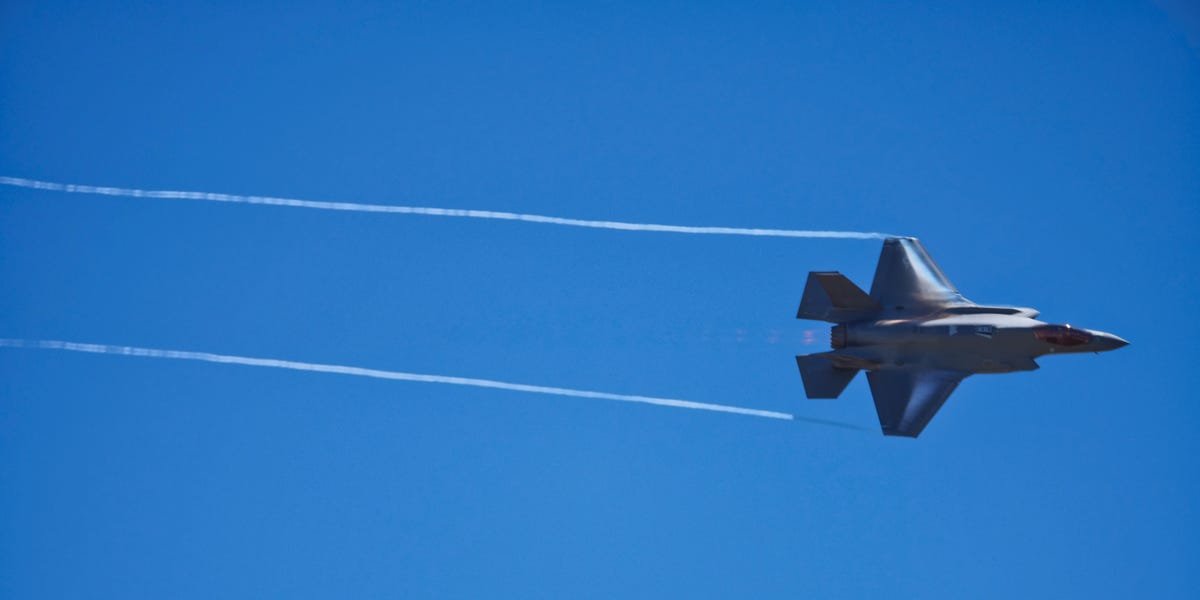

Modern stealth aircraft can confuse radar, reduce infrared signatures, and slip through defended airspace with an impressively small electronic footprint. Unfortunately, the atmosphere did not sign the secrecy agreement. Under the right conditions, even an advanced stealth plane can draw a bright white line across the sky, effectively announcing, “Something interesting just flew this way.”
These condensation trails, better known as contrails, are not merely cosmetic. They can expose an aircraft’s approximate route, direction of travel, and recent presence. Persistent contrails may also help human observers or optical sensors focus their attention on an otherwise difficult-to-detect target. Stealth remains enormously valuable, but a visible trail reminds us that low observability is a carefully managed advantagenot a magical invisibility cloak.
Stealth Aircraft Are Difficult to Detect, Not Invisible
The popular image of a stealth plane is an aircraft that vanishes from every sensor the moment it retracts its landing gear. Real stealth technology is more complicated. It reduces the signatures that defensive systems use to detect, identify, track, and engage an aircraft.
Aircraft such as the B-2 Spirit use carefully shaped surfaces, specialized materials, internal weapon bays, protected engine installations, and low-observable coatings. According to the U.S. Air Force, the B-2’s design reduces radar, infrared, acoustic, electromagnetic, and visual signatures. That is a much broader job than simply making the aircraft look small on radar.
However, no design can completely separate an airplane from the air through which it flies. Engines release hot exhaust containing water vapor and tiny particles. Wings alter air pressure. The aircraft also produces heat, noise, turbulence, and sometimes a very conspicuous artificial cloud.
Stealth therefore works by reducing detection opportunities and shortening the distance at which an opponent can obtain a useful track. A contrail can complicate that strategy by providing a visible clue before radar or infrared systems have independently found the aircraft.
What Causes an Aircraft Contrail?
A contrail is a cloud of small ice crystals formed behind an aircraft. The basic process resembles the little cloud produced by your breath on a cold morning, although it occurs in far colder air and involves considerably more expensive machinery.
Hot Exhaust Meets Cold Upper-Air Conditions
Jet fuel combustion produces water vapor, carbon dioxide, and small quantities of other emissions. When hot, moist exhaust mixes with extremely cold air at cruising altitude, the mixture may briefly become saturated. Water condenses around particles in the exhaust and surrounding atmosphere, then freezes into ice crystals.
NASA, NOAA, the Federal Aviation Administration, and the Environmental Protection Agency all describe contrails as ice clouds rather than streams of fuel or mysterious chemicals. They have been a documented consequence of high-altitude aviation since its early decades.
Contrail formation depends mainly on temperature, pressure, humidity, engine characteristics, and fuel properties. Surface weather is not a dependable guide. A warm, dry afternoon on the ground can exist beneath a cold, moisture-rich layer several miles overhead.
Short-Lived and Persistent Contrails
If the surrounding air is relatively dry, newly formed ice crystals quickly sublimate back into water vapor. The resulting contrail may disappear within seconds or minutes. It still makes the aircraft more visible, but it does not leave a lasting atmospheric autograph.
If the aircraft enters air that is supersaturated with respect to ice, the trail can persist, widen, and drift. Wind shear and turbulence may spread it into a thin cirrus-like cloud. Persistent contrails can survive long after the aircraft has moved away, sometimes stretching across a large area.
This distinction matters. A short trail can point toward an aircraft’s immediate location, while an older, spreading trail is more like a historical record. It indicates that an aircraft passed through the region, but wind can move and distort the trail. A contrail is a clue, not a precision targeting coordinate.
Aerodynamic Contrails Are a Related Phenomenon
Some visible condensation forms because pressure drops over wings, in vortices, or around other aerodynamic surfaces. These clouds are often seen during high-load maneuvers or in moist air at lower altitudes. They usually vanish quickly. For long-range, high-altitude stealth missions, persistent exhaust contrails are generally the more troublesome problem.
Why Contrails Are a Problem for Stealth Planes
They Create an Optical Signature Much Larger Than the Aircraft
A stealth aircraft may be only a small speck to the naked eye, but its contrail can extend for miles. Against a clear blue sky, the white line may be visible from a considerable distance. Observers do not need to recognize the airplane immediately; they only need to notice that something has disturbed an otherwise empty patch of sky.
The trail can suggest a recent flight path and general direction. Fresh sections of the contrail are closest to the aircraft, while older sections widen and drift. The geometry is imperfect, especially in strong upper-level winds, but it can narrow the search area.
Visual Detection Can Cue Other Sensors
Stealth is most effective when defensive sensors must search a large volume of air without knowing where to look. A contrail may give that search a starting point. Ground observers, airborne cameras, infrared systems, or satellite imagery can potentially notice the trail and direct attention toward a smaller region.
This does not mean that seeing a contrail automatically defeats stealth. Detection, tracking, identification, and weapon engagement are separate steps. A fleeting optical observation may never become a stable firing solution. Nevertheless, any unexpected cue is unwelcome when the mission depends on reducing the defender’s reaction time.
Persistent Trails Can Reveal Patterns
A single contrail may disclose little more than the passage of an aircraft. Repeated trails, however, can help observers infer frequently used corridors, operating altitudes, approximate timing, or the scale of nearby activity. Mission planners are therefore concerned with patterns as well as individual moments of exposure.
Contrails can also complicate formation tactics. Multiple aircraft crossing a moisture-rich layer may create several visible lines or one broad area of artificial cloudiness. In other words, the sky can become a whiteboard on which the formation accidentally sketches part of its plan.
Military Aviators Have Worried About Contrails for Decades
The conflict between altitude and visibility is much older than modern stealth. High altitude can provide greater range, better sensor coverage, and protection from some ground threats. Yet it also places aircraft in the cold upper atmosphere where contrails commonly form.
During World War II, large bomber formations sometimes produced enormous trails that could be seen from far away. NASA educational material notes that wartime contrails could interfere with navigation and target observation. They could even expand into cloud cover dense enough to disrupt formation flying.
High-altitude reconnaissance pilots faced a particularly awkward version of the problem. U.S. Air Force historical material describes pilots watching mirrors to ensure that a contrail was not revealing their presence. The aircraft might be difficult to see, but the line behind it was considerably less shy.
The B-2 Spirit brought the issue into the stealth era. In 1994, the Air Force awarded Northrop a publicly reported contract worth $63.5 million to address B-2 contrails. The aircraft later became associated with a Pilot Alert System using laser radar, or lidar, to detect conditions indicating that a contrail was forming behind the bomber. Public descriptions suggest that the system warns the crew so corrective action can be considered.
The importance of that effort is easy to understand. Engineers can spend years reducing radar reflections from seams, inlets, coatings, and access panels. Allowing the finished aircraft to tow a glowing white pointer through the sky would be a particularly irritating final detail.
How Can Stealth Aircraft Reduce the Contrail Risk?
Forecast Contrail-Prone Atmospheric Layers
Weather models can estimate where temperature and humidity may support contrail formation. Mission planners can compare proposed routes and altitudes with these forecasts, much as civilian dispatchers consider turbulence, thunderstorms, and winds.
The challenge is resolution. Ice-supersaturated regions can be thin, irregular, and temporary. Forecasts may identify a broad risk area without accurately describing every moisture layer an aircraft will encounter. Research from NOAA, UCAR, MIT, NASA, and other organizations continues to improve contrail prediction.
Change Altitude or Route
A modest altitude adjustment may move an aircraft out of the cold, humid layer responsible for a persistent contrail. The plane might climb above it, descend below it, or divert around the region. Civil aviation studies have found that targeted changes can sometimes avoid substantial contrail formation with relatively small average fuel penalties.
Military operations face additional constraints. A different altitude may change fuel consumption, sensor performance, radar exposure, communications, threat geometry, or weapon employment. Avoiding a contrail is valuable, but not if the alternative places the aircraft in a more dangerous layer of defended airspace.
Use Real-Time Contrail Detection
Onboard systems provide feedback when forecasts are incomplete or conditions change unexpectedly. Lidar can probe the air or detect particles in the wake, while optical cameras may look for the trail itself. A warning allows the crew or flight-control system to evaluate whether a change is practical.
Real-time detection is especially useful because pilots often cannot directly see behind the aircraft. Waiting for another aircraft or a ground observer to mention the trail rather defeats the purpose.
Improve Engines and Fuels
Engine efficiency, exhaust temperature, and the number of soot particles emitted can influence contrail formation and ice-crystal properties. Sustainable aviation fuels may reduce soot emissions, potentially producing contrails with fewer ice crystals under some conditions.
Cleaner exhaust does not guarantee a contrail-free stealth plane. Atmospheric temperature and humidity remain decisive, and water vapor is an unavoidable product of hydrocarbon combustion. Engine and fuel improvements are therefore part of the solution, not a weather-canceling cheat code.
Why the Contrail Problem Is Harder Than It Looks
The simplest advice“fly where contrails do not form”hides several engineering and operational trade-offs. The most favorable altitude for range may overlap with a contrail-prone layer. Descending can increase drag and fuel use. Climbing may be limited by aircraft weight or engine performance.
Atmospheric information is also imperfect. Humidity measurements in the upper troposphere are less complete than surface observations, and small errors can determine whether a predicted trail disappears or persists. Researchers have found that accurately forecasting ice supersaturation at the scale of an individual flight remains difficult.
Timing adds another variable. A moisture layer may move, weaken, or thicken between mission planning and arrival. A route judged acceptable hours earlier might produce a persistent line when the aircraft reaches it. This is why future solutions will probably combine forecasts, satellite observations, onboard sensors, and continuous route optimization.
Future Stealth Will Need Better Atmospheric Awareness
Next-generation low-observable aircraft will operate in an environment filled with networked radars, infrared search-and-track systems, satellites, passive sensors, and automated image analysis. In that setting, managing visual and atmospheric signatures becomes more important, not less.
Improved geostationary satellite imagery is already helping scientists identify persistent contrails. Machine-learning systems can compare those observations with weather forecasts and flight data, gradually improving predictions. Similar research could support military mission planning without changing the basic physics involved.
Future aircraft may treat contrail risk as a dynamic navigation factor. A mission computer could weigh atmospheric visibility against fuel, threats, timing, and sensor requirements, then recommend an altitude change only when the overall benefit is positive.
No single technology will make contrails disappear under every condition. The more realistic goal is to predict them sooner, detect them quickly, and avoid the most revealing trails when mission circumstances permit.
Experience-Based Lessons From the Contrail Problem
Historical aviation experience offers a useful warning: a clear sky is not necessarily a friendly sky. To someone standing on the ground, a cloudless day may appear dry and stable. At cruising altitude, however, an invisible ribbon of ice-supersaturated air may be waiting. An aircraft can cross the boundary and begin producing a bright trail almost immediately.
This creates an important lesson for pilots and planners: atmospheric visibility must be monitored continuously. A preflight forecast is a starting point, not a permanent guarantee. Upper-air conditions evolve, and even a sophisticated model cannot perfectly describe every thin moisture layer along a long route.
Lesson One: Altitude Is Both Protection and Exposure
High-altitude flight often improves range, expands sensor horizons, and keeps aircraft away from some short-range defenses. Wartime bomber and reconnaissance experience showed the other side of that advantage. Cold upper-air conditions could produce trails visible to enemy observers and interceptors. Crews sometimes had to choose between remaining at an efficient altitude and abandoning the layer that was advertising their presence.
The same tension applies to stealth planes. Descending may stop a contrail but increase fuel consumption or exposure to other sensors. Operational judgment consists of choosing the least dangerous compromise, not blindly eliminating one signature at the expense of everything else.
Lesson Two: A Contrail Warning Must Arrive Quickly
A pilot sitting at the front of a large aircraft cannot casually lean out and inspect the wake. Older reconnaissance crews used mirrors or relied on other aircraft. Modern sensor systems can perform the check faster and more reliably.
Speed matters because a short episode can leave a long trail. At jet cruising speeds, several minutes of unnoticed contrail formation may mark a substantial section of the route. The useful response is early awareness followed by a measured decision, not an abrupt maneuver every time a few ice crystals appear.
Lesson Three: Not Every Contrail Is Equally Dangerous
A thin trail that vanishes almost immediately presents a different problem from one that persists and spreads. The first may briefly highlight the aircraft. The second can document its passage and attract attention for much longer.
Experienced analysis must also account for wind and age. A persistent contrail seen from the ground may no longer sit directly beneath the aircraft that created it. Treating every white line as an exact pointer can waste defensive resources. Its real value is as one piece of evidence that can be combined with radar, infrared, acoustic, or satellite observations.
Lesson Four: Stealth Is a Discipline, Not a Single Feature
The B-2’s carefully maintained coatings, reduced infrared signature, controlled emissions, route planning, and contrail-alert technology illustrate a broader truth. Low observability depends on many small measures working together. A spectacular airframe shape cannot compensate for careless signature management.
That may be the most enduring experience associated with stealth aircraft and contrails. Technology can make an airplane remarkably difficult to detect, but successful stealth also requires weather knowledge, maintenance, planning, crew awareness, and restraint. The airplane does not become invisible; it gives the mission team more control over when, where, and how it may be discovered.
Conclusion
Contrails expose an unavoidable tension in modern military aviation. Stealth planes are designed to reduce radar, infrared, acoustic, electromagnetic, and visual signatures, yet they must still travel through a cold and unpredictable atmosphere. When exhaust water vapor freezes into a long white trail, the aircraft may acquire a visual signature far larger than the plane itself.
A contrail does not automatically defeat stealth or provide an instant weapons-quality track. It can, however, reveal activity, narrow a search area, indicate a recent route, and cue other sensors. That is enough to make it a serious operational concern.
Better forecasts, small altitude changes, onboard detection systems, cleaner fuels, improved engines, and real-time mission planning can reduce the risk. None can repeal atmospheric physics. Even the world’s most advanced stealth aircraft must occasionally negotiate with the weatherand the weather is famously unimpressed by classified technology.