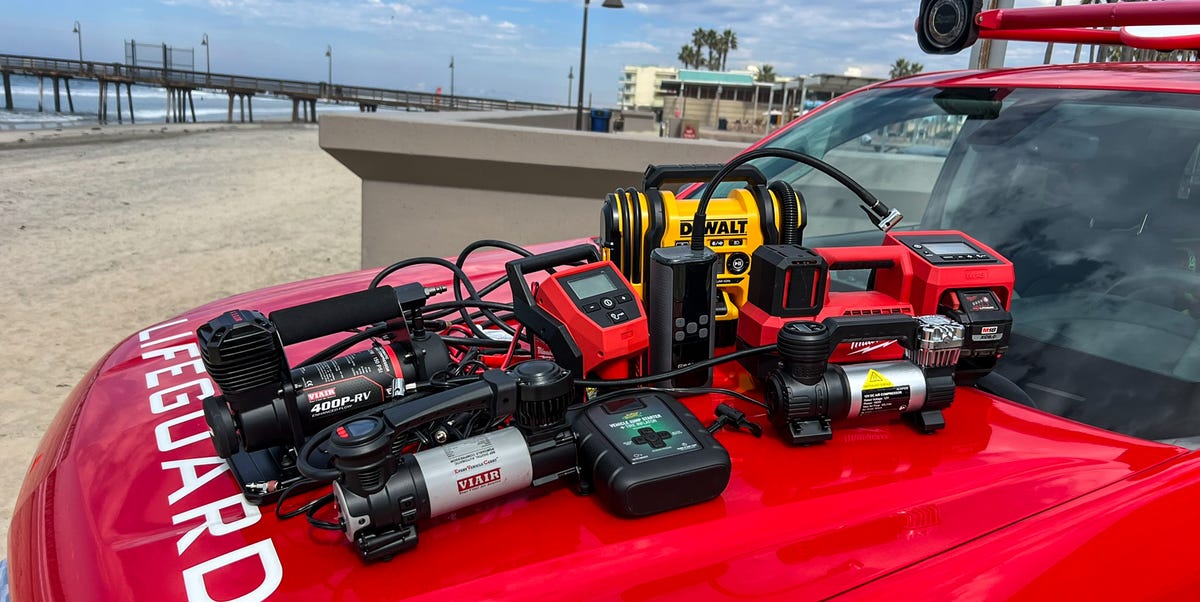

A low tire has a special talent for appearing at the worst possible moment: before work, during a road trip, or while you are wearing clothes that should never touch roadside gravel. A portable tire inflator turns that irritating dashboard warning into a manageable five-minute maintenance job.
The best portable tire inflators of 2025 are smaller, smarter, and more powerful than the rattling plastic pumps drivers once tossed into their trunks. Many now offer digital pressure gauges, automatic shutoff, rechargeable batteries, work lights, multiple power options, and presets for cars, motorcycles, bicycles, and sports equipment.
However, a pocket-size cordless pump and a heavy-duty tire air compressor are not interchangeable. Compact models are excellent for routine top-offs, while larger compressors handle SUV and light-truck tires more comfortably. This guide compares eight standout options for different vehicles, budgets, and emergency kits.
Quick Comparison of the Best Portable Tire Inflators
| Portable Tire Inflator | Best For | Power Source | Maximum Pressure |
|---|---|---|---|
| Avid Power Cordless Tire Inflator | Best overall value | 20V battery or 12V vehicle outlet | Up to 100-150 PSI, depending on version |
| Milwaukee M18 Inflator 2848-20 | Fastest premium option | Milwaukee M18 battery | 150 PSI |
| Fanttik X8 Apex | Best compact rechargeable inflator | Internal rechargeable battery | 150 PSI |
| DeWalt DCC020IB | Best three-way power system | 20V battery, 12V DC, or 110V AC | 160 PSI |
| Viair 88P | Best for SUVs and light trucks | 12V battery clamps | 120 PSI |
| Slime 12V Digital Tire Inflator | Best budget corded model | 12V vehicle outlet | 99 PSI digital gauge range |
| AstroAI Handheld Cordless Inflator | Best easy-to-use handheld model | Rechargeable battery and 12V backup | Up to 160 PSI |
| Black+Decker 20V MAX Inflator | Best for tires and household inflatables | 20V battery, 12V DC, or 120V AC | Up to 150 PSI |
Specifications, accessories, and battery bundles can vary by retailer and product revision. Always verify the exact model number before ordering.
How We Selected the Best Tire Air Compressors
A giant maximum-pressure number does not automatically make a portable air compressor excellent. Most passenger cars need roughly 30 to 40 PSI, so a 150-PSI label is less important than inflation speed, gauge accuracy, airflow, hose reach, heat management, and ease of use.
For this list, we compared independent performance tests with manufacturer specifications and evaluated the factors that matter during an actual roadside stop:
- Inflation performance: How efficiently the unit adds several PSI to a passenger-car or truck tire.
- Power flexibility: Whether it uses an internal battery, removable tool battery, 12V vehicle outlet, household outlet, or multiple sources.
- Pressure control: Digital readouts, preset pressure settings, gauge accuracy, and automatic shutoff.
- Portability: Weight, storage size, cord organization, hose length, and carrying accessories.
- Vehicle compatibility: Whether the compressor is best suited to bicycles, sedans, SUVs, pickups, or repeated garage use.
- Long-term usefulness: Battery-platform compatibility, durability, replacement parts, warranty coverage, and practical attachments.
1. Avid Power Cordless Tire Inflator: Best Overall
The Avid Power cordless tire inflator earns the best-overall position by combining useful performance with a reasonable price. It is shaped like a compact power tool, has a comfortable grip, and can operate from either its removable 20V battery or a vehicle’s 12V outlet. That backup cord matters when someone forgets to charge the batterywhich, according to the universal laws of roadside emergencies, is exactly when a warning light appears.
A digital gauge allows you to select the desired pressure, and the automatic shutoff stops inflation after reaching the target. A built-in work light improves visibility at night, while the USB output can provide emergency power for a phone. Independent testing has also found it competitive with more expensive inflators for ordinary passenger tires.
Who Should Buy It?
It is an excellent choice for drivers who want cordless convenience without paying professional-tool prices. It works particularly well for sedans, crossovers, motorcycles, bicycles, and regular pressure adjustments.
Main drawback: It is not intended to be a high-volume compressor for oversized truck tires. Battery bundles also vary, so check whether the charger and 20V pack are included.
2. Milwaukee M18 Inflator 2848-20: Best for Speed
The Milwaukee M18 is the heavyweight athlete of this group. It is larger and considerably more expensive than a glove-box inflator, but its inflation speed puts most compact models in the slow lane. Milwaukee rates it for passenger-car and light-truck tires, with a maximum pressure of 150 PSI and enough output to top off large tires rapidly.
Its TrueFill system checks pressure after the airflow stabilizes, adds more air when required, and automatically stops at the selected target. Four memory slots can store frequently used pressure settings, which is convenient for households managing several vehicles or professionals servicing equipment.
Who Should Buy It?
This is the model for pickup owners, contractors, fleet users, RV travelers with compatible tire requirements, and anyone already invested in Milwaukee’s M18 battery system. It is also a strong garage replacement for smaller 12V pumps.
Main drawback: The tool is heavy, lacks the tiny footprint of a rechargeable handheld pump, and is commonly sold without a battery or charger. New buyers must include those costs in the real purchase price.
3. Fanttik X8 Apex: Best Compact Rechargeable Inflator
The Fanttik X8 Apex looks more like a large flashlight than an air compressor, making it one of the easiest options to store in a center console, motorcycle case, or small emergency bag. Its internal battery, clear digital display, preset modes, 150-PSI ceiling, and automatic stop make routine inflation refreshingly simple.
Fanttik says the unit can move a typical medium-size car tire from 28 to 33 PSI in about a minute under its specified test conditions. Independent tests using more demanding inflation scenarios have produced longer times, but the X8 Apex remains a capable compact tool for adding several pounds of pressure.
Who Should Buy It?
Choose it for passenger cars, motorcycles, e-bikes, standard bicycles, and sports equipment. The USB power-bank function and emergency light add value for road trips.
Main drawback: The short hose offers less reach than console-style compressors. It is designed primarily for moderate tire sizes, not repeated inflation of oversized pickup tires from very low pressure.
4. DeWalt DCC020IB: Best Multi-Power Tire Inflator
The DeWalt DCC020IB is the Swiss Army knife of portable inflatorsminus the tiny scissors nobody trusts. It can run from a DeWalt 20V MAX battery, a vehicle’s 12V outlet, or a 110V household power source when used with the appropriate cord.
High-pressure mode handles vehicle and bicycle tires, while high-volume inflation and deflation modes are useful for rafts, pool toys, and air mattresses. The threaded chuck creates a secure valve connection, and the digital gauge supports automatic shutoff at the selected pressure. DeWalt also includes onboard accessory storage and an LED work light.
Who Should Buy It?
It is ideal for homeowners, campers, tradespeople, and DeWalt battery owners who want one compressor for the garage, jobsite, vehicle, and weekend adventures.
Main drawback: It is bulkier than a dedicated handheld tire pump. The AC cord, battery, and charger may be sold separately, depending on the package.
5. Viair 88P: Best for SUVs and Light Trucks
The Viair 88P takes a more traditional approach. It does not rely on a tiny internal battery or a cigarette-lighter socket. Instead, it connects directly to the vehicle battery with clamps, giving the compressor access to the current required for higher airflow.
Viair rates the 88P for tires up to approximately 33 inches, with a 120-PSI working-pressure limit. Its long power cord and air hose provide plenty of reach around larger vehicles. The metal compressor body and straightforward controls feel more like serious automotive equipment than a gadget designed mainly for occasional bicycle tires.
Who Should Buy It?
This is a smart choice for SUVs, light-duty pickups, off-road vehicles, trailers, and drivers who prioritize durability and airflow over digital presets.
Main drawback: The basic 88P is less automated than modern digital inflators. Connecting battery clamps is also less convenient than inserting a plug into a 12V socket, although it supports stronger performance.
6. Slime 12V Digital Tire Inflator: Best Budget Corded Model
The Slime 12V Digital Tire Inflator proves that emergency equipment does not need a luxury price tag. Plug it into the vehicle’s 12V outlet, connect the hose, select the required pressure, and let the automatic shutoff system stop the compressor at the target.
Its digital display is easier to read than a tiny analog dial, and the built-in LED light is useful when a low tire interrupts an evening drive. The long power cord provides enough reach for most passenger vehicles, while included adapters expand its usefulness to sports equipment and other small inflatables.
Who Should Buy It?
It is well suited to budget-conscious drivers who want a simple compressor that stays permanently in the trunk. Because it draws power from the car, there is no battery to charge or replace.
Main drawback: Materials and noise levels reflect the affordable price. It is also slower than premium tool-battery inflators and depends entirely on a working 12V outlet.
7. AstroAI Handheld Cordless Inflator: Easiest to Use
AstroAI’s handheld cordless inflator follows the familiar drill-style design: squeeze the trigger, watch the digital gauge, and allow the compressor to stop after reaching the preset PSI. The design is approachable for drivers who do not want to decode a control panel while kneeling beside a tire.
Selected models include a rechargeable removable battery, a 12V backup adapter, an LED light, a USB charging output, and accessories for balls and bicycles. The lightweight body is easier to carry than a console compressor, and the handle provides better control than smooth cylinder-shaped pumps.
Who Should Buy It?
It works well for first-time buyers, apartment residents, commuters, cyclists, and families maintaining several small vehicles or recreational items.
Main drawback: Compact AstroAI units can be noisy, and their real-world speed depends heavily on the exact model. They are generally better for top-offs than repeatedly filling large truck tires.
8. Black+Decker 20V MAX Inflator: Best Home-and-Car Hybrid
The Black+Decker 20V MAX inflator is built for people whose air requirements extend beyond tires. Its high-pressure outlet handles vehicle tires and sports balls, while the high-volume side can fill or deflate air mattresses, rafts, and pool equipment.
Three available power sources20V MAX battery, 12V vehicle power, and 120V household powermake it unusually adaptable. The digital gauge and automatic shutoff reduce guesswork, and onboard storage keeps small nozzles from migrating into the mysterious dimension where spare valve caps live.
Who Should Buy It?
It is a practical option for families, campers, Black+Decker tool owners, and anyone who wants one machine for the car, garage, backyard, and guest air mattress.
Main drawback: Its size makes it less appealing for compact emergency kits, and the battery is typically sold separately. It also prioritizes versatility over class-leading tire inflation speed.
How to Choose a Portable Tire Inflator
Match the Compressor to Your Vehicle
A rechargeable handheld pump is usually sufficient for a sedan or compact crossover that only needs occasional top-offs. Larger SUV, pickup, trailer, and off-road tires contain more air, so they benefit from a higher-flow compressor with a longer duty cycle.
Maximum PSI alone does not reveal inflation speed. A tiny pump may technically reach 150 PSI but still take a long time to move a large volume of air. For truck use, examine recommended tire-size limits, airflow ratings, hose temperature, and continuous operating time.
Choose the Right Power Source
Internal rechargeable batteries offer maximum convenience but must be charged periodically. Removable tool batteries provide strong performance and easy replacement, especially when you already own compatible tools. A 12V cord offers reliable emergency power but requires adequate cord length and a properly rated vehicle outlet.
Direct-to-battery compressors are usually better for higher-output applications. Household AC support adds versatility when inflating equipment in a garage or home.
Look for Automatic Shutoff
Automatic shutoff allows you to set a target pressure and prevents accidental overinflation. A digital display is also easier to interpret in poor light, although keeping a separate, reliable tire-pressure gauge is still sensible.
Do Not Use the Tire Sidewall as Your Target
Inflate each tire according to the vehicle manufacturer’s recommendation, normally printed on the driver-side doorjamb label or listed in the owner’s manual. The number molded into the tire sidewall is generally a maximum specification associated with the tire, not the everyday pressure target for your vehicle.
Check pressure when the tires are coldideally before driving or after the vehicle has been parked for several hours. Driving warms the tires and temporarily raises the pressure reading.
Real-World Experience: What Using a Portable Tire Inflator Is Actually Like
Product descriptions make tire inflation sound wonderfully elegant: attach hose, press button, resume adventurous lifestyle. Real-world use is slightly messier. The valve stem may be inconveniently positioned, the power cord may wrap itself around your ankle, and the compressor will probably be loud enough to make a nearby dog file a formal complaint.
The first practical lesson is to test the inflator before placing it in the trunk. Unbox it at home, identify every adapter, charge the battery, and inflate each vehicle tire by one or two PSI. This simple rehearsal reveals whether the hose reaches comfortably, the valve connector seals correctly, and the displayed pressure agrees with a separate gauge.
Rechargeable units are wonderfully convenient until they spend eight months forgotten beneath a blanket and emerge with an empty battery. Add the inflator to a seasonal maintenance routine. Charge it before major road trips and every few months during ordinary use. Models with a 12V backup cord provide valuable insurance against battery neglect.
Heat is another overlooked detail. Compressing air creates heat, and small inflators can become surprisingly hot around the hose fitting. Follow the manufacturer’s duty-cycle instructions and allow the compressor to cool between demanding jobs. A unit that easily adds five PSI may not be designed to inflate four completely flat truck tires consecutively.
Noise varies, but no portable compressor is exactly a lullaby. When using one early in the morning, move the vehicle away from bedroom windows when possible. Place console-style units on pavement rather than loose gravel, because vibration can make lightweight models wander around like overcaffeinated kitchen appliances.
Valve connectors also change the experience. Clamp-on chucks are quick and easy, while threaded chucks produce a secure seal but take longer to attach and may release a small puff of air during removal. That brief hiss is usually normal. Practice helps you disconnect quickly without losing meaningful pressure.
During roadside use, safety matters more than convenience. Pull as far away from traffic as possible, activate hazard lights, and avoid kneeling near a tire exposed to passing vehicles. A work light improves visibility, but reflective emergency equipment and a flashlight should still be part of the vehicle kit.
A portable tire inflator is most useful for correcting gradual pressure loss, seasonal changes, or a slow puncture long enough to reach professional service. It cannot safely repair sidewall damage, a separated tire, a badly damaged wheel, or every rapid air leak. If the tire will not hold pressure, stop repeatedly feeding it air and arrange roadside assistance.
Finally, check all four tires rather than fixing only the one that triggered the warning. Temperature changes often affect the entire set. Do not forget the spare tire, either; discovering that your emergency spare is also flat is the automotive equivalent of opening an umbrella and finding it has no fabric.
Final Verdict
The Avid Power cordless inflator offers the best balance of price, portability, and everyday convenience for most drivers. The Milwaukee M18 is the better premium choice when speed and light-truck capability matter, while the Fanttik X8 Apex is the most appealing compact model for routine passenger-car top-offs.
Drivers who want maximum power flexibility should consider the DeWalt DCC020IB or Black+Decker 20V MAX. The Viair 88P is better suited to larger tires, and the Slime 12V Digital Inflator provides dependable emergency utility on a smaller budget. Whichever model you choose, charge it, test it, and learn how it works before the dashboard warning light starts its tiny orange panic attack.