
A flat lawn is basically a green carpet. A hilly lawn is a green carpet that occasionally tries to throw you down a staircase.
That is why choosing the best riding lawn mower for hills is not just about grabbing the biggest engine or widest deck. Sloped yards demand steady traction, controlled speed, stable handling, dependable braking, and a mower that does not panic when one rear tire hits a damp patch of grass.
The best riding lawn mowers for hills tend to be lawn tractors rather than ultra-fast zero-turn machines. A traditional tractor layout gives many homeowners more predictable steering, easier speed control, and better versatility for hauling carts, spreading seed, or pulling lawn equipment. Zero-turn mowers can still be excellent for rolling properties, but they require extra caution on slopes because quick turns and downhill momentum are a terrible combination.
This guide compares several standout riding mowers for uneven terrain, gentle hills, and larger sloped properties. It also explains what actually matters when buying a hill-ready mower, because horsepower alone cannot save you from wet grass, hidden holes, or a slope that looks innocent until your mower starts sliding sideways like it has suddenly joined an Olympic bobsled team.
Quick Picks: Best Riding Lawn Mowers for Hills
- Best Overall for Hills: Husqvarna TS 375XD Lawn Tractor
- Best Premium Lawn Tractor: John Deere X370 Lawn Tractor
- Best Value for Mild Slopes: Cub Cadet XT1 LT46 Lawn Tractor
- Best Electric Riding Mower: Greenworks Pro 60V CrossoverT
- Best Zero-Turn for Rolling Terrain: Toro TimeCutter 42-Inch Zero-Turn
What Makes a Riding Lawn Mower Good for Hills?
A mower that works beautifully on a flat suburban lawn can become frustrating on a slope. The key is to focus less on flashy marketing language and more on the parts that influence traction, balance, control, and durability.
Hydrostatic Transmission
A hydrostatic transmission is one of the most useful features for hilly yards. Instead of shifting through gears, the operator controls speed with pedals or levers. That means you can slow down when grass gets thick, keep the blades spinning efficiently, and avoid abrupt movements that can upset the mower on uneven ground.
On hills, smooth speed changes matter. A machine that lurches forward or suddenly coasts downhill is not “spirited.” It is stressful.
Locking Differential or Traction Assistance
If one rear wheel loses grip, an ordinary mower may spin that wheel while the other wheel politely contributes nothing. A locking differential helps both drive wheels work together, improving traction on damp grass, loose soil, and rolling ground.
This feature does not turn a riding mower into a mountain goat. It does, however, make a meaningful difference when climbing moderate grades or mowing uneven acreage.
Wide Rear Tires and a Stable Wheelbase
Wide rear tires can provide better grip and help distribute the mower’s weight over soft turf. A stable wheelbase also helps the machine feel planted while moving over rough ground. Large tires are not a license to mow reckless slopes, but they can reduce wheel spin and improve confidence on a properly maintained hill.
Comfort Features Matter More Than You Think
On a smooth lawn, a basic seat may be perfectly fine. On uneven ground, a suspension seat, padded steering wheel, good foot placement, and easy-to-reach controls make a real difference. When the mower bounces around, the operator naturally grips tighter and gets tired faster. Fatigue can lead to rushed turns, poor judgment, and the classic “I will just finish this last section” mistake.
Best Overall: Husqvarna TS 375XD Lawn Tractor
The Husqvarna TS 375XD is one of the strongest choices for homeowners with larger, uneven, or moderately hilly yards. It combines the familiar control of a lawn tractor with features that specifically help on challenging turf.
Its 24-horsepower Kawasaki V-twin engine provides plenty of power for thick grass, larger lawns, and demanding mowing sessions. The mower is available with wide cutting-deck options, including a 48-inch configuration and a larger 54-inch version for acreage owners who want to cover more ground per pass.
The standout feature is the push-button locking differential. When conditions become slippery, the locking differential helps both rear wheels maintain traction instead of letting one tire spin uselessly. That is especially helpful on wet grass, loose soil, or sections of lawn where the terrain changes from firm to soft without warning.
The hydrostatic drive adds another layer of control. Operators can maintain engine speed for clean cutting while adjusting ground speed with foot pedals. That makes it easier to slow down in heavy grass without sacrificing blade performance.
The TS 375XD also includes a suspension seat, cruise control, and a fabricated cutting deck designed for durability. It is a serious lawn tractor for people who mow more than a neat little rectangle behind a fence.
Best for: Large lawns, rolling acreage, uneven terrain, and homeowners who prioritize traction.
Keep in mind: Its size and price may be excessive for a small yard with only one gentle slope.
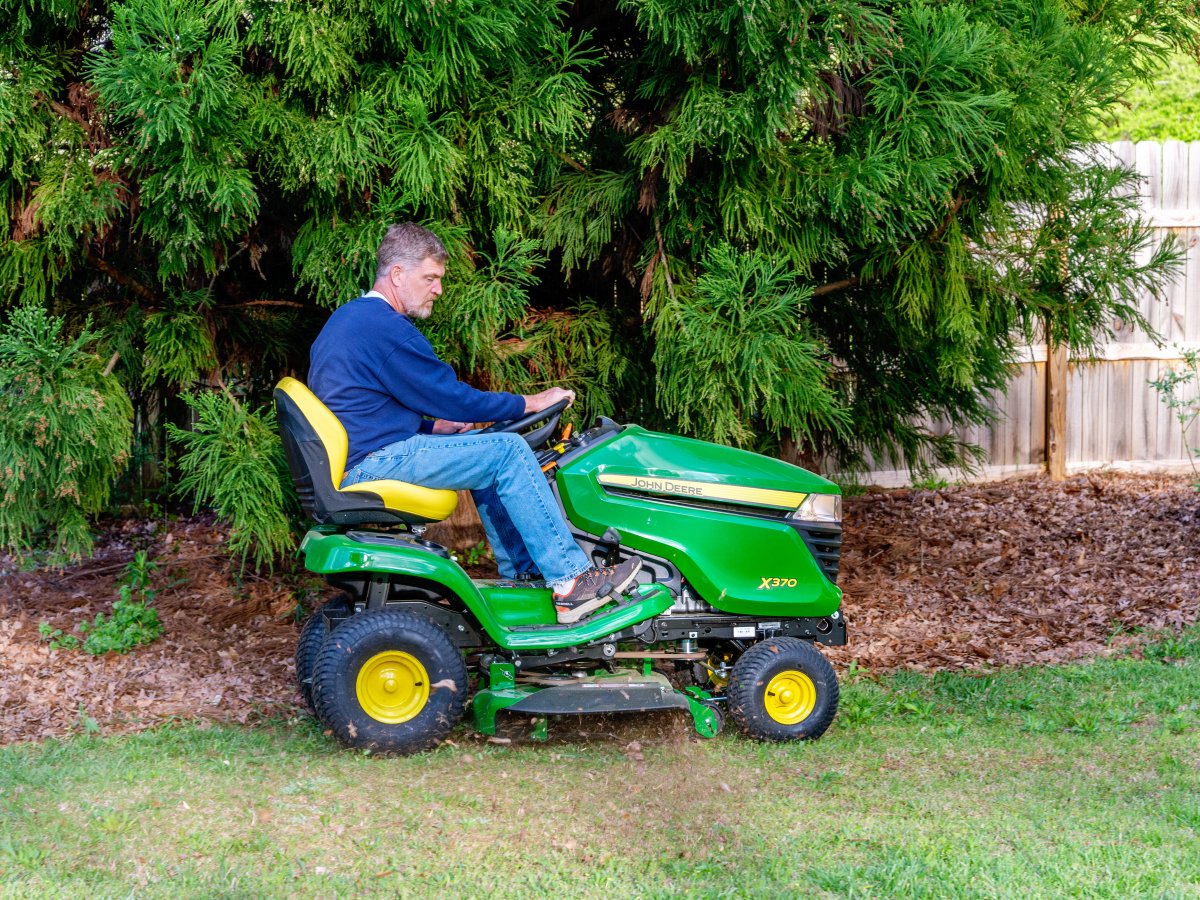
Best Premium Pick: John Deere X370 Lawn Tractor
The John Deere X370 is a polished, comfortable lawn tractor that makes an excellent choice for homeowners who want refined handling and dependable long-term ownership. It is especially appealing for people who value smooth steering, quality construction, and the ability to use attachments beyond mowing season.
The X370 uses a 21.5-horsepower V-twin engine and hydrostatic transmission, allowing operators to control forward and reverse movement with foot pedals. This setup is especially useful on uneven turf, where a steady pace is safer and produces a cleaner cut.
Its 42-inch Accel Deep mower deck is a practical size for many residential lawns. It is large enough to reduce mowing time compared with a walk-behind mower but compact enough to navigate around trees, garden beds, and uneven boundaries.
The X370 earns points for power steering, cruise control, wet disc brakes, and thoughtful operator ergonomics. It feels more refined than many entry-level lawn tractors, especially when mowing for an hour or more.
The drawback is that it does not include a locking differential. That does not make it a poor choice for hills, but it means owners should be realistic about wet grass and traction limits. It is best for maintained slopes where turf is dry, obstacles are cleared, and the grade stays within the manufacturer’s recommendations.
Best for: Homeowners who want premium comfort, reliable handling, and attachment versatility.
Keep in mind: It is better suited to controlled slopes than slick, rugged terrain.
Best Value for Mild Hills: Cub Cadet XT1 LT46 Lawn Tractor
The Cub Cadet XT1 LT46 is a practical option for homeowners who have a larger yard with mild hills, open grass, and a few landscaping obstacles. It offers a broad 46-inch cutting deck, hydrostatic drive, and a capable twin-cylinder engine without wandering into luxury-tractor pricing.
The hydrostatic foot-pedal transmission is easy to use. Rather than worrying about manual gear changes, you can concentrate on keeping a controlled pace and following a safe mowing path. The mower also has a relatively tight turning radius for a lawn tractor, which is helpful around trees and curved lawn borders.
With a 22-horsepower Kohler engine and a 46-inch stamped deck, the XT1 LT46 has enough muscle for regular mowing on lawns of roughly one to one-and-a-half acres, depending on terrain and grass density.
The important limitation is traction. This model does not have a rear differential lock. That means it is best treated as a mower for gentle slopes and dry grass rather than a dedicated hill-climbing machine. It can handle uneven ground well when used carefully, but it is not the mower to choose for steep or persistently damp hillsides.
Best for: Budget-conscious homeowners with mild slopes and medium-size lawns.
Keep in mind: Skip this one if your yard regularly causes tires to spin or if the grass stays wet for long periods.
Best Electric Option: Greenworks Pro 60V CrossoverT
Electric riding mowers have come a long way from the early days of “quiet but maybe a little nervous around tall grass.” The Greenworks Pro 60V CrossoverT shows how far battery-powered lawn equipment has progressed.
This riding mower uses a 42-inch cutting deck and a 60V battery platform. It offers a quiet mowing experience, instant electric torque, and no gasoline, oil changes, spark plugs, or carburetor drama. For homeowners who are tired of fuel cans smelling like a tiny gas station exploded in the garage, that is a major advantage.
The CrossoverT has a 12-gauge deck, 20-inch rear wheels, a top mowing speed of up to 8 miles per hour, and a reported runtime around one hour depending on conditions. Battery performance will vary with grass height, terrain, temperature, cutting speed, and whether you are mowing uphill while pretending the lawn is an off-road course.
Electric power can work well on rolling lawns because torque arrives immediately. However, battery-powered riding mowers are not automatically better for steep hills. Weight, traction, wet grass, and the manufacturer’s slope limits still matter. The best use case is a maintained property with moderate terrain, predictable mowing conditions, and access to convenient charging.
Best for: Homeowners who want a quieter, lower-maintenance riding mower for moderate terrain.
Keep in mind: Runtime can shrink when mowing tall, wet grass or repeatedly climbing hills.
Best Zero-Turn for Rolling Terrain: Toro TimeCutter 42-Inch Zero-Turn
The Toro TimeCutter 42-inch zero-turn mower is a strong option for homeowners who want to reduce mowing time on a property with gentle rolling terrain, open grass, and plenty of trees or landscaping beds.
Its biggest advantage is maneuverability. A zero-turn mower can pivot quickly around trees, garden islands, and lawn ornaments that apparently migrated three feet since last weekend. The 42-inch deck is also compact enough for many suburban properties while still covering far more ground per pass than a standard walk-behind mower.
This Toro model uses a 22-horsepower engine and offers multiple speed settings. It is fast, capable, and fun to operate once you learn how to control the lap bars smoothly.
But here is the important warning: zero-turn mowers are not automatically the best choice for serious hills. Their speed and maneuverability can become disadvantages on steep or wet slopes. Sharp turns, sudden steering input, downhill braking, and slick grass can quickly create a loss-of-control situation.
The TimeCutter works best on rolling yards where the slopes are gentle, dry, and within the manufacturer’s stated operating limits. On more demanding hills, a lawn tractor with a steering wheel, hydrostatic pedals, and a traction-focused drivetrain is often the smarter choice.
Best for: Fast mowing on gently rolling lawns with trees and landscaping.
Keep in mind: Do not buy a zero-turn just because your property has hills. Buy one only if the hills are mild enough for safe operation.
How to Safely Mow Hills With a Riding Lawn Mower
A hill-ready riding mower is only half the equation. The other half is the person in the seat. Even a well-equipped lawn tractor can become unstable if it is operated too quickly, too close to a ditch, or on grass that is wet enough to qualify as a skating rink.
Measure the Slope Before Buying
Do not estimate your slope based on vibes. Use a slope gauge, clinometer app, or the guidance in a mower’s operator manual. Manufacturers set specific slope limits for a reason, and those limits should always come before confidence, convenience, or the desire to finish mowing before dinner.
Never Mow Wet Grass on a Hill
Wet grass reduces traction, clogs decks, and hides uneven ground. Even a mower with a locking differential can lose grip when grass is slick. Wait until the lawn is dry, especially after rain, morning dew, irrigation, or that one neighbor who waters the sidewalk with military precision.
Use Slow, Steady Movements
Abrupt acceleration, hard braking, sharp turns, and sudden direction changes can destabilize a riding mower. Keep movement gradual and deliberate. Slow is not boring when the alternative is explaining to your spouse why the mower is leaning against the shed.
Stay Away From Drop-Offs and Ditches
Keep a generous buffer from retaining walls, creek banks, drainage ditches, ponds, embankments, and culverts. These areas can collapse under the mower’s weight or pull a wheel over the edge. Use a string trimmer or walk-behind mower for sections that are too risky for a riding mower.
Keep Children and Pets Away
Before mowing, check the entire area for children, pets, toys, branches, rocks, hoses, and surprise lawn decorations. Never carry passengers on a riding mower, even if a child insists that sitting on the fender would be “super fun.” That sentence has never improved a mowing situation.
Field Notes: Real-World Experiences With Riding Mowers on Hills
Anyone who has mowed a hilly yard for more than a few weekends learns the same lesson: the lawn always looks flatter from the kitchen window.
At first, a sloped property can seem easy enough. You buy a riding mower, make a few confident passes, and enjoy the feeling of being the captain of a very loud green ship. Then the grass gets taller after a rainy week. The hill becomes slick. One rear tire starts spinning. The mower slows down. Suddenly, your peaceful Saturday chore feels like a low-budget adventure movie.
One of the biggest differences between mowing flat land and mowing hills is how often conditions change. A small slope can become difficult when the grass is wet. A gentle rise can feel steep when the mower deck is full of clippings. A patch of loose soil near a tree can make the machine slide just enough to remind you that traction is not a personality trait; it is a mechanical reality.
Experienced owners often learn to mow their property in zones. The flattest areas get handled first, usually when the grass is still cool and dry. Next come the moderate slopes, where speed is reduced and turns are planned before the mower reaches the edge of the hill. The trickiest sections are left for last, and sometimes they are not handled by the riding mower at all. A walk-behind mower or string trimmer may take longer, but it can be the safer tool for a ditch line, steep bank, or awkward patch beside a retaining wall.
Another common experience is discovering that wider is not always better. A 54-inch deck can make fast work of open acreage, but it can also feel oversized around narrow paths, trees, and sharp changes in grade. A 42-inch or 46-inch mower may take slightly longer to mow, but it can be easier to place accurately and less likely to scalp a hump or scrape a slope transition.
Owners also tend to become obsessed with tire pressure, and for good reason. Uneven tire pressure can affect cut quality, traction, and how stable the mower feels. Checking the tires before mowing is not glamorous, but neither is explaining why your lawn now has stripes that look like modern art.
Comfort matters more over time, too. A suspension seat sounds like a luxury until you spend two hours bouncing over old tree roots, shallow ruts, and the mysterious lump that has existed in the yard since 2009. A comfortable seat helps you stay focused, and staying focused is especially important when every turn requires a little planning.
The best long-term experience usually comes from choosing a mower that matches the property rather than choosing the fastest or flashiest machine in the showroom. For mild hills, a solid lawn tractor with hydrostatic drive may be all you need. For larger, rougher terrain, a locking differential can be a game changer. For steep slopes, the smartest choice may be accepting that no riding mower belongs there.
That is not a disappointing conclusion. It is the kind of practical wisdom that keeps the grass trimmed, the mower upright, and your weekend from becoming a story everyone tells at family gatherings for the next decade.
Final Thoughts
The best riding lawn mower for hills is not necessarily the fastest mower, the biggest mower, or the one with the most cup holders. It is the one that gives you controlled speed, reliable traction, comfortable handling, and enough stability for your actual terrain.
For serious rolling ground and larger properties, the Husqvarna TS 375XD stands out because of its locking differential, hydrostatic drive, strong engine, and durable deck. The John Deere X370 is an excellent premium choice for maintained slopes and homeowners who value smooth handling. The Cub Cadet XT1 LT46 offers solid value for mild hills, while the Greenworks CrossoverT is an appealing electric alternative for moderate terrain. The Toro TimeCutter is a fast, capable choice for gentle rolling lawns but should not be treated as a mountain-climbing machine.
Note: Product availability, pricing, specifications, and manufacturer slope limits can change. Always review the current owner’s manual and safety labels before operating a riding mower on any slope.