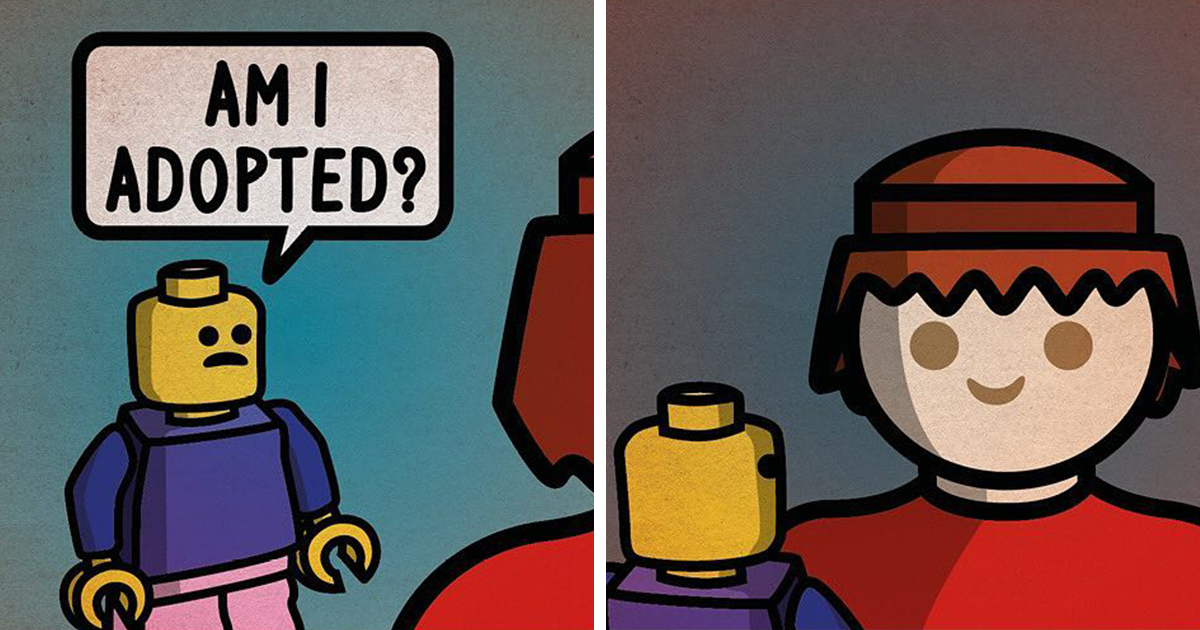
This Artist Creates Dark Yet Silly Comics About A Funny Grandma And Other Unexpected Situations (30 New Pics)

Grandmothers in popular culture are usually assigned a predictable set of accessories: a warm cardigan, a plate of cookies, several strong opinions about your relationship status, and perhaps a suspiciously large collection of plastic grocery bags. Suzanne, the unpredictable star of the Psycho Suzanne comics, apparently missed that meeting.
Instead, she wanders through a cartoon universe where ordinary situations can become absurd, sinister, strangely wholesome, or all three before the final panel. One moment feels like a harmless family joke. The next delivers a punchline from somewhere between a neighborhood barbecue and a low-budget horror movie. That contrast is exactly what makes these 30 dark yet silly comics so entertaining.
Meet Psycho Suzanne, the Grandma Who Refuses to Behave
Psycho Suzanne is the work of Paul, a comic artist based in Paris, France. Although the character is heavily fictionalized, Suzanne was loosely inspired by his real grandmother, whom he visited during childhood summers in southern France. According to the artist, she watched horror movies with him, played chess, and occasionally pretended to lose to encourage him.
The real Suzanne was reportedly sweet and had darker hair than her cartoon counterpart. The fictional Suzanne, however, has been given permission to cause considerably more trouble. Paul has said that his grandmother probably would have enjoyed the exaggerated character created in her honor.
Artist identity, location, inspiration and childhood details are based on interviews and profiles of Paul and Psycho Suzanne.
That emotional connection gives the series more personality than a collection of random dark humor comics might otherwise possess. Suzanne is not merely an interchangeable cartoon senior inserted into unrelated jokes. She represents a playful memory transformed into a recurring comic personality.
She may be chaotic, but she is rarely dull. Her presence immediately creates tension because readers know that the harmless-looking grandmother may be the most dangerous, clever, or unpredictable person in the room.
A Familiar Character With an Unfamiliar Attitude
The design works because it takes a recognizable cultural stereotype and turns it upside down. Readers expect an elderly woman to be cautious, gentle, or confused by the strange behavior around her. Suzanne frequently becomes the source of the strange behavior.
That reversal produces instant comic energy. A younger character may look physically stronger or socially more confident, but Suzanne often controls the situation. She does not need superhero muscles, magical powers, or an expensive utility belt. She has experience, confidence, and the unnerving calm of someone who has already survived several decades of nonsense.
Why the Dark and Silly Combination Works
Dark humor is difficult to handle well. Push too far in one direction, and a comic becomes unpleasant rather than funny. Stay too cautious, and the promised darkness feels like a porch light flickering once before behaving normally.
Paul’s comics generally balance the two moods by beginning with something simple and familiar. The setup may involve a household problem, an animal, a conversation, a relationship, or another ordinary inconvenience. The artwork encourages the reader to relax. Then the final panel introduces a ridiculous reinterpretation of everything that came before it.
This is a classic use of comic incongruity: the brain anticipates one logical outcome but receives another. Research into black humor suggests that understanding darker jokes can involve both cognitive and emotional processing. The audience has to recognize the disturbing implication while simultaneously accepting the fictional absurdity of the situation.
Research on humor, incongruity and black-humor processing supports this analysis.
The Setup Builds a Tiny Trap
A successful short comic makes readers participate in their own surprise. The opening panels quietly encourage an assumption: this is a sweet interaction, a familiar complaint, or a harmless misunderstanding. Readers fill in the missing information and predict what will happen next.
Then the punchline reveals that the prediction was completely wrong.
This process is especially effective in a three- or four-panel format. There is little room for unnecessary explanation. Each expression, pause, speech balloon, and visual detail must move the joke forward. The empty space between panels also matters because readers mentally connect the separate moments into one continuous event.
Comic scholars often describe this act of inference as “closure.” The artist does not show every movement or explain every transition. Readers complete the sequence themselves. When the final panel changes the meaning of the setup, they must mentally reconstruct the entire joke in an instant.
Visual-storytelling analysis is informed by research into panel transitions, inference and the combination of words and images in comics.
The Punchline Arrives Without Wearing a Warning Label
One of the strengths of Psycho Suzanne is that the artwork does not announce every dark turn with dramatic shadows and thunderclouds. The characters often maintain calm, uncomplicated expressions even when the situation becomes thoroughly unhinged.
That visual restraint makes the punchline sharper. If every panel screamed, “Something terrible is coming,” the surprise would disappear. Instead, a clean cartoon style allows the joke to sneak into the room, sit politely on the couch, and then reveal that it brought a chainsaw.
Thirty Comics, Countless Unexpected Directions
The new collection demonstrates that the series is not limited to jokes about aging or family life. Suzanne may be the signature character, but the comic’s world is broad enough to include animals, romantic misunderstandings, technology, death, everyday frustrations, social behavior, and surreal scenarios that seem to have escaped from a very peculiar dream.
Some comics begin with annoyances nearly everyone recognizes. A stubborn printer, an irritating sound, a strange pet, an awkward conversation, or an insect trapped near a window can become the foundation for an absurd punchline. Other strips borrow familiar ideas from horror stories, fairy tales, religion, science fiction, or popular culture and then steer them toward something much less dignified.
This variety keeps the collection from becoming repetitive. The reader understands the general promisesomething unexpected is approachingbut cannot predict its exact shape. It could be dark, childish, clever, gross, sweet, or so wonderfully ridiculous that analyzing it feels like using a laboratory microscope to inspect a rubber chicken.
Suzanne Is the Anchor, Not the Limitation
A recurring character can become restrictive when every joke depends on the same personality trait. Suzanne avoids that problem because her defining quality is unpredictability. She can be kind in one strip, brutally practical in another, and delightfully strange in the next.
Her age also adds flexibility. She can be written as someone with old-fashioned habits, unexpected modern knowledge, a long memory, or absolutely no patience for younger people’s drama. Each version still feels compatible with the central character.
More importantly, Suzanne provides emotional continuity. Even when the comic explores unrelated situations, returning to her feels like visiting an eccentric relativeassuming that relative might challenge Death to a board game and complain about his manners.
The Art of Keeping a Comic Simple
Paul has advised aspiring cartoonists to simplify their work and remove anything that does not serve the joke. That philosophy is visible throughout Psycho Suzanne. The panels are easy to read, the dialogue is usually concise, and the compositions direct attention toward the essential action.
Simplicity, however, should not be confused with laziness. Creating a clear comic often requires more discipline than filling a panel with decorative detail. Every extra object competes with the punchline. Every additional sentence slows the timing. Every unnecessary explanation risks turning a sharp joke into a committee meeting.
Paul’s comments about simplicity, making readers laugh and not taking oneself too seriously come from his published interview.
Expressions Do Much of the Heavy Lifting
In short-form comedy, a character’s face can function as an entire paragraph. A raised eyebrow may signal suspicion. A blank stare can make a bizarre event funnier. An exaggerated reaction can tell readers exactly when the situation has crossed from normal into chaos.
Caricature has relied on visual exaggeration for centuries. Cartoonists reduce complicated emotions to recognizable shapes, gestures, and expressions. The technique allows a reader to understand a character’s attitude almost instantly, which is essential when a strip has only a few panels to establish its premise.
Historical discussion of caricature and visual exaggeration is supported by Smithsonian coverage of cartoon art.
Good Timing Exists on the Page
Comic timing is not exclusive to stand-up comedy or film. On a page, timing emerges from panel size, dialogue length, repetition, pauses, and the order in which information is revealed.
A silent reaction panel can create the visual equivalent of a comedian pausing before a punchline. A repeated composition can establish a pattern that the final image breaks. A short final sentence can land harder than a long explanation because the reader reaches it at exactly the right moment.
Paul’s strongest comics understand that a joke should stop after it lands. They do not chase the punchline down the street, tackle it, and demand that it explain itself.
Dark Humor With a Surprisingly Warm Center
Despite the comic’s title and twisted endings, the project is not built entirely on cynicism. Paul has described his goal in simple terms: he wants to make people laugh for a few seconds during a difficult day.
He has also recalled receiving a message from a reader experiencing long-term depression who said that new comics made difficult days more bearable. That response helped reinforce his reason for creating them.
The story highlights an important feature of silly webcomics. A short joke may appear lightweight, but its effect can still be meaningful. Readers do not always need a long inspirational speech accompanied by piano music. Sometimes they need a strange cartoon grandma to behave terribly for four panels.
The artist’s stated creative goal and the message from a reader were reported in his interview.
Studies of humor have explored its role in cognitive reappraisalthe process of viewing a difficult experience from a different perspective. A joke does not erase a problem, but it can briefly change the emotional distance between the person and the problem.
Dark comedy can be especially effective in this regard because it does not pretend that life is always cheerful. It acknowledges discomfort, fear, embarrassment, and absurdity, then rearranges those feelings into something manageable enough to laugh at.
Research has examined humor as a tool for reframing adverse experiences and regulating emotion.
How Psycho Suzanne Fits Into the Dark Cartoon Tradition
The combination of harmless-looking characters and macabre ideas has a long history in cartooning. Charles Addams famously placed disturbing behavior inside polite domestic settings, while Gahan Wilson depicted ordinary people encountering monsters, death, and impossible situations with uncomfortable calm.
Psycho Suzanne belongs to that broad tradition without simply imitating it. Its humor has been shaped for the speed of social media, where a comic must communicate clearly on a phone screen and reward readers almost immediately.
That does not make contemporary webcomics less sophisticated. Economy can be an artistic strength. A successful social-media comic must introduce characters, establish a situation, control the reading rhythm, and deliver a memorable ending before the audience’s thumb decides to continue scrolling.
The historical comparison draws on New Yorker discussions of Charles Addams and Gahan Wilson, as well as Library of Congress material on comic-strip storytelling.
What Aspiring Comic Artists Can Learn From the Series
Start With a Clear Expectation
Unexpected endings only work when the reader first expects something else. Before writing the twist, establish a believable direction. The more natural the setup feels, the more satisfying the reversal becomes.
Build Characters, Not Just Punchline Delivery Systems
A memorable protagonist gives readers a reason to return. Suzanne is recognizable before she says anything. Her appearance, age, confidence, and reputation all contribute to the joke.
Remove Explanations the Artwork Can Provide
If a facial expression communicates confusion, the character does not also need to announce, “I am confused.” Trusting the illustration creates cleaner dialogue and better pacing.
Use Darkness as Contrast, Not Decoration
Adding violence, death, or shock does not automatically make a joke clever. The dark element should change the meaning of the setup. Otherwise, it is merely wearing black clothing and hoping nobody asks follow-up questions.
Keep Collecting Ideas
Paul has described sketching ideas on small pieces of paper scattered around his home. The system may not win an award for office organization, but it reflects a useful creative habit: capture ideas before they disappear.
A strange observation in a grocery store, an overheard sentence, an annoying household object, or a childhood memory can all become comic material. The joke may arrive immediately or sit on a scrap of paper until the right character discovers it.
Paul has discussed his childhood interest in drawing cavemen and his habit of recording comic ideas on small pieces of paper.
The Reader Experience: Spending Time in Suzanne’s Strange Little World
Reading a collection of Psycho Suzanne comics produces a particular rhythm. The first few strips teach you not to trust anything. A pleasant conversation may conceal a dark motive. An innocent object may become dangerous. A character who appears to understand the situation may understand absolutely nothing.
After several comics, you begin searching every panel for clues. Is that animal important? Why is Suzanne smiling? Is the ordinary household appliance secretly planning something? Has the Grim Reaper made another poor career decision?
This heightened suspicion becomes part of the fun. The reader is no longer passively waiting for a joke. You are attempting to outsmart the artistand usually failing with impressive consistency.
The most enjoyable experience comes from resisting the urge to rush. Webcomics are designed for fast reading, but the punchlines become more effective when you briefly pause before the final panel. Let the setup establish itself. Notice the characters’ expressions. Decide what you think will happen. Then scroll.
That tiny delay gives the twist more room to work. It recreates the pause a comedian uses before delivering the final line. It also allows you to appreciate how carefully a seemingly simple comic directs your attention away from the real ending.
Another pleasure is sharing the strips with someone whose sense of humor you know well. Dark comedy is highly subjective. One person may laugh immediately, while another stares at the screen as if you have just revealed an alarming personality test result.
That difference can generate its own comedy. Sending a Suzanne strip to a friend is partly a recommendation and partly an experiment: “Will this person laugh, groan, or quietly reconsider our relationship?”
The grandma character also creates a surprisingly nostalgic reading experience. Even when the fictional Suzanne behaves nothing like our own relatives, she can remind us of older family members who were sharper, funnier, stranger, or more rebellious than outsiders realized.
Many people remember a grandmother who cheated slightly at cards, ignored unnecessary rules, told inappropriate stories at dinner, or possessed an unexplained ability to intimidate customer-service representatives. Suzanne exaggerates that hidden energy until it becomes cartoon chaos.
The emotional warmth behind the character makes the darker jokes easier to accept. Knowing that she was inspired by affectionate childhood memories changes how the series feels. The fictional grandma may be outrageous, but the project itself is rooted in admiration.
There is also something refreshing about seeing an elderly woman occupy the center of absurd comedy. Older characters are often treated as background figures, sources of wisdom, or jokes about confusion. Suzanne gets to be active. She makes choices, creates problems, surprises younger characters, and refuses to become invisible.
That agency makes her more than a gimmick. She represents the possibility that aging does not automatically eliminate mischief, imagination, anger, humor, curiosity, or terrible decision-making. In other words, there is hope for all of us.
By the end of the collection, the reader may not understand Suzanne any better than before. That is probably intentional. A perfectly predictable Psycho Suzanne would be a contradiction. She works because each new situation feels like opening a door without knowing whether the other side contains cookies, a monster, or a monster holding cookies.
Final Thoughts
These 30 new Psycho Suzanne comics show how much entertainment can fit into a handful of carefully arranged panels. Paul combines simple visual storytelling, familiar situations, expressive characters, and sudden reversals to create jokes that are both silly and slightly dangerous.
Suzanne remains the ideal guide to this strange world. She looks familiar enough to earn our trust and unpredictable enough to make that trust a serious tactical error. Beneath the dark humor, however, the comic carries a warm purpose: honoring a beloved grandmother and giving readers a brief laugh when the day becomes difficult.
That is a respectable mission for any artist. It is also considerably cheaper than therapy, although readers should probably avoid accepting medical advice from Suzanne.