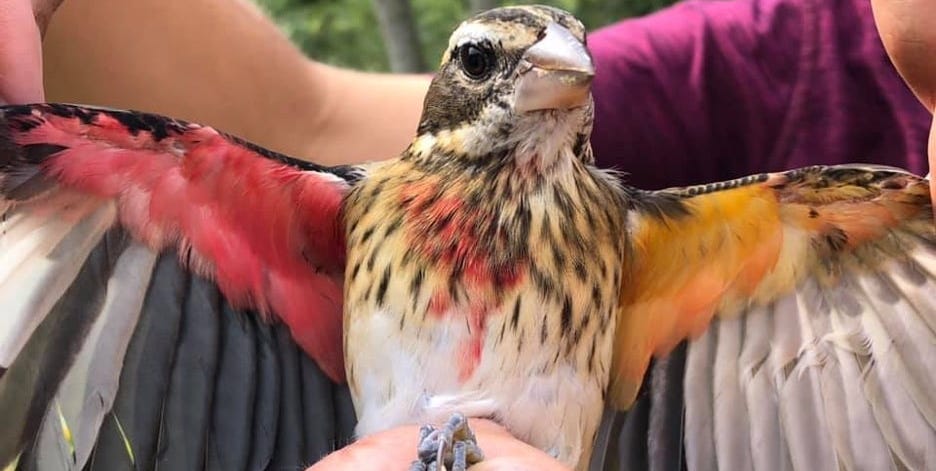

Imagine looking out at a bird feeder and seeing a creature that appears to have been painted by two committees who never met. One side flasr wears the softer tones of a female. No filter, no Photoshop, no prank from a bored ornithologist with a tiny paintbrush. This is a real biological phenomenon, and it has a wonderfully dramatic name: bilateral gynandromorphism.
In plain American English, a bilateral gynandromorph is an animal whose body shows male characteristics on one side and female characteristics on the other. In birds, this can create some of the most astonishing sights in nature: a half male, half female bird split nearly down the middle like a feathered science-fiction character with excellent symmetry.
The most recent famous example is a wild green honeycreeper photographed in Colombia. The bird showed blue male-like plumage on one side and green female-like plumage on the other. Northern cardinals have also made headlines for the same reason, especially because male cardinals are bright red and females are warm brown. When that contrast appears on a single bird, even casual backyard birders suddenly become very serious scientists with binoculars.
What Is a Gynandromorph Bird?
A gynandromorph bird is not simply a bird with unusual feathers. It is an individual whose body contains cells with different biological sex identities. In many documented bird cases, one side of the body may be genetically male while the other side may be genetically female. That means the split is deeper than color. The feathers are only the billboard advertising what happened during development.
The word “gynandromorph” comes from Greek roots meaning female, male, and form. It sounds like something you would need to defeat in a fantasy video game, but it simply describes an organism that displays both male and female traits. Gynandromorphism has been observed in birds, butterflies, bees, spiders, crustaceans, and other animals. It is easiest to notice in species where males and females look dramatically different, a feature scientists call sexual dimorphism.
That is why cardinals and green honeycreepers are perfect headline-makers. A male Northern Cardinal is famous for its brilliant red body and black face mask. A female Northern Cardinal is mostly pale brown with reddish highlights. A male green honeycreeper can show vivid blue-green plumage with dark facial markings, while a female is typically greener and more subdued. Put both patterns on one body, and nature has created the birding equivalent of a plot twist.
Bilateral Gynandromorphism: Nature’s Split-Screen Mode
Gynandromorphism can appear in more than one pattern. Some animals show a patchwork or mosaic pattern, with male and female traits scattered in different areas. Others may show a front-to-back division. But the most visually shocking form is bilateral gynandromorphism, where the animal appears divided into left and right halves.
In a bilateral gynandromorph bird, one side may carry male plumage and the other side female plumage. The result can look almost too neat, as if someone folded the bird along its spine and gave each half a different wardrobe. But the split is not decorative. It reflects the way cells developed early in the embryo.
For humans, the usual shorthand is XX for female and XY for male, though real biology is more complex than school posters suggest. Birds use a different system. Male birds usually have two Z chromosomes, written as ZZ. Female birds usually have one Z and one W chromosome, written as ZW. That reversal surprises many people. In birds, females are the sex with two different sex chromosomes.
Scientists believe many gynandromorph birds may arise when an egg forms unusually, carrying two genetic nuclei instead of one, and then is fertilized in a rare way. The developing embryo can end up with some cells that are ZZ and others that are ZW. If those cells become arranged mainly on opposite sides of the body, the bird may develop with a male-looking side and a female-looking side.
Yes, biology occasionally assembles an animal like it is testing a limited-edition model. No, it does not ask permission from our tidy categories first.
The Green Honeycreeper That Stunned Birdwatchers
The green honeycreeper case is especially exciting because this species had only a very small number of recorded bilateral gynandromorph examples. The bird was observed near Villamaría, Colombia, and photographed over an extended period. It showed male-type plumage on one side and female-type plumage on the other. The observation was remarkable not only because of the bird’s appearance, but also because it was seen alive in the wild over many months.
Green honeycreepers are small, energetic birds found in tropical forests from southern Mexico through Central America and into South America. They feed on nectar, fruit, and small arthropods. At feeding stations, they can appear with other colorful birds, which is already a pretty good morning for anyone with binoculars. But seeing a green honeycreeper divided into male and female sides is the kind of moment that makes even seasoned birders forget how to speak in full sentences.
The documented bird behaved mostly like other green honeycreepers. It came to feeders, moved around the area, and fed on fruit. Researchers noted that it often appeared more solitary and sometimes waited until other birds had moved away before feeding. There was no clear evidence of courtship or successful reproduction. That does not mean every gynandromorph bird behaves the same way; it means each rare observation is valuable because scientists have so few opportunities to watch these animals closely.
Half Male, Half Female Cardinals: Backyard Science With Drama
For many Americans, the most familiar example of a bird both male and female is the Northern Cardinal. Cardinals are common backyard visitors across much of the eastern and central United States, and they are famous for being easy to recognize. The male is the red celebrity of the bird feeder. The female is subtler but still beautiful, with warm brown plumage, red-orange accents, and the same proud crest.
When a cardinal appears red on one side and brown on the other, it immediately grabs attention. Several such cardinals have been reported and photographed. One well-known case involved a bird observed in northwestern Illinois from late 2008 into 2010. Researchers watched it for more than 40 days. It had male-like red plumage on one side and female-like brownish-gray plumage on the other. It was not heard vocalizing, was not seen paired with another cardinal, and did not appear to be treated unusually aggressively by other cardinals.
Another widely discussed cardinal appeared in Pennsylvania, where backyard birders noticed a striking red-and-brown split. Because cardinals are so familiar, their differences are easy to spot. A half-red, half-brown cardinal does not blend into the usual feeder crowd. It arrives like a tiny biological headline with wings.
Is a Gynandromorph Bird the Same as a Hermaphrodite?
No. This is one of the most important distinctions. A gynandromorph is not simply a hermaphrodite, and the two words should not be tossed into the same nest.
A hermaphrodite usually refers to an organism that has both male and female reproductive organs or reproductive functions. Many plants and some animals naturally fit that description. A gynandromorph, on the other hand, has male and female characteristics because its body is made of different populations of cells. In birds, that may mean some tissues are genetically male and others are genetically female.
With gynandromorph birds, the outside appearance may not tell scientists everything about the internal anatomy. A bird might look male on one side and female on the other, but researchers cannot know the exact internal arrangement without detailed study. In the wild, ethical observation usually means watching, photographing, and leaving the bird alone. Nature does not owe us a lab report, even when it lands conveniently near a feeder.
Why These Birds Matter to Science
A bird that is both male and female is not only a curiosity. It can help researchers understand how sex develops in birds. For a long time, many scientists emphasized hormones as the main drivers of male and female differences in vertebrates. Hormones are certainly important, but gynandromorph birds suggest that individual cells also carry strong sex-specific instructions.
Studies of gynandromorphic zebra finches and chickens have helped show that bird cells may retain a kind of built-in sexual identity. In one famous zebra finch, the brain itself showed differences between the genetically male and genetically female sides. That mattered because song behavior in zebra finches is strongly linked to sex. Male zebra finches usually learn and sing courtship songs, while females generally do not. When scientists examined a gynandromorphic finch, they found that the song-related brain areas differed between the two sides.
This does not mean every half male, half female bird has a perfectly split brain or predictable behavior. It means these rare animals provide clues that ordinary individuals cannot. They are natural experiments, although “experiment” sounds too cold for something so alive, bright, and busy hopping around fruit.
Can a Half Male, Half Female Bird Reproduce?
The answer is: sometimes maybe, often probably not, and always more complicated than a quick headline wants it to be.
Reproduction depends on internal anatomy, hormone function, behavior, and whether the bird can attract or respond to a mate. In many bird species, the left ovary is the functional one in females, which creates an interesting possibility. If a bilateral gynandromorph has functional female reproductive tissue on the correct side, reproduction might be possible. However, most observed gynandromorph birds are not known to have reproduced.
Behavior matters too. Birds do not mate by spreadsheet. They sing, display, defend territories, choose partners, build nests, and respond to seasonal cues. If a bird’s body, brain, and hormones send mixed signals, courtship may be less likely or less successful. Some observed gynandromorph cardinals were not heard singing or seen paired. The green honeycreeper observed in Colombia also did not show clear evidence of pairing or reproduction.
Still, scientists avoid making universal claims from a handful of rare cases. Every new observation adds another feather to the file.
How Rare Are Birds That Are Both Male and Female?
Bilateral gynandromorph birds are extremely rare. Many experienced birdwatchers may go their entire lives without seeing one. But rarity is tricky. These birds may be underreported because they are easiest to detect only in species where males and females look very different. If a species has males and females with similar plumage, a gynandromorph individual might fly past unnoticed, living a perfectly unusual life in total privacy.
There is also the timing problem. Birders must be in the right place, at the right moment, with enough knowledge to recognize what they are seeing. A person might glimpse a strange bird and assume it is molting, injured, muddy, shaded, or just having a rough fashion day. Only clear photographs and repeated observations help confirm what is happening.
That is why backyard birdwatchers matter. Many important sightings begin with ordinary people noticing something extraordinary. A feeder, a camera, and curiosity can turn a backyard into a tiny field station. Science sometimes starts with a sentence as simple as, “Honey, come look at this bird.”
What to Do If You See a Bird Like This
If you ever see a bird that appears half male and half female, the first rule is simple: do not disturb it. The bird does not need to be chased, trapped, cornered, or promoted to neighborhood celebrity status with paparazzi-level enthusiasm.
Instead, take clear photos or video if you can do so from a respectful distance. Record the date, time, location, behavior, and species if you know it. Note whether the bird is feeding, singing, interacting with others, or returning regularly. Then consider reporting the observation to a local bird club, ornithological organization, eBird reviewer, wildlife biologist, or natural history museum.
Good documentation helps researchers separate true gynandromorphism from other possibilities such as unusual molt, leucism, injury, staining, hybridization, or age-related plumage changes. A clear photo can be more useful than a breathless description, although breathless descriptions are understandable. Seeing one of these birds is not exactly a sip-your-coffee-calmly situation.
What This Bird Teaches Us About Nature
A bird both male and female reminds us that biology is not a row of perfectly labeled boxes. Nature has patterns, but it also has exceptions. Those exceptions are not failures. They are clues. They show us how development works, how chromosomes influence cells, how bodies form, and how much remains to be learned.
There is also a humbling lesson here. Humans like categories because categories are useful. Male and female, adult and juvenile, common and rare, normal and unusual. But living things do not exist to satisfy our filing systems. A bilateral gynandromorph bird is not confused. It is not trying to make a statement. It is simply alive, built by a rare developmental pathway, and carrying its biology in plain sight.
That is part of the wonder. The bird does not need our metaphors, but we keep making them anyway because we are humans and apparently cannot see a two-toned cardinal without becoming poets. It is a split-screen miracle, a genetic mosaic, a flying reminder that the natural world is more inventive than our vocabulary.
Experience Section: What It Feels Like to Encounter a Bird Both Male and Female
Anyone who spends enough time watching birds learns that most days are pleasantly ordinary. Sparrows argue. Doves waddle around like soft gray accountants. A cardinal lands, grabs a seed, and leaves with the confidence of a bird that knows it looks good. Then, once in a great while, something appears that makes the whole morning feel rewired.
Picture standing near a window with coffee cooling in your hand. At first, you notice movement. A small bird lands near the feeder. Your brain identifies the species automatically, because birdwatching trains the mind to sort shapes quickly: bill, tail, crest, posture, color. But then the color does not behave. One side seems male. The other side seems female. You blink. The bird turns. The split remains. The coffee is now officially forgotten.
The first reaction is usually disbelief. Maybe it is lighting. Maybe the bird is partly hidden behind a branch. Maybe the window is dirty, which is always possible and never flattering. But then the bird hops into a clearer view, and the division becomes obvious. The body is not just oddly colored. It is organized. One side tells one story, the other side tells another.
That moment changes the way a person sees the ordinary yard. The feeder is no longer just a feeder. It becomes a stage where rare biology may appear without buying a ticket. The shrubs become cover for mysteries. The familiar birds suddenly feel less familiar, not because they changed, but because your sense of possibility expanded. If one bird can carry such a visible exception, what else has been happening in plain sight while everyone was checking email?
There is also a strange tenderness in watching a gynandromorph bird go about its day. The internet may call it “extremely rare” or “half male, half female,” but the bird is not posing for a headline. It is feeding, balancing, watching for threats, choosing when to approach and when to retreat. It has the same practical concerns as every other bird: food, safety, weather, competition, survival. The miracle is not separate from daily life. It is daily life.
For birders, that is the lasting lesson. Rare sightings are thrilling, but they also deepen respect. The correct response is not to own the discovery, crowd the animal, or turn it into a circus. The best response is careful attention. Observe. Document. Share responsibly. Let the bird remain a bird.
And afterward, every flash of color at the feeder feels a little more electric. A red cardinal is still a red cardinal, but now it carries the memory of what nature can do when development takes an unexpected turn. A green honeycreeper is still a small tropical bird, but also a reminder that the world keeps a few secrets in feathers. The experience leaves people with a rare feeling: not just that they saw something beautiful, but that they briefly saw how flexible, strange, and generous life can be.
Conclusion
This bird is both male and female because of a rare condition called bilateral gynandromorphism, in which male and female traits appear in the same individual, often split between the left and right sides. In birds, the phenomenon is tied to their Z and W chromosome system and unusual early development. The result can be visually stunning, especially in species like Northern Cardinals and green honeycreepers, where males and females wear dramatically different colors.
But the real story is bigger than a beautiful oddity. Gynandromorph birds help scientists study sex determination, brain development, behavior, reproduction, and the limits of simple categories. They also remind everyday birdwatchers to keep looking closely. The next great natural history observation may not happen in a distant laboratory. It may land on a branch ten yards from the kitchen window, dressed in two outfits and acting as if it has always belonged there.
Note: This article is original, written for web publication, and based on documented ornithology research and real observations of gynandromorph birds.