
Some ideas are so good they refuse to stay in their original decade. BIG TRAK, the chunky programmable rover that looked like it had escaped from a low-budget moon mission, was one of those ideas. It rolled into homes as a toy, but it also quietly introduced kids to a profound concept: a machine can follow a sequence of instructions and do exactly what you told it to do, not necessarily what you meant. That tiny gap between intention and execution is where programming begins, and where the fun usually starts wearing a crash helmet.
So what does it mean to turn the Big Trak into a turtle? Not into a reptile, sadly. It means transforming a retro programmable vehicle into a Logo-style turtle robot: a machine that can move through space in ways that feel mathematical, expressive, and educational instead of merely toy-like. It is the difference between telling a rover to scoot forward and telling a robot to think in motion. One is a preset stunt. The other is a conversation between code, geometry, and hardware.
This idea has such staying power because it connects three worlds people love: vintage electronics, hands-on robotics, and the wonderfully nerdy educational tradition of turtle graphics. In other words, it is where 1970s toy design meets school-floor geometry and then bumps into modern maker culture with a cheerful plastic thud.
What Made BIG TRAK So Special in the First Place?
BIG TRAK earned its place in retro-tech folklore because it was more than a battery-powered vehicle. It was a programmable one. You entered commands through a keypad, then watched the machine carry them out in sequence. Forward. Turn. Pause. Fire the dramatic little “phaser.” Repeat. That might sound modest today, but at the time it felt futuristic. It gave ordinary households a machine that visibly obeyed code.
The genius of the design was its simplicity. You did not need a monitor, a compiler, or an engineering degree. You needed curiosity, some floor space, and enough optimism to believe the coffee table would not become an obstacle. In practical terms, BIG TRAK introduced procedural thinking. Users had to break a route into discrete steps, estimate movement, and debug failures when the toy ended up under a chair instead of at the intended destination. That is programming, just with more carpet friction.
Its appeal also came from its physicality. A screen turtle draws on pixels. A floor turtle draws on reality. When a robot turns too far, every mistake becomes visible in three dimensions. Kids learn quickly when their code sends a machine toward a wall with the confidence of a startup founder and the judgment of a shopping cart.
Why “Turtle” Matters More Than It Sounds
In computing history, the turtle is not a mascot. It is a philosophy. The Logo tradition, closely associated with Seymour Papert and educational computing, used turtle graphics to teach mathematical thinking through movement. Rather than describing geometry as abstract rules on paper, turtle systems let learners think in body-centered commands such as “forward” and “right 90.” This made direction, distance, angle, and sequence feel intuitive.
That educational insight was brilliant because it turned math into action. A child did not merely memorize angles; the child experienced a turn. A polygon was not an intimidating diagram in a workbook; it was a path the turtle could walk. Debugging a shape became a way to understand the shape itself. If your square looked like a tipsy rhombus that had just heard bad news, your code probably needed another look.
Turning Big Trak into a turtle therefore means giving it a richer identity. Instead of functioning as a programmable stunt vehicle, it becomes a spatial learner’s companion. The machine is no longer just following a keypad routine. It becomes a body-centered robot whose movement can express geometry, algorithms, and feedback. That shift is the real magic.
From Toy Commands to Computational Thinking
A standard programmable toy asks, “What should I do next?” A turtle robot asks, “How do I move through a world defined by position, angle, and sequence?” That distinction sounds subtle, but it changes everything. Once a robot behaves like a turtle, the user starts thinking in patterns, loops, turns, distances, and procedures. Suddenly, code is not just a list. It is a language of motion.
This is why the Big Trak-to-turtle idea resonates so strongly with educators and makers. It preserves the immediacy of a classic toy while borrowing the deeper conceptual structure of Logo. You keep the delight of pressing commands and watching a physical robot roam the room, but you gain a framework that naturally supports math, programming, experimentation, and design thinking.
How the Conversion Idea Works
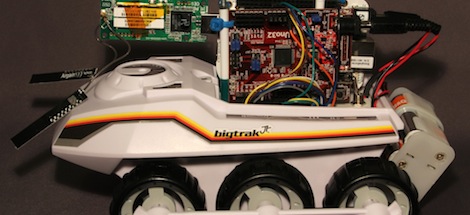
The famous maker interpretation of this concept was not simply a cosmetic makeover. It was a brain transplant. The project upgraded the original style of command system with more modern electronics, making it possible to control the vehicle with a Logo-like interpreter. In practical terms, that meant replacing “limited built-in toy behavior” with “expandable computing platform.” That is a polite way of saying the little rover got promoted.
In the documented hack that popularized the phrase “Turning The Big Trak Into A Turtle,” the build used newer controller hardware and a Python-based Logo interpreter. That matters because Python made the system more flexible, and a modern controller stack allowed the robot to be addressed with higher-level commands rather than just the original keypad’s narrow input method. Wireless control was also added, which is exactly the sort of feature that makes a retro robot feel less like a relic and more like an overachieving grandparent who just discovered Wi-Fi.
What Changes Under the Hood
To convert a BIG TRAK-style vehicle into a turtle robot, several layers usually need attention:
Control electronics: The original logic is either bypassed, supplemented, or replaced. A modern microcontroller or compact computing board can issue more flexible movement instructions and manage timing with greater precision.
Motor control: The drive system has to respond reliably to precise commands. For turtle behavior, sloppy turns are the enemy. If “right 90” means “right-ish, on a good day,” the educational value disappears quickly.
Software interpretation: This is the heart of the transformation. A Logo-style interpreter allows high-level commands to be translated into movement. Instead of entering a fixed sequence by hand, a user can create reusable procedures or test geometric patterns more naturally.
User interface: The original keypad is charming, but modern makers often add browser control, serial input, or wireless access. That turns the robot into a platform rather than a one-trick plastic celebrity.
Why a Logo-Like Layer Changes Everything
Once the robot can interpret turtle-style commands, the machine stops being limited by its factory imagination. You can ask it to trace shapes, explore angles, test repeated motions, and model geometric ideas. A square becomes a program. A spiral becomes a lesson. A debugging session becomes a minor family event where someone inevitably says, “It looked right in my head.”
This is also where the project becomes more than nostalgia. Nostalgia is fun, but it only gets you as far as the first delighted grin. A turtle conversion gives the old platform a second life with actual educational and technical relevance. It lets a classic toy participate in modern conversations about coding, robotics, and STEM learning.
Why Makers Love This Kind of Project
Maker culture adores a good resurrection story. There is something deeply satisfying about taking a device that once represented the future and making it useful again with contemporary tools. BIG TRAK is perfect for that because its original concept was already halfway to robotics. It does not need to be forced into relevance. It was born there.
Converting it into a turtle also scratches several creative itches at once. It is part restoration, part reverse engineering, part educational design, and part performance art. You are preserving a beloved object while also politely informing it that the twenty-first century has arrived and it now has homework.
There is another reason the project sticks in people’s minds: it makes abstract computing visible. Modern software often feels invisible and sealed away behind glossy screens. A turtle robot is the opposite. The code becomes motion. Every instruction turns into a wobble, a turn, a pause, or a triumph. It is computing you can watch from across the room.
The Educational Payoff
If you are wondering whether this is just a clever hobby build, the answer is no. It is also a smart teaching tool. A BIG TRAK turtle can support lessons in sequencing, estimation, geometry, and debugging. Students can predict a route, run it, compare the result, and revise the program. That cycle of hypothesis, test, and correction is one of the healthiest habits in learning.
Physical robots also encourage collaboration. One person measures. One person writes commands. One person watches alignment. One person points out that the robot was definitely going the wrong way three commands ago and should perhaps not be trusted with national infrastructure. The social side of learning matters, and tangible robots invite it naturally.
Better still, a turtle robot makes mistakes in public. That sounds harsh, but it is pedagogically wonderful. When the machine overshoots a turn, everyone can see it. Errors become shared evidence rather than hidden embarrassment. In many classrooms and home workshops, that visible debugging process is where the real understanding begins.
Specific Examples of What a Turtle-Style BIG TRAK Can Teach
A simple “draw a square” challenge teaches repeated structure, angle control, and the relationship between distance and closure. A “navigate around obstacles” exercise adds planning and environmental awareness. A “make a letter or logo on the floor” challenge combines geometry with creativity. Even a failed attempt has value because learners must ask what went wrong: Was the distance off? Was the turn inaccurate? Was the robot drifting? Or did someone type like a raccoon on espresso?
The Technical Challenge Nobody Should Romanticize Too Much
Of course, turning Big Trak into a turtle is not all graceful circles and inspirational geometry. Real hardware pushes back. Wheel slippage, battery inconsistencies, motor drift, floor texture, encoder accuracy, and timing noise all have a say in the final result. A theoretically perfect program can still produce a path that looks like it was negotiated during an earthquake.
That is not a flaw in the idea. It is part of the lesson. A turtle robot sits at the meeting point between pure logic and messy reality. It teaches that programming a physical system requires calibration, tolerance, and patience. That is a valuable truth for beginners and seasoned hobbyists alike. Computers are literal. Wheels are not.
The best conversions respect this. They do not merely bolt on new electronics and hope for poetry. They pay attention to motion control, feedback, and testing. The stronger the calibration, the more faithfully the robot behaves as a turtle instead of a caffeinated shopping basket.
Why the Idea Still Feels Fresh
In an era of sleek coding apps and cloud-connected learning kits, a BIG TRAK turtle should feel obsolete. Instead, it feels oddly timely. People want technology they can touch, understand, repair, and personalize. They want tools that teach without pretending the learning is accidental. They want projects with history, character, and a little plastic swagger.
Turning The Big Trak Into A Turtle delivers all of that. It honors a classic programmable toy, borrows the educational strength of Logo and turtle geometry, and proves that old hardware can still spark new thinking. It is retro, but not stuck in the past. It is educational, but not dull. It is technical, but still playful. That is a rare combination.
Most of all, it reminds us that the best robots are not always the most expensive or the most advanced. Sometimes the most memorable machine is the one that takes a clever old idea, gives it a better brain, and lets it roam the floor teaching geometry while everyone nearby grins like it is 1979 all over again.
Hands-On Experiences With Turning The Big Trak Into A Turtle
The experience of working on a project like this is half engineering and half emotional time travel. The first moment that really gets people is usually not when the code compiles. It is when the shell comes apart and the old machine reveals its insides. Suddenly the retro toy stops being a nostalgic object and becomes a real system with wiring, logic, drive mechanisms, and all the small design compromises hidden inside mass-market electronics.
Then comes the second emotional shift: respect. Anyone who assumes an old programmable toy is “simple” usually changes their tune after tracing connections, studying movement behavior, or trying to make turns consistent. Retro hardware has a way of humbling modern confidence. You start the day feeling like a genius and end it grateful that screws come in containers now.
The most satisfying experience, though, is calibration. That sounds boring until you do it. You tell the machine to move forward, then watch it veer slightly. You adjust. You test again. You tell it to make a square, and it produces something that resembles a square’s emotionally complicated cousin. You adjust again. Slowly, the robot begins to obey not just approximately, but gracefully. That is the point where the project stops being a hack and starts becoming a language.
There is also a special pleasure in watching other people react. Adults who remember BIG TRAK usually smile first and ask questions second. Kids, on the other hand, skip the nostalgia and go straight to the important matter: “Can it do more?” That question is the whole project in miniature. Yes, it can do more. That is exactly why the conversion matters.
In workshops or family settings, the experience often becomes collaborative almost by accident. One person writes commands, another measures distances, another spots drift, and another argues passionately that the floor is uneven and therefore the robot should not be blamed. By the time the machine finally runs a clean pattern, the room usually celebrates as if a small moon landing has occurred near the couch.
And then there is the fun of using turtle-style commands with physical motion. On a screen, turtle graphics are elegant. On the floor, they are suspenseful. Every command carries anticipation. Will the turn be accurate? Will the robot stop where it should? Will the pattern close properly, or will the machine wander off like it suddenly remembered another appointment? That uncertainty makes success more rewarding.
Perhaps the most memorable experience is realizing how naturally the project teaches patience. You cannot bully a physical robot into precision. You have to observe, revise, and try again. The machine becomes a partner in your thinking, sometimes cooperative, sometimes stubborn, always informative. By the end of the process, you are not just restoring a toy or building a robot. You are participating in the same enduring lesson that made BIG TRAK and turtle geometry so powerful in the first place: ideas become real when they move.
Conclusion
Turning The Big Trak Into A Turtle is more than a clever retro-computing headline. It is a compact history of programming culture in one project: a 1970s programmable toy, a powerful educational idea from the Logo world, and a modern maker instinct to rebuild, extend, and improve. The result is a machine that can entertain, teach, and inspire all at once.
If that sounds like a lot to ask from a chunky plastic rover, well, BIG TRAK has always overperformed. It started as a toy that made coding visible. In turtle form, it becomes a reminder that the most powerful technology is often the kind that helps people think better while having fun on the living-room floor.
SEO Tags