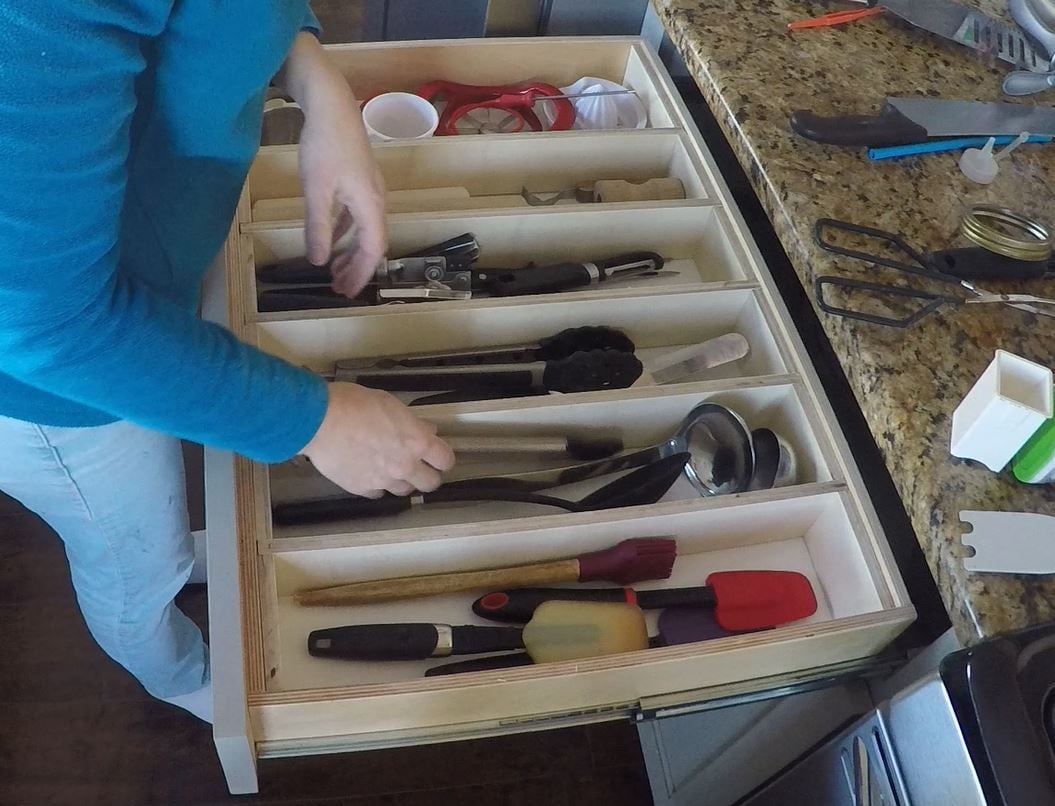

A kitchen drawer should open with a smooth glide, not with the dramatic soundtrack of forks, tongs, and a potato masher fighting for territory. Yet many utensil dr fixed compartments that rarely match the tools people actually own.
An adjustable and customizable utensil drawer organizer takes a more flexible approach. Instead of forcing every spoon, knife, whisk, and bottle opener into predetermined slots, it adapts to the drawer and its contents. Expandable sides, movable dividers, removable inserts, and nonslip features let homeowners create storage that fits their kitchens rather than organizing around the limitations of a plastic tray.
The result is not merely a prettier drawer. A thoughtful layout can make cooking faster, simplify cleanup, protect utensils, and prevent the familiar experience of opening a drawer only to discover that the pizza cutter has formed an alliance with three measuring cups.
What Is an Adjustable Utensil Drawer Organizer?
An adjustable utensil drawer organizer is a storage tray or divider system that can change in width, compartment size, or internal layout. Some models expand from one or both sides. Others use repositionable dividers that create custom sections for different utensils.
Expandable trays commonly provide a compact central area for everyday flatware and additional side compartments for serving spoons, peelers, chopsticks, kitchen shears, or longer cooking tools. Adjustable divider systems take customization further by allowing each section to be widened, narrowed, removed, or relocated.
Current organizer designs vary widely in size. Examples sold through major U.S. retailers include models that expand from approximately 13 to 22 inches, trays with six to eight compartments, and extra-deep organizers made for oversized kitchen drawers. These variations demonstrate why measuring the drawer is more reliable than trusting a label that says “fits most drawers.” djustable Versus Expandable
The terms are often used together, but they do not always describe the same feature.
- Expandable organizers increase or decrease in overall width.
- Adjustable organizers allow the internal compartments to be rearranged.
- Modular organizers use separate bins or trays that can be combined in different layouts.
- Custom-fit dividers stretch across the drawer to create open sections without using a traditional tray.
The most versatile option combines at least two of these ideas. An expandable outer frame with movable internal dividers can accommodate both a new drawer and a changing collection of kitchen tools.
Why Fixed Utensil Trays Often Fall Short
A standard flatware tray works reasonably well when the household owns a basic set of forks, spoons, and table knives. Trouble begins when the drawer must also hold reusable straws, measuring spoons, chopsticks, steak knives, serving utensils, a vegetable peeler, and that mysterious tiny fork nobody remembers buying.
Fixed compartments may be too narrow for bulky handles, too short for long knives, or too numerous for categories the household does not use. When seven types of utensils must fit into five compartments, unrelated items inevitably get stacked together. Professional organization guidance therefore recommends matching the number and shape of compartments to the actual utensils in regular use. oorly fitted tray can also waste space around its outer edges. A narrow organizer placed in a wide drawer may leave several unusable inches on each side. An oversized tray may rub against the drawer walls, prevent smooth expansion, or fail to sit flat.
Customization solves these problems by turning unused gaps into functional storage. It allows the layout to evolve when utensils are replaced, new gadgets arrive, or the organizer moves to another kitchen.
Benefits of a Customizable Utensil Organizer
It Makes Better Use of Drawer Space
An expandable organizer can fill more of the available width while maintaining separate categories. Instead of leaving narrow strips of wasted space beside a fixed tray, the side panels can open to hold larger cooking utensils or specialty tools.
This is especially helpful in apartments, older homes, recreational vehicles, and compact kitchens where every inch of storage must justify its existence. Compact organizers that arrange flatware in angled or stacked sections can also use depth more efficiently in narrow drawers. t Improves Visibility and Access
When each utensil category has a defined home, people spend less time searching. Measuring spoons stay together. Kitchen shears stop hiding beneath spatulas. The corkscrew no longer disappears precisely when guests arrive with a bottle of wine.
Visibility is one of the simplest principles of functional organization. Clear trays, open compartments, and logical grouping make it easier to identify an item and return it after use. Organizers are most effective when they maintain obvious zones rather than creating dozens of tiny, overly specific spaces. t Can Protect Utensils and Drawers
Separate compartments reduce contact between metal utensils, delicate serving pieces, and sharp tools. Nonslip feet or drawer liners also prevent the entire organizer from sliding backward every time the drawer opens.
Movement may seem like a minor annoyance, but repeated sliding can create noise, scratch drawer interiors, and cause neatly separated utensils to migrate into neighboring sections. Tested organizer guides frequently highlight rubber feet, padded liners, tension mechanisms, or grip surfaces as valuable stability features. t Adapts to Household Changes
A fixed tray has one layout for its entire life. An adjustable design can change when children begin using smaller utensils, roommates move in, cooking habits evolve, or an impressive collection of baking tools quietly takes over the kitchen.
This flexibility also makes adjustable organizers practical for renters and frequent movers. A tray that contracts for a narrow drawer and expands for a wider one has a better chance of working in the next home.
How to Choose the Right Utensil Drawer Organizer
1. Measure the Interior of the Drawer
Measure the usable interior width, front-to-back depth, and height. Do not measure the outside of the cabinet or assume two nearby drawers are identical.
Pay special attention to drawer hardware, rounded corners, screws, interior lips, and side rails. These features can reduce usable space. The organizer should fit comfortably without scraping the drawer walls or interfering with closing.
Organization specialists consistently recommend measuring all three interior dimensions before selecting expandable, modular, or stacking organizers. Height is particularly easy to overlook; a tall tray combined with thick utensil handles can jam beneath the cabinet frame. . Check Both the Closed and Expanded Dimensions
Product listings usually provide a minimum and maximum width. The drawer should fall somewhere within that range, but maximum expansion is not always the ideal setting.
A tray stretched to its limit may leave wide side compartments but create visible seams or less stable panels. A better fit usually leaves a little adjustment room. This allows the organizer to be removed easily for cleaning and prevents pressure against the drawer walls.
3. Inventory the Utensils Before Buying
Empty the drawer and group everything into categories. Typical groups include:
- Forks, spoons, and table knives
- Steak knives or specialty cutlery
- Chopsticks and reusable straws
- Measuring spoons and small tools
- Serving utensils
- Peelers, openers, and kitchen shears
- Long cooking utensils
Remove duplicates, broken tools, and gadgets that have not been used since a highly optimistic cooking phase three years ago. Professional decluttering advice frequently recommends eliminating duplicate tools before purchasing additional storage. An organizer should support a useful collection, not preserve every bottle opener ever received as a promotional gift. . Select an Appropriate Material
Bamboo and Wood
Bamboo organizers offer a warm, built-in appearance and pair well with wood cabinetry. They are generally sturdy and available in expandable designs with several compartments.
Wooden organizers should be wiped rather than soaked. Standing water can affect finishes, joints, or dimensional stability. They work best when clean, dry utensils are placed in the drawer.
Plastic and Polypropylene
Plastic trays are lightweight, affordable, and usually easy to wash. Molded corners can simplify cleaning, while removable inserts make it easier to shake out crumbs.
Look for durable construction, smooth edges, and nonslip feet. BPA-free polypropylene is commonly used in contemporary expandable organizers, including models designed with adjustable compartments and anti-skid bases. lear Acrylic
Clear acrylic creates a visually light appearance and makes small items easy to see. It works particularly well in modern kitchens, bathroom drawers, offices, or multipurpose storage areas.
Because scratches and crumbs are more visible on clear surfaces, acrylic trays may require more frequent wiping. Soap and water are usually sufficient for routine cleaning, although manufacturer care instructions should always take priority. etal-Reinforced Designs
Some organizers combine stainless steel frames with plastic compartments. These can feel more rigid when fully expanded and may be useful for wide drawers or heavier utensil collections. Check that exposed metal edges are smooth and that the base includes sufficient grip.
5. Look for Practical Features
The most useful features depend on the drawer, but several deserve attention:
- Nonslip feet or a textured base
- Removable or repositionable dividers
- Rounded corners for easier cleaning
- Long sections for knives and serving utensils
- Curved compartment walls for easier lifting
- Stable expansion rails
- A low enough profile for drawer clearance
More compartments are not automatically better. Seven well-sized sections are usually more useful than ten cramped ones that turn every utensil into a precision parking challenge.
How to Customize the Drawer Layout
Step 1: Start With an Empty Drawer
Remove everything, vacuum loose crumbs, and wipe the interior. Beginning with a clean space makes measurement easier and prevents yesterday’s toast crumbs from becoming permanent residents beneath the organizer.
Step 2: Place Daily Flatware in the Center
Frequently used forks, spoons, and knives should occupy the easiest-to-reach compartments. Grouping daily essentials in the central tray creates a predictable routine when setting the table or unloading the dishwasher.
Step 3: Assign Side Compartments by Length
Use expandable side sections for longer tools such as chopsticks, serving spoons, thermometers, peelers, or kitchen shears. Place similar tools together, but avoid stacking so many items that the bottom layer becomes invisible.
Step 4: Adjust Dividers Around Real Objects
Instead of estimating compartment size, place the intended utensils in the drawer and position dividers around them. Leave enough room to lift items without catching handles on the partition.
Step 5: Stabilize the Organizer
If the tray shifts, add a washable nonslip drawer liner, small silicone pads, or removable museum gel where appropriate. Individual bins often benefit from discreet putty or gel underneath, especially when they are arranged as a modular system. tep 6: Test the Drawer for One Week
Use the arrangement normally before declaring it finished. If one section constantly overflows while another remains empty, resize the compartments. Customization is an advantage only when the layout is allowed to change.
Common Mistakes to Avoid
- Buying before measuring: “Standard drawer” is not a dependable unit of measurement.
- Ignoring height: A tray can fit perfectly across the drawer and still prevent it from closing.
- Keeping too many duplicates: Organization cannot create infinite space.
- Overexpanding the tray: Maximum width may not provide maximum stability.
- Mixing unrelated tools: Categories should make sense during cooking and cleanup.
- Skipping nonslip protection: A sliding organizer quickly becomes a noisy organizer.
- Using every compartment: Empty breathing room is better than unnecessary clutter.
Experts also warn against packing utensil drawers so tightly that they become difficult to open. Frequently used oversized tools may be more practical in a countertop crock or a separate cooking-utensil drawer. n>
Cleaning and Maintaining an Adjustable Organizer
Remove the organizer periodically and clean both the tray and the drawer beneath it. Fine crumbs have an impressive ability to appear under a tray even when nobody remembers placing crackers near the silverware.
Plastic and acrylic organizers can often be washed with mild soap and water. Bamboo is usually better maintained with a damp cloth followed by immediate drying. Avoid placing any organizer in a dishwasher unless the manufacturer specifically identifies it as dishwasher-safe.
During cleaning, inspect expandable rails, divider grooves, rubber feet, and corners. Reposition loose dividers and remove damaged nonslip pads. A quick reset every few months prevents small problems from gradually returning the drawer to its former utensil-jungle condition.
Is an Adjustable Utensil Drawer Organizer Worth It?
For most kitchens, the answer is yesprovided the organizer is measured correctly and matched to the utensils it must hold.
An adjustable organizer is especially valuable for wide drawers, unusual drawer dimensions, mixed flatware collections, renters, growing households, and enthusiastic home cooks. It offers more flexibility than a fixed tray without requiring permanent custom cabinetry.
The best organizer is not necessarily the largest or most expensive model. It is the one that fits the drawer, gives frequently used utensils obvious homes, remains stable during daily use, and can be cleaned without requiring an engineering degree.
Real-World Experience: Living With a Customizable Utensil Drawer
A useful way to understand the difference an adjustable organizer can make is to follow a common household experience. Imagine a medium-width kitchen drawer containing a standard flatware tray, two spatulas, several pairs of chopsticks, measuring spoons, a can opener, kitchen shears, and an aggressively shaped pizza cutter.
Before reorganizing, the flatware tray occupied only about two-thirds of the drawer. The narrow gap on one side collected loose tools, while the space behind the tray became a parking lot for items nobody could reach without removing everything in front. Opening the drawer caused the loose utensils to slide backward. Closing it occasionally required shaking the handle like the drawer owed money.
The first improvement came before purchasing anything: removing every item and identifying duplicates. Three nearly identical peelers were reduced to one favorite. A damaged corkscrew was discarded. Seasonal cookie-decorating tools moved to a baking bin. This reduced the total volume enough for the organizer to work without being packed to the ceiling.
After measuring the drawer, an expandable tray with movable dividers was installed. The center compartments held everyday forks, tablespoons, teaspoons, and table knives. One side expanded to create a long section for chopsticks and reusable straws. The opposite side was divided into two zones: one for kitchen shears and peelers, and another for measuring spoons and small openers.
The first arrangement looked impressively neat, but daily use revealed a flaw. The measuring-spoon compartment was too narrow, causing the spoon rings to catch on the divider. Meanwhile, the section assigned to table knives had more space than necessary. Moving one divider by roughly an inch solved both problems. This tiny adjustment demonstrated the main advantage of customization: the system could respond to reality instead of demanding that the utensils behave differently.
A nonslip liner was added after the tray shifted slightly during enthusiastic drawer opening. Once stabilized, the organizer remained in place and utensils stopped migrating. Unloading the dishwasher became faster because every category had an obvious destination. Other family members also returned items more consistently because the layout was easy to understand without labels.
After several weeks, the most noticeable benefit was not the drawer’s appearance. It was the absence of small daily frustrations. The vegetable peeler could be found immediately. Measuring spoons no longer tangled with whisks. The drawer opened without resistance, and nobody had to perform countertop archaeology while dinner was already cooking.
The experience also showed that an organizer cannot compensate for unlimited accumulation. When a new set of specialty utensils arrived, the solution was not to squeeze them into every available gap. Less frequently used pieces were moved to a secondary drawer. The primary organizer remained reserved for tools used at least weekly.
This practical approach produced a drawer that felt customized without permanent installation or expensive carpentry. More importantly, it remained flexible. If the household changes its flatware, adds children’s utensils, or moves to a different kitchen, the tray can be contracted, expanded, or divided again.
Conclusion
An adjustable and customizable utensil drawer organizer turns an awkward storage space into a functional part of the kitchen. By matching the organizer to the drawer’s dimensions and the household’s actual utensils, it becomes easier to see, retrieve, clean, and return every item.
The key is to measure carefully, declutter first, choose durable materials, prioritize nonslip stability, and adjust compartments based on real use. A successful organizer should make the drawer feel calmer and cooking feel easier. It may not transform anyone into a professional chef, but at least the whisk will stop ambushing the can opener.